Saturday, 10 November 2018

Oysters and Zinfandel top our Croatian culinary experiences

After five days of serious research into the topic, I still couldn't tell you what's distinctive about Croatian cuisine. The locals don't help much.

"It's very Mediterranean."

"We like a lot of fish. And vegetables. But if you like meat ... we have meat, too."

We sampled a procession of beautiful food and wine throughout the country. But if you served it to us in a blind tasting back in London, the restaurant serving it could have been Spanish, Provencal or Italian. Palate pleasing, for sure, but not differentiated. We found two exceptions: oysters and red wine. (Not, of course, consumed together!)

The Croatians take their bivalves very seriously. Their coastline is a perfect breeding ground for this category of seafood. There's no sign of industrial pollution. Fresh water comes cascading down limestone mountains to meet the crystal-clear Adriatic, screened from too much disturbance (and many predators) by a long chain of islands. Most of the coastline functions as a giant tidal lagoon. As filter-feeders, bivalves like oysters, clams and mussels reflect the taste of the water they live in; the terroir of the sea. This unique Croatian waterscape produces bivalves that are subtler, more nuanced and complex than usual, particularly in the case of the famous Mali Ston oysters.

The coastal geology is perfect for grapes as well. Steep slopes with a limestone bedrock, not too much rain and thin, free-draining, not-too-rich soil are exactly what vines like to drive their roots deep and suck the best out of the Earth. Regular sea breezes keep the threat of mildew low. Though 68% of Croatia's overall wine production is white, most of that comes from the continental heartland. The Dalmatian coast's most dependable white wine is Pošip, a remarkably flexible grape that can remind you of anything from a rich Chardonnay to a light Pinot Grigio depending on what the maker does with it, but is generally closest to a mid-market Sauvignon Blanc. But mostly, this part of Croatia is all about big, bold, fruity reds. Early in this century, scientists tracing grape vine DNA determined that this region is the birthplace of Zinfandel. That, and its descendant Plavac Mali, will keep wine lovers very happy throughout their visit.

Both the oysters and the wines come in very limited quantities and are so famous that they sell out before their producers ever need to think about export markets. If you want to taste these uniquely Croatian delights, you'll have to get on a plane. And, naturally, the closer you can get to the source, the better.

THE GREEN LAGOON
Our day in Ston was, no doubt, radically affected by going out of season. The number of restaurants, shops and excursion boats makes it clear that in summer this place is heaving with tourists. On 2 November we had it almost to ourselves. We felt like explorers stumbling upon some lost city enchanted in time.
Because of a strategic position for both transport and agriculture, Ston has been occupied
continuously since the classical period. It acquired its present, remarkably romantic appearance in the 14th century due to a period of intense civil war. Residents protected themselves with a circuit of walls more than four miles long, encompassing the towns of Ston and Mali (little) Ston, harbours, fortresses and acres of agricultural land stretching up a lofty hill. The walls are a remarkable sight ... in some ways far more impressive than Dubrovnik's because of their isolation. The locals claim Ston's is the longest wall in the world after the Great Wall of China. Not even close ... but that doesn't take away from their majesty.

(It's worth a quick aside here to explain that the Croatian tourism industry has an almost Trumpian flexibility with facts. You'll hear a lot of big claims, like that Wall of Ston boast, that you'll want to take with a grain of salt. Such as the idea that Trsteno is the world's oldest botanical garden ... many other's make that claim ... and the assertion by everyone in Split that the US White House was built with Croatian limestone. White House historian William Seale has proven that the stone came, far more logically, from a quarry in Virginia. And while he acknowledges that there's a possibility that some Croatian stone might have found its way into interior renovations in the 20th century, he's been unable to find any records that validate it.)

Mali Ston, on one corner of those rambling walls, is now just a cluster of ancient stone buildings ... almost all restaurants ... sitting next to a tiny harbour with a few old-style wooden boats. Beyond is an emerald-green lagoon of startling clarity, framed by the mountainous coastline and tiny islands, and dotted with buoys marking lanes of oyster cultivation. We set off on the good ship Bogutovac, a traditional wooden craft plying these waters since 1954, for a cruise around the beds. While she normally takes up to 50 passengers, we had her, her captain and first mate all to ourselves. The last had worked the oyster beds of New Orleans until Hurricane Katrina destroyed the industry and sent him home, so not only was his English excellent but he could talk about the differences in taste, harvesting and cooking between Europe and the USA.

I have no doubt that the standard, high-season tour is good value for money. A boat ride, a little talk, a shot of local liquor, 3 oysters and a glass of white wine in an hour. For our €30 each, we not only had the boat to ourselves but took a lengthy pause at a floating harvesting station in the bay, where we could climb aboard to take an up-close look at every aspect of oyster production as the first mate talked us through the steps. Our slow return saw the four of us seated in the prow of the boat feasting on a full plate of six oysters each, all of which had been hanging off a rope in the lagoon just 15 minutes before. Beverages were all we cared to drink, with shots of traditional plum rakia or myrtle liquor on the way out (I think these shots were as close as I got to anything that was truly Croatian) and Pošip on the return journey. The sun was shining, the world was almost silent and we felt like queens as we made our slow, stately return. None of us checked the time but I suspect their usual hour's excursion turned into two.

Obviously, we tipped generously. If you want to follow in our footsteps, go here.

ANOTHER SUNSET, ANOTHER VINEYARD
Our evening at the Kovac Winery was only slightly less private and just as magical. While winemaker and owner Anton will host up to 18 tourists on any evening, on this off-season Saturday night there was only one other guest. As some strange trick of cosmic fate, we soon discovered that her father had graduated from Northwestern (our generation, but none of us knew him), so she slotted into the girls' trip like family. Fortunately, she shared our delight in both learning about wine, and drinking it in memorable places.

Kovac is about half an hour outside of Split in Kaštel Sućurac, on the bay on the North side of the Split peninsula. Thankfully, given both for the hassle of transport and because of the generous amounts of wine involved, the evening's £70 fee includes pick up and return to Split's Golden Gate. (In this case Anton driving one car and the terrifically informative Andrea in another.) In older times Anton's home town was known as Putalj, and that's the name Anton puts on his labels. Given that he says his family has been making wine here for 1,000 years, it's a logical throwback.

The tour starts in the vineyard itself, where Anton is well aware of the majesty of his view. He's constructed a pavilion at the top of his slopes, from which serried rows of grape vines and olives descend to the town below. Beyond that is the bay of Kaštel and beyond that the peninsula on which Split sits. (Though Diocletian's palace, on its far side, is out of view.) The slopes face South and slightly West, setting you up for a gorgeous sunset. At this time of year it was a long, lingering one. We sat in the pavilion watching shadows lengthen and the limestone peaks to our left start to glow in pinks and golds. We helped ourselves to bottles of rosé and nibbled from plates of local cheese as Anton spun tales of the local industry: the history dating back before Roman times, the range of little-known local grape varieties, the boon of the Zinfandel discovery, the challenges of keeping the industry going through the disasters of phylloxera and communism.

Ironically, it's capitalism that's causing Anton his biggest problems at the moment. He sells everything he can make. Keen to expand, he regularly makes offers on adjoining parcels of land (often owned by cousins). But in a post-communist reaction against taxation, Croatia has decided not to levy property taxes. The result: people have no incentive to sell family lands. But few have the money it takes to create new wineries. So most of the slopes around Anton are picturesque, but lay fallow.

As we waited for sunset we grabbed our glasses and wandered the rows of vines, now blazing autumnal red and yellow in the dying light.
Once the sun had dipped below the horizon we headed back to the cars, then drove down to Anton's house and small but perfectly-formed winery. Here he did the usual wine tour overview of the production process and, uniquely, gave us a taste straight out of the vats of 6-week-old zinfandel that had just finished fermenting. Drinking too much of this would knock your head off, but it was an interesting contrast to the finished, aged Zinfandel and Plavac Mali we were comparing. Those related wines were so close I think even professionals would have a tough time judging if their difference came from the grape or from the makers' vinification. We thought the Zinfandel was smoother, richer and fruitier, but the Plavac Mali had more complexity and a sharper tannic edge that would work better with rich foods. At £18 each we bought all we could carry home on the plane. (Sadly, given that I was travelling light, I could only manage a bottle of each and one of Anton's freshly-pressed extra virgin olive oil.)

Business done, we retired to Anton's tasting room to drink far more than was wise, though enough to make the per-person price of the evening excellent value for money. He even opened a bottle of his prized 2014 Zinfandel, sadly no longer for sale.

That's another oft-validated lesson from years of girls' trips: the more intelligent interest you show in someone's wine, the more likely they are to break out the special stuff. The same general rule works across all of tourism. You might not always be able to pull off the magic of a private tour, but the more interested you are in your hosts ... and the more personal a connection you can make ... the more special your day is likely to become.

If you want to book your own evening with Anton, you can do it here


Thursday, 8 November 2018

There's more to Dubrovnik than Game of Thrones, but it's a great prism for seeing the city's history

One of the great joys of small group travel is the affordability of a dedicated guide. Funding a day of exclusive attention when travelling as a couple, or on your own, rarely makes financial sense. When you're splitting fees by four, it becomes logical.

While still a bit more expensive than standard group tours you can pick up on Trip Advisor, a little more money spent by our foursome on a dedicated guide inevitably returns enormous benefits. We get excursions crafted to our interests, form great relationships with our guides and have the flexibility to go off piste, whether in topic or locations. And we inevitably walk away with top tips for bars, restaurants and shopping. I'm convinced that our increasing use of private guides is one of the reasons that our annual girls' trips seem to get better every year.

It's probably impossible to tour Dubrovnik these days without talking about Game of Thrones. Croatia's not just a filming location; the show has spawned a whole new industry here. Shops bristle with themed items, costumed mannequins put characters on the street and dedicated boutiques will snap your photo on a full-size copy of the iron throne if you buy something. With three of the four of us being devoted fans of the fantasy epic, a dedicated tour was a must. But how to choose from the more than 25 options on Trip Advisor? Fortunately, one of us had past experience and hooked us up with Magnus Regis, a small company of locals who are all qualified guides, only do private tours and add professional backgrounds in history and archaeology to their passion for GOT.

Dubrovnik's walled centre is one of those places, like Venice and Bruges, that was once hugely prosperous but then forgotten by history.  There's little in your immediate view more modern than the 17th century. The most glorious buildings have the pointed windows and sinuous stone carving of those high Gothic merchant empires who linked East and West. Centuries of traffic have polished the white limestone streets to a brilliant shine like marble. The city insists that all signage must be worked into glass panels on uniform lanterns that hang above all the doorways, giving a pleasing uniformity to the streets.

No wonder directors love the place as a film set; It takes very little to conjure up another world. In addition to GOT, Dubrovnik has been the location for a soon-to-be-released version of Robin Hood, was the casino city of Canto Bight in Star Wars: The Last Jedi, hosts the currently-running Templar drama Knightfall and stood in for Venice in David Tennant's version of Casanova.  The Croats are also very canny business people. They scooped GOT off Malta at the end of Season 1, undercutting Maltese pricing, offering cheap and enthusiastic extras and massive additional support to the production team. They played the long game. They believed they didn't need to make money off the shoots themselves. The cash would come from the tourism that followed. They were right.

HALLOWED SPOTS AND HOT HISTORY
We started in the old town with Magnus Regis owner and founder Tom Matana. At the heart of the tour is a simple but effective strategy: you walk around, your guide gets you to a particular point, then holds up the appropriate page from a book of laminated scene shots from the show that are taken from the exact spot at which you're standing. He reminds you which season the action took place in, what's going on, and often gives you some insight into the movie magic that finished the transformation from modern Croatia to fantasy Westeros.

Good news for the GOT uninitiated: the last bit is fascinating even for people who have never seen the show. Look at how carefully this shot was framed to cut out the Christian imagery above the building's doors. (Even if there had been saints in Westeros, it's doubtful there'd be one above the door of Littlefinger's brothel.) Check out the artful addition of ivy and potted plants to cover those modern drainpipes and power lines. Look carefully here to see how the same guy appears in this scene multiple times; they filmed it with a much smaller group and duplicated it to form a crowd. Yes, those are the stairs Cersei descended in her walk of shame, but this is how they used giant green screens to block out the Jesuit church and university building at the top, and replace them with a painted version of the great sept.

Also good for non-viewers, the GOT sets are a prism through which you can explore all of this city's history, and because it's a private tour your guide can give you as much or as little as you're interested in. Standing on the old town's western heights (the walled centre is essentially a v-shaped cleft with the main business district on the flat bottom and steep, stair-stepped residential streets rising on either side) you can see by colour which tile roofs were replaced after bombing in the Bosnian war, and how terrifyingly close the ridge is from which the Serbs were attacking the town. Almost 300 Croatians died and more than 50% of the buildings in the old town were damaged (including the burning of seven Baroque palaces) and yet many visitors ... particularly non-Europeans under 35 ... are so totally unaware of the history that they think HBO paid for all those red roofs to give Kings' Landing a more uniform look. I was delighted to see so little evidence of conflict just 23 years after the end of a horrific war, particularly in a population far more interested in making a prosperous future than in re-hashing the offenses of the past. But as America descends into increasing factionalism, I couldn't help hearing Tom's stories about young tourists' ignorance and remembering that phrase about those who don't know history being doomed to repeat it. But I digress...

You'll learn why the broad, straight main street of the Stradun is so uniform: it had been the moat of an earlier, smaller version of the walled town, then was filled in and built on when the town expanded. The soft substructure made everything above it collapse in the calamitous earthquake of 1667, after which the town fathers mandated that everything be replaced to a master plan. Christopher Wren and London, eat your heart out. The number of showy churches and monasteries seems out of proportion to the place; we learned that the merchants of Dubrovnik were always flying close to the edge of Papal tolerance as they put friendly, business-enhancing relationships over religious disputes with their Islamic neighbours. Thus the church kept installing officials to keep an eye on them. The Croat's claim to have invented the cravat ... and through that, the necktie ... as tokens lovers tied around each others' necks before one went away to war. There's a museum here on the topic and shops selling gorgeous modern interpretations. Given the town's roots in trade, it's probably not
surprising that it also boasts one of the world's oldest continuously-operating pharmacies, from which you can still buy luxurious creams made with local roses and herbs.

And, of course, you'll also see the entire route of Cersei's walk of shame, the location of numerous street scenes and the exquisite little harbour that turns up in poignant moments of arrival and departure. We skipped the Red Keep (aka Lovrijenac Fort) because, this being the worst weather day of our trip, we were all soaked to the skin and the rain-slicked ascent looked dangerous. Time to switch to part two of the tour, which featured a handoff to driver/guide Neno and the comforts of a warm, dry car to explore some sets on the outskirts.

BEYOND THE WALLS
If you're only visiting Dubrovnik, it's possible that you'll never leave the walled old town except for airport transfers. This would be a mistake. The GOT extended tour is an excellent way to get a taste of the broader countryside.
Your first stop is the Trsteno Arboretum, 12 miles Northwest up the coast. The drive gives you a chance to appreciate Dubrovnik's impressive commercial and cruise ports, wisely screened by a line of hills from the old town, and a dramatic modern suspension bridge from which you can bungee jump if you're keen on adventure sports.

But the real attraction is the coastline itself. While the views from the walled town are fantastic, it's only by driving for a while that you appreciate just how expansive and beautiful the string of islands lying off the coast is. You don't get anywhere fast; this coastline could have been a piece of aluminium foil crumpled in a giant's hand, so deep and irregular are its bays. Rounding each gives different views of small villages and rocky hills covered with grape vines, olives, pomegranate trees and bougainvillea. You don't have to go many miles from Dubrovnik for the country to feel sparsely populated.

The Trsteno Arboretum was the country estate of a wealthy merchant family from Dubrovnik's glory days. In the middle 16th century, as a passion for exploring swept around Europe, the family's garden-mad patriarch asked his sea captains to return from trading missions with plants and seeds. Instead of the usual ballast, they filled their holds with topsoil from rich destinations so the boss could improve the poor base of his garden. Thus, despite years of neglect under the communists and a couple of disastrous fires, the garden is packed by an unusual number of exotic plants, from Asian bamboo to South American agaves. The place sprawls down a steep hill, with an aqueduct bringing water through an impressive fountain at the top, what's left of a summer palace in the middle and a private dock along the rocky shore below. A seasoned British garden and country house explorer is likely to be a bit underwhelmed; original planned beds and borders have lapsed into a benign neglect and the house is a mouldering ruin after the double hit of communist rule and war damage. Presumably the laid-back attitude to maintenance and conservation was an attraction for HBO, who were even allowed to gouge out part of the cliff face along the coast road to get their supply trucks in.

The production team certainly got their money's worth. An area not much bigger than a square mile shows up as the Tyrell family seat of High Garden, the gardens of the royal palace in King's Landing, some harbour scenes and even as the majestic seaside promontory on which Bron taught Jamie to fight again after losing his hand. (The latter was a perfect example of why you need a guide. Even standing 50 yards from the spot, you'd never discover it on your own as it meant climbing up a weed-pocked flight of steps, cutting through a yard of decaying boating equipment and slipping through a break in a wall and down some steps cut into the sea-side boulders to discover this dramatic scene.) Most memorable to many viewers will be the gazebo and another patio, both hanging over the sea, with remarkable views. Diana Rigg, who dominated most of the scenes filmed here, certainly pulled one of the better assignments by doing a lot of her shoots here. I didn't remember just how much nefarious plotting took place in the calming surrounds of gardens until we wandered Trsteno. It's no doubt a riff of the theme of beautiful-on-the-outside-rotten-within that shows up so often in GOT.

UP ON THE ROOF
Our penultimate stop required a return to Dubrovnik and the ascent of a series of hairpin turns cut into limestone cliffs to reach a high promontory that stretches above the old town. These are the heights from which the Serbs bombarded town, and the Croats tried to stop them ... with a few hundred yards of no man's land on the ridge between. It's one of the few places you'll still see war damage, as little has been rebuilt up here and the pockmarked land between is still rubble overgrown with weeds. We walked out to the edge of the cliff for an extraordinary view; it's as if you're hovering over the walled town and its bay like a gliding falcon. On a sunny day this would be one of the world's great picnic spots, but on our visit it was dangerously windy and lashing with rain. We beat a quick retreat.

Part of the ridge is covered by a long, straight bit of road bordered by a formal allée of trees. It's an oddly aristocratic touch to a fairly desolate area. Running beside it is a long, now-ruined complex of Napoleonic stables (different century, different invaders).  This area provided the backdrop for lots of travel scenes and meetings outside of Kings' Landing, including that touching moment when Brienne of Tarth and Podrick set off on their quest to help the Stark girls.

The final site was another proof point as to why a guide is essential. At the end of a long string of hotels and holiday villas along Dubrovnik's Eastern Bay, inaccessible except from a footpath behind a shuttered church, is a derelict hotel. The Belvedere was, for a just six years, the poster child for Yugoslavia's attempt to be an outward-facing, attractive, commercially savvy face of communism. The five-star luxury resort was an early casualty of the war and has been a hulking ruin since 1991, now overgrown with plants and its crumbling walls covered with graffiti. Part of the hotel's luxurious set up was a series of terraced patios flowing down the hill to a round arena hanging above the water of the Adriatic, with a clear view of the walled town across the bay. It must have been remarkable in its day.
And it was indeed remarkable as the setting for the trial by combat between Oberyn Martell and the Mountain. This is the place least likely to interest someone who hasn't seen the series. But for those of us who had, it wasn't hard to let your imagination return you to the majesty and the horror of that moment.

How long the arena will be on the GOT tour is an interesting question. The old Belvedere complex is now owned by a Russian oligarch who wants to tear the whole thing down and build a palace of opulence to match Dubai's bid for seven-star luxury. The problem: Croatian law demands public access to the seashore. Until the oligarch can assure his guests of complete privacy, he won't break ground. So the old Belvedere continues to crumble, and with a knowledgeable guide you can sneak  in to see one of GOT's most iconic film sets.

Note: You can also customise your full day trip with a boat ride to Lokrum Island, doppelgänger for the city of Qarth and reputed to be a place with excellent beaches for summer swimming. As it was a sodden day in November, we passed on this option.


Monday, 5 November 2018

N.U. Girls Trip No. 17: The lure of the undiscovered in Croatia

In a world of Bucket List-fuelled tourism, where ever more people are crowding in to the same hot spots to tick off their "must sees", Croatia appears regularly as an alternative for the savvy traveller.
It has historic towns with the architectural appeal of more famous Mediterranean cities. A string of more than 1000 islands scattered off its 2,500-mile coastline makes this bit of the Adriatic resemble the Virgin Islands, while inland there are dramatic limestone peaks that make the landscape a dead ringer for Provence. Local seafood, olive oil, figs, citrus, wine, meat and mountain herbs come together in food markets and dishes reminiscent of Barcelona or Sicily. In fact, Croatia is a bit like the whole Mediterranean in miniature. No wonder film makers take advantage of it so regularly as a stand-in for other locations. With the exception of Dubrovnik hotels, prices here are cheaper than the Med's usual hot spots, while personal guides and luxury experiences are particularly good value for money. Add a population so committed to tourism as a dominant part of their economy that they’re relentlessly service-oriented and ... if under 50 ... almost universally proficient at English and you have a winning combination.

Of course, by the time we got around to agreeing on Croatia as a destination for a Northwestern Girls’ trip, it was hardly a fresh discovery. The jet set has been infiltrating boutique hotels and yacht harbours, while a fleet of cruise ships brings in the mass market. Regular herds of Chinese and Korean group tours validated the much-written-about rise of East-to-West travel. In addition, serving as a regular filming location for Game of Thrones has created a whole new sub-genre in tourism as fans from around the world flock to see the "real" Kings’ Landing, Qarth and Meereen. 

Dubrovnik, better known a decade ago for the drubbing it took during the Bosnian war of the '90s, now runs a real risk of becoming like Venice; a tourists' amusement park devoid of real life. Very sensitive to the possibility of killing the goose that’s laying their golden eggs, local government is starting to limit cruise ships and considering cracking down on air B&B-style apartment rentals that are stripping the walled city centre of regular residents. Tour guides and waiters regaled us with stories of how horrible the summer season had become, but by our 31 October arrival we were rambling around often-quiet urban spaces with plenty of room in bars and restaurants and a fair chance of taking photos free of people.

While it would have been nice to sail through those islands and beaches in the balmy, light-drenched days of summer, I think we made the right choice. At least for an initial introduction to the country. Temperatures hovered in the mid-20s (mid- to high-70s F) with a fair amount of sunshine. We only suffered one day of rain; though we did suffer. Most sightseeing and dining is open air, long views are part of the appeal and the polished limestone streets of the old cities become hazardous when wet and pocked with deep puddles. As long as you anticipate the possible need for rain gear, I'd recommend our timing and this four-and-a-half day itinerary as an excellent introduction to the country.

START IN DUBROVNIK
We arrived around lunch time and had a driver take us from airport to old town. With four of us splitting the bill, it was by far the cheapest and most direct route and meant we were handed direct from informative guide to hotel manager who was waiting at the gate to take some of our luggage and walk us in to the pedestrianised city. The old town is mostly on a grid pattern so once you get your bearings it's not that hard to figure out, but the very narrow, architecturally consistent lanes and steep inclines make an initial guide very useful.

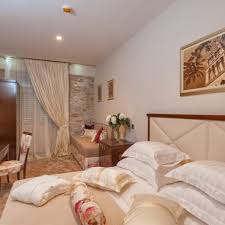
We stayed at the St. Joseph's hotel, a luxurious collection of six rooms in a 500-year old house. The Croatian owners are a brother-and-sister team, also British nationals with a base in London, so they're well used to English speaking guests. There are no communal spaces, which can be a bit frustrating if you're travelling with a group and want to spend some indoor R&R time together, but fortunately we were in the only two rooms on the top floor so we could keep our doors open and use the space like a two-room apartment. A lavish continental breakfast with a spread of bakery goods, fruit and home-blended smoothies, served with remarkably good coffee, comes to you in your room when you're ready. The location is perfect, in the middle of everything and no more than five minutes from top wine bars, the city walls, the harbour and a range of fabulous restaurants. There's always someone on the door to arrange whatever you need.

It's worth emphasising that Dubrovnik is no bargain. Queen rooms at the St. Joseph, even in this off season period, were £310 per night, a fairly consistent price for well-rated small hotels inside the city walls. Prices drop when you go beyond, of course, but then you're giving up atmosphere and adding transport hassles. You'll walk a lot in Dubrovnik, and do a leg-punishing number of steps. Stumbling to a nearby hotel when you hit the exhaustion point is wonderful. We splurged but kept our visit to two nights. If I returned I'd probably consider one of the rental apartments that seem to make up a big percentage of the old town. 

On our first afternoon we wandered around the walled city and did some shopping. Dubrovnik is packed with small, independent boutiques and is particularly known for its jewellery (especially silver filigree work and red coral) and its silks (the cravat originally comes from Croatia). We spent most of the next day on a Game of Thrones tour and on our last morning walked the walls. The towering medieval comprise a complete circuit of battlements and towers, all with astonishing views and all in excellent condition ... no doubt helped by the approx. £18 per person each tourist pays for access. We took an hour getting two-thirds of the way around from the Pile Gate to the Ploce Gate at a fairly brisk pace on this one-way (anti-clockwise) route, but you could easily spend a whole day up here since many of the towers are conveniently occupied by cafes and pop-up booths of local craftspeople.

ENJOY THE TRANSFER
There is, surprisingly, no direct and easy train route to Split, the other tourist blockbuster along the coast. During the summer season the best way to cover the 158 miles between Dubrovnik and Split is by ferry up the coast. By road, it takes about four hours, mostly because the first half of the drive is by a winding but spectacularly beautiful coast road that ... reminiscent of a past girls' trip to Iceland ... spends a lot of time going around big, deep bays.
We decided to make a day of the journey and, on the recommendation of our hotel in Split, hired a combined driver/and guide, the stalwart and exceptionally kind Boris, to take us. We stopped on the way at Ston, a beautiful small town famous for its walls (the Croats claim they are the longest continuous stretch after the great wall of China), its salt and its oysters. More more on this, see my coming article on food and wine experiences.

We also asked Boris to stop in Bosnia, which one must traverse for about 10 minutes due to old border debates. None of us had ever been to Bosnia before, and we didn't want to miss the opportunity to add a country to our travel collection. But we have a rule that to count as a real visit, you must stop somewhere to have at least one drink. Boris was both amused and a bit skeptical, but as he was at our command for the day he honoured our wishes, stopping at what he apologetically said was about the best he could do on the short stretch of coast.

Neither Dubrovnik nor Split show much evidence of the communism that once prevailed in Yugoslavia. Both feel affluent and modern. Not so for Neum, Bosnia, a string of ugly '70s- and '80s- era concrete block buildings that clearly stem from that time when communists were trying to convince the rest of the world that they could do fashion and holidays, as well as five-year plans. They couldn't.

They also don't seem to be able to do wine, despite the fact that the Croatian stuff on either side of
them is glorious. We should, of course, be grateful that we got any at all, Bosnia being a primarily Muslim country. But Neum is heavily populated by Roman Catholic Croats and the restaurant was a major stopping-off point, so white wine was available. With a beer-bottle top. And a label that looked like someone had designed it on an early Macintosh. It was thin, acidic and dirt cheap. Ironically, if you ignored the brutal architecture and the nasty wine (which, admittedly, got better by the second glass) you could drink in a vista of water, mountains and islands on par with the best seascapes in the world. Someone would charge you €10 on the Italian Riviera just to sit here.

After the Bosnian interlude the coast road returns to Croatia and dips into an enormous, fertile agricultural plain. Local farmers' booths line the road selling strings of oranges and garlic, and pyramids of precisely-piled vegetables in a scene that reminded me of Florida's US1 when I was a kid. Beyond that, you pick up a major highway and soon come into the outskirts of Split.

WHAT DID THE ROMANS EVER DO FOR US?
It's obvious from its furthest suburbs that Split is a very different kind of place from Dubrovnik. Its 178,000+ population is almost four times that of its southern cousin. People here obviously do a lot more than tourism; the approach is lined with warehouses, factories and office parks. There are enormous shopping malls and modern tower blocks. But there's history, too. Much older than Dubrovnik's.

Split started life as the Roman Emperor Diocletian's heavily fortified retirement complex. A local boy done good, he chose a beautiful and easily-defended bay near his home village and built essentially a walled town that was half palace, half administrative offices and all luxury. He even included a grand mausoleum at the centre, so he could go on occupying the place after his death. Given that he was the only emperor across more than four centuries to successfully retire, and one of the few to die in his bed at a fairly advanced age (mid-60s), the strategy seems to have worked.

The empire collapsed. The local economy crashed. The palace sat empty. Eventually, locals saw the merit of using the old walls for defence and built a new town within the ruins. More than 1,700 years on, Split's centre is a magnificent jumble of medieval, Renaissance and Baroque buildings wedged around the original architecture. Most structures have obvious borrowed elements ... columns, arches, decorated doorways, bits of sculpture ... while some classical spaces have been left to stand intact. The latter includes the famous peristyle, a town square in what was once Diocletian's colonnaded garden, and a warren of enormous, vaulted cellars. They're not only a treasured resource for Roman archeologists but provided another stage set for Game of Thrones.

By the late Middle Ages the town had spread beyond the palace. The districts immediately outside have a strongly Venetian feel about them, unsurprising since Split was officially part of the Venetian empire for more than 400 years. (Dubrovnik, on the other hand, was an independent republic only under Venetian domination for about a century, making the towns old rivals and adding to the differences in culture. Overall, Split feels much more Italian.

There's a long, grand seafront promenade where you can stroll, lap gelato, watch the ferries come in and out and get enough distance to appreciate the original walls of the palace. In the 19th century the locals (presumably as an architectural insult to the then-ruling Austrians) built a grand square inspired by St. Mark's in Venice, but open on one side to take in the harbour. It's a must-visit for a relaxed drink with a view. Like Dubrovnik, shopping in Split is dominated by small boutiques rather than global chains. (They're all in the out-of-town mall.) Jewellery, art and craft are also on show here, and Split has an unusual number of high-fashion clothing boutiques, many of them full of creations from local designers. The natives are all remarkably fashionable, making us feel distinctly underdressed. There's also a rollicking local fish market on one side of town and an enormous fruit, veg and local food producers' market on the other; it's the kind of place that makes foodies wish they had access to a kitchen.

We stayed at the Heritage Hotel Antique, another boutique choice in a medieval tower block built onto the wall of one of the palace's administrative buildings. In a breathtaking difference between "discovered", trendy Dubrovnik and slightly less on-the-beaten track Split, the hotel had dropped to off-season prices and put us up for just under £80 per room, per night. For less than a third of the price of Dubrovnik we had slightly smaller rooms with the same (and possibly even better) service; they even sent us away with both a packed breakfast and lunch when we started our journey back to the UK at 5 am. Beds were the same high quality with good mattresses, down pillows and high thread-count sheets. The decor was similar, the finish slightly less luxurious. (Not quite so deep a pile on the carpet, high-end linoleum flooring in the bathroom rather than marble ... though the exact same rain shower and a slightly better pile of toiletries.) Breakfast was in a breakfast room, rather than served by a uniformed maid. Not quite so much pampering, the pastries more mass production than hand-crafted and coffee was from a machine rather than silver urns, but you had the choice of a range of fresh-cooked egg dishes from an adjacent kitchen. Quite simply, the Antique was one of the best value-for-money deals we've snagged on any girls' trip and, on that front, far outstripped the St. Joseph.

While both cities were remarkable, Split seemed to have a vibrancy and a creativity that Dubrovnik lacked. We all agreed we were glad we spent three nights here (not just for the bargain hotel), and the Northern city has left me more intrigued than the Southern for further exploration. With nearby national parks, holiday islands and local wineries, we left feeling that there were plenty of depths in Split still to plumb, while two days in and around Dubrovnik felt about right.

In coming days I'll write more about each town, including our Game of Thrones tour, Diocletian's palace and ... of course ... fabulous food and wine experiences.

Monday, 29 October 2018

Stop moaning, Britain. You have only yourself to blame for Halloween.


Americans are everyone’s favourite scapegoat. Lay blanket blame any other group for pretty much anything and you’re likely to get hauled up on charges of racism, sexism or snobbery. Americans, however, are fair game. From the toxicity of the current political environment to the rise of obesity to the dumbing down of popular culture, it is ALL the fault of the USA. I am yet to witness an American physically forcing a European to use Facebook, eat at McDonalds or watch Big Brother (which was invented by the Dutch, btw), but we will be blamed.

Long term expats living in England get used to this, generally allowing the stars-and-stripes bashing to roll away like rain off the back of the Queen’s swans, but there are times we get pushed to the limit. Halloween is one of them.

Let’s get this clear, Brits. We did NOT force you to embrace Halloween. You did it all by yourself. Nor did we invent it. I understand your disgruntlement, but do not shift the blame. Accept responsibility for the choices you have made and, perhaps, work to improve things.

Let’s look at the arguments against you.

WHERE’S THE GUY?
Bonfire Night was a glorious, and uniquely British, festival. I remember going to a magnificent party in the village of Hartley Witney my first year working here (1994). Locals had been stacking wood on the village green for a month; the pile was bigger than a 4-bedroom detached home. It was studded with “Guys” ... no longer representations of Guy Fawkes himself, but witty takes on authority figures who needed to be knocked down a peg or two, from an irritating French trade minister with beret and garlic strand to an insufferably smug pop star. As night fell, villagers slowly emerged from the adjoining woodland, swinging balls of fire on chains. When they reached the pyre they processed around it slowly , whirling the fireballs above their heads before launching them onto the waiting pile with its crowd of effigies. It felt deliciously ancient and pagan, despite the ceremony’s roots in hard-line Protestantism.

The ensuing inferno was the biggest I’d ever been near, raising the temperature across the whole green. We ate baked potatoes and drank numerous pints from the two local pubs, who had extended operations to the fireside.
There were no trick-or-treaters that year, nor for the rest of the ‘90s. But even then, I could feel Guy Fawkes Night fading. The English are often shockingly ignorant of their history: people in our office pointed “foreigners” at me to explain the significance of the celebration because they weren’t quite sure. (On 5 November 1605, a plot by Roman Catholic extremists to blow up parliament was narrowly foiled; they were executed and thereafter burned in effigy on the anniversary, along with other symbols of Popery, to celebrate the triumph of local authority over foreign influence. There were more significant plotters, but Fawkes was the one found with the gunpowder so became the poster child for the event.) For many, by the mid-1990s the stories and relevance had faded away until it was just a bonfire and some fireworks. 

Even more, I blame government. Between European air quality regulations and local government health and safety, it became almost impossible for local parishes to host their own celebrations. And in an era of hyper-sensitivity, the idea of burning anyone in effigy ... even with humorous intent ... has become a no-go area.

A few particularly famous local festivals remain, notably in Lewes and Ottery-St-Mary, but in many places events have become large, almost-industrial fireworks displays without any historic tradition or local flare. Parents and children are simply often finding local trick or treating to be more fun than the soulless municipal Bonfire Nights that are left in most of the country.

NOT A “HALLMARK HOLIDAY"
American capitalists did not invent Halloween to “force” you to buy greeting cards, home decorations and candy. It was your festival a millennium before the USA even existed. Look up Samhain. The Christians appropriated festivities with the double feast of All Souls on the 31st and All Saints on 1 November, beloved celebrations marked throughout Britain for centuries before the Puritans went into abolition overdrive.

Guy Fawkes celebrations, in fact, were promoted by Cromwell’s administration as a way to replace Halloween in the people’s affections. So, rather than adopting something new from America, today's Brits who celebrate Halloween are returning to their original tradition. Got it?

YOU’RE MISSING SOME KEY POINTS
Sure, there’s an unhealthy element of gluttony to Halloween. In my experience, English kids have quickly embraced the get-as-much-candy-as-possible part of the event while missing all the nuance.

First. It’s Trick or Treat. Where’s your trick? American kids know they need to earn their goodies, from telling simple jokes to putting on mini-plays on the doorstep. Many homeowners buy a range of sweets, holding back “the good stuff” for kids with the best trick or the cleverest costume. English kids don’t get this at all.

There’s no sense of working for their treat: they just want candy. They’re totally missing Halloween’s most valuable life lesson.

The trick element also builds confidence. Most Brits will grudgingly acknowledge that Americans are naturally better and more confident presenters than they are. Look to early doorstep candy canvassing for one of the reasons.

The English kids at my door also show shockingly little attention to costume. It’s inevitably a procession of the same mass-produced tat grabbed at the local supermarkets. Meanwhile, American kids may spend weeks planning; often in a great bonding exercise with their parents and exploring their creativity. Costumes are often home made; having the same outfit as someone else is abhorrent. Last year, I think my godson had the only hand-crafted costume amongst the hundreds of kids haunting our housing estate. Which is a nice cue to run that adorable photo again...

Costumes span all of imagination and are often quite clever. Halloween is where many American kids are introduced to current events and political satire. A fair number of Supreme Court justices showed up on friends’ Facebook feeds last year. Groups will organise team costumes. In Texas I remember a bunch of kids dressed as different fish, with their parents holding the frame of the aquarium. In Chicago, a set of cardboard boxes painted as buildings that turned into the city skyline when the kids stood in the right order. It’s also a great way to learn history. Since Hamilton, American doorsteps have seen a surge in founding fathers, many of whom will rap for you.

Oh, what I would give this year to see a WW1 soldier, a suffragette, a Russian with a Salisbury guidebook or a May-Corbyn Punch-n-Judy Show. Sadly, we can confidently expect the same repetitive stream of Sainsbury's vampire & witch costumes.

AND YOU’RE IGNORING SOME BENEFITS
When you get past the candy, you’ll see that there are some fabulous benefits to Halloween. If done properly, as described above, the annual outing builds creativity and self confidence. Costumed roll play fosters imagination. Parents and children work together on a shared project.

Even if you miss all of this, there’s still an element of communal fun that’s rare in modern life. In my Hampshire neighbourhood (see below), groups of parents go out with the kids, talking to each other and making community connections often missing in an English housing estate. People share photos of best decorated houses and cute kids on the local Facebook page. It’s one of the few things that’s managed to give our neighbourhood, full of commuters who spend most of their waking hours elsewhere, a community spirit more like an old, established village.

Even sugar-fuelled greed has its upside. The desire to milk my childhood subdivision for all the candy possible taught me early lessons in project planning , team management and map reading. 

AMERICANS DIDN’T COME TO EUROPE FOR AMERICANA
Yes, I’m excited that the MLB is bringing a few baseball games to London next year. Sometimes I feel the need to drop in to the Fat Bear for some home style cooking. Amazon delivery is a life-saver.

But on the whole, Americans in Europe want ... Europe. In France, we want to sit under the lime trees drinking Pastis and watching the locals play Pétanque. In Spain we want to see villagers parading flower-draped statues of saints. We thirst for locally-brewed beer in Munich gardens and shop for exquisite handicrafts in tiny Italian shops. If I wanted to drink Bud and shop at Wal-Mart, I could have stayed home. Offer most Americans in Britain the choice between that magical Hartley Whitney bonfire night and Halloween, and they’d take the former. It’s not our fault that the choice doesn’t exist any more.

Have I made my point? Good. If you’re still wound up about the incursion of this rubbish American event into your national traditions, then DO SOMETHING ABOUT IT. Go to your local council and volunteer to organise your Guy Fawkes celebrations.

I, meanwhile, will be polishing my arguments for why Black Friday is not our fault, either.

Saturday, 6 October 2018

Re-opened London Mithraeum underwhelms despite investment

No major construction project gets planning permission in the UK these days without an element of quid pro quo.

Our house builder won the right to lay suburbia over farmland with a snazzy new community centre. Earlier this year, I wrote of how London’s newest theatre was the by-product of a recent luxury Thames-side development. Now we get London’s newest heritage attraction as a consequence of Bloomberg’s impressive new corporate headquarters.

The Foster and Partners-designed building in the heart of the City of London has been showered with press attention, was the darling of London Open House weekend 2019 and just snagged the prestigious Royal Institute of British Architects’ Stirling Prize for best new building of the year. I wish I could say I was as impressed by the re-instatement of London’s mithraeum (an ancient Roman temple of the god Mithras) in its basement. Bloomberg's restoration and re-siting of the temple to its original location, surrounded by a new, small museum with free public entry, was the price for planning permission of the building above. While the new installation is far better than the open-air, back-alley site it had been mouldering in for decades, the experience didn’t live up to the slick marketing Bloomberg has been putting out about it.
In addition to a too-successful PR team, this may, in large part, be due to a combination of the people working there and poor design of the experience. I suspect the 20-somethings who welcomed us were recent graduates on rotation through the marketing department. They seemed to know little about Romans, Mithras or the temple, and had a remarkably laid back attitude to the whole thing. “Here’s the layout, explore what you want, the next show is in 5 minutes.”

At that, we rushed directly down to the temple itself, past other displays on two floors. Heavy use of the words “show” and “multi-media experience” had prepared us for something special. The newly-restored foundations do look good on first glance, with clumsy modern additions stripped out and a full-scale glass representation of Mithras slaying a bull where it would once have been on the altar. Promising. Lights went down. Some mist came up. A high-quality, “total surround” sound system gave us the audio effects of a ceremony, then the following banquet. And then the lights came up.

We were puzzled. That felt like a teaser. Where was the main event? It was back in the rooms we’d rushed through to get to the “show”, we later discovered.

The whole experience would be more meaningful if it if it worked more like a ride at Disney’s Epcot Center, with a gated flow from one section to another, learning about what you're about to see. Let the tension and the excitement build. So that when you get to the temple, you know what you're looking at and are better able to engage your imagination.  I suspect that’s how it was designed, but the youngsters on the door .... by rushing you straight to the end ... didn’t deliver. So let’s spool back and consider the experience again.

You arrive at a dedicated door into a big, empty room decorated with modern, but Roman inspired, floor-to-ceiling wall murals. The long-time marketer in me sees this for what it no doubt is: a corporate entertainment space. (And why not? If you’ve got a Roman temple in your basement, incorporating it into client cocktail parties makes sense.).
But instead of letting you pass straight through this cavernous echo chamber, the youngsters on the door could give an inspiring little intro to what you’re about to see and why it’s special. They could explain the murals that celebrate with photo-realistic detail the influence Roman architecture has had on London to this day. They don’t necessarily need to be in period costume but ... why not? The cult of Mithras was primarily adopted by the army. A centurion complete with plumed helmet, introducing himself as Ulpius Silvanus, donor of the building, would have been a great touch.

Most of all, they should stop you by the case of artefacts at the top of the stairs, all unearthed in recent excavations as they prepared foundations for the new building, and explain why they’re special. The showiest finds from the temple are across town at the Museum of London. This looks like a case of seemingly inconsequential household ephemera. While you can find the information in the guide book to explain its importance (the temple was next to a river; lots of stuff washed downstream; thus the latest excavations told us more about life in the whole city), the experience would be better if someone took the time to explain it live.
From here you climb down a long flight of stairs to reach the street level of Roman London. It looks like a staircase in a sleek corporate office building. Which, of course, it is. With some music, lighting effects and information on the walls they could have given more of a sense of time travel, plunging down into history. (Only after I left did I learn that there were historic street levels noted on the walls; they are so subtle and the lighting is so low we missed them.)

You emerge into an ante-chamber where the meat of the information about the temple is conveyed. For the temple to make sense, you need to spend some time here. This is the best designed of the rooms, with video projections on the walls setting a nicely-mystical atmosphere while telling the story of the temple. The audio feed is a documentary hosted by Joanna Lumley, including various experts on the site and Mithras. Information screens on plinths let you browse through a catalogue of artefacts found here and moved to the Museum of London, photos of the original excavation, reconstructions of what the temple and its surrounding neighbourhood would have looked like, etc. Once armed with all this information, you'll have a much better idea of what you're looking at and be far more impressed at how it's come to be here.
Another rather industrial hallway takes you to the temple entrance. Not for the first time, my mind turned wistfully to the Danish museums at Jelling and Moesgaard, with their remarkable ability to use multi-media technology to bring history to life. They, doubtless, would have found a way to make this hall look like the banks of the Wallbrook, and would have given us a sense of the half-submerged, grotto-like set-up of the temple. Like all Mithraea, this one was at least partially underground to evoke a cave that's central to Mithras' story.

If you've taken the time to pay attention to the artefacts and information before this point, then the short sound and light experience at the temple makes more sense. There's only one source for what might have happened here (a 4th century Egyptian papyrus), so the fact that you're essentially eavesdropping on the original Latin ceremony is rather cool. Still, I wanted more. Instead of reconstructing the temple on the computer screens outside, why not project walls and people against the mist to bring it all to life in situ?

Big picture: the London Mithraeum is surprisingly old school for a brand new cultural experience. The Danish museums mentioned above, the Dutch National Maritime Museum and England's own Mary Rose Museum are all great examples of people using technology to bring history to life and make artefacts more relevant. The Mithraeum could have so easily been the same. Sure, it's the quid pro quo afterthought to the building above, and it's free, so perhaps we shouldn't expect much. But given that the whole site cost £1 billion, has state-of-the-art environmental systems and is sheathed in 600 tonnes of bronze imported from Japan, a bit more investment in user experience doesn't seem like a big ask. As it is, I can't see many beyond true devotees of ancient Roman history getting too excited about this.

Why should an insignificant temple to a niche god be worth your time, anyway? Because Mithras has a direct connection to our world today. In the first century, jaded Romans bored with their state religion were dabbling in new "mystery cults". Three gods were running neck-and-neck for dominance on this scene: Mithras, Isis and Jesus. How the followers of the latter won the race, consigning the others to footnotes in history (while borrowing attributes of their worship) is not only relevant to anyone interested in Christianity today, but gives fascinating insight into why organisations succeed and fail. There's an intriguing theory that Mithraism, by being a cult limited to men and mostly confined to the military, put itself out of business with its exclusivity. While Christianity, by not only targeting but encouraging women and slaves amongst its early followers, hit upon a winning bottom-up growth strategy.

This is, sadly, not something you'll learn much about when you visit the London Mithraeum. But maybe it's enough to tempt you to check it out. If you're in the area, it's certainly worth half an hour of your time to take advantage of a free ticket. You will need to get one in advance: book here to do so.

Monday, 1 October 2018

Brownsea is a safe haven for more than just red squirrels

Most people know the stories of how vast numbers of native Americans died in the early days of European exploration as they encountered for the first time, and were defenceless against, diseases brought by the newcomers. We don't hear so much about biological disasters coming the other way across the Atlantic, but they happened. It's how most of England ended without its native squirrel.

The distinctive red creature, with its tufted ears, intelligent eyes and diminutive frame, is today more familiar from Beatrix Potter illustrations than live observation. That's thanks to imported American grey squirrels who, in less than a century, spread from a curiousity in one aristocratic park to the dominant breed scrambling through trees across the country. I'd always assumed it was because the immigrant grays, who are three times the size of the reds, either killed their hosting cousins or stole their food. It turns out there was no rodent genocide. The grays simply carried a disease that doesn't bother them, but quickly wiped out the reds.

My fresh awareness is thanks to a guided squirrel walk on Brownsea Island, one of the last refuges of the native animal. We'd decided on the National Trust property in Poole Harbour as something new and different to do on a gorgeous autumn day before my visiting father headed back to the States. Expecting little, we were blown away ... not just by the squirrels but by the secret garden quality of the whole island and the unexpectedly magnificent sweep of Poole Harbour.

The communities around the harbour host some of Britain's priciest real estate, and one look at the view on a fine day makes it obvious why. This is the second-biggest natural harbour in the world after Sydney, but it's surprisingly devoid of commercial shipping or large buildings. None of the ports in the harbour are big enough to host cruise ships. Instead, this massive stretch of water ... an inland lake but for a narrow mouth opening onto the Solent ... is populated by pleasure craft, yachts and an archipelago of small, mostly privately-owned islands. The shores to the north and east are fringed with charming small towns (Poole foremost amongst them), sleek blocks of modern flats and mansions torn from the pages of architectural magazines. To the west, the Dorset hills fill the horizon, still the wild, green expanses of Thomas Hardy novels. It's spectacular.

Poole is a pleasant place to poke around in, with a higher-than-average number of independently owned boutiques and restaurants thanks, no doubt, to the higher-than-average income of local residents. If you're making for Brownsea, it's notable as being the main departure point for the harbour ferries that will get you there. (You can also depart from Sandbanks, but it's further from the motorways you'll probably use to get here.) There's plenty of room in a multi-story car park to abandon your vehicle for the day, but drivers of larger models should proceed with extreme caution. This is a vintage facility from the era when Brits drove tiny cars; every column and tight ramp entry is marked with the paint of vehicles that didn't judge the tight spaces correctly. Including mine.

Try to get here by noon so you can grab lunch in one of the restaurants along the High Street. There is a National Trust cafe on the island but the selection is very limited.  Alternatively, pack a lunch and take advantage of the island's abundance of gorgeous picnic spots. The ferry costs £11.50 and is not part of island admission, so even National Trust members need to pay up. It goes direct from Poole Harbour to Brownsea, which is a quick 10- to 15-minute hop. On the way back, however, you'll continue on a clockwise circumnavigation of the harbour with some informative commentary, so it's a pleasure cruise as much as practical transport.

A Victorian faux-castle and a range of suitably baronial outbuildings welcomes you as you arrive on the island, but they're some of the only signs of "civilisation". The castle is a private retreat run by the John Lewis partnership for its employees. The National Trust cafe occupies the old stable and some waterside lawns with spectacular views. Other outbuildings house a small gift shop and a couple of holiday cottages. Beyond is 500 acres of woodland, lawns, heath, salt marsh and cliff walks. At just 1.5 miles long and 3/4 mile wide, it's small enough to cover in a day but big enough to offer variety and ... at least on a weekday in October ... to find yourself alone in glorious woodland solitude.

With its salt marshes, Brownsea is a haven for bird watchers. It's also a sacred spot for the Boy Scouts because Baden Powell started the organisation with camping trips here. Scouts still regularly come to stay. But it's the red squirrels that draw most of the crowds. Though visitors should be aware that it's possible, and even common, to spend a day here without seeing any. Red squirrels are small (about seven inches tall without their tail and weighing in at about 10 ounces), fast and reclusive. Fortunately, the National Trust offers daily squirrel safaris with knowledgeable guides who will take you to the spots where you're most likely to catch a glimpse of one of the 200-strong population. By pure circumstance we ended up on the island in peak squirrel-spotting season, when the population is hard at work finding and caching nuts for the winter. We saw five on the group walk, then I returned on my own to commune with a few more.

A stand of beech, hazel and pine forest behind the island's church was the week's hot spot. It's woodland from a fairy tale, dense enough to provide shade and a springy carpet of loam, but well-spread enough to allow glimpses of dappled sunshine and long views through tree trunks to distant clearings. I perched on a log and opened my ears as well as my eyes; you can hear the squirrels scampering through the leaves before you spot them. There was a magical moment when one paused atop a fallen trunk less than 6 feet from me and looked me straight in the eye, but I can't prove it. By the time I raised my camera, he was gone.

We wandered around the island for a couple of hours. With warm summer weather, well provisioned and with a good book, you could lounge here for hours. It's not just a refuge for squirrels. If you want to disconnect from the modern pressures for a bit, this haven feels much further away from the "real world" than a 15-minute boat ride.


Tuesday, 25 September 2018

You owe it to yourself ... and them ... to spend some time in corners of these forgotten fields

Even those who dozed through history class will feel a tug on their memories as they read road signs on a drive across northern France. Menin. Thiepval. The Somme. Verdun. Ypres. You may not recall the details of what happened here, but you probably remember that it was ugly.

That's because through two world wars (and numerous conflicts before) these broad, rich agricultural lands have been the contested mid-point between battling powers. It's hard to believe now, when the adjective "sleepy" is the one most likely to come to mind and there seems little in the way of chateaux or great cathedrals to tempt you off the motorway. But history is about more than sights. It's also human stories, sacrifices and tragedies; and on that front this is one of the most historically significant places on earth.

After four years of WWI commemorations, and with the 100th anniversary of the armistice nearing, we thought this was the perfect year to break our journey in the region and explore some of the memorials. We concentrated on the Somme, particularly the Lochnagar Crater and the Thiepval War Cemetery and museum, and also took a side trip to visit the grave of one of my husband's ancestors. I found visiting the whole area to be profoundly moving.

We also discovered that stopping here is tremendously practical for a quick get-away from England. You can work a full day, hop a channel-tunnel crossing after work and be in Arras for dinner. The town is just a little over an hour from the Channel Tunnel port in Calais and a few minutes south of the A26 motorway. Getting this far after work allows you to wake up in France on your first full day off, feeling like you're already properly on holiday rather than in transit.

Arras' architecture looks more like Amsterdam than Paris, a reminder that this region has long floated between nationalities. The compact, easily walkable town centre radiates out from two stately squares (the Grand'Place and the Place des Heroes) connected to each other by a short, impressive avenue. The modern, reasonably-priced IBIS hotel just a block off the two squares, and free overnight parking on the Grande'Place, further enhance Arras' journey-breaking credentials. And, once you drop your bags, a pleasant evening's stroll delights the eyes and gives you a sense of the place.

The houses have Dutch gables. There's a rather stolid neo-classical cathedral and a slightly more interesting early-20th century neo-gothic church, Saint-Jean-Baptiste, that shows off a rather magnificent Rubens. (It's a convenient 5-minute detour after breakfast at the IBIS.) The fanciful spires and dormer-studded roof of the town hall are distinctly Flemish. I expected someone to be hawking waffles on streetcorners. Instead, we stumbled onto a culinary outpost of Gascony. Le Domaine de Chavagnac is exactly the full-on French experience you want on your first night in the country, from checkered tablecloths and baskets of perfect bread to a chalkboard full of top-quality yet reasonably-priced wines. The unseasonably cold drizzle and architecture might have been saying Northern Europe, but the foie gras, duck and armagnac took us south. I suspect the Arras-IBIS-Chavagnac nexus may become our new M.O. for starting a journey across France.

Central Arras is in beautiful shape now, and dramatic lighting makes it magical at night. But it doesn't take long in the daylight to spot pockmarks from bullets and artillery in most walls. The front line surged back and forth around the town throughout WWI and most of what you see now was rebuilt from total devastation. These were the more somber thoughts that framed our explorations the next day. A 20-mile drive south takes you into the heart of the Somme, and the grim contemplation that this may just be the biggest battlefield in the world.

For mile after mile the monuments appear. Some are humble obelisks or stone markers. Some, like the British war cemetery at Pozieres (photo top), enclosed on four sides by impressive walls and colonnades, are so striking you're compelled to pull over and explore. Signs reveal the resting places of French, Brits, Germans, Indians, Australians ... emphasising that this was the first world war. Signs along the road mark where the front line was on certain days. There are a lot of them, and sometimes they're only separated by a few hundred yards. Villages along the way are neither charming nor characterful; though there are some local architectural touches it's obvious that almost everything you see was either new or rebuilt in the 20th century. In most places, the evidence of trench warfare has been ploughed flat beneath enormous fields of potatoes, cabbages and wheat. But not all. As you approach La Boisselle you see strange undulations. Grass has been allowed to grow back but the land still rises and falls in bizarre ridges that suggest the scars of war.

Just behind the main village of La Boisselle you'll fine the Lochnagar Crater (or, as it's called in French la grande mine). It is, quite simply, an enormous (98' x 330') hole in the ground left when the Brits set off an enormous explosion to start the advance we now know as the Battle of the Somme. Holes in the ground are not usually worth a detour. This, however, was one of the most evocative war memorials I've ever visited, second only in my experience to the Documentation Centre in Nuremberg.

Englishman Richard Dunning bought the land here in the 1970s, after the crater had been used for years as a rubbish tip and a cross-country biking spot. He set about cleaning it up and erecting memorials. Today you circle the crater, reading boards that tell the story of 1 July 1916 from the perspective of individual soldiers. There's the crazy, claustrophobic bravery of the sappers who spent weeks digging inch-by-inch closer to the German lines. The awe-struck descriptions of the never-seen-before devastation at detonation. (Thought to be the loudest noise made on the planet until that time, people claim to have heard it and felt the ground tremble in London.) There are first-hand accounts from soldiers who survived, and about many more who died, including the tale of one who described his vision of the heavenly host welcoming him as he expired in his friend's arms. Survivors, friends and family have added additional markers over the years, like the section of decking around the crater rim where each plank bears the name of a different former student from just one school in the north of England. It's a disturbingly long section. And most of all, there are the horrible statistics, of more than 11,000 casualties and little ground gained in that one action. Of a day that was supposed to be decisive, but opened a horrific four-month battle that devastated both sides with little result.

Fortunately, there are also quiet gardens with benches for reflection. Because, about two-thirds of the way around, I needed to just sit down for a while and sob. Lochnagar manages to commemorate both the horrible waste of war and the nobility of love and sacrifice people can achieve when they're defending what they treasure. It is both wonderful and horrible. And, like Nuremberg, the world would probably be a better place if everyone spent some time here.

With Dunning's private purchase and its intimate, small memorials, Lochnagar is a place of extremely personal reflection. At neighbouring Thiepval, you can see how governments do official, public remembrance.

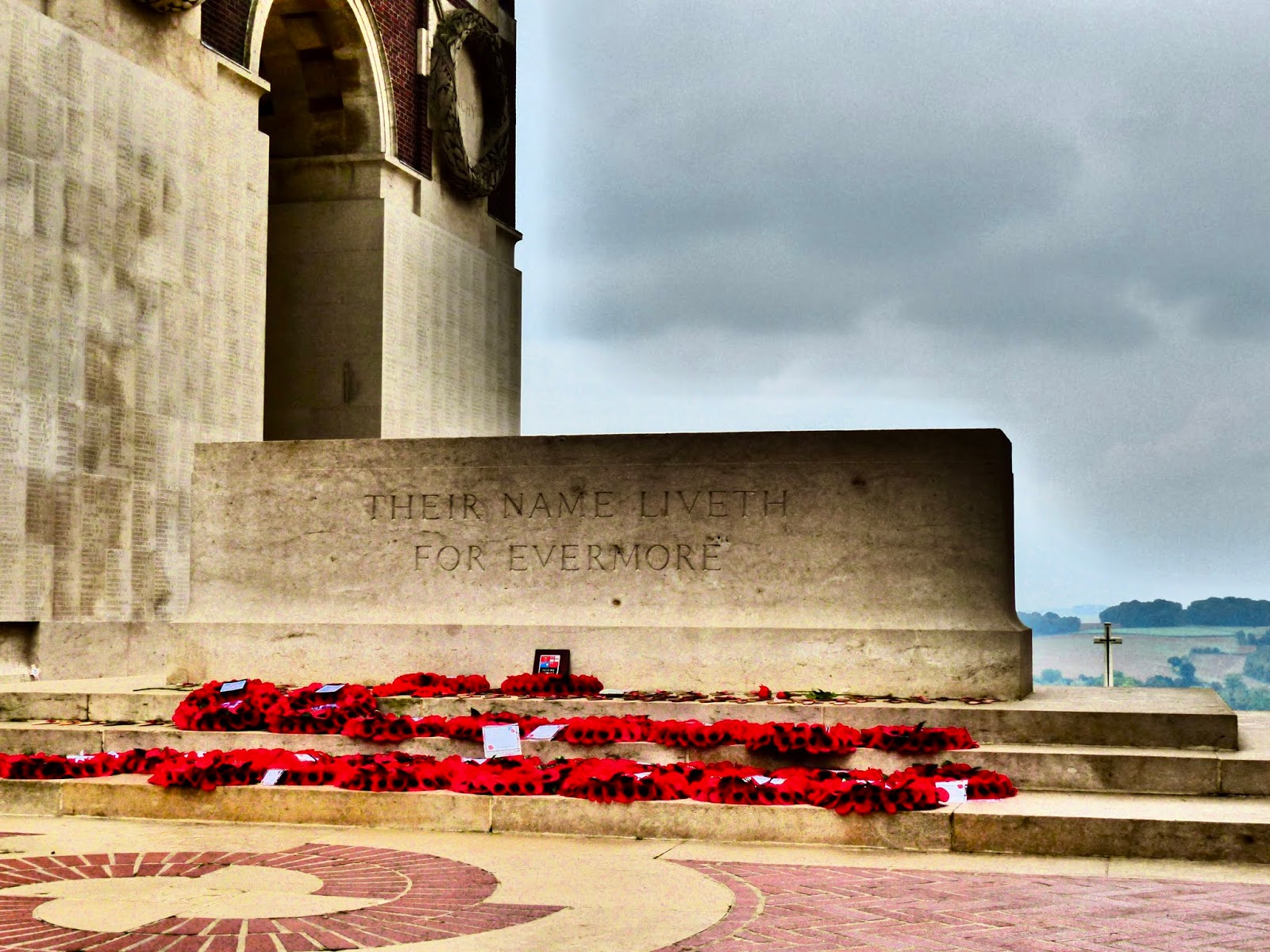
This is the memorial to the dead of the Somme who are not buried or commemorated elsewhere. Given that you seem to have driven by scores of graveyards on the way to this place, it's hard to imagine there'd be many left to worry about. Wrong. The white stone walls at the base of the memorial, towering well above your head, are dense with the names of 72,337 Brits and South Africans who never returned. The structure itself is magnificent: architect of empire Sir Edwin Lutyens piled monumental arches one on top of another to reach dizzying heights. You can see it for miles, including from Lochnagar. Normally, such arches get the word "triumphal" stuck in front of them, but that's not the mood here. There is nothing triumphant about a mass of names so dense and vast your eyes have difficulty focusing. It is noble and dignified, especially standing at the altar at the centre of the arches. But by massing the thousands of names into a communal sacrifice for the good of empire, it lacks the emotional sucker punch of Lochnagar.

It does, however, have an excellent little museum embedded into the hillside behind. It provides a helpful overview of the Battle of the Somme, thus putting the memorial in context. There's a free section which goes over the basics, but if you have time and don't mind spending a bit of cash, it's worth paying to go into the restricted entry section for some particularly useful graphics (the time-lapsed map of the moving front line is great), fascinating photos of the devastation, collections of soldiers' letters and memorabilia and a WW1 aircraft. Most visually striking is a modern interpretation of a trench, laid down the centre of a gallery that's covered with black-and-white cartoon illustrations of life on the front from the innocent merriment of soldiers on leave to the dismembered body parts and dead animals of trench warfare. Stand on the glass above the trench and look down at some of the artifacts they've excavated out of such places,  including a German machine gun.

Thiepval, Lochnagar and the exquisite cemetery at Pozieres provided quite enough to think about for one day. It was time for a break from war. But we had one more stop to make on our return journey. Laventie Military Cemetery is typical of the scores of burial grounds that dot this landscape. Not much bigger than the plot beneath a large suburban house, established to house and honour the dead of just one three-day battle nearby, miles from any main road and surrounded by a tiny modern farming village whose residents have no personal connection to the men buried there, you'd think that such a place would be moldering and ignored. Not so, thanks to the extraordinary efforts of the Commonwealth War Graves Commission.

This organisation cares for the graves and memorials of almost 1.7 million men and women killed in the two world wars, maintaining 23,000 locations in more than 150 countries and territories. Every spot we visited was pristine: carving still sharp on tombstones, marble spotless, grass mowed. And in front of all the graves, gardens full of classic British plants. Though I didn't spot one of the CWGC's 850 gardeners, I didn't see a weed or a tuft of grass that needed trimming. Flowers bloomed, perennials were carefully managed and bushes pruned. That's a very British kind of respect.

And what had brought us to this tiny but not forgotten corner of a foreign field? Rather who. Lieutenant John Charles St. George Welchman was an ancestor of my husband's on the maternal side. Born to a military family stationed in India, he grew up there and though he was sent back to England for school, he followed in his father's footsteps and returned to the sub-continent after officer's training at Sandhurst. He and his troops ... tough tribesmen from the Himalayas ... were amongst the first to arrive at the front lines. They had some success taking trenches back from Germans. One of his men was the second Indian to receive a commendation in the war. They even took part in one of those legendary, spontaneous Christmas cease-fires and communal celebrations of 1914.

But by the 10th of March the following year, John's dead body was hanging half way through the barbed wire he'd been struggling to push through to reach the German lines. Every officer and many men of that battalion of the Garwhal Rifles died in that battle. Most of the bodies had been collected and dragged back to the field that became Laventie. John had been hurriedly buried where he fell, and his grave was later lost beneath further battles. He's commemorated on a stone at the back of Laventie, where 494 others are commemorated with him. Just another day in a horrific conflict that was to last three and a half more years.

Thanks to our little side trips in Northern France, this coming Remembrance Day will be so much more than words to me. When we say "we will remember them", them will have names and faces, places and stories. That, after all, is what remembrance really means.