Thursday, 30 September 2021

Europe’s oldest town and its treasures are Crete’s must-see attraction

Twenty years ago, when my energy levels were higher and my sightseeing philosophy more American, I was appalled when friends came back from Crete without visiting any of its cultural attractions. How could you travel to the birthplace of European civilisation and not pay homage to its remains?
Now, drained by exhaustion, deprived for too long of sun and sand, and ensconced in a luxury resort to fix both, I had a bit more empathy for those I once condemned. But only a bit. No matter what else happened … or didn’t … on this holiday, I had to make it to Knossos.

For those less enchanted by the ancient world than I: Knossos was the capital of ancient Crete and a civilisation we call the Minoans. We don’t know what they called themselves, because we still haven’t deciphered their writing. But archaeology tells us they were remarkably sophisticated, building cities that were not only lavishly beautiful but precision-engineered with running water, complex architecture and efficient food storage facilities. Evidence of international trade and influences in their art tells us they were cosmopolitan types who did business across, and welcomed citizens of, the known world. And they appear to have been, if not entirely matriarchal, a society that respected and treated women similarly to men.

No civilisation in Europe would reach such glory for 1000 more years. (And it would take everyone a lot longer on the female empowerment front.) Which is perhaps why Crete shows up so often in Greek myth. The birthplace of Zeus. Honeymoon spot of Zeus and Europa and home to their descendants. Home of the Minotaur, the Labyrinth and the world’s first super-inventor, Deadalus, who built the maze beneath the palace to keep the bull-headed monster restrained. The ruins of the palace at Knossos are so labyrinthine that archaeologists point to them as proof of some historical reality in the tales.

Today’s Knossos is a 1,400 square metre archeological site five kilometres outside of Heraklion, the island’s capital. Admission is €15 (€20 for a combined ticket that also gets you into the Heraklion Archeological Museum) and you are free to wander on your own, though I would highly recommend a guide to help you understand what you are looking at.


We travelled with “Get Your Guide” on their tour from Agios Nikolaos. I had hoped to find the sort of combination driver and guide, hireable on a day rate, I once used in Athens. But equivalent services aren’t available here and a taxi for the day would have been exorbitant. The tour, officially originating in the town 20 minutes from our resort but picking you up at your hotel, had the disadvantage of a two-hour meander through resort areas before and after, since our starting point of Domes of Elounda was furthest away. But we rode in comfort, the six hours spent touring were expertly guided and we got in to Heraklion as well as Knossos. It’s a bargain at £31 per person; admission to the attractions is separate..


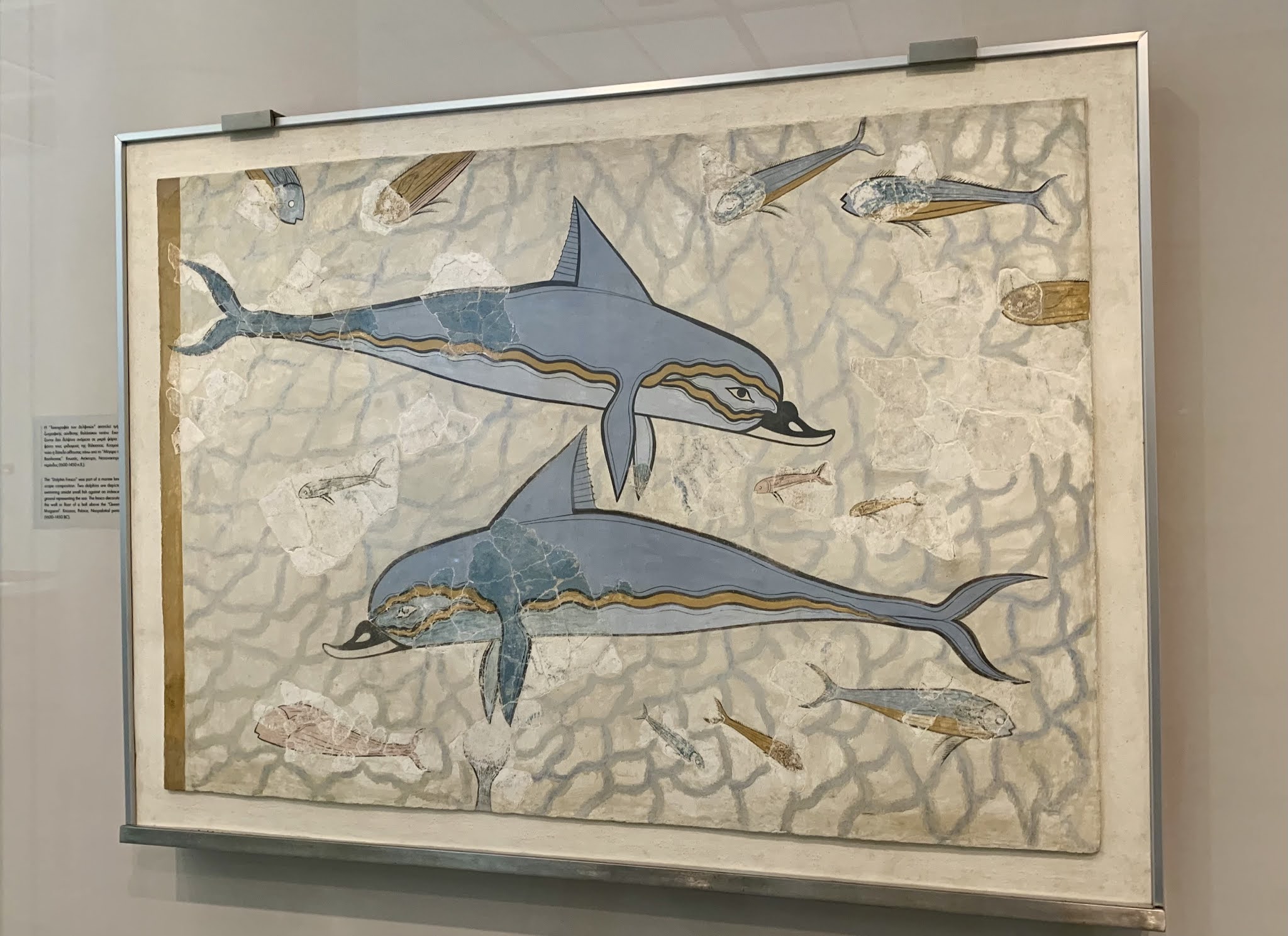
The ruins at Knossos are so magnificent because of an early 20th century preference for putting things back together. The practice is much frowned upon these days, and there’s a suspicion amongst modern scholars that the legendary archaeologist Arthur Evans might have been a bit overly imaginative with his reconstructions, but his efforts bring the site to life. Distinctive Minoan columns, wider at the top than at the bottom and painted a striking oxblood red, hold up lintels and walls. Murals are re-created in all their opulent, vivid glory. Processional staircases descend in stately grandeur. Enormous, highly decorated storage jars stand ready for wine or olive oil. Some of the most important rooms (at least, the ones Evans thought were most important) have been almost completely reconstructed and furnished, though sadly the queen’s apartments with their famous dolphin murals were closed due to the inability to ensure social distancing in cramped spaces.


The Minoans preferred small rooms, but plenty of them, connected by doors and transoms that could be shuttered for privacy or opened to let air and people flow. Knossos contained multiple levels of these cubist warrens, rising around a massive central courtyard now flooded with tourists. (Given that visitor numbers are still down due to COVID, it’s frightening to imagine how packed this site must be in a normal high season.) While it’s known as a palace, it’s much more like a small town and probably housed an equivalent population.


One of the best places to see the sophistication of the site is from the top of a heavily reconstructed light well, where a broad staircase descends through three stories of colonnaded loggias. To one side, you can appreciate the grandeur of the central court, while on the other you see the palace’s excavated levels, falling away down the hillside like the open face of a doll’s house. It’s not hard to see why anyone would associate this with the labyrinth.


Just a few decades ago, our guide Poppy told me, all areas of the site were open for visitors to just wander at their leisure. Global tourism numbers don’t allow that any more. This is the second-most visited attraction in Greece after the Parthenon and crowds were starting to do damage, so these days you explore a set tourist path with many avenues blocked so you can only look from a distance. What those blocked passageways took away, Poppy gave back with her clear explanations of what happened where, how the Minoans lived, the story of the site’s rediscovery and reconstruction, and the latest theories about this still-mysterious ancient society.

As magnificent as it is, the palace at Knossos is an unfurnished shell of a building. For the complete picture, you need to get to the museum in Heraklion. Where you’ll also see the magnificent wooden model of the palace at its height. (It’s a shame there’s not a version of this on the actual site, for those who don’t have time to do both.) Just to complicate things … the museum holds artefacts from across all of Knossos’ 7,000-year history and treasures from other palaces around Crete. So don’t imagine these galleries as exact furnishings of the place at one point in time. But what you see here, in a way the ruins only hint at, is staggering sophistication, joyous use of colour and an exuberance for life.


Pottery, jewellery and murals last in regular use 3,500 years ago seem comfortingly modern. The enormous jar with the cheerful, writhing octopus would look magnificent in my garden. The famous dolphin mural would fit right onto the wall of any beach resort (and no doubt does in a thousand copies). The magnificent turquoise and cobalt pattern in that Minoan’s kilt would make a mouthwatering dress. All those examples of the goldsmith’s art would grace any modern neck or hand. And, thanks to plenty of jewellers in town turning out reproductions, they do. I had always been an admirer of Minoan art, but seeing it gathered in such profusion makes me think they just might have had the best design sensibility of any civilisation in the ancient western world.


Beyond the museum, Heraklion is a sometimes charming, often undistinguished sprawl. (Nothing I saw in Crete persuaded me away from an opinion formed on an early trip to the mainland that, for such a historic country, Greece is sadly dominated by ugly, run-down 20th century buildings.) The most noteworthy site in Heraklion is the old Venetian fort, sitting at the end of a long causeway guarding the harbour. It’s particularly beautiful on a sunny day when its white stone gleams against the blue of sea and sky. There’s a Venetian lion fountain in the centre of the shopping district that would be more magnificent it it weren’t wedged in between cafes, mobile phone shops and tourist tat vendors. A couple of historic churches offer themselves up for exploration, but centuries of use as mosques under the Ottomans before they were re-purposed for the modern age left neither the glories of Islamic nor Byzantine art. There’s nothing here worth going out of your way for.


Heraklion does have a good range of shops, from big names and luxury brands to market traders, jewellers and local crafts. All of which confirms that if you can only bother to leave your resort once, this is the tour to take. You get all the culture and history of the Minoans, plus the chance to pick up any souvenirs and gifts you might need. Just make sure you have a good book for that long bus ride on either side of the tour.


Speaking of books … if you’re heading to Crete and want a list of relevant reading, I highly recommend the following:
Mary Renault’s The King Must Die. The story of Theseus and the Minotaur, told as a ripping and plausible adventure by one of the greatest interpreters of the ancient world in fiction. A particularly fabulous imagining of what all the tributes and bull leaping might have been about. I had to read this in high school and was delighted to find an audio version from BBC Radio 4 before the trip.Jodi Taylor’s Plan for the Worst. I adore the time travelling historians of the Chronicles of St. Mary’s and couldn’t believe my luck when the next one on my reading list (no. 11 in the series) reached its climax in Knossos on the day the volcano at Thera blew apart Minoan society. Tour guide Poppy explained that modern theories think the immediate devastation and tidal wave wasn’t as bad as described in the book, but the imagined cataclysm makes for one hell of a page turner.Stephen Fry’s Mythos and Heroes. The first covers foundation stories and a basic who’s who in the Olympian world, the second … as its name implies … tells the adventurous tales of big names like Heracles and Jason. In classic Stephen Fry style, he mixes delightfully every day language and plenty of humour with insightful observations that will have you pondering deeper issues.Everyone in the tourist industry on Crete recommends Victoria Hislop’s The Island. Even though I spent every day of my holiday looking out at the former leper colony and Venetian fort of Spinalonga that’s at the heart of the novel, it’s set in modern times. And anyone who knows me knows that I’m not going to waste my precious holiday reading time on anything set after 1815. When she does a prequel about what happened on the Island when the Ottomans wrested it from the Venetians, I’ll check it out.

Monday, 27 September 2021

Luxury and lethargy in a land of legend

Anyone who knew me at age 10 would be astonished that it has taken me nearly five additional decades to get to the Greek islands. I was obsessed with Greek myths as a child.

At the age of eight I had stumbled across my mother’s high school textbook: Myths and their Meaning. This worthy, old-fashioned little book should have been well above my reading level. But the magic of the stories triumphed over the lack of pictures and the academic writing. I was hooked. I gobbled up stories of gods and heroes, their adventures, temples and cities, until I knew the details the way other children knew the names of dinosaurs or kept track of Barbie’s friends and accessories.

Children without siblings often have imaginary friends; that mine were demigods, fauns, nymphs and priestesses of Athena was no doubt decidedly odd. Had my older self not been distracted by journalism and English history, I like to think I might have come up with Percy Jackson and the Olympians before Rick Riordan. But life intervened, other passions entered my life and other holiday destinations clamoured for attention.

This year, The Fates intervened. Not the traditional Clotho, Lachesis and Atropos, but the British government, the Greek tourism board and employers who’d had us both at Sisyphean tasks throughout the pandemic. Finding a holiday destination that was open to British travellers and met our dual needs of complete relaxation and a memorable 10th wedding anniversary trip was fiendishly difficult. Six other options had failed to clear the Olympic hurdles. So here we were.

“Here” is a magical bit of Mirabello Bay in northeastern Crete. Sheltered by the islands of Kalydon and Spinalonga, this long, narrow inlet is framed by steep hills; like a fjord that’s drifted into hot and sunny seas. These hefty breakwaters mean this bit of the bay is calm and ideal for swimming, and the view in every direction is spectacular. And I mean jaw-dropping, heart-stoppingly spectacular. Glittering cobalt and turquoise waters. Majestic mountains. The romantic ruins on Spinalonga. Luxury villas built into the hillside with more than a touch of Bond villain lair about them. All shifting constantly as the light changes throughout the day.
This is all much easier to appreciate, of course, from the welcoming luxury of a five-star resort. Our home for 13 nights is Domes of Elounda, an Autograph Collection (Marriott) property that’s actually … despite its name … in easy walking distance of Plaka. I’ll do a full review in a later entry; this story is simply meant to set the scene.

The resort climbs up two sides of a steep hill beside the bay, sprawling through several sections with a variety of pools, restaurants and styles. Our room is at the crest of the hill, in one of three long, low lines of stone buildings that channel the simple square huts along Plaka’s harbour, but descend in a straight architectural line from the bold yet simple squares and rectangles of ancient Minoan ruins. Built from the local stone, they merge organically into a landscape of rust, ochre, gray and olive.

Their interior, however, is a very long way from the simple structures they mimic. Ours has a private patio and plunge pool, perfect for the initial rest and recovery mission of this trip. In our first few days, we barely had the energy to leave the room. And we didn’t need to. Sleep. Stagger to private pool. Turn face to sun. Drink in landscape. Heal me, Gaia and Helios.

The silence is extraordinary. Though the resort was full in our first week and at more than 80% for our second, the design and the hilltop position whisks sound away. At least human sounds. The wind is a different matter.

Our first few days were hot and still. Not a cloud drifted over the sky. Nothing moved. The heat, when not enjoying the benefits of cool water, was intense. The bay was a placid lake. How did Odysseus spend 10 years blundering through this? Even becalmed and rowing couldn’t have been that tough. And then the winds started.

Our fourth day was cloudy day with a bit of rain, a much appreciated pause from the sun. The wind swept the heat haze away, gave us even better views and stayed with us even when the sun returned. I’ve never experienced anything quite like it. It will be still, and then a gust will hit you with force, then disappear as fast as it came. On the beach, the breeze is mostly gentle. But gusts will dive into the bay, driving geysers of spray before them and whitecaps below. For the first time I understood why the horse was associated with Poseidon. These strange effects on the bay were positively equine.

On our hilltop, the gusts are fierce. And puzzling. I’m used to ripping gales on Dartmoor or Chicago’s skin-shredding winds. I associate wind with bad weather. Here, the sun is shining and the sea is turquoise. The wind seems contrary. Odysseus, forgive me for underestimating you. There’s no way I’d want to sail in this. Most interestingly, the Cretan winds make different noises. Some howl mournfully. Some sing in a comforting bass. They have personality. No wonder the Greeks had four different and distinct gods of the wind. (I’m hoping for a little more Zephyros and a bit less Boreas in our final days.)

I’m not sure the rest of Crete is so magical or mythic. An excursion to Knossos (which I’ll write about next) took us through beach resorts on the north coast between Malia and Heraklion to pick up fellow travellers, and confirmed that our little it of the island is quite exceptional.

The destination might have been accidental, but the results are just what Aesculpius ordered. My 10-year-old self isn’t surprised. If Crete was good enough to host the birth and early years of Zeus himself, why wouldn’t it offer a healing, memorable holiday. Pass me the cornucopia along with a bit more sun cream, please.

Saturday, 11 September 2021

England’s Gusbourne and Hambledon take on the great Champagne houses

What makes Champagne special?

It’s not the bubbles. Many beyond the designated area of Champagne use the méthode traditionelle to produce sparkling wine from the same grape varieties. Many are just as good as what can officially be called “Champagne”, and some are both better and less expensive. Cynics might say the differentiation comes simply from the marketing that preserves the word Champagne for the production of just one region in France. But people who really know wine will talk about terroir: a unique combination of soil composition, growing conditions and weather patterns that imprints a distinctive taste onto the grapes.

But is Champagne’s terroir unique? Winemakers along a swathe of Southeast England argue a definitive “non”! 

The exact same ridge of chalk that lies beneath the Champagne region extends across the English Channel and becomes the Downs of Kent, Sussex, and Hampshire. That mattered little when summers across the Downs were cold and wet. But in the past 20 years climate change has brought the conditions in Southern England much closer to those in Northern France. Longer, hotter summers bring grapes more reliably to their sweet maturity and drier autumns allow them to be harvested before they can be waterlogged or start to mildew. This leaves only the talent of the winemaker as a differentiator, and, as small vineyards across the Downs are proving in critical reviews, wine competitions and their places on top restaurant wine lists, they are the equals of their French cousins.

I had the joy of exploring two of them within a week of each other recently, giving me the chance for a delightful “compare and contrast” exercise.

Gusbourne and Hambledon share an obsession with quality, small batch production, private ownership and a coveted place on Berry Bros. & Rudd’s shelves. Both use only their own-grown grapes and see growing, harvesting, production and ageing as inseparable pieces of  a continuous process; each depends on the other, no one step is more important. Both adopt marketing strategies more familiar to Napa and Sonoma than the French, with carefully-crafted visitor experiences and wine clubs to build allegiances. Both produce wines that, in a blind taste test, would be indistinguishable by all but the most sensitive palates to fine Champagne. And both price their wines accordingly. These, like their French cousins, are special occasion wines, not cheap substitutes to be found on grocer’s bargain shelves.

In taste and visitor experience I give the slightest edge to Gusbourne, though its location in Appledore, Kent means it’s not close enough for me to be a regular visitor. (A highly convenient stop for anyone who’s going to and from the channel tunnel, however.) The vines date back to 2004 and the first wines appeared in 2006, though it’s in the ‘10s that the winery made its reputation. Gusbourne’s biggest differentiator is its decision to make only vintage wines. Though there is a house style, every year is slightly different, reflecting the weather and growing conditions. Their Blanc de Blanc is generally considered their masterpiece by critics and management alike, a Chardonnay-only sparkling wine with deep minerality, green apple and citrus notes and that wonderful essence of toasted toasted bread so typical in classic Champagnes.

My favourite, however, was their distinctive 2016 rose, which is an extraordinary, almost luminescent salmon pink colour and a gorgeous combination of soft red fruits on the tongue that hits a perfect balance between sweet and dry. I was also impressed by Gusbourne’s playful sense of experimentation. While Blanc de Blanc, rose and Brut Reserve are their perennial money spinners, they play around with still wines, or wines from just one field, when conditions suggest there might be something special worth creating.

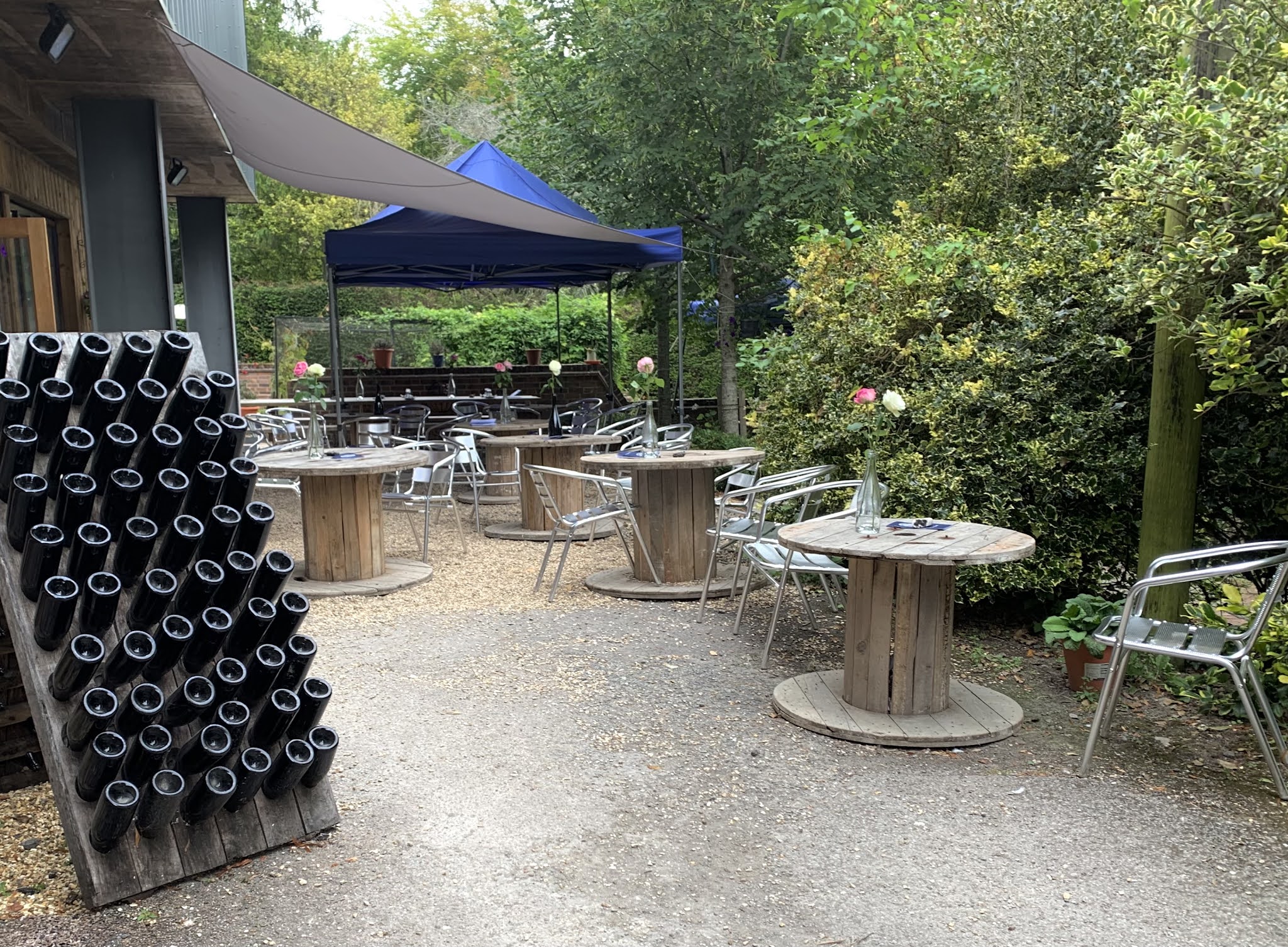
While their tourism ambitions are newer than their wines, Gusbourne is clearly making a go at turning their vineyards into a “destination”. A modest but beautifully-designed building called The Nest is a visitor and tasting centre next to the working winery. A semi-permanent marquee next door is serving as a pop-up restaurant, with hopes for a permanent building to come. Throughout the vineyards they’ve installed … and continue to create … decks and open-sided marquees with space for picnics and special events. Visitors can bring their own picnics, buy a bottle and disappear into the vines on a self-guided tour, buy a picnic with wine or sign up for a full-on dining experience. 

While the views over sloping vineyards are pleasant at Gusbourne, they’re verging on the spectacular at Hambledon. The Cotswolds get the international nod as picture-postcard England, but I can make a strong argument for my adopted home county. Hampshire’s valleys are deeper, the forests thicker, the undulating countryside’s rolls gentler. The drive from Basingstoke to Gusbourne’s vineyards just north of Portsmouth is almost entirely rural, shade dappled lanes alternating with expansive views. The vineyard itself fills a gentle, green valley, with the house and winery near the crest of the hillside to take in the best views. 

Hambledon’s wines are a little less quirkily distinctive than Gusbourne’s, possibly because they don’t follow the vintage strategy. They’re also cheaper. If I wanted to serve a basic English sparkling wine made from the classic trio of Chardonnay, Pinot Noir and Pinot Meunier at the start of a dinner party I would go for Hambledon’s classic cuvée at £30 rather than Gusbourne’s similar Brut Reserve at £39. 

Hambledon’s marketing USP is that it’s the oldest commercial vineyard in England. Which is true, but a technicality that has little to do with current production. The original vineyard dates back to the 1950s, when the founder asked his mate Winston Churchill for a favour and got the Pol Roger team to come to Hampshire to advise on winemaking, Back then, they suggested German-style, white table wines. The original family had lost interest in winemaking and the acreage under cultivation had shrunk by the time the current owner reinvented the place when he took over in 1999. He tested vines and winemaking in the ‘00s (including talking Pol Roger into a return consultancy gig), but didn’t start re-planting and producing in earnest until the 2010s. So while they can claim to be older, in every practical way Hambledon is actually a bit younger than Gusbourne.

The Hampshire vineyard may have deeper pockets, however. A beautiful new building is rising at the side of the old winery that already holds cellars beneath ground level and will soon grow to include a new tasting room and a fine-dining restaurant on the top floor that will have spectacular views over the valley. I feel another outing coming on … just need a boutique B&B in Hambledon village to recover from the effects of a sparking wine-based tasting menu

Saturday, 28 August 2021

Cinnamon Club is past its prime; try Kricket instead. Your stomach and bank account will thank you.

Trips down memory lane often lead to disappointment. Case in point: a recent return to the once-remarkable Cinnamon Club was profoundly underwhelming. Meanwhile, an unexpected drop in to one of the three branches of Kricket demonstrated the innovation and excitement Cinnamon Club was once known for, but at a fraction of the price.

Let’s start with the disappointment. 

The Cinnamon Club was one of the places to be seen in the '00s. Its concept of Indian food as something worthy of fine dining was, at the time, revolutionary. Vivek Singh shot to celebrity chef-dom and inspired a howdah of imitators across the UK. Turning its back on the cheap and easy "Anglo-Indian" of the local curry house, the Cinnamon Club and its progeny introduced a more delicate and subtle side of Indian cuisine, fit for fine dining and grand events. Even the decor was revolutionary. No flock wallpaper or tinny Bollywood music here. Singh had rescued the old Westminster Library from dereliction and kept its floor-to-ceiling bookshelves intact and full. You ate in what was once a grand reading room, surrounded by literature, and your bill came tucked inside a book. 

Throughout the restaurant's first decade I was there regularly for everything from corporate events to private parties to dinner with friends. I hadn’t been there in its second. Regular readers will know that the combination of my husband’s tomato allergy and his dislike of anything too spicy makes Indian a rare cuisine for us, and we only attempt it with kitchens we trust on the allergen procedure front. We had fantastic luck at Quilon nearby (review here) so I thought returning to the godfather of Indian fine dining in the UK would be a good bet. Not so.

On the positive side, the food was delicious, though not the novel experience it was in the ‘00s. We both opted for fish for starters (kingfish and a salmon carpaccio) and moved on to venison and king prawns. Puddings … a caramelised banana and pistachio mille-feuille and a creme brûlée laced with spices of the Indies … were by far the best part of the meal. The presentation was beautiful and the spicing exquisitely delicate, each flavour rolling over the other with distinct character and nothing overwhelming the star protein on each dish. If all I had to consider was the food, it would go down as a perfectly pleasant evening, though not special enough to prompt a return engagement any time soon.


The problem was everything else. First of all, we were sat in a balcony area off the main dining room that I had not realised existed. When part of your appeal is your iconic dining space, putting people in another setting starts the evening with frustration. And when you’re in the middle of a pandemic, with restrictions still in place, and you populate every table in a low-ceilinged room with little ventilation, you add anxiety to the frustration. (Six days later, despite being fully vaccinated, my husband tested positive for Covid. Fortunately, the vaccination reduced the illness to a bad cold, and I can't confirm he picked it up at the Cinnamon Club, but nowhere else that weekend were we in such a confined space with so little air flow.) Lesson learned: if you are booking at the Cinnamon Club, insist on the main room or don't go.

Next, the tomato challenge. At the aforementioned Quilon, we were able to opt in to the entire chef's menu. Almost nothing was a problem. Almost everything everything could be altered to accommodate. It was a much bigger deal at the Cinnamon Club, where the chef's menu was strictly off-limits (giving me a sense that much more was pre-prepared here). Even though they had been warned of the allergy at the time of booking, the waiter had to do several consultations with the kitchen to see what dishes were OK. Meaning it took an exceptionally long time just to get our orders in. My husband is used to asking "what can I eat?" and going with recommendations. That process was hard work here.

And then, the service. Our starters took well over half an hour to arrive, and when they did, they brought my husband the wrong dish. (Something he said would be his default if they couldn't make his first choice without tomato, which they did.) Given that my starter was served hot, it meant that I ate alone, and we waited another 15 minutes before his finally arrived. We might have enjoyed some wine while we were waiting, but the wine waiter took so long to take our order that the wine showed up halfway through my starter. (At least the husband's delayed dish meant that he could enjoy the wine throughout.) 

We had booked The Cinnamon Club well in advance, excited for a special night out as pandemic lockdowns eased and ready to explore a cuisine we rarely eat. Instead, we had an anxious evening with bad service and an enormous bill. Note that there are very few reasonable options on the wine list. We made a tactical mistake, instinctively ordering wine in a nice restaurant when beer would have been just as nice with the food and far better on the bill. I'm happy to lay out cash for a great dining experience, as scores of articles on this blog attest. But there are few things worse than the disgruntlement of parting with your credit card for an evening deeply inferior to something you could have had for half the price.

Or a quarter of the price ... if you go to Kricket Soho and drink beer.

To be fair, Kricket didn't have to face the tomato challenge, since I was out with a friend instead of the husband. And there's no fine dining or fancy presentation to challenge the staff here. The concept is a crazy mash-up (should I say masala?) of Indian street food, tapas-style sharing plates, and British ingredients turned on their head. You can hardly call it a dining room. It's a long bar with stools that overlook the food prep, with a few tables along the outside wall and ... while the pandemic curtails traffic in central London ... a few picnic tables outside on Denman Street. But the service is light years ahead of the Cinnamon Club in attitude, speed and information volunteered about the dishes. And the tastes! Every dish was eye-rollingly delicious, leaving us wanting to order more even when we were full.

The Hyderabadi aubergine, with coconut, peanut and curry leaf, would tempt even the most resistant to that vegetable, showing off its essential beauty as a conduit of other flavours. Another item that divides people, sardines, swam in a lusciously spiced tomato chutney given added life with ginger pickle and a bit of fresh fennel. If you think the taste of that fish is too strong, this dish will convince you otherwise as that chutney pulls back the flavour profile. Thankfully, we had the brown butter paratha on hand to scoop up every last drop. The love of British products is obvious in the rabbit and pork fat kebab, where a spice-laden "sulla" sauce perks up the rabbit, while the pork fat retains the rabbit's moisture and flavour. Carrot pickle comes on the side. Keralan fried chicken was a brilliant variation on a classic, best dipped in lashings of  curry leaf mayonnaise. 

Sweets are limited. We split the Mishti Doi. a puddle of caramelised white chocolate with a panna cotta-like consistency dappled with strawberries, hazelnut and mint. Its most striking element was an almost overwhelming flavouring of cardamom. White chocolate is tricky, often managing to be too sweet without actually tasting of anything. The cardamom here actually brought out the taste of the chocolate while holding back the sugar.

When not enjoying the luscious food, we were entertained by the clientele. There'd been plenty of open spots at 7, but by 9 the place was heaving with primped and preened 20-somethings out to see and be seen. Kricket's owners, Will Bowlby and Rik Campbell, are due to open what they're describing as a "speakeasy" in the space next door in September, and they appeared to be hosting a preview evening. A parade of extraordinary costumes streamed by us, high heels, make-up and suits seeming as exotic, after lockdown, as the spice mixes on our plates. 

Time moves on. Twenty years ago, the young and glamourous were flocking to The Cinnamon Club. Today, it's Kricket. Everything about my recent experiences makes Kricket my preference of the two. But it's worth remembering that Kricket wouldn't exist without the revolution Vivek Singh started in Westminster. And, someday, Kricket will be old and tired. That's how the culinary world turns, and how we diners can find our enjoyment. As long as we're brave enough to follow new roads and be wary of memory lane.


Friday, 27 August 2021

Hockney’s Norman spring is pure joy for the soul

Anyone who has helped older relatives come to grips with mobile devices and apps will approach David Hockney’s new exhibition with a sense of wonder before they even see the paintings. The 84-year-old artist produced everything in his new show, The Arrival of Spring, Normandy, 2020 on an iPad, working at speed.

To be fair, the British-born artist is a long way from your average octogenarian. He is probably the world’s best-known modern painter, producing steadily since the 1960s, and holds the record for the most expensive work ever sold by a living artist. He’s had an interest in innovative tools and technology his whole career, from the high-tech acrylics he used in his early works to initial explorations of the drawing power of computers in the mid ‘80s. His iPad has been a favourite canvas for at least a decade now, and he has become so associated with it that app developers work with him to create new brush styles and functionality.

This show is special not because of the technology but because of its circumstances. Hockney was visiting a house he owns in Normandy early in 2020 when the COVID-19 pandemic spread across Europe. He ended up locked in there. While most of us binge-watched Netflix and overindulged on comfort food and alcohol, Hockney saw a chance to do something special with his art. He created a new painting every day in his garden, returning to subjects as the world progressed from stark winter to glorious spring.

He’s taken a page out of Monet’s book, fitting since the impressionist painter’s famous garden is not far from Hockney‘s Norman place. Looking at 2020’s progressions of an apple tree, the sunrise over distant hills or the same stand of poplars, you’ll immediately think of Monet’s repetition of haystacks or water lilies, and have the same joys of comparing and contrasting. Also in common with the Impressionists is the way these paintings look radically different from up close and far away. In close proximity, you will marvel at the composition, the brushstrokes, and the way simple, repetitive techniques coalesce to create an object. Look back from across the room and all the detail fades into a spectacularly beautiful picture.

Most of all, however, these paintings will just make you happy. Hockney‘s colour palette is as joyous as the season he is representing. The three exhibition rooms are bright, cheerful, and full of hope. As every gardener knows instinctively, spring is a time of unbridled joy and possibility, when everything bursts fresh from the ground and all the colours seem more intense after the gloom of winter. The 116 paintings hung here capture that perfectly, starting with bare branches in a stark landscape and taking us through the to full, lush greenery of early summer. Trees blossom. Buds pop. Daffodils dance. Leaves creep over a treehouse. Gentle spring rain makes fairy circles on the pond.  

These paintings are deceptive. At first glance, many of them seem remarkably simple; large blocks of colour, single trees, basic shapes. You might dismiss them as graphic design or illustration. But the longer you look, the more complex they become. In fact, there are no solid colours. The green of a lawn is layers of subtly different brushstrokes and colours to give that sense of life and variety between blades of grass. A spill of white blossom is a careful construction of minute dots and dashes of whites, pinks and greens. Skies are a fabulous riot of much more than blue.

Hockney is a master of light. From the watery, weak sun glimmering through bare branches, to the sharp, crisp light of a spring morning to the low spotlights of late afternoon falling across bushes, you can feel the earth moving the sun ever higher. When fog dispels that light, he blurs every edge and surface to create such a perfect atmosphere you can almost feel gentle mist on your skin. Night skies perfectly capture the reflections of a bright moon against drifting clouds

The show is hung in chronological order, allowing you to walk through the developing season. You will then want to go back to find the repetition of the different subjects and compare and contrast. The catalogue, reasonably priced (as exhibition catalogues go) at £25 focuses more on the objects painted as a series. I snapped it up, not just for the smile it will put on my face every time I flip through it, but to study his techniques in colour and layering as I try to get better at drawing and painting. 

As all really good art exhibitions do, the Hockney show sparked all sorts of great conversational topics afterwards. Though these were different than the usual. How does intellectual property work when your art is digital, and therefore easily reproduced? Does the artist dictate the size of the reproduction? What difference does printing technology make? Certainly the colours of ink must vary and threaten the artist’s vision. If digital art can be easily reproduced, is there any point in seeing it in a gallery? Can’t you just look at a book or browse it online?

I can answer this last one. You still need to see it in person. It is a matter of size. Most of these paintings are quite large… they would overwhelm any room in a typical family home. Seeing them at this size drives home the magic of the variation between up close and the long view. Being surrounded by a dense hang of them is like being enveloped in colour and delight. My body might have been in the Royal Academy in late August, but my soul was in Normandy in the spring.

It’s a delicious irony that art created by a forced incarceration has allowed all who look at it to travel in time and distance. And in a time when the word is so full of worry, it’s a potent and much-needed medicine to see something that inspires such pure joy. 

The Arrival of Spring is on at the Royal Academy until 26 September. At posting, there was limited availability, mostly on weekdays, with Sunday the 19th and 26th the only weekend dates left. 

Sunday, 22 August 2021

Treasure house or treasure garage, Beaulieu is a great day out

In 1985 the National Gallery of Art in Washington DC hosted what's since become known as one of the most influential exhibitions of modern history. "The Treasure Houses of Britain: 500 years of Private Patronage and Art Collecting" fanned the flames of American anglophilia, established "country house studies" as a discipline in British universities and super-charged the transition of the British stately home from aristocratic playground to heritage enterprise. At the show's heart was the argument that British country houses, though often heavily foreign in their architectural influences, furnishings, art, and even the craftsmen who built them, came together to create something entirely unique to Britain.

At the time, I was a senior at Northwestern University, majoring in journalism but minoring in history and studying the British past with renown Tudor specialist Lacey Baldwin Smith. Journalism would give me a career, but Smith's classes were my passion. He'd been to the exhibition, of course, and sang its praises. I was dying to go. But I was a poor student, about to graduate into a tough job market with $55k in student loans hanging over my head. (More than $131,000 at today's value.) No matter how badly I wanted to get to Washington that year, I just couldn't make it happen.

My interest in the show and its exhibitions didn't fade, however, so in the years to come when I finally got to the UK ... first as tourist, then on work assignments, and finally as immigrant and naturalised citizen ... I followed the trail of what I'd missed back to the sources. In England, a group of 10 privately-owned houses formed a marketing consortium off the back of the show called "The Treasure Houses of England" and I visited them all. Some multiple times. 

All but one. Beaulieu remained a mystery.

Given that I have shared a county with the place for a decade and have driven by the entrance multiple times, this may seem unbelievable. But for me, Beaulieu had one significant problem: it was best known … and priced … for its motor museum. The Victorian Gothic house had little to recommend it by way of architecture or interiors. So I never went out of my way. All that changed with the need to entertain and impress a 12-year-old godson.

He was impressed. And, I admit, even I enjoyed the cars. I have pragmatic view of motoring. One car is much like the other, they exist to get you from point A to point B, and as long as it’s comfortable enough for a road trip and big enough to pick up visitors with luggage from the airport, I’m not bothered about make or model. I am puzzled by the whole obsession with“driving experience”, think people spending vast amounts on performance cars are idiots, and have been delighted with the idea that electric cars will silence all that silly engine noise. But I do love design, appreciate anything handcrafted, and I am intrigued by how things are marketed. And there is enough of all of that at the National Motor Museum to keep even this autophobe intrigued.

Early motor cars have more in common with horse-drawn carriages than the things we drive today, and Beaulieu has a hefty collection from the late 19th and early 20th century. Most are rich with gleaming bronze, polished wood, and hand stitched leather. One quirky example had a round driver’s windscreen like a giant monocle, and a horn-shaped basket on the side for umbrellas and walking sticks. 

Best of all from that era, the film version of Chitty Chitty Bang Bang sits in the centre of the museum on its own plinth. There are also race cars, motorcycles, James Bond cars and super-fast prototypes. Those who want to dive deep can pop into smaller galleries on everything from tyres to how engines work to green motoring. There’s an early 20th century street with old shop fronts and commercial vehicles, campervans, an amphibious car, and even a whole section on car-inspired children’s toys. Yes, it was good fun.

But as the boys started to linger in a car park filled with vehicles brought by enthusiasts (it was Aston Martin day) I started to get anxious. The day was spinning away and I had yet to lay eyes on any art or architecture. Is the house worth the effort? If that is all you come to look at, probably not. It is an attractive place with mediaeval roots, though most of what you see today is a Victorian reinterpretation and expansion of the abbey gatehouse that once stood here. There’s lots of wallpaper of the type Burgess put into the Houses of Parliament. Some beautiful rooms with vaulted ceilings and atmospheric Gothic windows. But you only see about five historically-furnished rooms along the public route, best among them a great Hall, a sitting room, and a dining room. Nothing particularly noteworthy on the art and furniture front.At least, not in the traditional sense.

The most interesting things in the house, to me, were the artworks of the current owner’s mother. Belinda Crossley is a well-known artist working in tapestry and embroidery. Rooms here show wall hangings as well as paintings, panels and clothing design. There were some spectacular things on display, my favourite being a wall hanging somewhere between Klimt and a Tolkien book illustration. 

One assumes her artistic flare has flown down to her son, the fourth Baron Montagu, who works as a graphic designer and had turned both house and grounds over to a massive display of modern sculpture all up for sale. From abstract to traditional, small pieces for a tabletop to massive items for the garden, there was something for everyone here. (Though most of it at hefty prices.) Had I been on my own, I would have cut the cars short and spent much more time on the sculpture trail.

There is more to see in the grounds than most people could race through in a day. The ruins of the original Abbey are worth exploring. They are both picturesque and historically noteworthy for being the only abbey in England founded by King John. There are some pretty long borders … exploding with a fantastically colourful range of dahlias at the moment … and  several garden “rooms” walled by hedges. These run the gamut from working vegetable plots to a romantic rose garden to a delightful topiary garden on the theme of Alice in Wonderland. There’s a monorail you can ride around the grounds to view everything from on high. 

A small display in one of the garden buildings tells the house’s story in training intelligence officers during World War II. If you haven’t had enough cars, there’s a “World of Top Gear” section (I avoided that, but the boys liked it.) and a separate exhibition on cars in the movies (that I might have checked out if it hadn’t been hidden behind the testosterone-drenched Top Gear franchise,) There’s a playground area full of climbing frames and zip wires targeted at younger guests. There are falconry exhibitions and a proper hunting mews; logical since from its entry into private hands at the Dissolution of the Monasteries to relatively recent times, Beaulieu was used more as a hunting lodge than a main home. Much of the charm of the place comes from the fact that nobody has ever done the kind of massive remodelling that would have wiped away the past for something new.

At £16 per adult (more if special events like the Aston Martin day are on), it’s good value for money for a family day out. But if all you’re interested in is the house, gardens and ruins, it would be a pricey visit. Beaulieu is a member of the Historic Houses Association but doesn’t allow members to use benefits on pre-booked tickets. Which are currently necessary given the pandemic and the crowds caused by all the “staycations”. If I can use my membership to drop in at some future date, I would like to spend more time exploring the ruins, and pay more attention to the falconer. 

Beaulieu’ s not a traditional “treasure house” of Britain, but it did give us a family day that we each treasured for different reasons.


Thursday, 19 August 2021

The Purefoy Arms delivers gourmet gastro pubbage on the outskirts of Basingstoke

Some might accuse me of being a food snob. In my defense, I’m just being practical when it comes to restaurant selection.

We like to cook. We cook from scratch most nights. Even if I wanted convenience food, my husband’s unusual tomato allergy takes the vast majority of prepared foods off limits. It can also make chain restaurants, or those who get packaged ingredients from an industrial source, a gamble. We love great ingredients and are lucky to live in a county blessed with excellent fruit, vegetables, meat (farmed and wild), trout streams and a coastline offering a wealth of seafood. Winchester’s twice monthly farmers’ market is as good as any you’ll find in France or Italy. 

Quite simply: unless we are dropping from exhaustion or away from the house doing other things, we don’t see the point of going out unless it’s better than we can make at home. And that attitude takes all of the pubs in our immediate neighbourhood, and most of the restaurants in Basingstoke, out of consideration. 

At last, however, I’ve found an exception. A 25-minute meander down lovely country lanes puts The Purefoy Arms on the edge of what we can properly call local, but it’s worth the drive, and what’s coming out of the kitchen is far beyond my abilities. We’ve tested the place twice in a week; once by chance for a Sunday lunch, again as a planned dinner for visiting friends from France. Aside for some slightly dry burgers on the first visit, it was a triumph. 

The menu is upscale British classics, locally sourced, with a fairly limited but interesting selection. The expansive garden could double potential covers, as it did on our Sunday visit, but on a Thursday night with steady rain booking was essential and the cozy dining room was limited to eight tables. It’s an intimate place and feels very local, given that it’s on a country road that neither outsiders nor tourists have any reason to traverse. I suspect the residents of Preston Candover, a picture-postcard village with plenty of thatch and substantial homes that turn up in the advertising pages of Country Life, like it that way. 

Their local, named after a local nobleman and not the famous actor, occupies a sober yet elegant Georgian brick building that would be at home in any Jane Austen adaptation. (Little wonder, given we’re in her home county and the pub is just 10 miles from the house where she did her best work.)  The bar at The Purefoy spans the dining room on the left and the pub on the right; and though occupants of one can get a peak at the other, they have separate doors from the entry porch.

My meal on the Sunday was so exceptional I had to order it again: the ox cheek donut followed by pork belly. The donut was more accurately (though less poetically) a dome-shaped pudding, with an outer crust that was both sweet and savoury, and more the consistency of cornbread than wheat pastry. (Though wheat it was.) Crispy on the outside, fluffy beneath, giving way to a filling of shredded ox cheek stewed down in a rich, tomato-based sauce. As if that weren’t special enough, it was crowned with a smooth onion jamb and a sprinkle of herb crumb. I nearly wept that my husband’s allergies kept him from trying this wonder.

The pork belly that followed was probably the best I’ve ever had. Every distinguishable bit of fat had been rendered into the flavoursome meat, which didn’t even need a knife to cut. It had been both smoked and cured, and after its long and slow (one assumes) cook augmented with a rich, sticky sauce and an orange and almond granola. There was also a bit of pickled fennel. None of this shouted out on its own, but rather made every bite of the pork an explosion of flavour. The additional element on the plate that did stand out was “crispy bubble and squeak”; essentially a sphere of that butter-laden, tasty side dish breaded and then deep fried. This is comfort food elevated to a higher plane.

I wasn’t the only one indulging in culinary reveries. My godson, a slight 12-year-old who isn’t normally a big eater, demolished an entire side of ribs that looked and smelled worthy of a Midwestern BBQ master’s grill. The peppered fillet stake won raves for its spectacular combination of accompaniments. Celeriac remoulade, mushroom and spinach tartlet, truffle and creamed potato combined for that perfect “Masterchef bite”. But the real accolades were saved for one particular starter.

It was not the pan fried scallops, beetroot, apple foam, peanut, chilli and ginger, even though that tasted delicate enough and looked pretty enough to grace any Michelin-starred table. But rather the more prosaic-sounding caramelised onion quiche with onion ice cream, pickled onion and fennel. Who raves about a quiche? And there was so much that could go wrong in this trio of rather odd treatments of a vegetable usually in a supporting role. Instead, this was an exercise in delicacy. The quiche was more of a delicate flan, each onion element subtle but full of flavour, the fennel barely there but adding a little hint of spice. The sample bites my husband shared out were so beguiling we immediately ordered another for the table to share.

Unsurprisingly, the desserts we sampled were also excellent. A plate of English cheeses did their patriotic duty and conquered the taste buds of our French guests. A rum baba managed to be both beautiful, delicate and boozy enough to make me slightly worried about my designated driver status. A white chocolate mousse was an Instagrammable thing of beauty.

The only failure here was my godson’s white hot chocolate. Without the redeeming bitterness of cacao it drifted into mouth-numbing sweetness I’ve only tasted twice in my life: the truly vile butterbeer at the Harry Potter studio tour and the St. Louis Ritz Carlton’s attempt to turn that city’s classic gooey butter cake into a martini. As with the other two, one taste of this concoction was exquisite, the second a bit much and the third overwhelming. Served in a shot glass, it might have been perfect.

A bit of research into the man at the helm indicates that such excellence in this quiet country pub should not come as a surprise. Having cut his teeth at The Vineyard near Newbury (my review here), Gordon Stott moved to The Sun in Dummer (just down the road from Preston Candover and an equally affluent area) where he became head chef at just 20 and went on to win a host of accolades, including gastropub of the year. In 2018 he moved to become owner and head chef at the Purefoy, where he’s earned a “plate” mention in the Michelin guide and where I suspect he’s on track for a star. He is, after all, barely 30. We’ll be keeping our eyes on him, and the pub’s phone number on hand for those nights when we want someone better than us … much, much better … to cook.