Almost everywhere in and around Basingstoke is bigger and more significant today than it was in the past. Old Basing is a notable exception.
For a little over a century after 1531, Basing (the "Old" came later) snuggled against one of biggest aristocratic palaces in the country. In ornate red brick accented with stone, Basing House resembled Hampton Court and sprawled over two separate but interconnected buildings with more than 360 rooms. The village beyond its walls would have been a bustling place, ready to spring into action to support regular royal visits (Henry VIII and all his reigning children came here) or simply to take care of the resident Paulet family and their entourage.
The grandeur was a statement of success by the man who became the first Marquess of Winchester. William Paulet was Lord High Treasurer of England for more than 20 years and served in major government roles under Henry VIII, Edward VI, Mary I and Elizabeth I. He must have been an extraordinary diplomat to remain in favour through those tumultuous administrations, particularly since he remained Roman Catholic throughout.
The site where the house once stood is now a pleasant place to stroll around ruins, earthworks and gardens while you contemplate how the mighty can fall. The best time to come is when historical re-enactors are encamped to commemorate Basing's role in the Civil War. (I wrote about that here.) The site was closed due to COVID precautions when I had a recent ramble, but you can see the original castle mound which held one of the palace's two main buildings from certain spots in the village.
The old gate lodge offers some picturesque (and free) sightseeing just next to the village pub.
But the only significant building still standing from those glory days is the enormous tithe barn.
Paulet family diplomacy couldn't carry them through the Civil War, however. I suspect the 5th Marquess' overt Roman Catholicism and close friendship with the French Catholic Queen Henrietta Maria made him a particularly juicy target for Cromwell. The Parliamentary leader was so irritated by two failed sieges of Basing House he came to Basingstoke to direct the third personally.
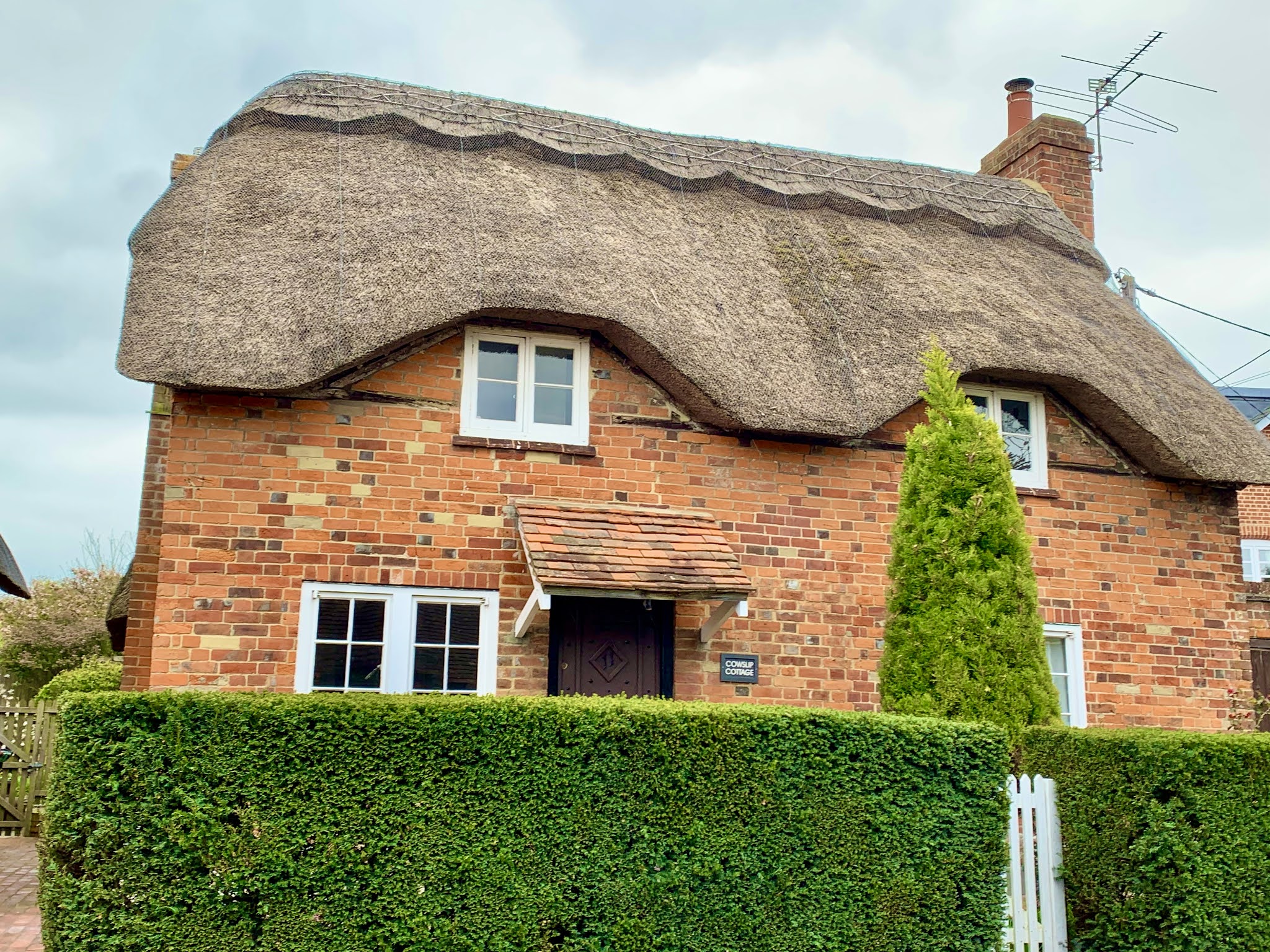
So eager was Cromwell to destroy the Paulets and their cause that, once he'd taken the house, he not only destroyed it but encouraged villagers to re-use its materials to enhance their own homes. Thus fuelling a bit of a building boom in Old Basing in the 1640s. (While I can't be certain these particular buildings were part of the post-war boom, they certainly look the part.)
Basing House was destroyed, but its owner lived on and his son's political choices were luckier. He supported the import of William and Mary from Holland (The Glorious Revolution) and they rewarded him with a new title: Duke of Bolton. He rebuilt a very grand hunting lodge next to the old tithe barn (another memory long torn down, sadly) and chose to be buried in the village church. By this point both he and the parish church had converted to Church of England, reputedly much to the locals' dismay.
Villagers also were doubtless irritated that Charles removed himself from cheek-by-jowl proximity to the village by building the new family seat within a buffer zone of hundreds of acres of enclosed parkland. His new neoclassical pile was equidistant between Basing and the flourishing market centre of Basingstoke. Thus began Basing's slide toward's backwater-dom.
About a mile's walk from Old Basing's village centre you'll find the main gateway to the estate he built, called
Hackwood Park.
Hackwood Park is no longer in the family and ... thanks to the M3 motorway ... could no longer be considered a part of Old Basing since the massive, always-bustling highway now cuts through the old estate and forms an impressive barrier between its old village and the house. Though you once might have walked easily from village to house, today the new gates are on the other side of Basingstoke and it's a drive of several miles to reach them. (The house isn't open to the public.)
The land between the arch and the motorway became a public park called Crabtree Plantation after the M3's construction. The views are spectacular, though the constant whir of traffic undermines the bucolic scene.
A long, narrow strip on the north side of the park is woodland, however, which muffles the traffic noise. It's a popular local spot to exercise both dogs and children, and can seem almost Tolkeinesque is certain lights.
Meanwhile, back in Old Basing, nothing much happened. Following the trajectory of places like Bruges and Venice, with its main claim to fame gone the village sank into quiet obscurity. Though people added houses in the 19th and 20th century, the place retains the feel of the 16th - 18th, and is one of the loveliest places to ramble around Basingstoke.
There's a beautiful walk along the river Loddon ... and an unusual one, since so much of the river's access is privately controlled because of conservation and fishing rights.
Sitting alongside the river is one of the prettiest pubs in the area, Barton's Mill:
And the village remains full of picturesque houses to appreciate:
Though the modern-day Paulets have decamped to South Africa, the original ones sleep soundly in the parish church.
The fifth marquess, who fought Cromwell and lost, had grander ambitions and had built a lavish mortuary chapel on a hill above Basingstoke. But it was destroyed in the Civil War and is now just a picturesque ruin. (See
this story for more.) His ancestor's tombs frame the high altar in Old Basing's parish church, and his son's tomb (pictured above) is in a side chapel.
Old Basing seems to be working on a new claim to fame. Last autumn catering veteran Tim Goodwin opened The Street Bakeshop, an old-fashioned bakery where everything is done on-site, by hand. Their sourdough is the best I've had outside of Michelin star restaurants, and their pastries on par with anything the Danes could crank out.
Fortunately bread and cake fall into the "essential" category so the shop has been able to remain open for take-away though lockdowns two and three. It's rare to see the place without a queue outside, and it's quickly become a local legend.
So for what's probably the most picturesque walk in the Basingstoke area: start at The Street for coffee and pastries, take a long ramble around the village and perhaps even around Crabtree Plantation, then collapse at the soon-to-be-reopened Barton's Mill for a pub lunch beside the Loddon.