Showing posts with label Gardens. Show all posts

Saturday, 31 October 2020

World’s best for autumn colour? Stourhead has a claim.

The English class system has done a lot of damage over the centuries, but we can also bless it for its impact on architecture and interior design. In the success-obsessed United States, new money has tended to splash out on bling-drenched conspicuous consumption. In England, while the consumption might be equally prodigious, self-made fortunes seek the best in establishment tastes and bend over backwards to rub off any taint of the new.

In just the past few months, the trend has shown up on this blog in articles about Harewood House and Bovey Castle. And here, on a crisp autumnal day en route to the West Country, the glorious Georgian mansion and landscape garden at Stourhead.

Stourhead was the country pile of the unfortunately-named Hoare banking family. They never quite washed the taint of trade off their hands. Though they kitted out a lavish bedroom for Queen Victoria she never visited, thinking the family too far beneath her. Presumably the Hoare’s had the last laugh, since they’re still in charge of the oldest private bank in the country and Victoria’s kingdom is now heavily dependant on financial services to survive. Had the queen lowered herself to a visit she would have discovered not only a house very much to her husband’s Italianate tatstes, but one of the two best examples of a classical landscape garden in the country. (The other is Stowe, bigger but, IMHO, not as dramatically beautiful.)

Wealthy tourists in the 18th century would return from the continent ... usually Italy ... laden with treasures that showed off what they'd seen, and fired with a passion to re-create some of the magic at home. Most houses of the time will feature Roman statuary in the gardens, or showy pieces of furniture inlaid with semi-precious stones (called pietra dura) from Florence, or a few paintings of Venice by Canaletto. That balanced approach wasn't enough for Henry Hoare, who was obviously obsessed to something bordering madness by all things Italian. 

The house is a stately Palladian cube, rather small as grand country houses go, packed to the gunnels with paintings of classical stories and Italian landscapes, plaster ceilings and decorations taken from Roman temples and Italian style furniture. Obelisks, classical statuary, collections of Roman seals and lofty gods and goddesses run amok. There are few masterpieces on the walls, but the theme is clear. Hoare was re-creating Italy in the England.

But the house wasn't enough. He went on to re-create the countryside itself. Ironically it was three Frenchmen of the time ... Claude Lorrain, Nicolas Poussin and Gaspard Dughet ... who became most famous for painting imagined scenes of Italian antiquity. Gods, heroes and historic figures play out their adventures in deep, romantically-wooded valleys dotted with classical temples. There's almost always a lake to reflect the architecture and the action. Many English tourists decided they'd try to re-engineer their gardens to evoke this look, but nobody did it as thoroughly as Hoare.

This Lorrain painting in Stourhead’s collection is thought to be a direct inspiration for the garden

He was lucky enough to have the wooded valley beneath his house as a foundation, but no lake. So he dammed a stream and time did the work for him. Once the valley floor was appropriately flooded, the temple building began.  There's a miniature pantheon, an ancient and stolid temple of Flora and a magnificently bonkers domed and columned temple of Apollo on a hillside. 

A gracious Palladian bridge links the two, purely for visual effect since it's bridging an inlet you could walk around in three minutes. 

Each is designed to look out over at least one of the others, all set in a carefully chosen mix of trees. The lake is a mirror to add another dimension to your views. 

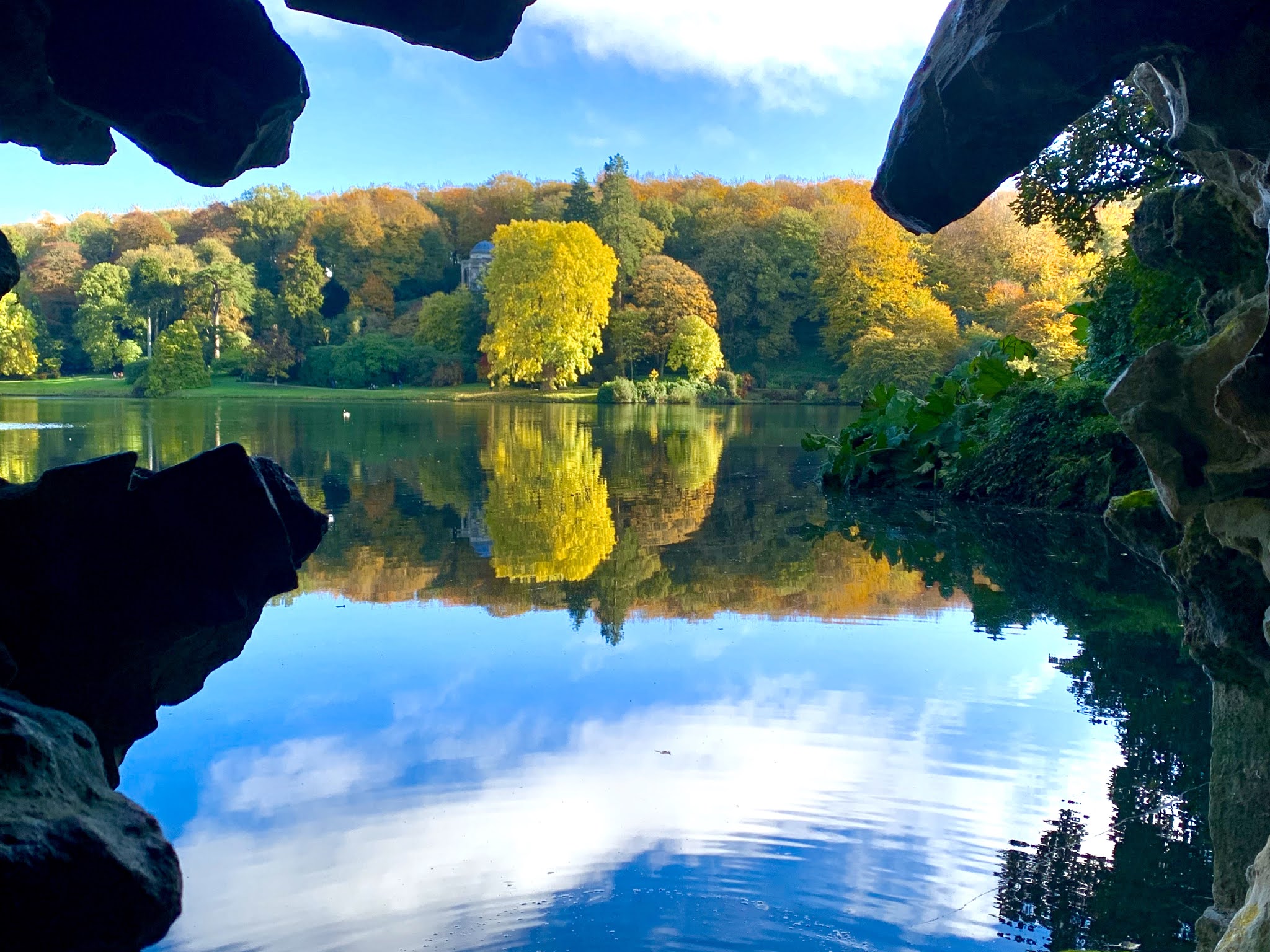
At one point, the path brings you into a dark cave where the sound of dripping water beckons you to a grotto where a water nymph and river god lounge in alcoves while carefully planned gaps in the wall conjure more artistic views across the lake to other temples. 
A towering obelisk adds to the classical antiquity, not near the lake but at the top of the hill with a long grassy avenue cleared through the trees to allow an impressive vista. In modern terminology the place is, as one of my friends proclaimed, top Instagram porn.

Despite the Hoare family’s obsession with the classical world, they couldn’t resist a few other passions of the time. There’s a sweet little cottage called The Hermitage with gothic windows and a thatched roof, playing on the passion for hermits and dark mysteries that came with the rise of gothic literature. A little over two miles from the lake stands King Alfred’s Tower, a 161-foot construction that looks rather strangely Germanic with its crenellations and pepper pot roof. It marks the spot where King Alfred was supposed to have mustered his troops in 878 before his success at Edington. Love of the gothic also led the family to rescue Bristol’s market cross, a glorious spire that was unloved and would have been destroyed by the town’s improvers had it not found a second life as a garden ornament. 

The cross marks the transition between the garden and what’s left of Stourhead village. A picturesque row of cottages, a parish church, a Georgian pub and an aristocratic stable block now mostly cater to tourists’ needs, with the cottages all B&B or holiday rental and space in the stables let out to shops and snack bars. The Spread Eagle Inn also offers accommodation, with its ground floor given over to picture-postcard pubbage. On the sunny afternoon we visited, the pub had extended service to tables in the stable courtyard and had a full menu from light pub classics to full three-course meals. I gave high marks to my ploughman’s but three of us all envied the fourth’s towering Waldorf salad, studded with local, seasonal apples, walnuts and cheddar.

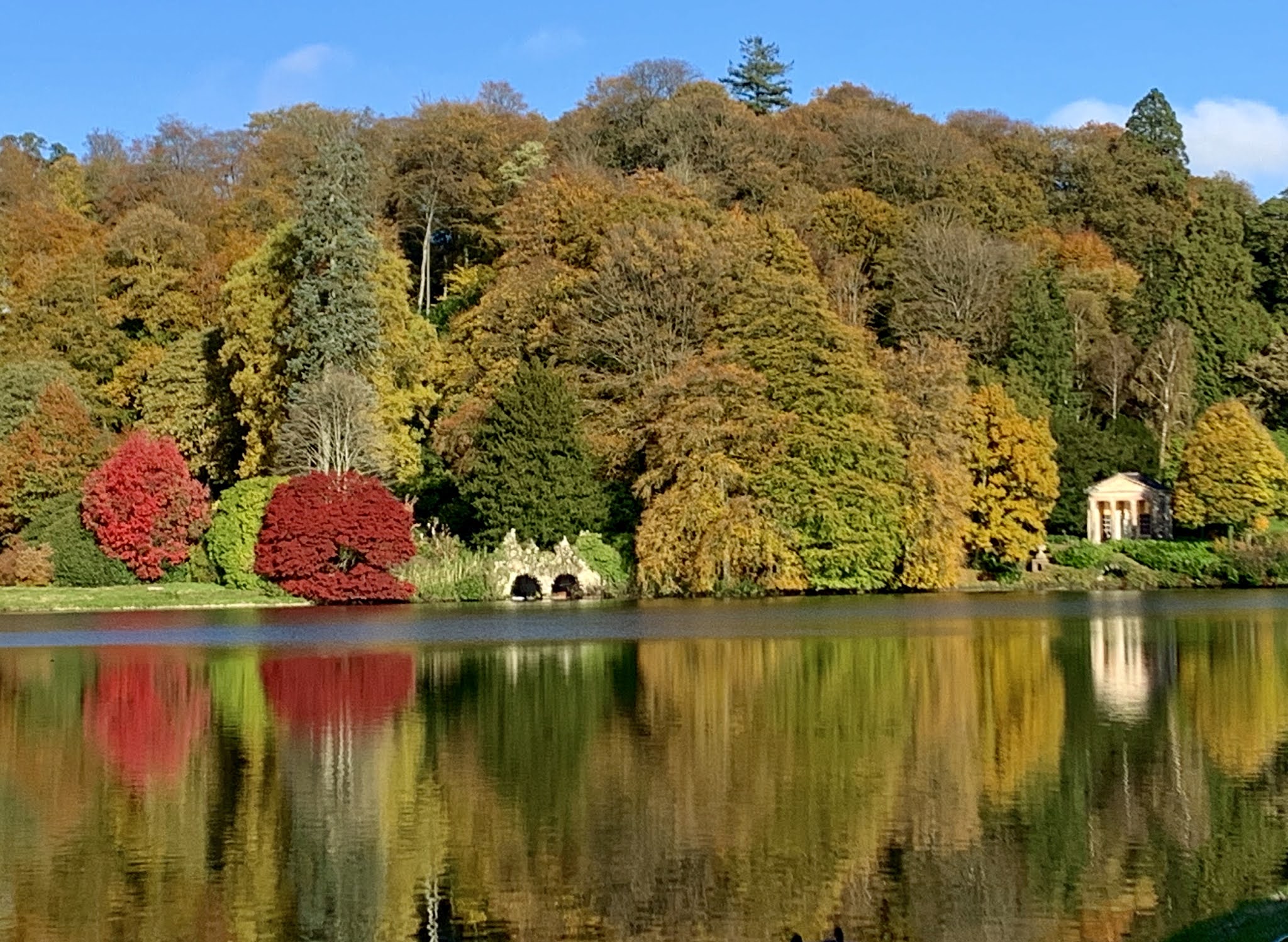
I have been to Stourhead many times, in all seasons, but there’s no question in my mind it’s at its best in the autumn. And we couldn’t have timed our visit better. Oaks, maples, alders and chestnuts were blazing in a merry range of yellows, oranges and vivid scarlets, bearing miraculous testimony to the people who designed this planting scheme but wouldn’t live to see it mature. These trees weren’t put in haphazardly, but purposely placed so their autumnal foliage would create a living painting. It is, with blue skies in late October, quite simply one of the most beautiful places on Earth.

You’ve missed this year’s autumn show but the garden is open all year and the local National Trust managers do a fine job of programming special events for all ages. Winter illuminations run from 27 November to 3rd January. You can get tickets here.

Saturday, 27 May 2017

Nope, it's not Chelsea. It's Bencard Gardens, year five

I didn't make it to the Chelsea Flower Show this year. If I had, I would have enjoyed some of the warmest, sunniest days in my history of attendance. I chose, instead, to enjoy my own garden. As my patch enters its fifth full summer since being carved out of the featureless stretch of a new build's back yard, I can proclaim myself satisfied. 

I'm getting the hang of the light and soil conditions. My anchor plants have bedded in. (Well over half my plants ... and the vast majority of those big, showy anchors ... come from Hardy's Cottage Garden Plants. I'm incredibly lucky to have this nationally-famous grower a short drive away.)  My hard landscaping has softened. Chelsea week is a great time for taking stock, so here's an inventory of how my little patch of the green and pleasant land is coming on.


The pond continues to be the heart of the garden and is now fairly self sufficient, with four types of waterlily, grasses, iris, oxygenators and other marginal plants sharing space with fish and frogs. Much of my inspiration and all my best pond plants have come from Waterside Nursery. I was originally concerned about getting plants by mail order, but they've never let me down. The water hawthorn in the top pond is so rampant I now pull about half of it out each spring, it still gave me a lovely spread of white flowers nodding above the water's surface this year.  In the lower pond, the water cress has been blooming for well over a month and the first water lily came out today. The glass flowers in the top pond are a new acquisition from our recent French holiday. The bed edging the pond is my best in the garden, which is no doubt because it gets the most sun.


A closer shot of the pond-edge bed shows off my new-found appreciation for matching orange with purple. The geum and Siberian Iris have been spectacular this year.

Here are my glass flowers and the blooming water hawthorn up close.

Just to the right of the pond, my other bed is framed by steps on both sides going between the top and bottom patios. The bluebells and forget-me-nots were so rampant this year I think I'm going to have to do some serious digging to thin things out. They may be drowning out other perennials. It's hard to see. Certainly the monkshood and a towering chrysanthemum are coming out with a vengeance, and last year's alliums have returned. Possibly a bit smaller, but still beautiful.

 On the lower patio, leading to my office door, the fig in the blue tub is flourishing. The box planter on the left should be a tower of flowers by high summer.

The hosta walk is looking great. And full. I need to start considering how I could anchor more to the wall.

 On the other side of the hosta walk's pergola, rose Generous Gardener is just coming into bloom.


On the stairs between the top and bottom patios, I have herbs, lettuce and cucamelons planted in pots. At the top left, my patio raspberries have set fruit for the first time since I bought them in 2015.
I haven't decided how I feel about this experiment yet. Inspired by all the meadow planting at Chelsea shows past, and especially by the herbal lay in Jekka McVicar's garden last year, I've tried my own. It's not bad, but I think I need more varieties of grass to really make it work.

At the end of my bottom path, near the back door, my espaliered apple (Worcester Pearmain) has set the most fruit ever. About a dozen spotted so far ... much better than the single apple I harvested last year! Hand pollinating with that paintbrush seems to have helped. Turns out this corner really doesn't get enough sun for a bumper harvest, but does mean that I can underplant with more hosta. And lavender, which sends up scent when the back door hits in.
I haven't bothered much with the spaces around the front of the house, with the exception of this hosta bed. I'm very happy with the mix of varieties, and especially with the enormous Sum and Substance in back with the allium coming through its leaves.


I'm working to establish a balance between flowers and stuff I can use in the kitchen. The shot above shows a montage of my edibles. Clockwise from top left: Mediterranean herbs a few steps from the back door; peas, cucumber, courgette (zucchini) and borage in the main bed, exotic mints in pots and regular mint and dill right next to the back door; what were supposed to be winter potatoes failed miserably for the November harvest, but are now coming on with fervour; baby apples; more courgettes set to grow up the pergola and my new Semillon grape vine; a few punnets of strawberries on the way.

I'm particularly happy with some of my planting combinations. Purple and pink remain my anchors. From left to right: Siberian Iris share space with a double-flowering geranium and sea thrift ... though plant-wise I may be most delighted with the alien-like spread of the sempervivum at the bottom; rose Sceptred Isle shares space with forget-me-nots and a rust-coloured verbascum; pink geranium and white tradescantia mix with nigella that's now freely re-seeding every year.

The biggest difference this year, however, is that some of my anchor plants have finally reached a glorious maturity. The centaurea (top left), the water lilies and the rose will keep blooming most of the year.

Not quite a Chelsea Show Garden ... but enough to be very proud of my achievement.

Friday, 28 April 2017

Three must-see gardens in the Loire: Villandry, Chenonceau, Chedigny

If you want a holiday that majors on great gardens, go to England. Not only was Chaumont a pale imitation of Chelsea (see my last entry), but the other gardens of the Loire can't really compare to your average National Trust property in the UK.

This may, admittedly, be a matter of taste. French gardening style is radically different from the British. While the anchors of most UK gardens are their herbaceous perennials, the French are all about ornamental trees, shrubs and annuals. And that's not just in the grand gardens. I nosed around a big local garden centre and there wasn't a perennial besides herbs in sight. In the Loire's most noteworthy gardens, at Chenonceau and Villandry, these are planted in parterres. The designs are impressive when viewed from above, but there's little botanical interest when wandering amongst them. (It's worth nothing that both Monet's garden at Giverny, and the magnificent gardens at Le Romieu in Gascony that I wrote about here in 2015 are designed in the "style Anglais.")

Still, that doesn't mean the gardener can't find joy in the Loire. Here are three sights to put on your list.


Villandry
You don't need me to tell you about this one. It's probably the most famous garden in France. Deservedly. It's the ultimate in French parterres: annuals and vegetables planted in serried ranks within shapes formed by box hedges.

Resist any temptation to skip the chateau. First, because it's a fascinating interior: an eclectic mix of styles assembled in the late 19th and early 20th century by a Spanish immigrant and his American heiress wife, and still very much lived in by the family. (Their love of flowers is obvious in many of the interiors. Don't miss the beds built into alcoves with floral drapes and covers making them into lush bowers.) Second, because you'll appreciate the garden best from the top of the highest tower, where the various sections spread out beneath you like a carefully-planned quilt.

I last visited Villandry in the '90s, and it's clear the family is continually adding elements to reward the gardeners who come from far and wide to visit. In addition to the three original, very famous gardens ... the vegetable parterres with rose arbors and the intersection of paths, the knot garden with flowers in various shapes with complex symbology, and the Italian garden with its lawns, paths, water and evergreens .... there's now a maze, a herb garden, a couple of English-style gardens walled by high hedges and a play area for the kids. The family has added to the interiors as well, with a Spanish art collection, including a Moorish ceiling transported from a Medieval palace, on display and a lush Napoleonic-style bedroom that looks so fresh it must have been completed within the last decade.

The problem with parterre-based gardens is that they offer little horticultural interest once you're down inside of them. They restrict the palette to a few varieties to achieve the big effect. Still, it is a delight to see and a humbling experience for any vegetable gardener.

Chenonceau
The Loire's most-visited attraction is a must-see for the gardener, but not for the reasons you'd think. Yes, the gardens are lovely. There are two attractive parterres enhanced by their position next to the river Cher, a maze in the woodland and some less formal gardens off to one side of the main approach. After Villandry, these are the best gardens you'll see in the region. But it's the flowers inside that deserve your attention.

Every room in the chateau is decorated with exquisite fresh floral arrangements. You see this a lot in the Loire chateau, but nobody does it like the management at Chenonceau. There are striking modernist displays. Traditional arrangements. Big, bold statements and quiet, subtle options. They incorporate a range of colours and types of flowers; far more, in fact, than you'll tend to see outside in the formal parterres. During our visit, the kitchen decorations celebrating Easter were particularly good.

Chedigny
I can imagine how it happened. At some point in the recent past, the residents of this small village near Chenonceau with no obvious tourist attractions came up with a fresh angle for getting people to visit. "Most of us like to garden. It's a pretty place, and we have an unusual number of climbing roses. Let's have a rose festival."

There are now more roses (700+) than people (500) here, and every year in late May the village attracts crowds to wander around the handful of lanes to drink them in. The French government has named it a "jardin remarquable", the only village to hold the title. Though I was a bit early for the roses, Chedigny proved a wonderful detour with its garlands of wisteria and colourful tulips in bloom. Tree peonies, flowering fruit trees, spring clematis and early-blooming roses added colour. I could well imagine the glory of the festival (27-28 May this year) as I walked by bushes weighed down with buds. An early visit came with the advantage of a private view. Like so many French country villages, Chedigny appeared almost empty on the weekday I visited. It was Monday, so even the one shop in the village (a boulangerie, of course) was closed. It was as if all the people had been placed under a sleepy enchantment, but the flowers kept going.

Chedigny is probably the place with the most appeal for fans of the perennial-based, English style of gardening. Unlike the Villandry or Chenonceau, it's free to park your car and have a ramble.

Saturday, 28 May 2016

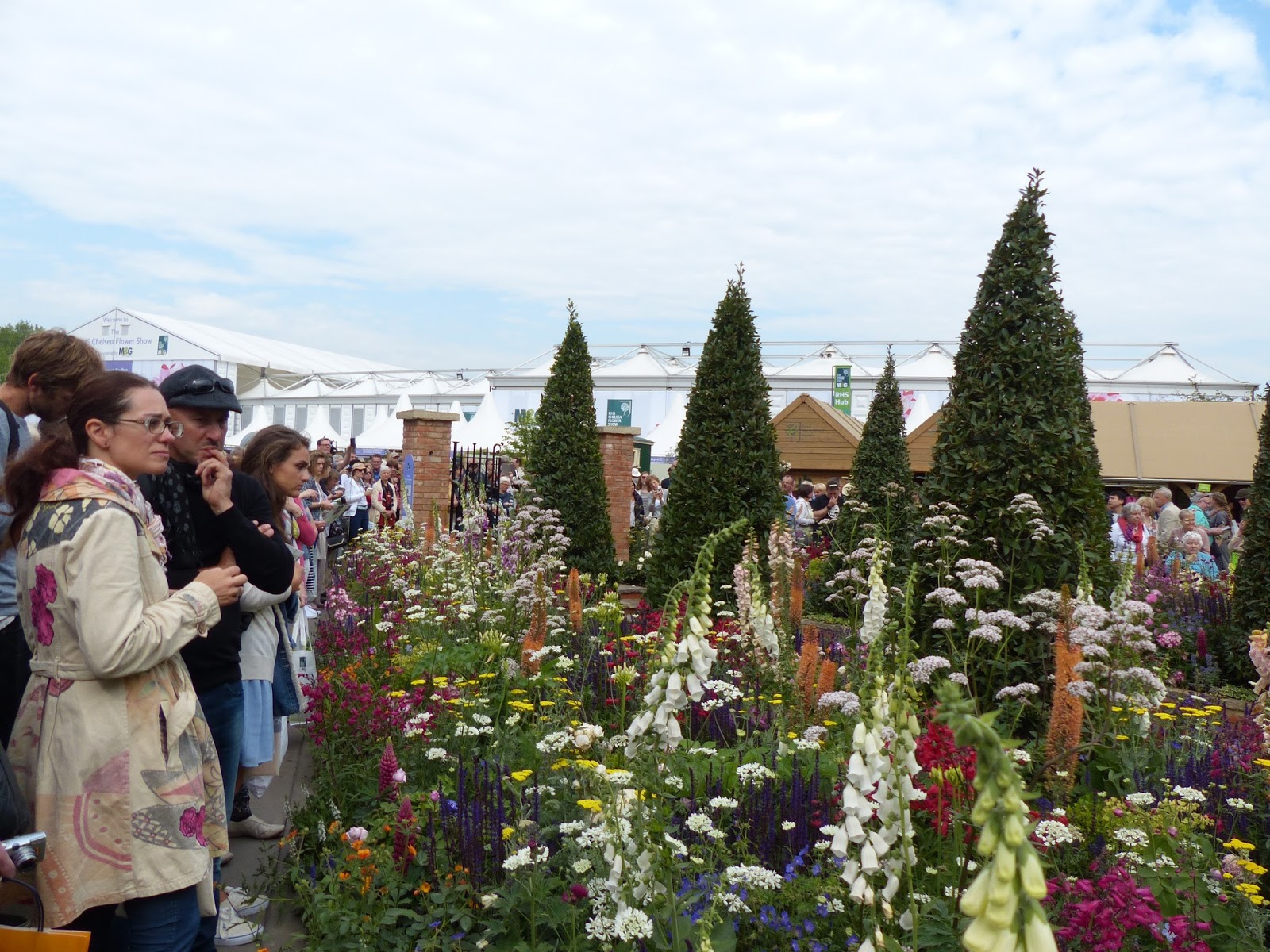
At Chelsea, starting early rewards the floral faithful

Though a Chelsea Flower Show veteran, it's been well over a decade since I went for a full day. The need to take a whole day off work, the more expensive entry ticket and the rush hour train fare all argued for the 3:30 entry. Yesterday revealed that's a false economy.

The hours between 8am and noon are blissful. It's easy to see the gardens. The main avenues are thriving, but not uncomfortable to navigate. We took our time, and were able to see all the show gardens by 3:30. By the time the afternoon ticket holders swelled the crowds, we could turn our attention to shopping. (This year's prizes: gladioli, sweet pea seeds, tulips and a few carefully-chosen plants to fill holes in my water garden. The last two for home delivery, as Chelsea doesn't allow plant sales.) 

Even though I'm a member and could have gotten tickets for the members' preview days (Tuesday and Wednesday), we went on a Friday. Since all tickets always sell out, the numbers are no different on member or general public days. So other than some roses and tulips in the Floral Marquee starting to look a bit tired, there's no real difference. Go early; which day doesn't matter.

It was a year of glorious diversity. Sometimes a style or colour scheme seems to take over the show, spreading a worrying sameness across proceedings. Not this year. There were naturalistic gardens that captured the spirit of Exmoor, Jordan and Provence. Highly structured gardens of sharp lines and box-hedged precision. Crazy gardens with dancing plants (on hidden hydraulics). While sponsorship has always been important to Chelsea, this year it seemed more intrusive than in the past. Most of the small gardens are sponsored by charities, bringing us a lot of planting with grim messages. Death, slavery, impoverished children ... it could all get a bit heavy. Inside the Floral Marquee, thankfully, it remained all about the pure beauty of the plants, and the technical achievement of getting them all to hit their peak for five days in late May.

Let's let the photos speak for themselves.

This evocation of Exmoor interspersed soothing blue and white planting with monumental stone.

The LG garden was heavy-handed with its sponsorship (it was all about how you could control home and garden with their smartphone app) but the strip of planting down the middle of the outdoor living room was effective.

The perfect garden for the obsessive compulsive: Straight lines, precision box hedge cutting, a sunken manicured lawn. I thought the dark red, blue and purple colour scheme worked well.

This one divided opinion. Voted best in show by the all-male judging team. Loved by men, left women lukewarm. Few flowers, mostly orange. Big, black, phallic monoliths. Large fire pit. I was unimpressed.

The mathematical garden. Everything related back to maths or geometry. Intellectually challenging but also lovely; shows that a gravel garden can be more than a low maintenance plot with a few architectural plants.

The Yorkshire garden. Panels of stained glass inspired by York Minster, mirrored by the colours of the flowers below.

Crowds queue up to see the Harrod's garden's spinning trees and whirling borders. Performances on the quarter hour.

Not just about flowers, Chelsea is where you can spend a fortune on garden art. Like these amazing driftwood sculptures.

Huechera. I really need to do more with huechera.

A floral art installation leading to the military hospital. Each crochet poppy was made and contributed by someone in honour of a friend or relative who died in combat.

My favourite garden: Jekka McVicar's exquisite herb garden, where every plant has a medicinal purpose.

Oh, clever Blom's Blooms. Order now, pay on delivery! Of course I did. Bought these two and plan to mix them together for a suitably Northwestern purple and white display.

Had never heard of hepatica until this show. Now, I'm wondering where I can fit this shade loving, late-winter blooming woodland plant.


Monday, 24 August 2015

Pack plenty into a weekend in culture-rich Kent and East Sussex

Chartwell, Sissinghurst Castle Garden, Battle of Hastings Abbey and Battlefield, Bodiam Castle


A typical Englishman might be surprised by the density of tourist sights in North Hampshire (written about here), but he'll take it for granted in Kent.  It's hard to drive more than three miles in the so-called "garden of England" without stumbling on another brown sign pointing to something significant.

It was precisely that quality that saw me using Kent as a base when a young, eager, yet cash-strapped tourist.  I'd done my research.  Nowhere else outside of London allowed me to use more of my "Great British Heritage Pass" in such a short radius.  (The passes are, sadly, no longer sold.  They offered access to National Trust, English Heritage and privately owned sites for a single price.)  I spent an entire fortnight's holiday staying there and sometimes slipping over the border into neighbouring East Sussex in the early '90s.  I returned many times after, meaning that though I haven't spent much time there recently, I actually know the county and its sights well.  Not so for my husband.  We had an event in Tenterden on Sunday, so though ... why not make a long weekend of it?

With the exception of a quick garden visit, I let him pick the locations.  Which, unsurprisingly, leads us on a trail linked by military history.  Being Kent and East Sussex, of course, that also means good architecture, lush landscape and inspiring gardens.  Here's what we got up to.

Chartwell
Winston Churchill's home is in the northwest corner of the county and if, like us, you're coming from the west, this is the perfect gateway sight to welcome you to Kent.  Leave plenty of time, however.  This is one of the National Trust's most popular properties, and they only let a certain number of people into the house each half hour.  When all the tickets are distributed, you're out of luck.  Arriving around noon on a Friday snagged us tickets for 2:30; I certainly wouldn't have wanted to risk getting there after 1.  I'd go earlier on a weekend.

Spending your time before getting into the house is no problem.  There's a restaurant here where we stopped for lunch.  The views are better than the food, but the basic lunch fare won't let you down.  The bigger-than-usual National Trust shop has, as you would expect, lots of Churchill memorabilia and books, plus a fine range of plants you'll find in the gardens.  In fact, I found the gardens as much of a highlight as the house.  There's a beautiful walk to the house looking over a grassy valley to the wooded ridge beyond, ending at the lily pond where the great man used to sit to think and paint. A formal, walled area billowing with roses greets you near the house; beyond that is a lawn cornered by
a pavilion commemorating Churchill's ancestor's victory at the Battle of Blenheim.  Follow the slope down through the orchard to Churchill's studio, still packed with his paintings.  Whether you regard them as art, or an insight into his coping strategies, they're fascinating.  Work your way back up to the house through the walled vegetable and flower garden, unusually built into quite a steep slope.  That makes the view from the top all the more dramatic.

Of course, the house is the main event.  The Churchills left it to the nation and his family's close personal involvement before they handed it over means you're seeing something put together with thoughtful care.  The decor has been carefully arranged to show Chartwell as it was between the wars.  These were Churchill's wilderness years when he was out of government, waiting, worrying, thinking and writing.  What a wonderful setting to do those things in.  In most rooms, it looks as though someone has just stepped away, and will be back at any moment.  You can even spot those famous cigars perched in ashtrays.  Several upstairs rooms are given over to a wonderful museum where you can learn more about Churchill's life while seeing his uniforms and gifts accumulated from respectful fans ... common people to world leaders ... around the world.  Don't miss the slightly hideous cut class and silver bowls from Stalin; exactly the kind of art you'd expect a brutal dictator to favour.

Sissinghurst Castle Gardens
This was my non-negotiable stop.  I can't be within 20 miles of what's probably the world's most famous garden without popping in for a look at what's in bloom.  I've been here many times, going back to my first visit when we stayed in the farmhouse on property, and there's always something new to see.  This was my first visit in August, seeing the white garden at its peak.  Areas that stand out in
spring and early summer (the orchard, the the lime walk) fade to obscurity, while the cottage garden is exploding with oranges, reds and yellows and the rose garden ... its main occupants past their prime ... gives over to asters, dahlias and chrysanthemums.  The herb garden is also at its best at this time of year.

One thing that never changes here is the crowds.  Get here before the place opens.  Have a coffee, walk around the perimeter, check out the vegetable garden (not part of the ticketed area).  Go in when the main garden opens, and you'll be leaving just as the crowds start outnumbering the flowers.

Battle Abbey
Even Brits who are terrible at history can usually drag "Hastings 1066" out of their brains.  Fact is, William of Normandy may have landed at Hastings, but he beat the Anglo-Saxons at a place called Senlac about six miles inland.  The fight there was such a horrific bloodbath the pope ordered conqueror William to establish an abbey there in atonement, which is how the abbey and town of Battle came to be.

The abbey passed into private hands at the dissolution of the monasteries and followed the usual path of such things:  church torn down for building materials, domestic buildings turned into an aristocratic home, a few ruins left standing for picturesque value.  By the middle of last century, the buildings were put to their current use as a school.  But the battlefield, remarkably, was never built on.  Now under the care of English Heritage, your entry fee gets you an audio guide that will take you through the late-medieval gatehouse, to an exhibition centre explaining the story of the battle, around the battlefield, ending at the ruins of some abbey buildings.  (You can't go in the school.)

The exhibition and the guide combine to give good insight into the dynastic struggles that led up to the conflict and the drama of the day.  I've never heard the claims of William and Harold stated in such a balanced way, explaining why about 7,000 people on EACH side were willing to give their lives for the cause.  (The Bayeux Tapestry, which I wrote about here, unsurprisingly makes Harold's
case pretty weak.)  Even people who don't care much for battlefields should enjoy the stroll, which includes fine views and quiet forest paths.  If you're a bit of a battle geek, however, you may find the guide simplistic.  We were hungry for more details: what kept William from trying a flanking manoeuvre?  How has the topography changed?  The visitors' centre could use a diorama that shows the landscape of 1066, before 1000 years of farming and trees altered things.  The ruins do their picturesque job, but aren't much to see.  If the theatrical troupe is doing their battle play for the kids, however, stay around to watch.  They are hysterically funny.

If you're looking for food while in the area, try the Pilgrims' Rest just across the street, where you'll find generous ploughman's platters and other lunch classics in an historic half-timbered hall.

Bodiam Castle
Jump forward 300 years from Battle's battle, and Kent was fearing French invasion again; this time in the 100 Years' War.    That might have been Sir Edward Dalyngrigge's excuse for building his castle at Bodiam, but it's obvious that, right from the start, he was as interested in luxury as defence.  The castle was carefully placed within landscaped gardens, in the middle of a larger-than-usual moat.  The exterior architecture is particularly graceful and the wealth of large fireplaces inside hints at the comfort its residents enjoyed.  The place was never used for military purposes in the Middle Ages, but met its doom in the English Civil Wars, when it was destroyed by parliamentarians as a preventative measure.  It became one of the Romantic Era's most popular picturesque ruins, painted by JMW Turner amongst many others.  Lord Curzon, a giant of historic preservation, bought the place in 1916, stabilised its fabric and gave it to the nation a decade later.  (Read about my visit to his magnificent family home here.)


Since then, it's become one of England's best known castles.  Even though there's almost nothing inside, the exterior is perfectly preserved and its setting in its placid lake is worthy of a fairy tale.  It's used extensively as a film set.  The problem with visiting is that, once you take in the view, there's little to captivate.  There's not much left to explore inside, and the museum is pretty basic.  If you're not a National Trust member, I don't think it's worth the admission fee (£7.80 for adults, £3.90 for kids) unless there's an event on.  You can catch a free view from the car park that's not bad.  Turner and the other Romantic artists had the right idea, though.  The best way to do Bodiam is to bring a picnic lunch, sit on the hill above it and try to paint the place.

These were all add-ons, however, to the main attraction of the weekend: a winery tour.  In England?  Yes, indeed.  I'll cover that in the next entry.


Friday, 3 July 2015

Blazing heat, less congestion make a memorable Hampton Court Flower Show

On the 25th anniversary of the Hampton Court Flower show, the Royal Horticultural Society hasdone a major overhaul of the layout and organisation that dramatically improves the visitor experience.  If past visits have left you jaded by crowds and exhausted by not enough places to rest, your worries are over.  With three days left to run, there's still time for you to head there and check out the changes.

The old central bandstand and food court area is gone, dispersed into at least four areas around the show.  We noticed more restaurants and drinks stands, and there's a substantial grassy area between the floral marquee and the Long Water that's been set aside for picnickers.  For the first time ever, we managed to snag tables at several times throughout the day.  The breaks gave us the energy to stay until the very end (7:30), discovering that the last hour is a glorious time to linger, talk to exhibitors and buy plants, since the bulk of the crowds have gone.

The other significant change is that the majority of plant sales are now gathered near the Stud Gate car park entrance.  This means that if you drove, you can buy your plants on your way out, rather than hauling them around the show ground all day.


All this added comfort and convenience was particularly prized this year, as we managed to make our annual visit on the hottest July day ever recorded in England.  Given how many years we've attended wrapped in Barbours, squelching through mud, we were delighted to have glorious sunshine.  But it did make mid-day a bit of an endurance test for both visitors and flowers.  Exhibitors were watering madly, but there's no denying things looked more bedraggled than usual.  (Including us.)

The show gardens are more widely dispersed around the grounds and there are now five categories:  the existing show, conceptual and summer now joined by world and historic.  I confess to liking the last two additions best.  World gives foreign organisations a chance to show off the merits of their countries, and is heavily sponsored by tourist boards.  Normandy brought one of Monet's Giverny paintings to life, Turkey gave us a sumptuous ... and best in category ... courtyard garden worthy of a Sultan's palace.

I suspect "historic" addresses the long-standing conflict between the public's taste for classic English gardens and the judges desire for cutting edge design.  They can love the conceptual gardens, making bold statements with giant guns and henges of driftwood in gravel.  The crowds gathered around cozy gardens with traditional plantings and Hobbit House-like sheds.


If there's one drawback to the additional categories, it's that there are now so many show gardens that they all start to run together.  My trend-spotting for this year:

  • After a bit of a hiatus, purples and burgundies seem to be back as the favourite dominant planting colour.
  • Garden walls and roofs are big, presumably for all those keen gardeners who are running out of space. 
  • Hydrangeas seem to be experiencing a come-back, with all sorts of new colours and forms; it seemed like every fourth person was carrying one to the car. 
  • An increasing number of gardens in every category are sponsored by charities.  I think this is becoming the defacto standard in charity branding.
The heat did more than just wilt flowers.  Though food and drink outlets have expanded significantly, and there's a great new food court with more gourmet options, vendors told us their sales had plummeted from last year.  It was simply too hot for people to want to eat much beyond ice cream, and nobody wanted to carry home cheeses, luxury pies or artisan sausages.  The craft tent was emptier than we've ever seen it; few had the fortitude to try on clothing or jewellery.  Overall, people were definitely buying less, because it was simply too exhausting to carry much around.  We made 80% of our purchases in the last hour, in the section closest to the exit.

This raises a possibility that rather than the new design spreading people out and making things feel less crowded, it was simply the heat driving people away that made the place less crowded.  Whatever the case, the combination of sunshine and less congestion made it a particularly enjoyable year.  I suppose I'll find the answer next year when it will, undoubtably, be cold and rainy once more.