Our first Japanese destination, Osaka, celebrated street food, casual dining, and an all-out approach to profligate consumption called kuiadore (eat 'til you drop). Kyoto's food philosophy is at the opposite end of the spectrum. More than one thousand years as a sacred imperial capital elevated refinement, sophistication and nobility into the artistic world of kaiseki.
Kaiseki is a multi-course meal, with a procession of small dishes that each give fanatical attention to taste, presentation and tradition. The closest Western equivalent is a lavish, multi-course chef's menu at a Michelin-starred restaurant. But with kaiseki you're less likely to recognise what you're eating. Don't panic, none of it is too weird and most of it is tasty, though there was one bowl of what might have been fish intestines to which we both returned the lid rapidly. You'll be ploughing through with chopsticks, the array of ceramics on and in which things are served will dazzle you and ... if you're lucky ... you'll be served by ladies in ravishing kimonos.
There are a lot of places to have kaiseki in Kyoto, and a lot of travel writers offering lists of the best options. The most highly-rated ryokans tend to be celebrated for their kaiseki as well, however, so we thought we'd kill two Japanese birds with one stone. Thus we experienced two nights of dining like members of the imperial court at Yoshida Sanso. (For more about what it's like to stay here, read my last article.)
Kaiseki at Yoshida Sanso consists of nine courses: an appetiser selection of sashimi, cold salads and small bites; a soup course; a full sashimi course; four more savoury dishes that are mostly fish, though beef or a vegetarian course may turn up; the traditional kaiseki conclusion of miso soup, rice and pickles; and, as a concession to Westerners, a final dessert course. This last is probably just fruit, however. Extravagant sweets are not part of this tradition.
Apon arrival at Yoshida Sanso you'll be offered a choice between three levels of kaiseki. The regular (top photo) is £134, the gourmet (pictured below) £225 and a third level some astronomical price for a degree of epicurean excess that our kind hostess discouraged us from pursuing. (I suspect it's for profligate business dinners where people want to show off to the point of wastefulness.) We opted for the regular our first night and the upgrade on the second. While interesting to see and taste the different menus, if I had to do it again I would have stuck with the standard. There is no difference in the numbers of courses, the quality of their taste or the staggering effort put into presentation.
The additional £91 basically gets you more, and higher quality, animal protein. Back tuna in the sashimi course becomes the fattier belly cut (toro). A cooked fig with salmon milt upgrades to a delicate lobster tail in broth. The Japanese, unsurprisingly, don't make the mistake of overcooking lobster and turning it rubbery, as so many Western chefs do. Steamed sea bream becomes grilled beef. Perhaps most importantly, the mountain yam salad with crunchy pops of pomegranate seeds becomes buttered abalone. This mollusc is one of the most expensive seafoods in the world, with a texture between a scallop and squid and a taste that's gently salty and with a richness that's almost buttery. I'd never had it before, and it was delicious, though I think I still prefer the less exalted scallop.
Overall, kaiseki is a celebration of the bounties of the sea, presented both raw and cooked. Over two nights ... in addition to the fish already mentioned above ... we had Pacific saury, sea bream, squid, tachiuo (silver belt fish), Pike eel, red snapper, mackerel, shrimp, salmon and flounder. Japan in general would be tough for anyone who doesn't eat fish. Kaiseki would probably be impossible.
If the foundation of fine French food is its sauces, the same seems to be true of broths for kaiseki. And indeed, for Japanese cuisine overall. Nearly half of the courses were swimming, whether in a full-on soup or a small puddle, and therefore served in bowls. Naturally, this makes much of the food quite wet and pushes texture towards soft rather than crunchy. In retrospect, I find myself wondering if this is a natural consequence of a cuisine without knives and forks. Lacking the ability to cut anything yourself, it makes sense that everything is soft enough to be severed by teeth and that bowls can be picked up to slurp in all the bits and pieces of goodness your chopsticks leave behind. There is plenty of variety in the soups, with flavour originating from bean pastes, fish or vegetables, but they're all enormously subtle.
Overall, the kaiseki food is a lot like Japanese gardens: deceptively simple. There may only appear to be two or three things in your bowl, but each has been prepared with multiple, complicated steps and developed to the extremes of its natural flavour.
Alcohol isn't included in the price of your meal, but selected from a separate wine and spirits list. We went for the house's premium sake, prepared exclusively for them by a local maker. It was lovely stuff, served cold in small jugs that are roughly the same as a half-bottle of wine. The taste was crisp and a bit acidic to cut through all that fish, with a slightly harder, more alcoholic edge than your average white wine. Thus the wisdom of consumption from small cups. We spent about £35 each night on fairly liberal consumption.
People eat with their noses as much as their taste buds. Here, your eyes are also integral to the process. Every course comes out on different pottery. Some is elegant with sophisticated glazes and delicate painted patterns. Some rough and homespun. There are little boxes and lidded bowls to open up to reveal treasures inside. Shapes vary from simple circles and squares to dishes in the shape of leaves or sea shells. One particularly pleasing crescent resembled an overturned samurai helmet. There must be a large room in the house just for storing all the ceramics. Through 18 courses over two nights I never saw anything used twice.
That visual pleasure extends to both your surroundings and the ceremony with which you're served. The first night we were in a room overlooking the gardens, the second in perhaps the finest room in the house, with windows on three sides giving you a panorama of the hills as the sun faded and twinkling electric light took over. (Perhaps dining in this room is also part of the upgrade?)
It is an unprecedented luxury to get top-restaurant quality service when there are just two of you in the room, and this is probably the most luxurious element of the kaiseki experience. Our servers were different over the two nights, both in exquisite kimono and with a grace of movement that illustrates why Japanese ladies have become legendary for their elegance. The vegetable hotpot on our second night was more extraordinary for its segmented, three-tiered pot and the way our hostess unstacked it and poured broth from the top piece than it was for the taste. (Which was also very good.)
The food experience at Yoshida Sando extends to extraordinary breakfasts. On our first morning, the staff was horrified to realise that they'd misread our instructions and had prepared a Japanese rather than Western breakfast. While they could swap out the tea for coffee, the food itself takes too much preparation time for a last-minute change, so we experienced one full-on, gourmet Japanese breakfast in the panoramic dining room. Another profusion of plates and bowls (eight), different again from the night before, brought us grilled fish left to cool to room temperature, broth you were meant to enhance with tofu, seaweed and spring onions, pickles, rice and fruit. I'm a fan of sweet stuff at breakfast and like some differentiation between the first meal and the others of the day, so I wouldn't make a habit of this. But the variety was great fun and the English-language Japan Times waiting on the table for us a nice touch.
The second morning's Western breakfast proved that Yoshida Sanso's kitchen can handle foreign food as well as their native cuisine. Buttery scrambled eggs, sausage with crisp skins and soft interiors, meaty bacon, artfully cut fruit and a basket of still-warm pastries that could go head-to-head with anything in Paris or Copenhagen.
Eating at Yoshida Sanso was tremendous fun and satisfied our desire for fine dining while we were in Japan. While we loved the experience, we were content to go for much simpler meals for the rest of the trip, usually sushi or multi-element set menus that give you a small sense of the variety of kaiseki but are much humbler in scope, sophistication and price. I join the chorus of travel writers, however, in encouraging everyone to try kaiseki at least once if you're visiting Japan. And if you can afford to splurge on Yoshida Sanso, you'll be doing it at a level of quality fit for royalty.
More than a thousand articles on travel, fine dining, good wines, art and culture. Mostly European, with some further afield. If you’re using a mobile device you’re probably only seeing a handful of the most recent posts. Switch to a desktop browser or scroll to the bottom and click “view web version” to see the search function, archives and location-specific collections of articles.
Showing posts with label Kyoto. Show all posts
Thursday, 10 October 2019
Sunday, 6 October 2019
Luxurious Yoshida Sanso lets you live like a Japanese aristocrat
Experts agree that you must spend at least one night at a Ryokan, or traditional Japanese inn, to consider your Japanese trip a complete experience. But how to choose one? Ryokans run the gamut from urban hideaways to country retreats, high-end elegance to homey simplicity, focused on locals or looking to global tourism.
I had narrowed my hunt to two categories: either an inn built around hot springs, or onsen, in the mountains between Kansai and Tokyo, or a foodie experience in an historic home in Kyoto's suburbs. Kyoto won. This was primarily because, as much as I love grand views and long soaks in hot water, I didn't want to spend much of two whole days in transit to get two and from the experience. So my choice came down to a triple enticement of gourmet food, historical ties and an establishment obviously used to catering to Westerners.
Two nights at Yoshida Sanso cost about the same as the seven preceding ones spend in Ibis Styles hotels. And that was before we tucked into the Michelin-quality (and priced) meals and premium sake. It was the indulgence of an already indulgent trip. Was it worth it? I give a satisfied but slightly qualified yes. Others might be a bit less enthusiastic. The difference is my love of architecture and decorative detail.
The house is an exquisite example of a kind of Japanese architecture of the 1930s that merged a revival of traditional styles with Art Deco's love of clean lines and thoughtful decorative elements. It was built for a young imperial prince, who had recently become brother-in-law to his distant cousin the Emperor Hirohito, to be his residence while attending Kyoto university. It's said to be one of the few domestic, non-royal spaces where you can see the Imperial chrysanthemum crest used in the decor. As royal residences go, it's tiny; about the size of a modern, five-bedroom, suburban "executive home". But there, the similarities stop. The quality of the craftsmanship is extraordinary.
Count Higashi-Fushimi was passionate about traditional Japanese craftsmanship and wanted to show off the best of its contemporary practitioners here. (He went on to become a professor at Kyoto University and then a Buddhist monk.) There isn't a metal nail in the whole house, rather the whole thing is wood, carefully jointed together. Most of the walls are sliding screens and the windows sliding panes. We learned that these do rattle quite a bit in a stiff breeze. A sacrifice made for authenticity. One benefit, however, is that the place is pretty much earthquake-proof, since all of those organic pieces simply rock, sway, swell and shrink naturally into each other.
The precision carpentry is enhanced by beautiful metal work, from the incised chrysanthemum crests on the sunken, round handles in the sliding doors to striking light fixtures to simple but elegant hinges. There's a subtle but distinctive love of geometric pattern throughout: the rectangles of the sliding paper screens, the lines of reed partitions, the interlocking "L" shapes of the balustrades, the overlapping weave of the tatami mats. The house embodies the idea of wabi-sabi, an appreciation of the beauty of the simple. There are definite hints of Art Deco throughout, particularly in the stained glass that fills the upper windows in many of the public spaces. Ironically, though they look modern, their pattern is lifted from pre-historic Japanese pottery that was being excavated at the time the house was designed.
Anyone familiar with the history of architecture will be reminded of the Arts and Crafts Movement in the UK, and even more of Frank Lloyd Wright. The American architect was heavily influenced by Japan, and its architects by him. I can't find any evidence of a link. In fact, Yoshido Sanso isn't even credited to an architect, but to a master carpenter called Nishioka Tsunekazu. But Wright was working in Tokyo less than a decade before Yoshida Sanso was built and I have to believe his thinking spilled over. If you've ever been inside the Robie House at the University of Chicago, or any other "Prairie Style" building, you'll feel that spirit come to life here in a distinctly Japanese incarnation.
One distinct difference, however, is the absence of much furniture. (With the exception of the initial sitting room in which you're welcomed and check out, above.) As any Marie Kondo fan knows, the Japanese are fans of uncluttered spaces, and the great aristocratic homes were primarily broad expanses of tatami-matted space framed by lovely walls. People sat on the floor. Low tables were brought in as needed. Yoshido Sanso isn't that austere. We were welcomed into a sitting room with benches, chairs and a table. Dining rooms have tables and chairs at western height, while our room had two chairs and a small table on the small enclosed balcony and a lower table with half-height chairs in the room, along with our wonderfully comfortable futon on the floor. The sparse furnishing means that the rooms are easily interchangeable. In theory, there are three guest bedrooms and we saw three different dining spaces. But there was little difference between these and, presumably, they could easily be re-purposed as needed.
Heightened design attention goes to the traditional tokonoma, a recessed space in which prized objects are displayed. As with so many things in Japan, of course, there are rules. There should be just three things. One scroll, one flower arrangement and one objet d'art. In our room, it was a scroll of a lusciously elegant Japanese lady in formal kimono holding a rather grumpy cat, a dramatic spray of autumn flowers and a little stack of fine porcelain boxes, each painted with a different insect (see top photo). That's very wabi-sabi for you: I'd never thought of bugs as worthy of artistic attention, but these were exquisite.
While you're enjoying all that interior beauty you'll be treated like the aristocrats for whom the place was built. And while the chairs, English-language hotel information and sprawling double sinks in the shared bathroom might be a nod to Western visitors, the service and the way they use the house is very Japanese. Particularly in the prevailing sense of quiet, and the intense privacy afforded to guests. Somehow, they manage to move people around the house in such a way that you feel you're the only visitors. I think all three rooms were occupied on both nights we stayed, yet I only saw the reflection of other diners in a window on the first and bumped into our next-door neighbours in a hall the next.
We were greeted on our initial arrival by a kimono-clad hostess and welcomed into the sitting room with tea, a traditional Japanese sweet and a poem written in traditional calligraphy by the owner, Kyoko Nakamura, who's a respected practitioner of the art. Several pieces of her work are incorporated into a screen in one of the dining rooms, leaving me to ponder how I can best use the two pieces she sent us home with in our (decidedly not wabi-sabi) home. The heat and bustle of Kyoto fell away in minutes, and soon our stockinged feet were sliding silently over tatami mats to our room. The mats, by the way, are surprisingly springy and a real pleasure to walk on.
Our room was one of two on the upper floor. There's another in the back corner of the ground floor. It was amply-sized, and in the centre lay two thick futon that were probably a bit bigger than a standard twin and thick enough to offer a night's sleep equivalent to being on a good-quality firm mattress with a down mattress topper. If you are of a certain age or lack flexibility, hauling yourself off floor level to head to the bathroom is a bit of a pain, but the quality of sleep in between such necessities is excellent.
Our room had a secondary space along the windows that could be shut off by screens or open to the rest of the room, essentially an enclosed porch. The view was as relaxing as the rest of the place, looking down into the house's traditional gardens and out over the mountains ringing Kyoto. Though the big city is in the valley below, Yoshida Sanso is positioned at an angle so most of it disappears. You just see a bit of suburbia and the roofline of one of the city's dramatic temples.
It's good that the rooms are big because the form here is to stay within them, lounging in beautiful light cotton yukata, or summer-weight kimono, printed with the house's indigo blue take on the imperial chrysanthemum. The sitting room at the front was really only for checking guests in and out. Staff summoned you for meals. Otherwise, your room was your castle. And there's no TV in that room, though there is excellent WiFi so you can stream things like World Cup rugby matches. But considering you're in a house with thin, sliding walls where silence is a virtue you need to do it very quietly.
If you are easily bored or need a lot of stimulation, Yoshida Sanso is not for you. If you want a meditative pause, it's bliss.
Three other things within the grounds might entice you out. The garden is worth a walk, though it's actually quite small and there's no place to sit within it. So you won't be long. There's a small cafe area in a side building in the grounds, but we never saw anyone in it so didn't venture in. The best option was the bathroom. We might not have made it to an onsen, but this came close.
Were it free standing, it would really deserve the name bath house rather than room. Down the back stairs and through another sliding door filled with opaque paper was a wooden-panelled dressing room with racks and baskets to hold your clothes. Beyond that, a large room of brick, stone, wood and tile, with three showers and washing stations along one wall and a tub that could seat three or four in one corner. In another, a precisely-arranged row of wooden buckets and stools. The form is to get clean first, sitting on the stools under the showers. Or fill the buckets with hot water for a bracing splash. Luxurious bath products in dispensers augmented the traditional kit. Then into the piping hot tub for a good soak. (You ask the staff to prepare it for you about half an hour before you want to bathe.) There's only one bathing room, so it's assumed that couples will bathe together so no one hogs the facilities for too long.
The greatest drawback of Yoshida Sanso ... other than its hefty price ... is its hours. Check-in is 4pm at the earliest, check-out by 11. So if you really want to drink in the whole experience and lounge around the place, you do need a 2-night stay. That gives you the day in the middle to relax and live like a Japanese noble. Although I suspect many people stay just a single night, treating it as a restaurant with rooms. Because the cuisine here is amazing. For more on that, read my next story.
A room for two at Yoshida Sanso, with breakfast, is about £800 per night. (It's important to note that the prices on their web site are per person, and not for the room.) Prices vary slightly depending on season and the specific room. The standard dinner is an additional £169 per person and the gourmet dinner is £260 per person, including sake. Interesting to note that the latter is the same price as the tasting menu with sake flight at Michelin starred Umu in London, which I wrote about here.
I had narrowed my hunt to two categories: either an inn built around hot springs, or onsen, in the mountains between Kansai and Tokyo, or a foodie experience in an historic home in Kyoto's suburbs. Kyoto won. This was primarily because, as much as I love grand views and long soaks in hot water, I didn't want to spend much of two whole days in transit to get two and from the experience. So my choice came down to a triple enticement of gourmet food, historical ties and an establishment obviously used to catering to Westerners.
Two nights at Yoshida Sanso cost about the same as the seven preceding ones spend in Ibis Styles hotels. And that was before we tucked into the Michelin-quality (and priced) meals and premium sake. It was the indulgence of an already indulgent trip. Was it worth it? I give a satisfied but slightly qualified yes. Others might be a bit less enthusiastic. The difference is my love of architecture and decorative detail.
The house is an exquisite example of a kind of Japanese architecture of the 1930s that merged a revival of traditional styles with Art Deco's love of clean lines and thoughtful decorative elements. It was built for a young imperial prince, who had recently become brother-in-law to his distant cousin the Emperor Hirohito, to be his residence while attending Kyoto university. It's said to be one of the few domestic, non-royal spaces where you can see the Imperial chrysanthemum crest used in the decor. As royal residences go, it's tiny; about the size of a modern, five-bedroom, suburban "executive home". But there, the similarities stop. The quality of the craftsmanship is extraordinary.
Count Higashi-Fushimi was passionate about traditional Japanese craftsmanship and wanted to show off the best of its contemporary practitioners here. (He went on to become a professor at Kyoto University and then a Buddhist monk.) There isn't a metal nail in the whole house, rather the whole thing is wood, carefully jointed together. Most of the walls are sliding screens and the windows sliding panes. We learned that these do rattle quite a bit in a stiff breeze. A sacrifice made for authenticity. One benefit, however, is that the place is pretty much earthquake-proof, since all of those organic pieces simply rock, sway, swell and shrink naturally into each other.
The precision carpentry is enhanced by beautiful metal work, from the incised chrysanthemum crests on the sunken, round handles in the sliding doors to striking light fixtures to simple but elegant hinges. There's a subtle but distinctive love of geometric pattern throughout: the rectangles of the sliding paper screens, the lines of reed partitions, the interlocking "L" shapes of the balustrades, the overlapping weave of the tatami mats. The house embodies the idea of wabi-sabi, an appreciation of the beauty of the simple. There are definite hints of Art Deco throughout, particularly in the stained glass that fills the upper windows in many of the public spaces. Ironically, though they look modern, their pattern is lifted from pre-historic Japanese pottery that was being excavated at the time the house was designed.
Anyone familiar with the history of architecture will be reminded of the Arts and Crafts Movement in the UK, and even more of Frank Lloyd Wright. The American architect was heavily influenced by Japan, and its architects by him. I can't find any evidence of a link. In fact, Yoshido Sanso isn't even credited to an architect, but to a master carpenter called Nishioka Tsunekazu. But Wright was working in Tokyo less than a decade before Yoshida Sanso was built and I have to believe his thinking spilled over. If you've ever been inside the Robie House at the University of Chicago, or any other "Prairie Style" building, you'll feel that spirit come to life here in a distinctly Japanese incarnation.
One distinct difference, however, is the absence of much furniture. (With the exception of the initial sitting room in which you're welcomed and check out, above.) As any Marie Kondo fan knows, the Japanese are fans of uncluttered spaces, and the great aristocratic homes were primarily broad expanses of tatami-matted space framed by lovely walls. People sat on the floor. Low tables were brought in as needed. Yoshido Sanso isn't that austere. We were welcomed into a sitting room with benches, chairs and a table. Dining rooms have tables and chairs at western height, while our room had two chairs and a small table on the small enclosed balcony and a lower table with half-height chairs in the room, along with our wonderfully comfortable futon on the floor. The sparse furnishing means that the rooms are easily interchangeable. In theory, there are three guest bedrooms and we saw three different dining spaces. But there was little difference between these and, presumably, they could easily be re-purposed as needed.
Heightened design attention goes to the traditional tokonoma, a recessed space in which prized objects are displayed. As with so many things in Japan, of course, there are rules. There should be just three things. One scroll, one flower arrangement and one objet d'art. In our room, it was a scroll of a lusciously elegant Japanese lady in formal kimono holding a rather grumpy cat, a dramatic spray of autumn flowers and a little stack of fine porcelain boxes, each painted with a different insect (see top photo). That's very wabi-sabi for you: I'd never thought of bugs as worthy of artistic attention, but these were exquisite.
While you're enjoying all that interior beauty you'll be treated like the aristocrats for whom the place was built. And while the chairs, English-language hotel information and sprawling double sinks in the shared bathroom might be a nod to Western visitors, the service and the way they use the house is very Japanese. Particularly in the prevailing sense of quiet, and the intense privacy afforded to guests. Somehow, they manage to move people around the house in such a way that you feel you're the only visitors. I think all three rooms were occupied on both nights we stayed, yet I only saw the reflection of other diners in a window on the first and bumped into our next-door neighbours in a hall the next.We were greeted on our initial arrival by a kimono-clad hostess and welcomed into the sitting room with tea, a traditional Japanese sweet and a poem written in traditional calligraphy by the owner, Kyoko Nakamura, who's a respected practitioner of the art. Several pieces of her work are incorporated into a screen in one of the dining rooms, leaving me to ponder how I can best use the two pieces she sent us home with in our (decidedly not wabi-sabi) home. The heat and bustle of Kyoto fell away in minutes, and soon our stockinged feet were sliding silently over tatami mats to our room. The mats, by the way, are surprisingly springy and a real pleasure to walk on.
Our room was one of two on the upper floor. There's another in the back corner of the ground floor. It was amply-sized, and in the centre lay two thick futon that were probably a bit bigger than a standard twin and thick enough to offer a night's sleep equivalent to being on a good-quality firm mattress with a down mattress topper. If you are of a certain age or lack flexibility, hauling yourself off floor level to head to the bathroom is a bit of a pain, but the quality of sleep in between such necessities is excellent.
Our room had a secondary space along the windows that could be shut off by screens or open to the rest of the room, essentially an enclosed porch. The view was as relaxing as the rest of the place, looking down into the house's traditional gardens and out over the mountains ringing Kyoto. Though the big city is in the valley below, Yoshida Sanso is positioned at an angle so most of it disappears. You just see a bit of suburbia and the roofline of one of the city's dramatic temples.
It's good that the rooms are big because the form here is to stay within them, lounging in beautiful light cotton yukata, or summer-weight kimono, printed with the house's indigo blue take on the imperial chrysanthemum. The sitting room at the front was really only for checking guests in and out. Staff summoned you for meals. Otherwise, your room was your castle. And there's no TV in that room, though there is excellent WiFi so you can stream things like World Cup rugby matches. But considering you're in a house with thin, sliding walls where silence is a virtue you need to do it very quietly.
If you are easily bored or need a lot of stimulation, Yoshida Sanso is not for you. If you want a meditative pause, it's bliss.
Three other things within the grounds might entice you out. The garden is worth a walk, though it's actually quite small and there's no place to sit within it. So you won't be long. There's a small cafe area in a side building in the grounds, but we never saw anyone in it so didn't venture in. The best option was the bathroom. We might not have made it to an onsen, but this came close.
Were it free standing, it would really deserve the name bath house rather than room. Down the back stairs and through another sliding door filled with opaque paper was a wooden-panelled dressing room with racks and baskets to hold your clothes. Beyond that, a large room of brick, stone, wood and tile, with three showers and washing stations along one wall and a tub that could seat three or four in one corner. In another, a precisely-arranged row of wooden buckets and stools. The form is to get clean first, sitting on the stools under the showers. Or fill the buckets with hot water for a bracing splash. Luxurious bath products in dispensers augmented the traditional kit. Then into the piping hot tub for a good soak. (You ask the staff to prepare it for you about half an hour before you want to bathe.) There's only one bathing room, so it's assumed that couples will bathe together so no one hogs the facilities for too long.
The greatest drawback of Yoshida Sanso ... other than its hefty price ... is its hours. Check-in is 4pm at the earliest, check-out by 11. So if you really want to drink in the whole experience and lounge around the place, you do need a 2-night stay. That gives you the day in the middle to relax and live like a Japanese noble. Although I suspect many people stay just a single night, treating it as a restaurant with rooms. Because the cuisine here is amazing. For more on that, read my next story.
A room for two at Yoshida Sanso, with breakfast, is about £800 per night. (It's important to note that the prices on their web site are per person, and not for the room.) Prices vary slightly depending on season and the specific room. The standard dinner is an additional £169 per person and the gourmet dinner is £260 per person, including sake. Interesting to note that the latter is the same price as the tasting menu with sake flight at Michelin starred Umu in London, which I wrote about here.
Wednesday, 2 October 2019
Sacred spaces magnify Japan's wonder. Here are Kyoto's best.
When it comes to Japan, "temple" is a small word with a big footprint.As a Westerner, I associate "temple" with a single building, like a church. Plan your Japanese sightseeing schedule on that basis and you're going to fall behind quickly, because the temples that make it onto the "must see" lists are enormous complexes with an array of sights within them. And temples, though a useful category label, isn't quite correct, since many noteworthy religious sites are shrines. Simply: temples are Buddhist, shrines Shinto. The religions sit comfortably side-by-side, and most Japanese use both, choosing temple or shrine to fit the occasion. For a Westerner new to the country it can be hard to tell the difference, as the buildings and the practices going on within them look remarkably similar. Usually, but not always ... if you spot distinctive Tori gates, it's Shinto, while serene, cross-legged figures (who are not always Buddha) indicate Buddhism.
Whether shrine or temple, it's in these spaces that you're most likely to tap deep into Japanese tradition. In an extremely urban, modern country, this is where you'll find quiet spaces, a connection with nature, majestic architecture, eye-numbing beauty and peaceful spirituality. The most famous ones are jammed with tourists, but it's not hard to slide off the beaten track to find lesser-known examples that are almost empty. And for every historically or architecturally significant place, you'll stumble across a roadside shrine or small neighbourhood temple. They might not have the cultural heft of the big sites, but they're charming and photogenic in their own ways.
Both the shrines and temples we visited had consistent layouts, and seemed to have a broadly similar form of worship. There will be a gateway, then an approach path of some sort, then perhaps another gateway. The more impressive the complex, the more gateways you seem to pass through and the more highly-decorated they will be. At the point where you're entering holy ground there will be a water fountain spilling in to a trough with some wooden ladles. Visitors should use these to clean their hands and, once they've done that, pour water into their hand to sip, swirl and spit, thus purifying the mouth. The path now may lead direct to the main building, or there may be smaller shrines and temples along the way. Bigger temples have separate prayer halls, usually open-sided pavilions where people sit in quiet contemplation, or to copy sutras. Buddhist temples often include cemeteries, and both shrines and temples may have gardens. Really big places, similar to the grand monastic complexes of medieval Europe, may have storehouses, offices and housing for priests.

Large or small, they'll have some method of leaving prayers. These are often lines of wire or string onto which strips of paper or cloth are tied. You can buy amulets to leave on statues, wooden sticks or placards to write your prayers on and hang on boards, or candles similarly inscribed to burn in front of the appropriate deity. (The wooden prayers are eventually burned to send the words heavenwards.) Money is key here. The thing Western visitors will find most jarring about Japanese temples and shrines is their straightforward consumerism.
Every altar has a collection box in front of it; it's understood that every prayer before it should be accompanied by at least a 5 yen coin. There will usually be thick ropes hanging from bells here; you get to ring them upon donation. But that's just table stakes. Most lanes up to temples will feature huts manned by priests selling lucky charms and wooden plaques for your prayers. The bigger the plaque, the bigger the cost. Resembling souvenir stands, these are even in the main temple buildings themselves; encountering five to ten different places to buy prayers wouldn't be unusual in your average complex. People also buy and light sticks of incense that fog the air. And that's just the everyday stuff. One assumes there are much more expensive and private deals to procure the big bottles of sake or boxes of luxury food items on altars as offerings. (Since the gods are unlikely to consume those, I'm assuming the priests tuck in after they've been on display for an appropriate time?)

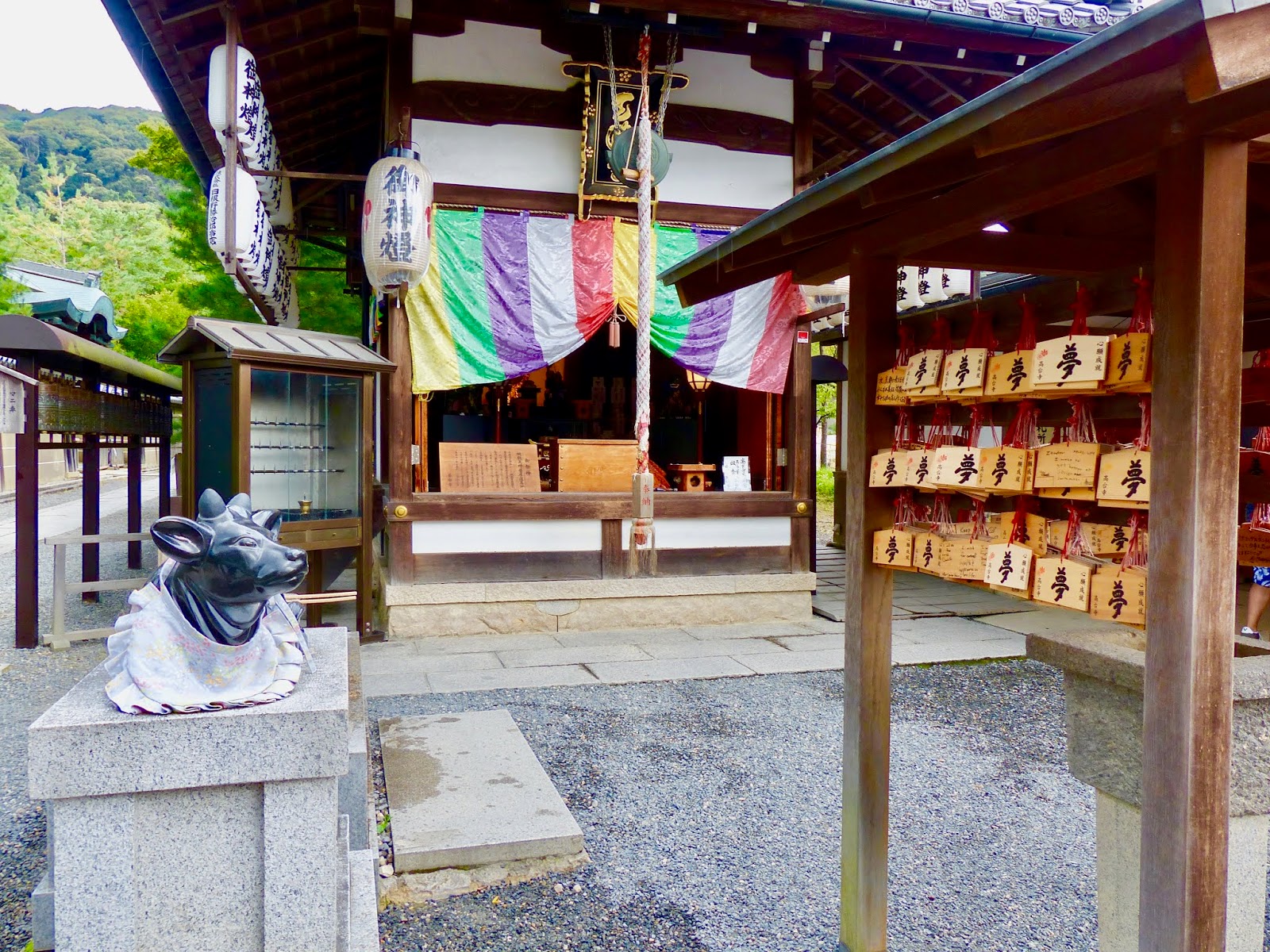
At really busy temples like Tokyo's Senso-Ji or Kyoto's Fushimi Inari, your mind reels imagining the amount of cash that must be flowing through the place. (Interestingly, these two most commercial temples were also unique in their free access. You'll usually pay between £3 and £6 to tour these sites.) One assumes that hard-line Protestants must reel in horrified shock, endlessly running the story of Jesus throwing the moneylenders out of the temple through their brains. As a Roman Catholic it didn't feel that strange, though maybe a bit extreme. When you grow up sliding a $5 bill under St. Anthony's statue for help finding lost property, or slipping an imploring note into the lap of Mater Admirabilis for help on your next French test, then tying a note to a string near an aproned cow, then rubbing the part of his anatomy that hurts on yourself to make your ache go away really isn't that odd.
I do wonder if Japanese religion ever had a Henry VIII figure, who tried to sweep some of that cash back into governmental coffers, or a Martin Luther type who bristled at the pay-to-pray relationship. But those are nuances not tackled in basic tourist material or the histories I've read. For tourism purposes, just embrace the fact that religion and commerce go hand in hand, and that the beautifully packaged lucky charms they sell at temples and shrines make lovely, inexpensive gifts to bring home. I wish I had bought more.
While everywhere in Japan bristles with temples and shrines, they're particularly abundant in Kyoto, where it's said there are more than 1,600. Looking at the map, I suspect you could walk much of the hilly perimeter of the city on sacred ground, just hopping from one complex to another. Many of these are the headquarters of different sects of Buddhism, while many shrines have something to do with deified personalities who once lived in the area. A sense of Roman Catholic familiarity rears its head again. Kyoto's sacred scene feels a lot like Rome, where every religious order has to show off with its own headquarters church, and every saint associated with the city needs his or her own place of worship.
I suspect I could have gone for weeks flitting from temple to shrine and back again, appreciating subtle differences and quirky characteristics. (There's a shinto shrine dedicated to a rabbit god, filled with hundreds of statues of the little critters. How did I miss that?) But if you're time-limited, or expect temple fatigue after the first few visits, which to choose in Kyoto? I recommend these.
KINKAKU-JI
This is the one no self-respecting tourist can visit Kyoto without ticking off his list. Consequently, it's also the one closest to being destroyed by crowds. The draw? Gold.
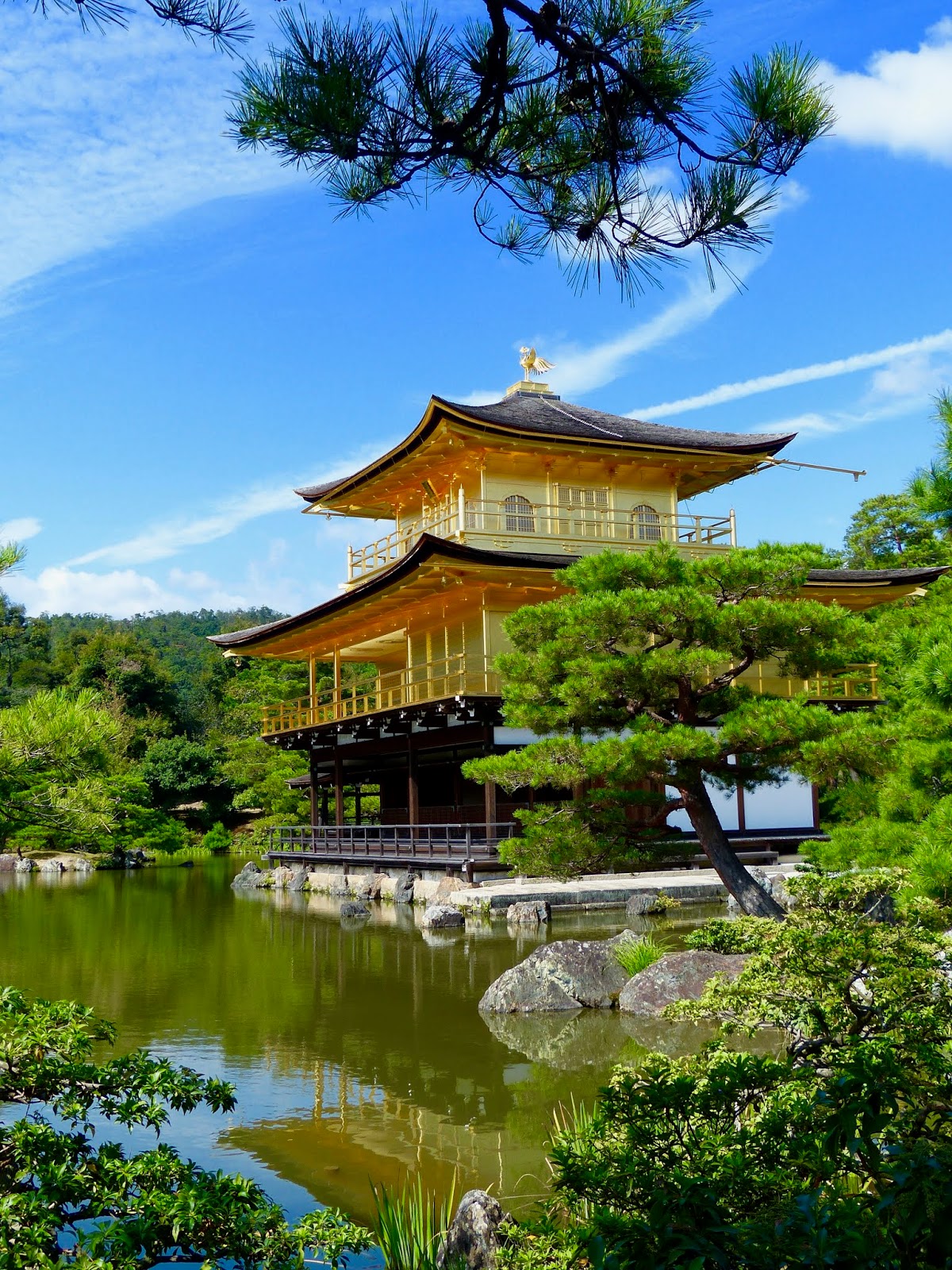
The Golden Pavilion at the centre of this complex is a three-story building, resembling the upper levels of a pagoda, sitting on a lake surrounded by a picturesque garden, snuggled into a wooded hillside. The walls of the top two levels are entirely covered with gold leaf, and a golden phoenix spreads its wings from the crest of the roof. A solid gold building may sound too blingy to be tasteful, but the classic lines and natural setting pull the overall effect from tacky to mystical. This is the kind of place people in fairy tales stumble upon to find bewitched princesses or all-powerful sorcerers.
It's hard to connect with that magical allure, however, when you're shoulder to shoulder with bus tours of the world, and every good viewing spot is full of people competing for the most outrageous selfie. In an attempt to cope with the masses, temple management has closed all side paths, forcing visitors along a single, circular path. Not only does this shoulder-to-shoulder packed route have all the charm of trudging to the office during rush hour, it offers no chance to slip to quieter corners to sit and appreciate the scene. The garden across the lake from the pavilion looks great, but you won't be getting into it. The one-way system brings you through some pretty woodland paths behind the temple, up a hill and round a lake with some monuments on an island before getting to a cluster of temple buildings where the full incense/bell ringing/lucky charms/wooden plaque system is in full swing.
Yes, Kinkaku-Ju is an impressive building in a gorgeous setting. But it's in a far corner of town, so challenging to get to, and the crowds make it hard work. You don't get to see any interiors. Besides the gold, there's nothing outstanding about the architecture. If you're not bothered by missing the one temple everyone will expect you to see, this is the one I'd skip.
FUSHIMI INARI TAISHA
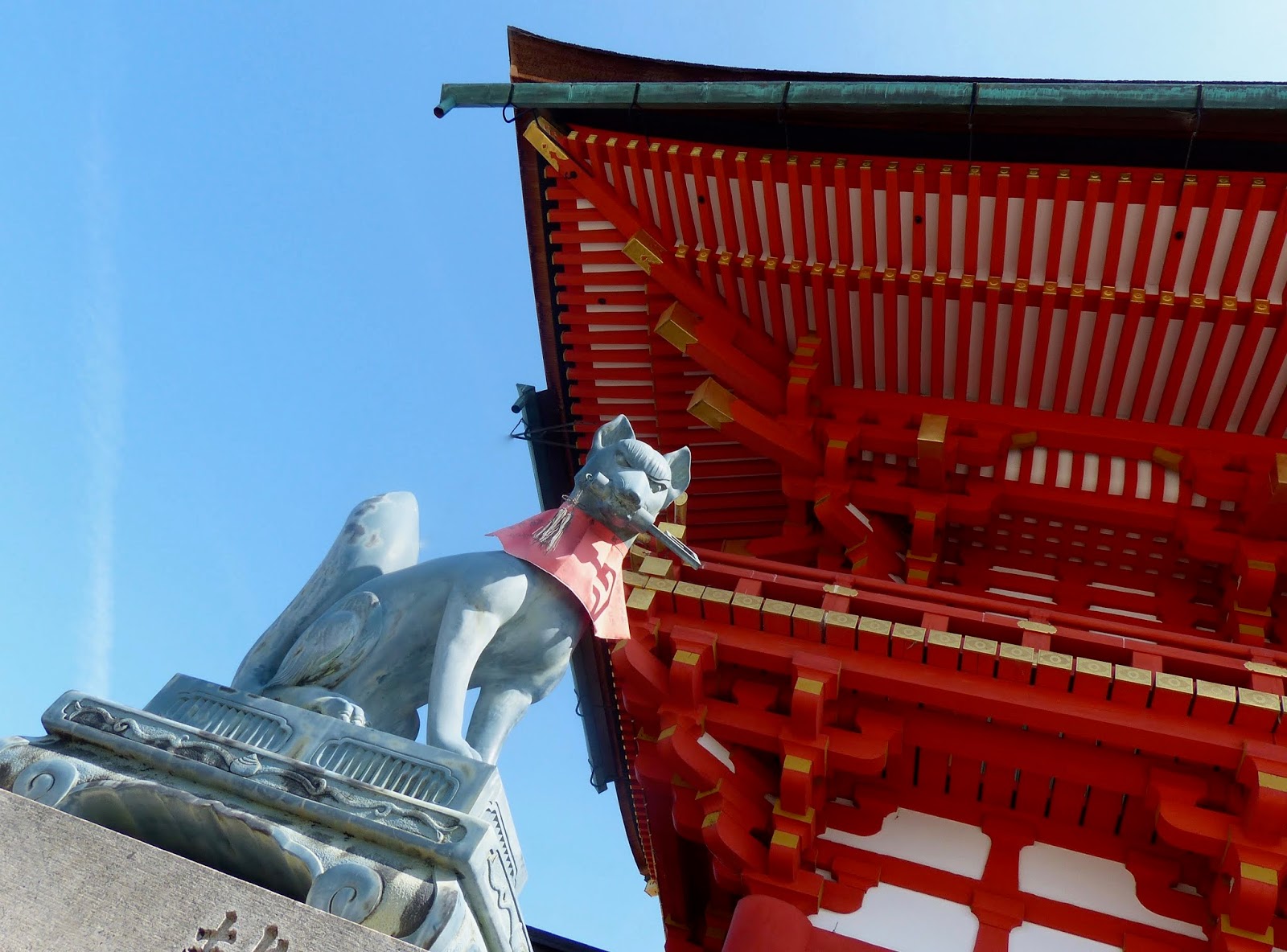
This Shinto shrine to the god of business has the same crazy crowds. Maybe worse. Getting out of the subway station here rivals rush hour madness in London. But it's worth persevering, both for the quality of the art and architecture, and for the cultural observation. This is the place with the long corridors of red tori gates; they snake up wooded slopes to a lofty mountainside platform above the city. It's possibly the most photographed spot in Kyoto. You'll also hear it called the Fox Temple.Shinto is closely associated with nature; mountains, streams and animals all have spirits that may be appealed to for help. In pretty much every other country's folklore, the fox is a bad guy: trickster, menace, chicken coop raider. For some reason lost in time, the Japanese fox, Inari, is a benign guardian. More dog than vermin, he's often pictured with the keys to the rice granary in his mouth. (You wouldn't trust an English fox with keys to anything.) He's also the spirit of rice and agriculture, and early-on was adopted by merchants as the patron of business. I will forever think of Fushimi Inari Taisha as the shrine of corporate sponsorship. All those tori gates that form the corridors, about 1,000, are actually funded by businesses seeking good fortune. I suspect the allure of the walk through the gates would be somewhat less compelling if you can read Japanese. "Eat at Yoshi's Noodle Shop", "Blessings On Hidate Motors" and "Seek Innovation at Yakata Data" have a good deal less majesty than rows of complex and unintelligible characters on red gates.
This is a sprawling complex, most crowded at its lowest, easily accessible levels. But even if you don't fancy climbing the mountain there's plenty to see here. Fox spotting is a joy. The ornamental gateway into the main temple courtyard has some spectacular life-sized archers on guard; they're statues, but so exquisitely painted you expect them to spring to life. The hall with the main altar has spectacular gold and white lanterns and stepped shelves lined with ceremonial sake. White robed priests in bulbous black hats bustle about, perform mysteries in front of altars and burn accumulated prayers. Business at the stalls selling prayer plaques, good luck charms and mini tori gates is brisk. As befits a shrine to business, there's a whole street of gift shops off to one side. If you want to take home a fox statue, tori gate or even a small home shrine, they're all for sale. A lane leading diagonally from the gift shops is lined with street food vendors and small restaurants. We got our timings wrong; schedule your visit to Fushimi Inari Taisha to finish at lunch or dinner.
The main appeal, however, is those corridors of tori gates. Even traversing them with packs of other tourists, they're magical. The further and higher you go, the more crowds melt away. We only did the first half of the circuit and found pleasant pockets of quiet; I suspect there are more moments of peace, and even better photo opps, for those who trek all the way to the top. The climbing isn't particularly hard, but if you're coping with Japan's grueling humidity, as we were, you'll probably find the lower slopes enough of an experience.
KODAI-JI
An excellent example of how, the moment you drop out of the acknowledged Top 10 sites, you're off the beaten track. Kodai-Ji is hugely significant from a historical perspective, holding the grave and shrine of the second of Japan's three unifiers, Toyotomi Hideyoshi, and his wife. She was responsible for creating the place after his death, at which point she had become a Buddhist nun. The statue of her in their tomb, one assumes, shows her before religious austerity.
This is another complex that drifts up a mountain. There are two main temple buildings at base level (which you've already climbed a steep processional avenue of stairs to reach), the Toyotomi tomb half way up, and another shrine at the very top, with steps through an atmospheric bamboo grove linking them. If you don't have time for the more famous, and famously crowded, Arashiyama bamboo grove, you'll get a similar feeling here and will probably be almost alone. Signs suggest you might have to share your space with some monkeys, but one assumes that on a day as hot and humid as the one that hosted our explorations, any creature sporting a fur coat was hiding somewhere cool and dark. The complex also holds a Buddhist cemetery, a museum of temple treasures we didn't have time to check out, several ceremonial tea houses and a handful of adjunct shrines, including one featuring the magic cow mentioned above.
This is also one of those temples to which gardens are central. On one side of the complex at base level there's an exquisite garden built around a lake, crossed by a remarkably picturesque covered bridge. Unlike Kinkaku-Ji, you can walk all over here and cross the bridge without restriction. There's no walking in the garden on the other side of the big, open-sided prayer and music hall, however, where you'll find one of the country's more famous Zen gravel gardens. Its regularly raked into different designs, all intended for contemplation and the generation of deep thoughts. Interesting, though I like my gardens with plants.
The buildings here are particularly lavish, both inside and out. The Toyotomi shrine is the central jewel, currently undergoing a restoration that's bringing its rich colours back to peak brightness. Life-sized statues of the unifier and his wife sit in a black and gold lacquered stage set inside, while gold and bright primary colours decorate the exterior eaves and cross-timber ends. There's an extraordinary set of paintings of dancing maidens in one prayer hall, and a dramatic ceiling of clouds and dragons in another. It's all fitting for the man who was also the most culturally sensitive of the three unifiers.
Just south of Kodai-Ji ... you'll exit onto it ... is a broad car and bus park lined with snack bars and touristy shops. Cross this and descend the stairs and you'll find yourself at the top of Nineizaka, the favourite shopping street I mentioned in my last post on Gion. But linger a bit for two other sights before you do. One is obvious: an enormous Buddha sitting against the hillside to the east. You'll already have spotted his head looming above the trees as you hiked down from Kodai-Ji's summit. Here you can get the full view, though you'll have to pay another admission fee to go into the separate temple housing him. Seek out a free audience with the robot kannon instead. The android version of the Buddhist deity of mercy preaches in both English and Japanese. Remarkably human skin on face, neck and hands contrast with an obviously cyborg body. His creators selected words, voice and facial expression to convey a benign, loving sense of calm. I wouldn't leave Kyoto without a visit.SANJUSANGEN-DO
Speaking of kannon, if one robot incarnation isn't enough for you, you can find 1,000 medieval ones at Sangusangen-do temple. These are arguably far creepier, with their 42 insect-like arms each and small secondary heads sprouting from around their crowns. Five hundred stand on either side of an enormous Buddha, in long rows on ten stepped platforms, filling a wooden hall that stretches for 120 metres. At the front, overlooking the aisle on which worshippers processes the length of the hall, are rather horrifying larger-than-life guardian figures protecting the kannon. (And, presumably, enforcing the "no photos" rule inside the sacred space.)
This temple is one of the oldest in Kyoto, founded in 1164, and the immense wooden hall has a feeling of extreme antiquity. The massed ranks of kannon are an extraordinary sight, unlike anything I've witnessed elsewhere. If you're looking for unique or deeply atmospheric, this is probably Kyoto's star sight.
It's also one of the few major temples that doesn't take much physical effort to explore, as it's all on the flat. The extraordinary length of the main hall is almost as impressive from the outside as in. (En route back to the UK, it occurred to me that the first time humans regularly built single spaces this long was train and airport terminals; nearly 1,000 years after Sanjusangen-do's establishment.) The length was so unique in Japan that this became a place for archery competitions. Were you strong enough to shoot the length of the hall? The major festival here, and the gift shop, is still based around the bow.
SAIHO-JI (KOKEDERA)
This temple takes effort to reach, space must be reserved months in advance and it's far better known for its garden (which I'll write about in my next story) than for its buildings. All that said, it was the most spiritual encounter we had in any temple or shrine in Japan, with the religious bit almost being more memorable than the justly-famous moss garden. It's worth the effort for the one-of-a-kind experience.
You'll apply to visit the garden: find instructions here, applications open two months before your requested date and spaces regularly sell out. Before you get into the gardens, however, you must attend and participate in the regular ceremony of Buddhist worship here. You'll arrive, walk to the entry building, present your ticket, remove your shoes and pay for entry. At the set time, temple attendants will lead you around the broad, covered verandas and into the main prayer hall, where rows of low desks .... to Western eyes more like the lap trays off which you eat sofa-based dinners ... await. There are a few tables on the veranda for the less agile, but you must be at the front of the group to grab one. Even if you're as creaky and inflexible as me, however, it's worth heading into the hall and getting onto the floor. It's far more atmospheric.
A temple attendant will launch a speech in Japanese that you won't understand, but an English fact sheet, observation and common sense will fill in the gaps. One form of Buddhist worship is copying sutras; the quiet, brain-intense act of repeating someone else's complex kanji characters becomes a contemplative spiritual exercise. In addition to your rosewood lap desk there's a dark stone inkwell with a bamboo handled brush and a puddle of black ink waiting for you. You might be hundreds of years in the past. It's hard to resist the temptation to panic when you see the length and complexity of the sutra, but they make it easy for you by passing out papers with the whole thing printed in a ghostly light grey. You just have to trace over what's already there with your brush. The man in charge (who might have been a priest, but was in normal clothes) launched us with something that had the cadence of a prayer, though we understood none of it, then came pleasant communal silence as about 100 people dipped their brushes and got to work. It was immensely soothing. Had they sold the equivalent of a colouring book to continue the practice at home, I would have bought it.
When you finish your sutra, you write your own personal prayer to one side and take it up to the main altar to present to the Buddha. With a 5 yen coin, naturally. At some point later, the labours and wishes of all those visitors will be burned, ascending to heaven as smoke. Saiho-Ji conjured a magical window of peace and serenity into a trip that was otherwise generally crowded and frenetic.
In a country as densely populated and urban as Japan, crowded and frenetic are inevitable. Temples provide a respite. So do gardens. By the end of the trip I came to see the latter not in the English way, as the magical combination of nature, horticulture and art, but as an intellectual pause in a busy world, designed to relieve pressure. More on that, and the best gardens in and around Kyoto, in my next entry.
Monday, 30 September 2019
Imperial Kyoto was the thrilling heart and soul of our holiday
Japan's Kansai region contains six of the country's top seven prefectures in terms of national treasures. Any fan of history, art and architecture is likely to be happier if they spend the bulk of their trip in this region forming a belt across Japan's main island of Honshu, about 2/3ds of the way down its length. Osaka, Nara and Kyoto form a tight little triangle in the broad plains and valleys here, with less than an hour between each by train. You could easily tour all the major sites from any one, and most people choose either Osaka or Kyoto as a base. We split our time between Osaka (four nights) and Kyoto (six nights), and were glad we had time to get to know both. If I had to choose one, however, Kyoto's sheer density of historic sites would tip the scale. (And just about anything in Kansai would beat Tokyo, in my book, but the rugby logistics of our trip mandated 11 nights in the capital.)
My experience simply validated what anyone who knew both me and Japan predicted, though Kyoto's ample charms are not obvious at first glance. Given what I knew ... it was the ancient imperial capital, home to the emperor and his surrounding ceremony but abandoned by functioning government from about 1600 AD ... I was expecting a place like Venice or Bruges; a backwater, now consigned to history and tourism, preserved in aspic at the point of it fell out of the centre of action. How wrong I was!
I've now learned that Japan's propensity for earthquake and fires ... the latter a constant threat in a country where, until modern times, all buildings were made of wood and paper ... makes any building to have survived from earlier times a miracle. Like the rest of Japan, the bulk of Kyoto's buildings have moved on. More importantly, Kyoto is dynamic, vibrant and lives very much in the present, complete with businesses, a thriving university and plenty of government offices. The impressive history is here, sometimes cheek-by-jowl with modernity and sometimes hidden in back lanes behind the glass, steel and concrete office blocks and stores lining most of the main avenues. The grid pattern of wide, straight streets may date back to 1000-year-old ceremonial and processional needs, but today it gives much of Kyoto the feel of a bustling, mid-sized American city.
Embracing the sometimes-jarring contradictions between ancient and modern is key to appreciating Japan; a realisation we first made in Kyoto. We based ourselves near, and ate most of our meals in, the enormous train station. Opened in 1992, drawing inspiration from futurism and cubism, it's one of the country's largest buildings. It houses six railway lines, the city's subway system, the main bus station, an enormous branch of Isetan department store with two interior "streets" of individual restaurants on its top floors, a shopping mall, a luxury hotel, a movie theatre, several local government departments and a roof garden. Parts of the complex, most notably the long line of escalators that proceed in a straight diagonal up seven stories to the garden, with a monumental staircase on the top few floors and a plaza at the mid point with "gateways" looking over the city in either direction, are as arresting a sight as any of Kyoto's famous temples.
The roof garden makes an excellent starting point for an exploration of the city, as it offers views over the whole city and is free. In London, it would have a ridiculously expensive cocktail bar and crowds of young professionals. Here, it's just a quiet place for contemplation on an industrial roof. As a whole, especially from the outside, the station is horrifically ugly, and the surrounding streets would stand in for the dystopian future film set of your choice. But it's magnificently convenient, both for getting to and from everything you want to see and for sourcing food and drink at the end of exhausting days of sightseeing. Even if you somehow managed to avoid travelling through it, I'd still put it on the "must see" list and plan on a couple of hours to wander around.
Our primary sightseeing objectives, of course, were firmly-rooted in the Imperial past. Kyoto is strong on temples and gardens, both of which I'll cover in other stories. Despite the glories I'll describe in those articles, if I had just one day in Kyoto I'd head for Nijo Castle. There are a lot of temples and gardens across the country, but very few palatial residences that still have much of their interior decoration.
Nijo was the Kyoto residence of the Tokugawa clan throughout the two and a half centuries they were shoguns. Though they effectively ran Japan from Edo (today's Tokyo) they needed to keep up the pretence of imperial authority, so regularly visited the emperor in Kyoto. Naturally, though they were one step down from the imperial family, they wanted the world to see that it was a very small step. When Tokugawa Ieyasu, the first shogun of his clan and the great unifier of Japan, started building the place, he demanded "contributions" from all the great families. Officially, Ieyasu was allowing them to add to the honour and glory of the newly-unified state. Cleverly, he was also reducing the resources of any families who might challenge him. The result was even grander than the imperial palace, and became the home of the restored Emperor Meiji when he and his family returned to power in the 19th century, before they moved up to Tokyo. The flurry of renovations done at that time is one of the reasons the interiors are in such good shape now. In short: the place has form. It's a UNESCO World Heritage Site and is the rough equivalent of Windsor Castle or Versailles, though in a very Japanese way.
Nijo is an enormous moated complex in the centre of town, hidden from passing traffic by high walls and corner gatehouses. Inside there are actually two palaces, the Ninomaru and the Honmaru, the latter being a fortress within a fortress with its own moat and screening walls. The Honmaru is closed for renovation right now, with only its gardens open to the public. The Ninomaru, frankly, is so breathtaking that I can't imagine having the brain space to appreciate the smaller palace in the same viewing, even had it been open.
It's the wall paintings that will be stealing your oxygen. Japanese rooms ... even palatial ones ... have little furniture. If you want to show off, you do it with the quality of painting on the sliding screens that form your walls. Various suites of rooms offer differing visions of power and authority: pine trees, birds of prey, tigers. (The last end up oddly sweet rather than menacing, as the artists clearly had never actually seen the animals and give us over-sized, slightly lumpen house cats.) All of the backgrounds are gold leaf, weathered to a mellow glow. In more private areas, the scenes get more casual, with pictures of everyday life and a remarkable series of waterfowl on winter lakes. There's even a hallway of exotic palm trees that shows that England's Prince Regent was on the right track with his Pavilion at Brighton, even though his architects couldn't possibly have seen this room. (Japan was still closed to foreigners at the time.) Besides the tigers, the virtuosity of the artists and the realism with which they present their subjects is astonishing. In what's essentially the throne room, you really do feel that you've wandered into a pine forest in an atmosphere of liquid gold.
Ceiling panels are also lavishly painted, sometimes with naturalistic motifs, others abstract or with family crests. Carvings in the transoms between sliding screens and ceilings are opulent in three dimensional detail, usually carrying on nature themes from the rooms below. In one astonishing example, even though the carving is pierced through in many places to let light flow, the scenes on each side are completely different. If you can tear your eyes away from all that colour and detail, the bronze work providing latches, door handles and nail covers is gorgeous while the simple paper screens, the dark wooden floors and the sleek lines of the long hallways are a design triumph.
The Ninomaru Palace is at the centre of a complex of buildings, all of which have striking roof guardians along their eaves and many of which have ornate carved gables. Elaborate gateways are an important part of Japanese architecture, and the one into the Ninomaru ... called the kara-mon ... is a blockbuster. Its elegant, bow-like roofline, gilded decorations of filigree metal work, brightly-painted carvings of storks and butterflies set against plants, and showy tiles and terra-cotta sculptures along its peak would be the most ornate gate we saw until we got to Ieyasu's tomb in Nikko.
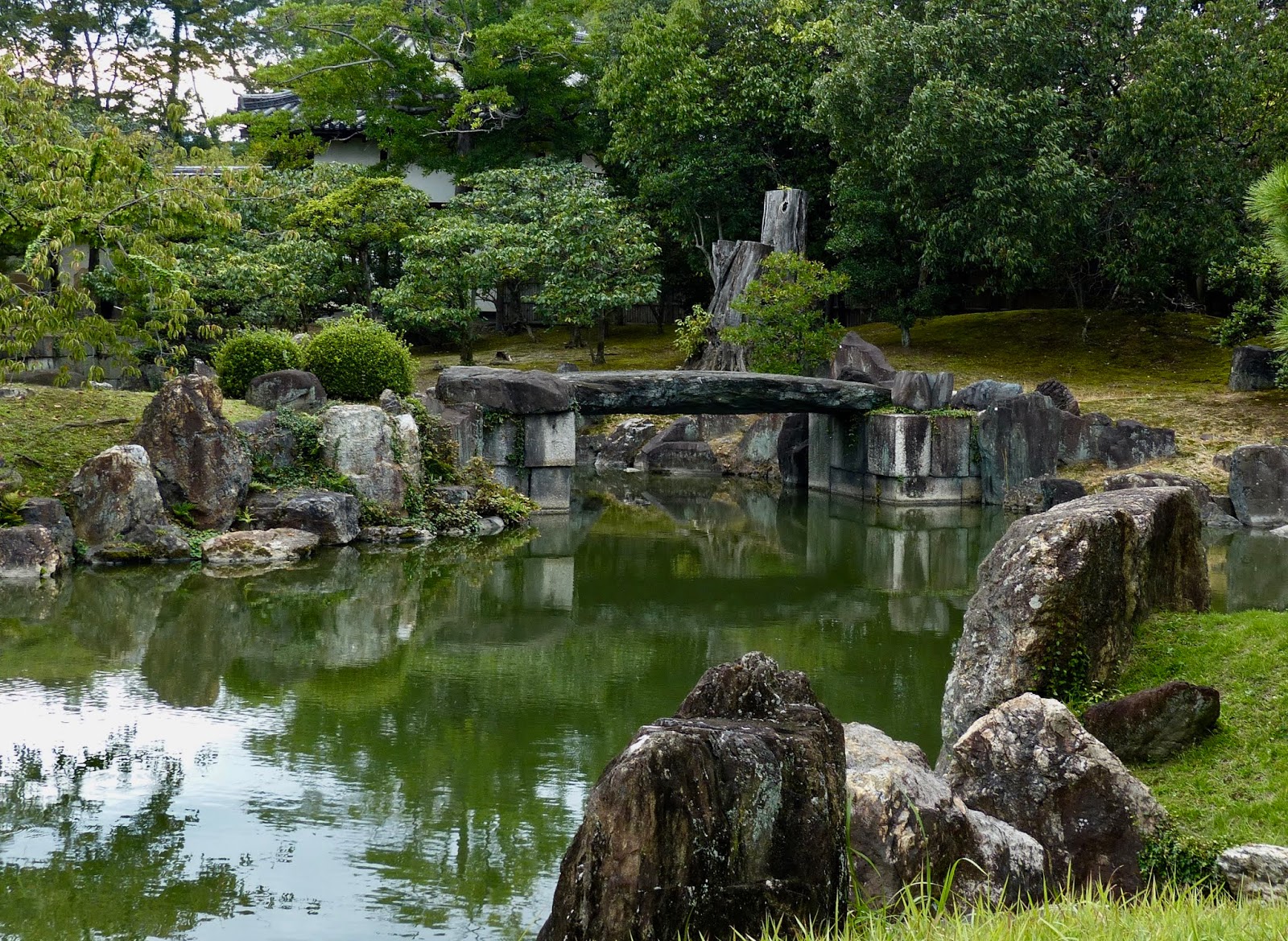
There are three gardens of note within the palace complex, the one outside the Ninomaru being the most classically beautiful with its ponds, pines and carefully-placed black boulders.
GION
Kyoto's Gion district was another unique highlight of this trip: it was the only place in all Japan that I found the combination of distinctive and charming architecture, fascinating crafts and atmospheric bars and cafes that add up to my perfect idea of a local shopping district. One of my greatest regrets of the trip is not having more time (and energy) to spend several hours wandering aimlessly here.
Most guidebooks will recommend a start at the Gion-Shijo subway station, with a quick stop to pay tribute to the riverside statue of Izumo-no-Okuni, the woman who's credited with founding the theatrical style called Kabuki. Then you'll head east up the broad avenue of Shijo-Dori, walking by the city's main Kabuki theatre before strolling beneath covered arcades of shops on either side of the street. Most of these seem to be selling luxury food: either the sweets made from various bean pastes or pickled vegetables, both of which Kyoto is famous for.
So celebrated are these pickled vegetables that there's an exclusive restaurant on this street that builds the whole menu around them. We stumbled into Nashiri by mistake: tired, hungry and mistaking the sample plates displayed out front as sushi. It was only after we'd settled in to an elegant dining room, ordered and started working our way through a visually exquisite meal that we realised all of the pieces we assumed would be fish were different vegetables. Though we both left feeling a bit unfulfilled, this has to be the most beautiful vegetarian meal ever created.
Continue up the street to Ichiriki Chaya, a striking terra-cotta coloured tea house that you're unlikely to be entering. It's been here for 300 years and is still an exclusive place where Geisha entertain the rich and prominent. Samurai film fans will thrill to the fact that it's where one of the leaders of the real 47 Ronin assumed the role of a dissolute wastrel until the time came to spring an elaborate revenge plot. The tea house marks the start of Hanamikoji Dori, one of the most famous streets in Gion. It's lined with picturesque wooden houses now used as shops, restaurants and small cultural spaces. If you want to buy in to a Geisha experience, it's probably going to be here.
I preferred the streets around the Yasaka-no-tou temple, a five-story wooden pagoda that's become the quintessential picture of Gion. Though the streets up here ... you're hiking uphill from the river ... are still packed with tourists, there are fewer big groups and more interesting shops. The most beautiful street is called Nineizaka, really just a pedestrianised lane that runs north-south, curving down and back up a little valley just above the pagoda. (The Park Hyatt Kyoto fronts onto the lane's northeastern edge, making a great landmark to find it.)You're more likely to be peering into the studio of a working craftsperson here; pottery, paper making, and fabric painting, dying and embroidery are all common. There's even a caricature artist who will draw you manga-style. There are also plenty of kimono shops where you can buy your own, or hire one with all the proper accessories to wear for the day.
All the tourist literature encourages you to keep an eye out for a real Geisha, or more likely for their trainees ... maiko ... going about their business. Though we're fairly sure we saw two groups of maiko, differentiated from lesser humans by their matching kimono, highly-styled hair, traditional shoes and handbags, and escorting older chaperone, most of the women we spotted in kimono were probably tourists. Sightseeing in costume is increasingly popular for both women and men, and listening to their conversation tells me that the overwhelming majority of Oriental people in traditional dress in Gion are actually Chinese. That's ironic on multiple fronts, particularly in that traditional Japanese dress was basically a straight knock-off of Tang Dynasty court costume in the 9th century. Early medieval Japanese had an enormous cultural inferiority complex and copied China for everything considered worthy. China moved on in costume, artistic styles and the use of chairs. Japan didn't. I wonder how many Chinese tourists adopting kimono realise they're actually tapping in to their own medieval past?
SAMURAI JUKU
If you're more martially minded, you might prefer a samurai experience over shopping the lanes of Gion. My husband certainly did.
This took a lot of research. Like the cooking experiences mentioned in my last story, TripAdvisor lists a bewildering number of "samurai schools", both in Tokyo and Kyoto. All of them involve dressing up for Instagram-worthy shots, but there seems to be a wide variety in quality of instructor, what you actually get to do and your access to real blades. Given that the husband was vice-captain of his school fencing team, is a military veteran and well-versed in samurai film and history, this needed to be more than playing dress-up.
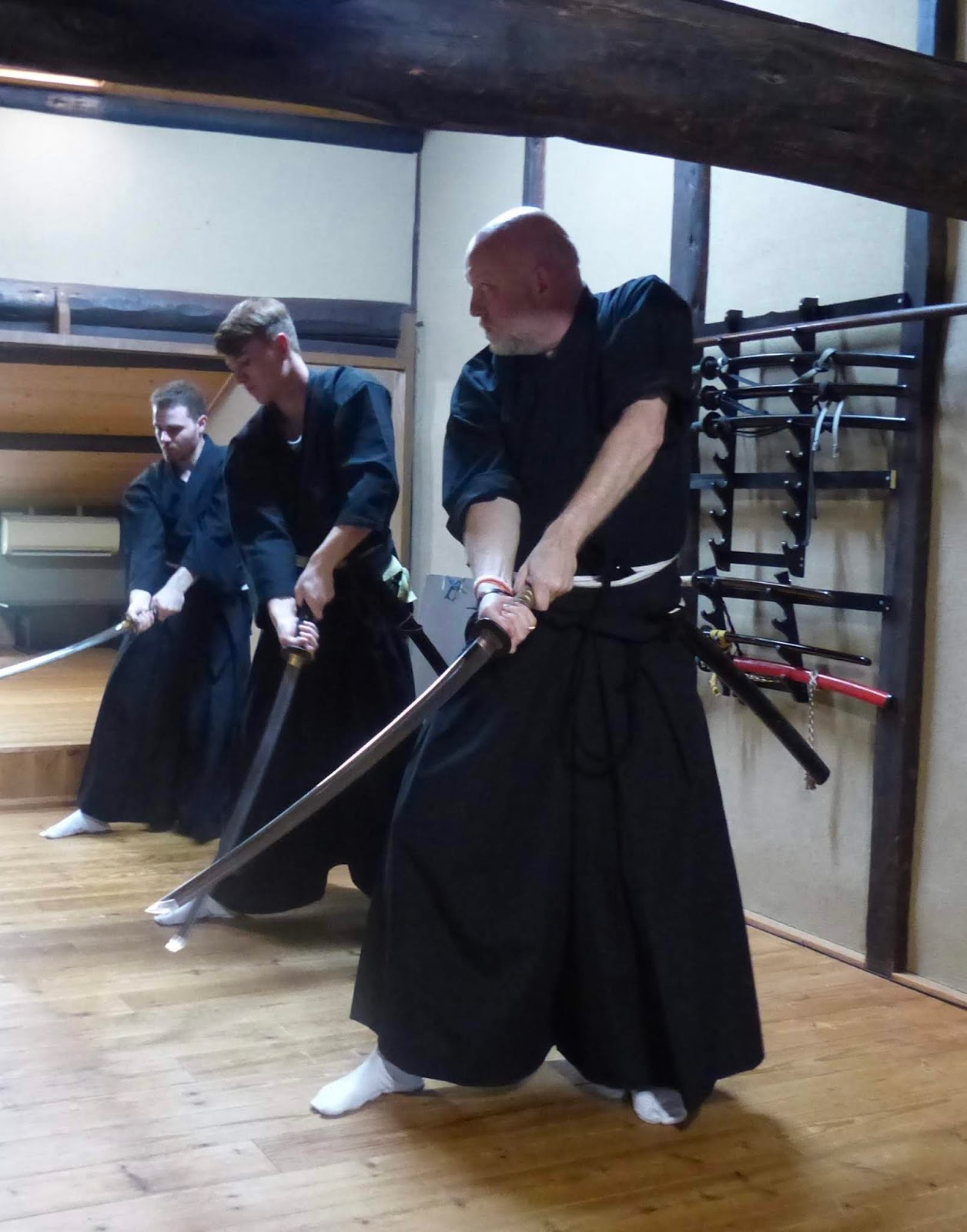
Samurai Juku delivered the quality we were looking for, though at a premium price point. For just under £80, you'll dress in black martial arts clothing, get a lecture from a sword expert who's descended from a samurai family, watch him do a few showy moves, learn how to unsheath and sheath a real blade, then head out to the back garden to swing your sword a few times to cut through a tatami mat. You can also just watch and photograph; for £40. It's a lot of money if you're not passionate about this stuff. If you are, it's a small price to get close to something you've only studied from afar.
The training ground shares its site with an armourer who makes full sets of highly-accurate kit for films, historical re-enactments and ceremonies. Come early to have a snoop around the gorgeous variety of armour on display. (Sadly, nobody was at work in the armoury when we were there.) This collection is as impressive as what you'll see in the National Museum in Tokyo. It just happens to be new.
Sword master Kawata-sensei is a small, venerably matured, grave-faced, bespectacled Japanese man who bears a distinct resemblance to Yoda when he's teaching 6-foot plus Europeans who tower above him. It's an even more pronounced comparison when he demonstrates some moves, springing from complete stillness into an arcing, swirling dance of menacing blades.
Kawata-sensei's accompanying "padawan" at our session was a young Japanese man who grew up outside of Detroit, and could thus translate the teacher's instruction and students' questions in detail. While I'm not sure that either my husband or I learned huge amounts about Samurai or their swords, because we started from a well-informed place, the session still had merit in being illustrated with real blades and the master's demonstrations of various moves. After about 30 minutes of discussion, it was time for the students to get on their feet with swords in their hands.
The length of a samurai sword, or katana, is between 60 and 80 cm. The average human arm length is about 76 cm. So getting one of these blades in and out of a scabbard hanging at your hip is challenging. Kawata-sensei and his assistant are patient with students of all abilities, praising those whose prior experience lets them get the hang of things more quickly while giving extra assistance to those who need it. By the time the lesson transfers to the garden and the tatami cutting, the students have the feel of things. With Kawata-sensei to direct the angle, everyone is a success (the razor-sharp blades and gravity do much of the work) and everyone gets a photo opportunity. They may be teaching an ancient art, but they're also plugged in to the digital age. The assistant not only translates and coaches on sword technique; he'll grab your phone and take plenty of Instagrammable photos if you don't have an attending friend to do it for you.
These experiences all seemed distinctly "Kyoto" to us. But there's another thing that may be even more characteristic of this city. Temples. There are at least 1,600 of them. Where to even start? That's the subject of my next story.
Subscribe to:
Posts (Atom)