Showing posts with label Robert Adam. Show all posts

Monday, 17 August 2020

Palatial Harewood shows the English country house at its best, in spite of dark origins

In these days of statue demolition and attempts to erase history, I find myself relieved that marauding anarchists tend to urbanites who don't actually know much about the past. Otherwise, I'd be quite concerned about England's grand country houses. Harewood, a palatial neo-classical gem that dominates the countryside between Leeds and Harrogate, would certainly be in the firing line. 

Many of England's great families made a fortune in West Indian sugar, a trade dependent on slavery, but the Lascelles were particularly good at it. Not only did they profit from their own estates, but throughout the American revolution they took advantage of war's disruption of trade, calling in loans and buying up the plantations of those who couldn't weather the storm. By 1799 the Lascelles were reckoned to be the 3rd wealthiest family in the country, and had been raised to the peerage. But they'd committed the social sin of earning their money, rather than inheriting it. And earning it in a trade that was increasingly seen as unsavoury.

Harewood House is a magnificent example of whitewashing your origins with grand art and architecture. The first Baron Lascelles went "by the book", drafting in only the best to create something at the pinnacle of establishment taste. John Carr of York for the classical Roman-style exterior, Robert Adam for opulent neo-classical interiors, Chippendale for furniture, Capability Brown for the landscape, European masters mixed with England's best portrait artists on the walls. If you want to see one place that defines the best that money could buy in the late 18th century, this is it. 

Succeeding Lascelles family members, thankfully, resisted any temptation for radical modernisation. They've enhanced the house ... art, furniture, a sympathetic addition ... but it all fits into the original masterpiece. An enormous, rather brutal early 20th century sculpture is a startling yet somehow cohesive introduction in the marble entrance hall. Adams' long gallery shows off an old-masters collection acquired 150 years after its construction. (The 6th Earl supervised his agents to collect across Europe while he was in the trenches of WWI. One assumes that, like his ancestors, he was maximising the opportunities of war.) The current generation has rolled out a show of modern art created with feathers in honour of the estate's exotic bird collection. Some are puzzling, some creepy, but the "rug" that uses feathers to mirror the swirling patterns of the ceiling above it is captivating. You'll learn what's what thanks to a digital guide you can bring up on your phone, prompted by a QR code in the lobby. Modernisation where it makes sense.

Given my love of all things Robert Adam, Harewood is most precious to me for its ceilings, all in excellent shape and returned to original colours in recent restorations. Many retain their matching, specially-woven carpets below and combine in what some find a shocking array of Easter egg pastels. Harewood won't let you forget that the Georgians loved colour. It also has one of my favourite libraries in the country, in which Adam designed bookshelves as gently curving apses so readers could literally be surrounded by knowledge. 

Though the interiors are open, social distancing rules made the upstairs impossible, so we missed out on a series of bedrooms that include some fabulous canopied beds, rare Chinese hand-painted wall paper and an art deco bathroom built for royalty. But given the treasures on display on the main floor, we didn't feel short-changed.

That all of this is in such good shape, and that there are new things being added to the family collection, probably has something to do with the house's frequent use in films. Its extensive 19th-century service wing is the set for all of the "below stairs" scenes in Victoria. It's grand enough to have stood in for Buckingham Palace in the films King Ralph and King Charles III, and featured as itself in the recent Downton Abbey film. The 6th Earl married the only daughter of King George V in 1922, Mary; the film showed a visit to the princess in her home. Less opulent, though probably just as lucrative, the soap opera Emmerdale films in a model village set in the grounds. 

The estate often hosts music concerts, pop-up drive in cinemas and other events, has developed an interesting zoo and exotic bird display and has one of the most sophisticated children's play areas I've ever seen, with a profusion of turrets, slides and swinging bridges. The 1st Earl might have been trying to disguise his talent in business, but you get the feeling his descendants are still quite good at it.

Marrying into the royal family was a coup, of course, and the family connection was enhanced when Tommy Lascelles, a grandson of the 4th earl and cousin to the 6th, became trusted private secretary to both George VI and Elizabeth II. Rather surprisingly, The Crown has not filmed here.

The royal connection certainly enhanced the grounds, however. Princess Mary was a keen gardener; you can even see her spades in a small museum inside the house dedicated to her life here. The famous terraces stepping down from the back of the house are her design, an unusual mix of rigidly formal parterres and dreamy, cottage-style borders. She and her husband embraced the fashion for rock gardens in the 1930s, installing an enormous version with car-sized boulders, cascading water and paths through deep ravines. Current family members restored and updated it in 2009 as a "Himalayan" garden, heavy on primulas, orchids, lilies and poppies in addition to the original wide variety of rhododendron. There's even an authentic Bhuddist stupa tucked in the hills.

The sprawling grounds also feature a walled garden ornamentally planted with fruit, veg and flowers and those birds and beasts, who live in what's actually called a bird garden. On a hot, humid August day you're more likely to appreciate the dense, exotic planting than the birds, many of whom were wisely hiding deep in cool, shady undergrowth. The flamingos, however, were in their element.

Harewood is a model for aristocratic estates that have managed to stay in private ownership: a diversified attraction with something for everyone, regularly updating to keep things fresh yet leaving its core appeal untouched. It's a delicious irony that a house initially created to disguise its owners talent in business has flourished because the family never lost its commercial savvy. One thing the 1st Earl would not have been hiding was his ownership of slaves, something that at the time was both legal and unexceptional. Fortunately, the Lascelles have had a talent for moving with the times. No contemporary will deny the ugly taint on the origin of the family money, but we can also celebrate that over the years Harewood has evolved into something that serves, delights and employs both its immediate community, and those who come to visit from around the world.

Wednesday, 14 November 2018

Seductive Split brings history alive

Dubrovnik interested me, but Split seduced me.

If Venice and Florence had a secret love child, then abandoned it to grow up in the ruins of ancient Rome, you'd get Split. It's gorgeous and haunting. Compact. Beautiful and mysterious. A place where the margins between the present and the distant past seem very slim indeed.

This magical time-shifting is most obvious in the peristyle, a rectangular public space at the heart of the old palace that forms the historic town centre. (I hadn't fully appreciated the reality until I got here. I knew the palace of Diocletian was in Split; I didn't grasp that the old town was actually in the palace.) In the peristyle, the Emperor Diocletian's visitors would have found a magnificent garden surrounded by a colonnade of towering columns of various colours, assembled to show the rich variety of empire. The greatest glories of the palace connected here. To the right, the temple of Jupiter (whose incarnation Diocletian claimed to be on Earth). To the left, the magnificent octagonal mausoleum that would someday take his earthly body. Straight ahead, a round vestibule where Diocletian would receive visitors, draped in imperial purple and haloed by light that came in from windows aligned to the sunrise and sunset, then bounced off gold-leaf covered walls.

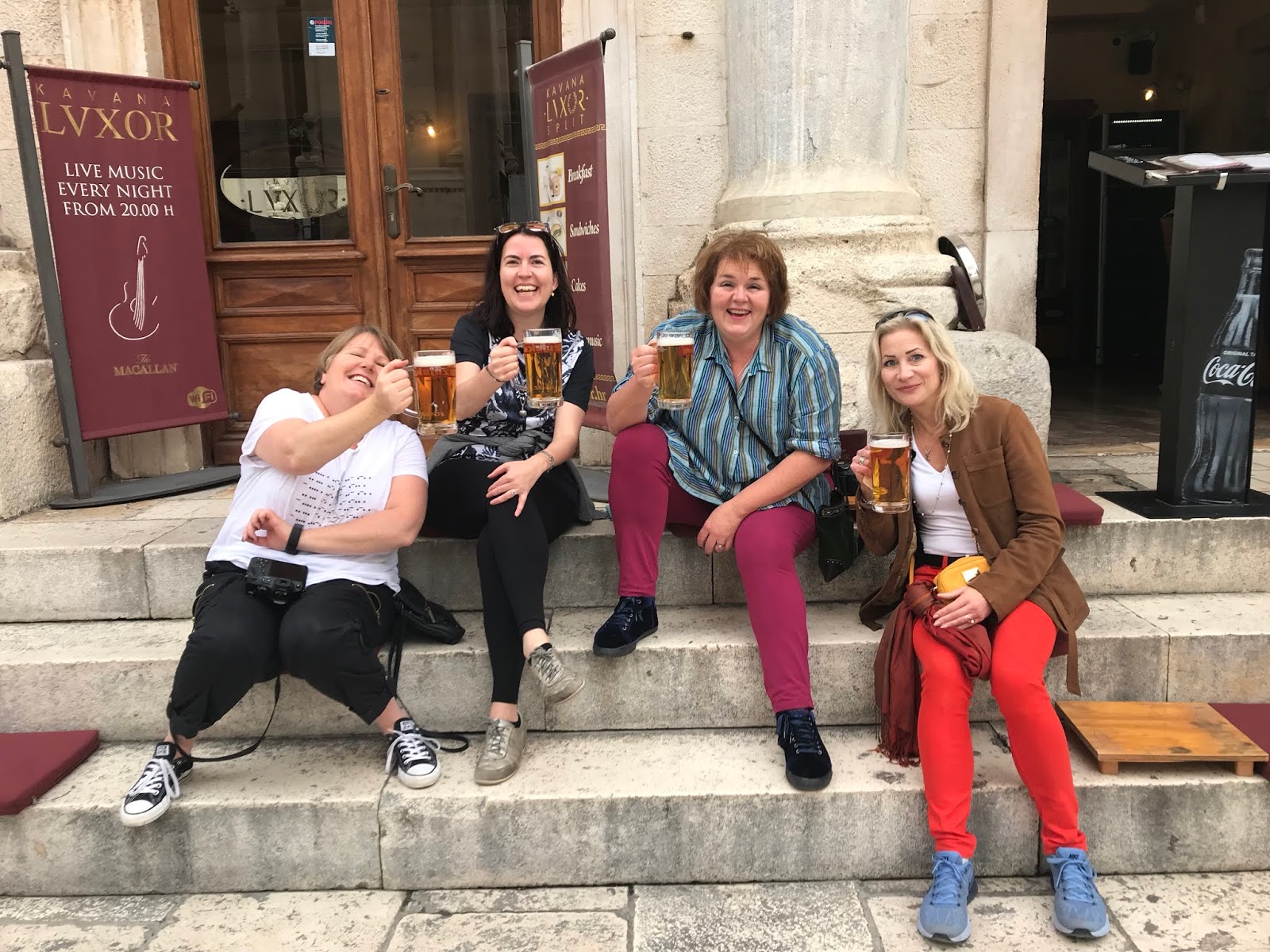
It's a little less showy these days, but all those elements survive. The peristyle is now a rectangular piazza known as Split's living room. The garden is long gone, now paved with white stone buffed to a mirror-like sheen by centuries of foot traffic. The mausoleum now stands, but as what must be one of the world's smallest cathedrals. The vestibule is an echoing ruin, now often occupied by musicians entertaining tourists and flogging CDs. Buildings have completely filled in the West side of the peristyle's colonnade, dominated by a bar and restaurant called Luxor. Their cushions cover the stone steps. While most visitors followed their guides through here, stopping, snapping photos, then moving on, we settled here at least once a day for cold beer and hot people watching. As dusk falls and the tour groups disappear, it's a magical place to while away the hours.

Tours aren't a bad idea, however. Beautiful as the old town is, it can be hard to piece its story together from your own observation. Informative guidebooks are remarkably absent. You can by a copy of Diocletian's palace modelled in white chocolate, but good luck finding one of those books that superimposes a coloured acetate onto a modern photo to give you a picture of then and now. There are a handful of plaques up on buildings, but nobody has bothered with a city trail that allows you to navigate around the old town's lanes understanding how they started. We hired history teacher Dino Ivancic to make it real for us. (Approx. £95 for two hours.)

Dino is either a remarkably good judge of character or an acquired taste to be approached with caution. I'm going to guess it's the former; he figured we already had a good understanding of basic history, were comfortable with wry wit and a bit of ribald humour. The resulting tour was half serious explanation, half history-based stand-up routine channelling Monty Python and Blackadder. So I didn't get quite the level of Roman history and architecture I would have liked (probably to the relief of my friends) but we were richly amused.

After a short walk out to the harbour to get a look at the full span of the palace walls, we plunged into its most remarkable feature. The basement. Yes, really. In order to level a sloping site, and put Diocletian's private apartments safely above sea level, the architects built an impressive sub-structure of lofty arched and domed rooms that matched the pattern of the palace above. The "barbarians" who moved in after the fall of empire couldn't figure out the underfloor heating, and thought the subterranean spaces would be more useful as cesspits. Their shocking mis-use of the space led to its preservation; the rooms weren't dug out by archeologists until the late 20th century, providing new understanding of the palace above and lots of museum-worthy artefacts that had been entombed in the mire.

All visitors get some exposure to these cellars as they walk from the main harbour-side entrance up to the peristyle. Craftspeople have set their stalls up here to form a picturesque shopping mall on the main tourist route. But for a small fee you can ramble though the whole atmospheric complex. Game of Thrones fans will get an extra thrill discovering the sets where Daenerys incarcerated her dragons and Barristan Selmy met his death.

Back up top, guides like Dino help you to decipher what the place looked like in the 3rd century and how it would have functioned in Diocletian's time. For example, standing us at the Iron (Western) gate today the path narrows quickly into a lane between shops. He pointed out the telltale marks in walls that reveal the width of the original road; the decumanus, where ten soldiers could walk abreast. Dino showed us how more modern centuries layered onto the Roman world, borrowing walls and integrating bits of ancient sculpture into their decor. He also exposed us to the historic Jewish quarter, not much mentioned in official guides. Similar to stories we heard in Dubrovnik, the people of Split didn't care much about religious differences as long as everyone made a good profit. This was a point of refuge for Jews getting kicked out of Spain at the time of the Inquisition, and Split boasts one of Europe's oldest continuously operating synagogues.

After leaving Dino we looped back to go inside the cathedral and the temple of Jupiter (joint admission ticket). Both are magnificent buildings. I found the cathedral both amusing and fascinating for its layering of the pagan and Christian. The frieze around the top, thankfully far too lofty for iconoclastic early Christians to do damage, has a shockingly profane theme of putti enjoying earthly delights of drinking and hunting. No doubt exactly what Diocletian planned to be doing in the afterlife. Successive generations have added a magnificent pulpit (very medieval Tuscan in style); pointy gothic side altars, a wildly opulent baroque altar that's a masterpiece of marble inlay work and a rather distracting choir. Despite all of this, it's still a resolutely Roman interior.
The temple of Jupiter, now the Baptistry, has seen less tampering. Other than a baptismal font cobbled together from gorgeous early Christian altar panels (almost Viking in their sinuous abstraction) and a hideous modern sculpture of John the Baptist, the space has been left bare. All the better to appreciate one of the most magnificent ceilings still intact from the ancient world. It's a coffered barrel vault, each coffer with a different decorative element at its centre and glorious foliage around its edges, held up by a ridiculously ornate, multi-levelled cornice. (Photo above) It was so magnificent I paid to see it twice.

For a separate fee you can clamber up the bell tower outside the cathedral. If its lines look a bit sleek, despite its Romanesque design, you're right to spot an aberration. It's one of the most modern things inside the place walls, being a 1908 reconstruction of an earlier tower that came down in an earthquake. I thought about this a lot as I made the vertigo-inducing climb. Pierced by stories of arched windows and entirely empty inside, the tower is ascended by metal stairs bolted to the interior walls. With nothing between the stair treads. Climbing feels like you're hovering in mid air. Descending is even worse. And I don't have an issue with heights. The view from the top is worth it. Be brave.

Streets immediately outside the palace walls are a pleasing melange of Medieval, Renaissance, Baroque and Neo-Classical. Many old palaces have a decidedly Venetian feel about them, with twisted columns and fanciful pointed windows. There's even an enormous piazza loosely based on St. Marks, with one side open to take in sea views. (Locals tend to drink here rather than in the peristyle). Other bits feel like you're deep in Tuscany (particularly the decidedly un-Italian sounding Narodni Trg square). There's a magnificent fruit and veg market out the Eastern gate and a fish market out the West; both will make foodies wish they had a kitchen.

Despite the antiquity, Split feels like a vibrant, modern town. Squares and restaurants are full of locals. Children play ball in the streets. There are trendy wine bars with rooftop gardens. We found restaurants we'd welcome, and repeatedly visit, if they existed in London. (Of that, more in my next story.) The shopping scene goes far beyond the expected tourist items; Split is packed with boutiques with locally designed clothes, dramatic jewellery and stand-out accessories. Most were a bit too high fashion for my style, but window shopping was a joy and we all agreed that the women of Split were some of the most fashionable of any city we'd ever visited. People watching was a catwalk show with good architecture.

There's no doubt this is a living city, not a stage set for tourists. That was obvious when we got out of town for our wine tour at Kovac. From Anton's vineyards we could see the sprawl of a very big, very busy place. "All the creative industries are here," our tour guide Andrea told me. "Government and the law are in Zagreb. Dubrovnik lives on tourists. We make things."

It's also a jumping off point for additional exploration. We gazed enviously at the day trips we wouldn't have time to take. Excursions inland to a national park famed for waterfalls. Jaunts to islands with exquisite beaches and picturesque towns. Winery tours (we'd done one, but there were more to be sampled.) The Medieval town of Mostar, just over the border in Bosnia, with its legendary bridge. Even Dubrovnik was accessible from here. The more I learned of Split, the more I marvelled that Dubrovnik is the go-to destination for most visitors to Croatia. This is the place I'd want to come back to, and use as a base for a longer holiday.

One of my great heroes felt the same way. If we dropped back two centuries ... still fairly modern for Split ... we'd find it a star on an extended Grand Tour trail thanks to now-legendary architect Robert Adam. In 1764 he'd printed a lavishly illustrated guide to the Ruins of the Palace of the Emperor Diocletian at Spalatro in Dalmatia. The first few pages are packed with the names of the aristocrats who subscribed to fund its production, topped with the king and queen. Thanks to a digitisation project at the University of Wisconsin, you can follow the preceding link to look at the whole thing online. Exquisite drawings go into obsessive detail showing architectural features that are, for the most part, still there and on regular view. He includes more "modern" fortifications and neo-classical buildings as well. Though scholarship has moved our understanding on since Adam's time (he believed the Mausoleum was the Temple of Jupiter, and the Temple of Jupiter one to Aesculapius) the  power and the beauty of the architecture hasn't changed.

And it will all look very familiar. Because this was one of the source books Adam used in his designs for the grand buildings of London and aristocratic country houses across Britain. Which were then copied across the world in government buildings, museums and grand residences. The creative spark we found in Split has travelled the world; most people just aren't aware of it. I'd encourage anyone who enjoys history and architecture to spend time here. They'll fall in love.