Showing posts with label Rothenburg. Show all posts

Monday, 16 May 2022

Rothenburg ob der Tauber is the Germany of your dreams

When Disney's designers return to a place for inspiration repeatedly for more than 80 years, it deserves the adjectives "fairy tale". So it is with Rothenburg ob der Tauber, model for Geppetto's village in Pinocchio (1940) and Belle's village in the 2017 live action version of Beauty and the Beast. It makes no difference that the wooden puppet's tale comes from Tuscany, and that Belle is supposed to live in France. Rothenburg is what fairy-tale villages are supposed to look like. You expect the seven dwarves to go high ho-ing around a corner, off to at work any minute. And while it's not a direct copy, the German pavilion at Epcot is a hotch-potch of architectural elements lifted from this Franconian town. 

It was also the village that the childcatcher stalked in Chitty Chitty Bang Bang, and has shown up in more than 30 other films. It’s seared into your imagination even if you haven't been there. No wonder this is the most famous town on the 220-mile stretch known as the Romantic Road; Rothenburg is the pattern from which a thousand Germanic fantasies have been cut. (The Nazis felt the same way, but Germans and visitors alike have agreed to overlook that darker history; architecture can’t help what people do with it.)

It was the first place on our holidays where the pandemic felt well and truly over; by 11am every street was packed and queues spilled from popular establishments. Rothenburg teeters perilously close to being one of those places, like Versailles or Mont Saint-Michel, where crowds make the experience so miserable it’s not worth going. So a good reason to bother with a guided tour here is to be with people who can work around the traffic flow.

We started from Karlstadt at 8:15. Early for a holiday, to be sure, but it meant we were rolling into Rothenburg around 9:30, well before things got too crowded. We were also treated to a gorgeous drive along a stretch of the Romantic Road with deep valleys, winding streams, verdant pastureland and picture-postcard half-timbered hamlets. It would have been easy to drive yourself, but it was nice to be a passenger and just take it all in.

Our early arrival meant our walking tour was relatively unencumbered by crowds, people only starting to jostle as we finished and rolled into time on our own. The included lunch later was at a restaurant within a hotel. Whether it had been booked exclusively for us or the hotel just doesn’t get much lunch traffic I don’t know, but finding someplace to sit down for a leisurely lunch without local knowledge would probably have needed queuing.

The tour was also pleasingly efficient in its route. The bus dropped us off in the car park near the Klingentor, quite literally at the top of things as the whole place cascades down a hill. This upper bit of the old town has fewer shops and tourist attractions, so is much quieter while still being picturesque. There’s also a large and spotlessly clean public toilet just inside the walls, at the edge of the Schrannenplatz, always a useful thing to know about. Our explorations took us ever downward, gently, and across town, until we finally rejoined the bus at a car park near the Spitaltor, on the far side of the historic district from where we entered.


And, of course, going with a local guide gives you the inside scoop on history, local attractions and culture. Most of that can be found in books or audio guides, of course, but they don't have the charm of human interaction.

Was Rothenburg worthy of its reputation? Absolutely. It is heart-stoppingly beautiful. Like Bruges and Venice, Rothenburg was a much bigger deal in the past than it is today. In the high Middle Ages it had a population four times its current one and was one of the richest and largest cities in the Holy Roman Empire. A favourite of royals, a hub of trade and a popular home of religious orders, it was packed with impressive churches, gorgeous mansions, showy towers and attractive shops. Then came the Thirty Years’ War.

The town's most enduring story from that time is a cheerful one that explains the clock on the market square. A Protestant leader captured the town and threatened to burn it down and kill all within. The Catholic councilmen tried to get him drunk so he'd go on his way. He refused, saying he would back off from his threats only if someone could drink all the wine he'd been offered ... 3 1/4 litres ... in one go. The mayor downed the prodigious quantity in one, the general left, and both are now automatons facing each other across the clock, with the mayor raising his oversized stein on the hour.

The reality of the war was far worse, bringing famine, conflict and the disruption of trade routes. Toward the end came plague. Rothenburg never recovered, a much reduced and much less affluent population maintaining what was there but never adding anything. It was the Romantic artists of the 19th century who "re-discovered" the place and it's been on tourist maps ever since. The money that comes with visitors has allowed all of those churches, towers, mansions and shops to be in a robust state of preservation, decked out in cheery pastels and enlivened by highly-decorative half-timbering. And yet the modern stores and housing ringing the historic centre, and signs for civic government, doctors and schools within the walls suggest this isn't just a tourist venue but still a living town.

There's far more for a tourist to do here than a few hours of free time can conquer. Many will head for the town walls, which completely circle the old town and are amongst just a few complete circuits left in Germany. The views must be spectacular throughout; the bit we ventured onto above the river Tauber was glorious. We skipped the Criminal Museum with its collection of torture instruments. Funny how such things intrigued me as a child but, as I've grown up and appreciated the reality of the world, I now find distasteful. Being history buffs, we naturally headed instead to the Imperial City Museum. It's a charmingly home spun affair, with a crowded jumble of artifacts and mannequins that look like they were liberated from store windows in the late 1960s before donning their 17th century costume, but we enjoyed it. There's a bit of everything, from weapons to furniture to historic documents to art and decorative objects, but the main focus is on the Thirty Years' War, with costumed figures set up to portray different scenes from history.

Another highlight is the headquarters location of the Käthe Wohlfahrt Christmas retail empire in two buildings facing each other over the road. There is no better Christmas shop in the world, a truth I understood the moment I stepped into the UK branch in York. That wonderland was just a teaser for the enormous sprawl in their home town. I have never seen more ornaments, nativity sets, nutcrackers and the like in one place in my life. The fact that I raced through, and bought nothing, is only due to a husband at my shoulder with a raised eyebrow and an aversion to excess that leaves a third of my existing Christmas decorations in their boxes in the garage.

Wohlfahrt is not alone. This is a town full of galleries, boutiques and quirky retail offerings. There's even a sprawling shop dedicated to historic cosplay. If you fancy your own hauberk and chain mail, this is the town for it.

One of the most famous views in a place packed with instagrammable scenes is at the Plönlein, a place where the cobbled street divides on either side of a mustard yellow, half-timbered cottage (Belle's, in Beauty and the Beast), and both lanes, lined with interesting architecture, lead off to picturesque city gates. The Glocke Winery and Hotel is a bright blue building whose location across from the street-splitting cottage must give it as many social media appearances per year as a Kardashian. This is where we had our lunch, in a cozy dining room looking over the Plönlein. The room was decorated with local memorabilia and had particularly interesting chandeliers with rearing lions and inscribed metal tags I wish I would have asked about.

Our meal of soup, followed by sausages, cabbage and potatoes, ended with strudel and was accompanied by local wine. The focus was supposed to be on Franconian food, and on wine after days in beer country. Here’s my only complaint of the day: the epicurean in me could have used some explanation of the meal before us. What were the differentiating qualities of the wine? What makes Franconian food distinct from other German regions? I was too busy talking to my fellow travellers to ask, and the waiting staff didn’t volunteer. I suppose it gives me a reason to return.

And I would like to return to Rothenburg. As an independent traveller I’d happily settle into the Glocke hotel, or better yet check out something like the Gasthaus Schranne in the much quieter area where we entered town. I’d spend my early mornings and evenings in town, and the heart of the day in a car exploring smaller and lesser known areas of the Romantic Road in either direction. Rothenburg would be the perfect location for a week-long water colouring or drawing course, so I could improve on this effort:

As an introduction to the town, however, our guided excursion within our Viking Cruise was an excellent investment.


Saturday, 23 April 2022

Welcome to the land of fairy tale and Baroque excess

VIKING’S GRAND EUROPEAN TOUR, WEEK ONE Kinderdijk, Cologne, Koblenz, Miltenberg, Wurzburg (Rothenburg ob der Tauber), Bamburg, Nuremberg 

I haven’t vacationed on an organised tour within Europe for more than 30 years, and its confines can feel as awkward as a stiff pair of new leather shoes. The sightseeing en masse, the constricted free time, the dashing through historical sites with only top-line summaries, the fresh locations with each day are all a far cry from the way we usually settle into a place and delve deep into local opportunities. It does, however, have its advantages.

A bit like a chef’s tasting menu, an organised itinerary pushes you to places you wouldn’t have bothered with on your own. Koblenz, for example, is a pleasant but unexceptional town best known for the monument at, and view down upon, the place where the Rhine and the Mosel come together. I wouldn’t go out of my way to visit its sprawling early-19th century Ehrenbreitstein Castle, but if you’re there already the guided tour conducted by an actor assuming the character (although not the accent) of a British officer who knew the place at its construction was quite entertaining. 

A deep restfulness comes with not having to think. If, as we were, you are mentally exhausted by the demands of leading projects at work, having someone else organising your every move so you don’t even need to be aware of what day it is or what you’re doing next is bliss. And if, like me, you have the tendency to sightsee to physical exhaustion, the need to weigh anchor and keep moving enforces the down time. 

I won’t bother with an entry on each destination as, to be honest, few are worth that level of detail. The first week of Viking’s tour collapses instead into four broad categories: fairy-tale villages, scenic cruising, baroque places and windmills.

FAIRY-TALE VILLAGES

Thanks to Walt Disney, people around the world know what to expect from picturesque German villages. Half-timbered, steep-roofed houses broader above than below. Stuccoed buildings in pastel colours with fanciful gables. Churches with onion domes or narrow, pointed spires. Wells adorned with baroque sculpture. Wooden shutters, gabled windows projecting from roofs and window boxes full of geraniums.  The town hall will inevitably have a Rathskeller for drinking and dining below (cue Gaston using antlers in all of his decorating) and a glockenspiel chiming the hours in the tower above. If you’re lucky, some automatons might pop out and do something interesting on the hour.

There are copious opportunities to take in such scenery in this first week. Miltenberg is a pretty little town beside the Rhine with a charming central square, a high street distinguished by an unusually long, uninterrupted run of historic buildings and a particularly pretty historic coaching inn that combines half-timbering with decorative painting, polychromed saints figures and an ornate wrought iron sign. 

Something that’s nominally a castle, but looks more like an aristocratic step-gabled manor house sits on a hill above town. Bamburg leans a little more to the Baroque, with its stuccoed building fronts and ornamental rooflines, but there’s charm aplenty inside its city centre. The town hall, built on an island in the river that cuts through town, is particularly attractive; part half-timbered, part covered in lavish fresco. Head to Schlenkerla brewery for a place so atmospheric Snow White and the Seven Dwarves could be in charge. (Their distinctive smoke-flavoured beer is one of the highlights of Bamberg).

Nuremberg is the second-largest city in Bavaria, so no village here, but the bit inside the old city walls has buckets of old-world charm. The square outside the Albrecht Durer House, tucked against those walls, is a particularly charming place to settle for a while, particularly as there are two establishments serving up Augustiner beers. The artist’s house is well worth a visit; something I may cover in more depth later. (And for more on Nuremberg, see my report from an earlier visit here.)

But for photographic charm, all these pale to insignificance beneath the fanciful towers, gables, spires and cupolas of Rothenberg ob der Tauber. It’s so perfect it’s been drafted into service as a film location multiple times, most recently notable in the live action version of Beauty and the Beast. Everything inside the city walls, which you can walk around, is stage set cute and the locals play on this. Every shop vies for tourist attention, every restaurant is traditional. Other places mentioned above have more history and culture … we dipped into the local museum on the 30 Years War and weren’t terribly impressed with the hotch-potch of displays and basic details … but nowhere else is so resolutely photogenic in every direction. Tourists have figured this out, of course, and this is the only place in Germany I’ve been to, other than Neuschwanstein, that feels like it exists only for tourists rather than having a reality of its own. I suspect that, like Mont Saint-Michel, the secret is to spend the night here so you can enjoy the edges of the day without the bus tours and drive to lesser known villages when they arrrive.

SCENIC CRUISING

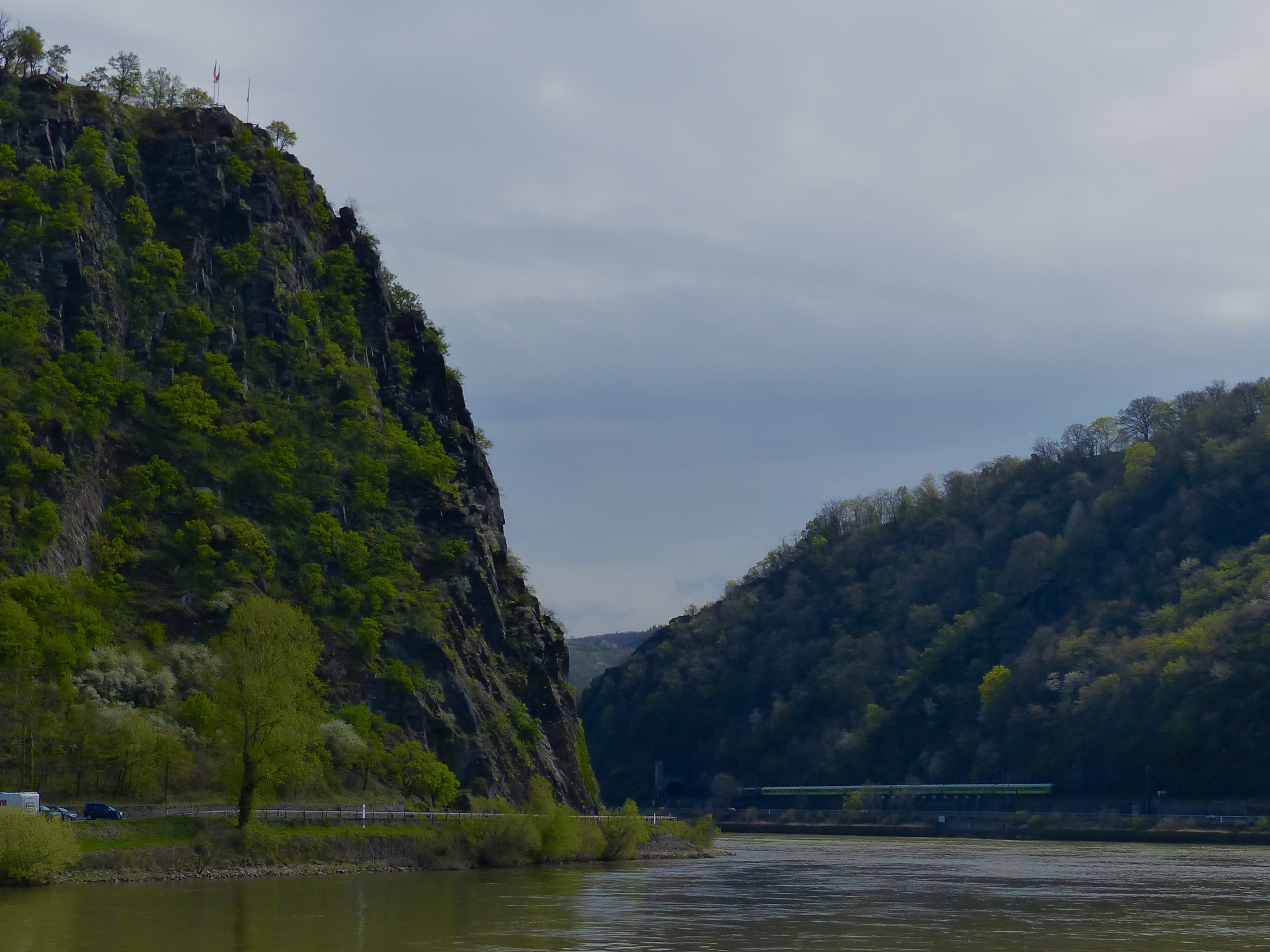
The stretch of the Rhine between Koblenz and Miltenberg is a highlight of the trip. For more than two hours of steady cruising the Rhine squeezes between forested hills broken by outcroppings of ruddy granite. Where the land slopes to gentle bottomlands there are charming villages. Vineyards climb up steep terraces. Orderly caravan parks expand the local population in riverside fields while every picture-worth building seems to be a hotel. At one dramatic point, the Lorelei Rock, the river here is particularly narrow, deep, and … before modern navigation aids … dangerous. Winds around the rock murmur and sigh, and the area is laden with legends.

Whether cruising or staying, visitors undoubtably enjoy the pastoral views, but it’s the castles that pull people in. It seems like a new one comes into view each time an old one disappears to your stern. And there’s a reason for that. The owners of these castles maintained commerce on the river. You can think of them as servants of the people or owners of a brutal protection racket, but whichever way you fall you’ll admit the architecture of their fortresses makes this a special part of the world. 

Ironically, most were just mouldering ruins until the 19th century, when the Romantic movement coincided with all those German states jockeying for power in a Germany on its way to unification. They look like something out of storybooks because that’s the way they were designed. At their most picturesque there are castles on the heights and at the riverside, presumably once working together. The most picturesque is Burg Pflazgrafenstein on an island in the river with Burg Gutenfels looming above. 

The lower could be a jewelled charm in a medical monarch’s cabinet of wonders; the upper is the kind of brooding ruin worthy of gothic horror.  The progression of castles on this stretch runs the gamut in between. Unsurprisingly, many now operate as luxury hotels. If you live in Europe, we’ve realised you could book into one of those hotels for a long weekend, take a day cruise and re-create this part of our journey fairly easily.

BAROQUE PALACES

Catholic Germany had a tradition of strong prince bishops who had both secular and religious authority and a taste for grandiose architecture. While they rolled out lavish Baroque architecture in their churches to assert the appeal of their religion over dour, ascetic Protestantism, they used the architectural style at home to demonstrate their political heft. Just like Louis XIV, father of the movement, they equated architecture with power.

The biggest of these examples in the first week is the episcopal palace in Wurzburg, a hefty block of golden stone that would make the French king feel at home. These places have a pattern across Germany: a porte cochere that allows carriages to unload their passengers at the bottom of a grand staircase. 

Shallow treads ascend to a landing, divide and continue up on either side. Statuary ornaments the railings, there’ll normally be some massive architectural statement on the landing and it will all be covered with a tromp l’oeil ceiling full of Greco-Roman deities frolicking their way across the heavens. Wurzburg looks like all the rest, with the exception that its ceiling is by Tiepolo so far better than most. A series of state rooms always follows, dripping with ornamental plaster work. Wurzburg is unusual in its embedding of mirror fragments into the swirls of the plaster, no doubt adding an exceptional glow to candlelit events. The best site here is a mirrored room, larger than these things usually are and unusual in that the mirrors are over-painted with scrolls and scenes. What you see today is a post-war recreation of what was destroyed by WWII bombs; even in modern incarnation it’s magnificent but a bit too much to live with.

Grand as Wurzburg is, I far preferred the smaller palace, its accompanying hunting lodge and the grotto-style chapel at Brühl. 

They’re all the creation of Clemens Augustus of Wittelsbach, a young man who had no interest in the church … he was forced in by his power-seeking family … but a great passion for hunting and showing off. The lodge, Falkenlust, celebrates falconry in its interior decor, complete with a blue-and-white tiled staircase hall with hand-painted tiles showing stages of his birds’ lives. Blue and while tiles (the Wittelsbach family colours) also clothe a delightful dining room in the main palace. 

The mirrored room in the lodge, though only a fragment of the size of the Wurzburg room, is much nicer, and more traditional with its writhing gilded wooden frames with little plinths occupied by china birds.

Back at the main palace, the artists behind the staircase might not be as famous as in Wurzburg, but I found the colours fresher and the architecture … complete with giant figures holding up the columns … altogether lighter and more fun than other examples. The chapel, created as a fashionable shell grotto in the ever-present blue and white, has the same effervescence. August Clemens was doubtless a terrible representative of the Catholic Church but as a builder and part host, he was my kind of guy.


WINDMILLS

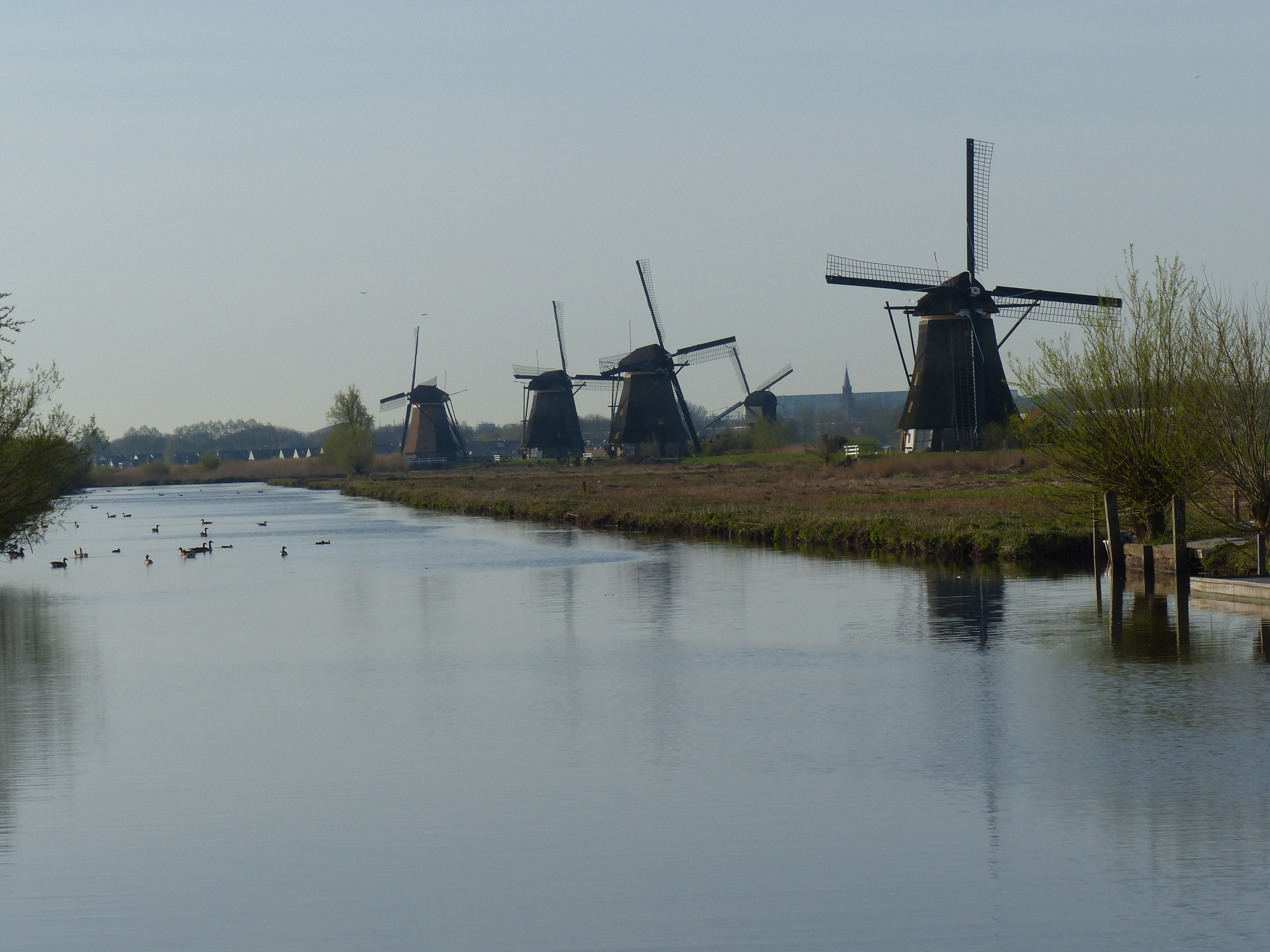
This falls into one of those pleasant surprises. Never in 20+ years of regular visits to Amsterdam has it ever occurred to me to travel to the windmills at Kinderdijk. I’ve been to individual Dutch windmills. I’ve seen them in the landscape. We have similar in Norfolk. What’s the big deal?

Well … UNESCO knows what they’re doing when they hand out those World Heritage Site designations. Kinderdijk isn’t just a bunch of windmills. It’s the largest concentration of these historic buildings … 19 from the 18th century or before … in the world, and demonstrates a unique ecosystem. The mills pumped water from one holding area to another, ever upward and to the sea. The “polder” is the cleared area left behind; a peat-rich, below-sea-level area of rich, green fields perfect for dairy farming. Windmills in such profusion are remarkably picturesque, and worth the visit to see whether you’re on a ship or in Amsterdam.


 * Viking runs this itinerary back and forth all season. If you start in Budapest, then what’s described here will be week one