Showing posts with label UNESCO World Heritage Sites. Show all posts

Wednesday, 30 October 2019

Remarkable Nikko Tōshō-gū was the most glorious sight in all Japan

I've saved the best for last. If, out of all the glorious things I saw in three weeks in Japan, I could only pick one, it would be the
Tōshō-gū shrine in Nikko.

The resting place of Tokugawa Ieyasu has it all: drenched in history, dramatic landscape and a concentration of jaw-dropping art and architecture that puts it on par with any of the greatest buildings of the world. It's no wonder that this, plus Ieyasu's grandson's shrine and some other temples, form one of Japan's most noteworthy UNESCO World Heritage sites. Your biggest problem will be finding the time to see enough of it.

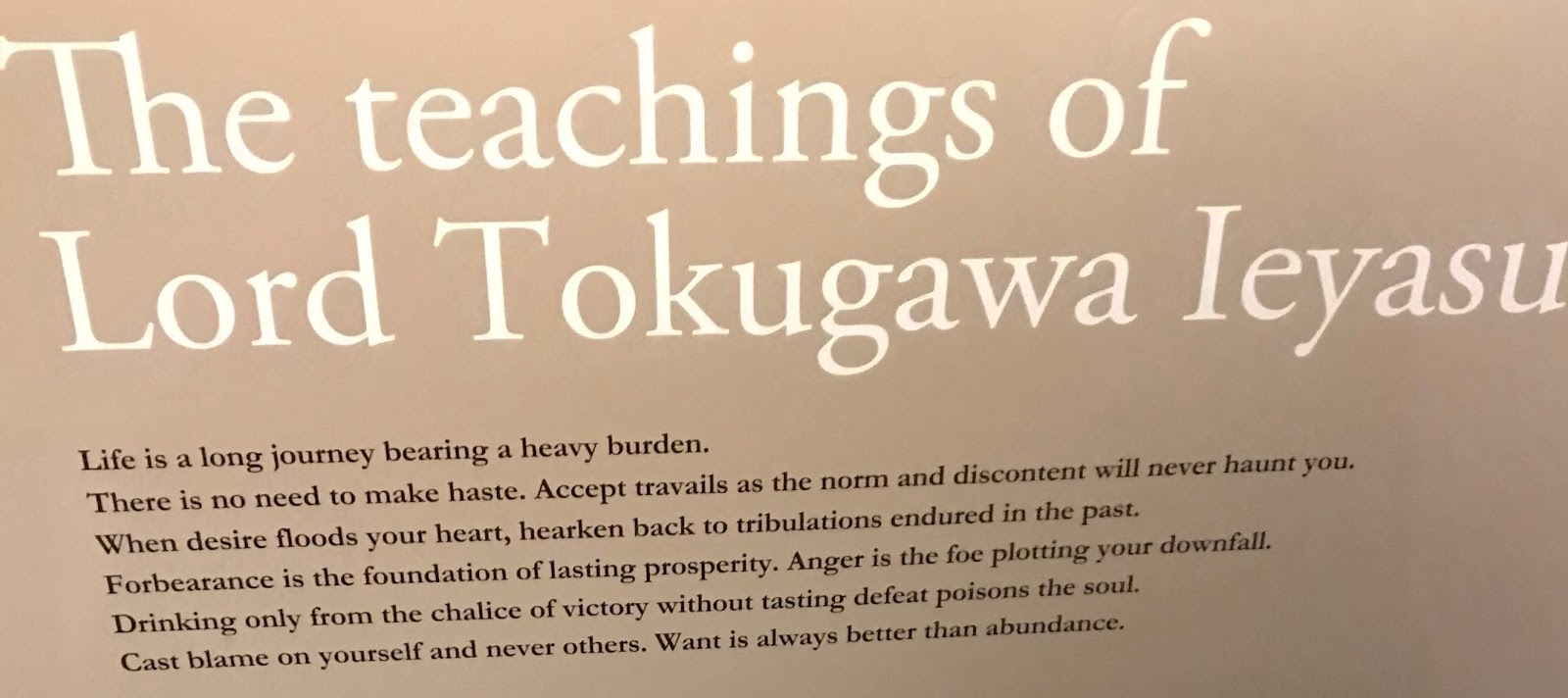
It started out as a more humble place. After unifying Japan, founding his dynasty of shoguns and stepping into semi-retirement, Ieyasu picked this spot in his home region for his mausoleum. The family had supported religious communities here for years. But Ieyasu was a soldier with fairly basic tastes. The place he built for himself was, legend has it, simple and elegant. This presented a problem for his grandson, Iemitsu.

By the reign of the third Tokugawa shogun, both the job and the country were stable and the Tokugawas had taken on the trappings of divine-right kings. Iemitsu wanted a funerary shrine as grand and glorious as his palaces ... and his opinion of himself. But he had a problem. Japanese respect for one's ancestors couldn't allow him to have a tomb more opulent than his grandfather's. His solution? Re-build Ieyasu's shrine with such extravagance that his own grand plans could play second fiddle.

The result is staggering.
Tōshō-gū is a complex of buildings climbing a mountain in multiple terraces. It's most notable for the deeply carved, lifelike reliefs painted in bright colours on most of the buildings. One of the gates is nicknamed the higurashi-no-mon, meaning "look at it until sundown and never tire of seeing it." You could say that of the whole extraordinary place.

The approach is up an avenue sunk between stone walls with trees towering on either side. There are other temples and attractions vying for your attention near the bottom. Don't be distracted, as you'll need most of your time for the Tōshō-gū shrine at the top. The pathway up is austere and elegant, and doesn't prepare you at all for the riot of colour you encounter when you get to the plaza at the top. To your left is a five-story pagoda with bright red eaves and balconies, green shutters, golden accents and a crazy mix of colours on the beams holding up the roofs.

There are lively carvings of animals, both real and mythological, above the windows and doors; a preview of what's to come. Across the square, next to the ticket booth, steps ascend steeply to the first of the complex's ceremonial gates. This one, amusingly, has elephants trumpeting from its corners. But not as we know them. It's rather obvious that the sculptors had never seen one of the beasts, so these seem more mythical than the dragons flying all over the buildings.

It's hard to believe that the complex of buildings through the gate is the administrative bit of the shrine, so ornate are they. There are storehouses, smaller temples, secondary gates and a stable for the horses used in ceremonial processions. All are encrusted with sculpted scenes, but the ones on the stable are the most famous. They depict monkeys demonstrating behaviours to be admired, most famously a trio representing see, hear and speak no evil. (Third panel down in the photo below.)
This area is also where you'll start to see clusters of large stone lanterns covered with moss. Each great family of the realm was invited to donate one in honour of Ieyasu; even those who had been on the other side in the civil conflicts of his early career. These reformed enemies' lanterns are placed furthest away from the main shrine building. The more faithful you were, the closer your lantern was to the great man's remains, and the larger and more opulent it was likely to be.

Walking through this "L"-shaped administrative level takes you to another set up steps, atop which you'll find an esplanade with two bell-towers, a temple building to one side and a selection of more impressive lanterns. The most interesting is a European-style oddity, cast in bronze and decorated with barley-twist columns and shields. There's some debate over whether this gift from the Dutch East India Company was crafted by clueless artists who didn't realise they incised a flipped Tokugawa crest, or whether the whole thing was installed by clueless Japanese workers who didn't know what European lanterns looked like. The local guides relate the first story. A hard look validates the second. The whole thing is clearly upside down.
The temple to the far left seems an afterthought amidst everything else here, but it's worth going inside to see the magnificent, writhing dragon painted on the ceiling and to have the priest demonstrate how the building's acoustics were designed so that any sound made directly under the mouth of the creature is amplified.

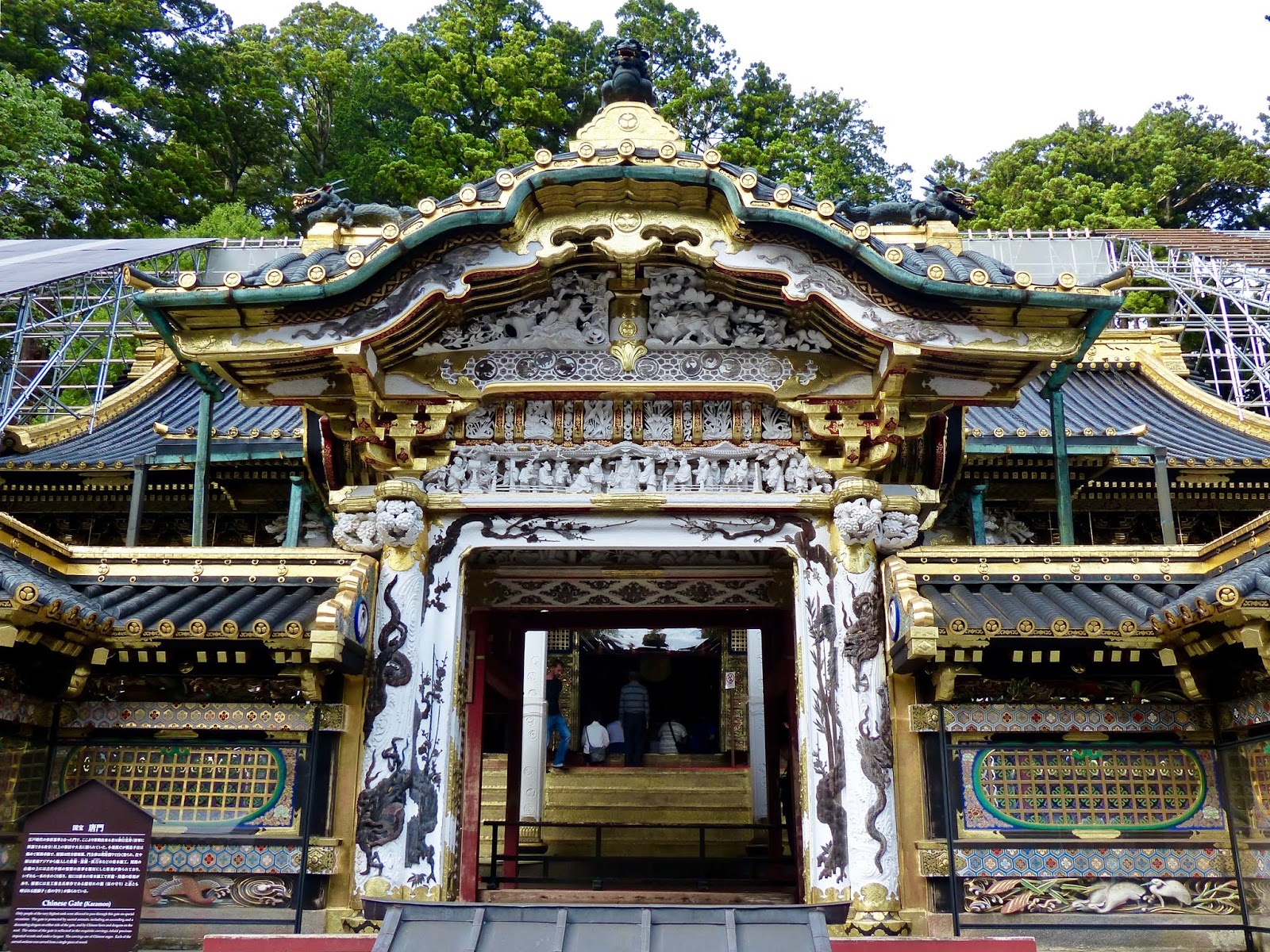
The most beautiful thing along this esplanade, however, is the gateway to the inner sanctum ... this is the higurashi-no-mon ... and the walls spreading out from it that enclose the buildings at the next level. The gate has multiple levels of dragon heads jutting outwards, with lashings of gold leaf,
white plaster guardian dogs and dragons who stand out by their lack of colour,
and scenes of particularly jolly Japanese people going about their lives.
Each panel of the surrounding carved cloister has three levels of carved decoration representing heaven, earth and water. This gave sculptors a broad scope which they lovingly filled with a dazzling collection of waterfowl, peacocks, clouds and flowers. Any one would be a masterpiece worthy of long concentration in a museum. The fact that there are 25, and these aren't even considered one of the major sights within the complex, gives you an idea of just how much there is to see here.
Climb up and through the gate, which is formally known as the Yōmeimon, and you'll come to a large courtyard in front of the main temple building, which lies through yet another ornate gate. This one has particularly magnificent statues of guardian dogs and dragons standing on the roof corners.
As a mere mortal you don't get to go through that one, however, but have to go around to the side, get rid of your shoes and join a shuffling queue of tourists. There's no photography allowed in the main shrine building, but it doesn't really matter; it's yet more of the exquisite high-relief interplay of flora and fauna with more crazy colours and abundant gold leaf.

Priests bustle quietly down the red-lacquer walkways on the inside of the cloister, which surrounds several other, smaller ceremonial buildings as well as the main one.
One, for example, is a performance stage for ceremonial dances. Another area holds a line of brightly-painted sake barrels ready for holy offering. A door nearby exits into the woods, giving access to Ieyasu's grave.

Above the door is one of the most famous carvings in the whole place, a peacefully sleeping cat. It is lovely, though I'm not quite sure why it's gained such fame as there's far more impressive work here. Nor is it representative of what's through the door. That would have been better shown by a horse, collapsed with exhaustion after being pushed to its limits ... because that may well be how you'll feel after your pilgrimage to the pinnacle of Nikko Tōshō-gū.
I didn't count the steps, but I'd guess the climb is the equivalent of scaling a 15- or 20-story building. The way is all paved with smooth, even stones and grand staircases, and you can stop at landings to admire the gorgeous forest of Japanese cypress you're climbing through, but it's still quite an effort. Thankfully, there's a water fountain and benches at the top, before you encounter the holy of holies.
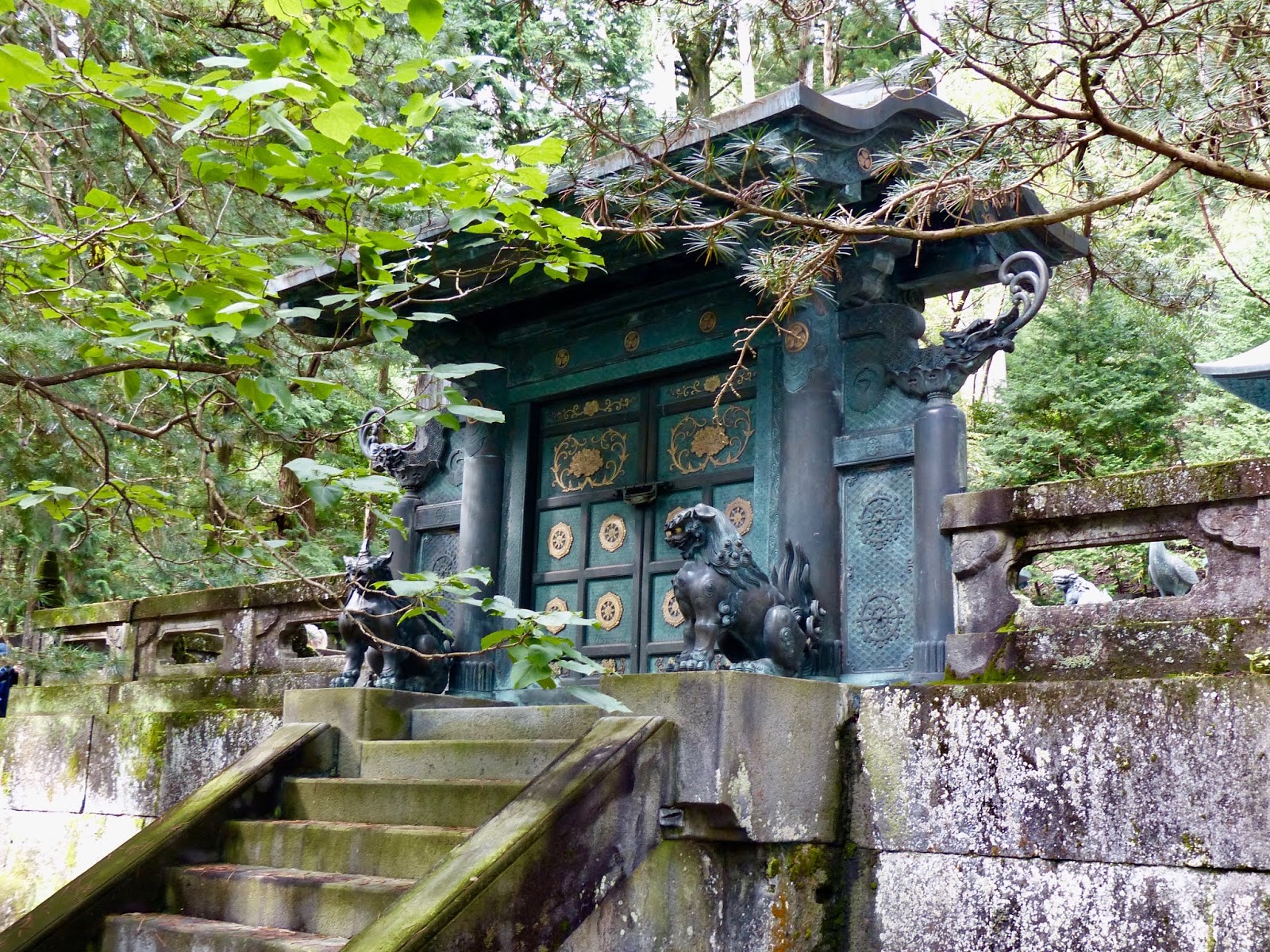
At this summit, the colour falls away and the pallet is mostly black, whether that's the paint on buildings or the patina of bronze. Even the tree trunks and the shadows between them seem thicker here, lending to the sombre atmosphere. There's another, short flight of stairs up to a small temple, then a path around it and one last burst of steps up to a walled, rectangular courtyard cut into the gentle slope of the mountainside. Closed bronze gates bracketed by snarling bronze guardian dogs block a straight-line access to Ieyasu.
You'll walk around the side. His remains lie in a bell-shaped bronze container capped with a pagoda-style roof, sitting atop a series of stepped octagonal platforms that rise like a pyramid to lift him to heaven. While there's a steady flow of people, it's nothing compared to the crowds below and everyone is respectful of this solemn place. His people proclaimed Ieyasu a Shinto deity after his death and there's no denying that this place of extreme beauty, surrounded by swaying cypress in the quiet mountain air, touches the divine.
If you want to know more about Ieyasu the man, once you trek back down from Nikko Tōshō-gū your ticket also gets you into the museum where you'll find many of his personal effects, a manga film about him and the treasures of the shrine. There's also a small cafe here where you can get drinks, sandwiches and cakes.
If you want to take in all the details and climb to the summit, then digesting the wonders of Ieyasu's mortuary complex will take you at least four hours. If you're coming from Tokyo you will have spent two hours getting here and will need the same to get back, so that's most of your day. Yet Nikko Tōshō-gū is only part of the UNESCO World Heritage site. The temple you passed at the bottom of the processional entry, Rinnō-ji, the Futarasan Shrine and the mausoleum of Ieyasu's grandson, called the Taiyuin, sell tickets for a combined entry. Unless you have two days here, or are a remarkably quick sightseer, don't make the mistake of buying this ticket first ... as we did ... because you'll never have time to see everything. We had a good wander around Rinnō-ji, and it is as impressive as some of the great temples of Kyoto, but didn't have time for anything else.
In fact, if we'd had the flexibility in our agenda I would have loved to have stayed several nights in Nikko. You'd really need to see the temples over two days, not just to have enough time but to give your brain a bit of a break from all that whirling colour and dense detail. But there's much more here. The town itself has an almost Alpine feel, with lots of high-peaked wooden buildings nestled against the mountains. We passed loads of intriguing shops and restaurants. In a land that doesn't do much dairy, local specialities included cheese and baked cheesecake. There are hot springs, hiking trails, a mountain lake and a historical amusement park populated with costumed performers from the golden age of the Shogunate.

All this makes Nikko not only the place with the most magnificent tourist attraction I saw in all of Japan, but the place I most want to return to. One taste wasn't nearly enough.


Monday, 14 October 2019

Take the side road for Nara's secret treasures

Was Nara really necessary? Kyoto's arsenal of historic temples, shrines and palaces can overwhelm even the most dogged sightseer. Daunted by the combination of my "must see" list, energy-sapping humidity and just four and a half sightseeing days, I couldn't help asking myself the question.

Surprisingly it was my husband, who usually accuses me of trying to pack too much in to holiday itineraries, who prompted me to buck up and stay on plan. Everyone he'd talked to who'd been there had said Nara was magnificent. And they were right.

Nara is primarily known for two things: the world's largest bronze Buddha and an enormous herd of tame deer. While those are both star sights, our day escalated from good to great thanks to an off-the-beaten track route that led us to my favourite garden in Japan and a magical secondary temple with larger-than-life-sized guardian figures that were probably the most memorable statues I saw anywhere in Japan, followed by one of the trip's most memorable meals.

In a country dominated by the modern, Nara is where you can touch true Japanese antiquity. This was the capital of Japan and home to the imperial court before Kyoto. Though the Nara period lasted for less than a century, from 710 to 794, that time coincided with the introduction of Buddhism into Japan. The religion's most important supporters were various Nara-based emperors and empresses who spent enormous ... and many historians would say unwise ... amounts of the national treasury on impressive temple complexes to promote adoption. Artistically, I get the sense that the Nara period is to Japan what the Renaissance is to Italy. Artists seemed to be cranking out masterpieces throughout the 8th century. Any item displayed in a museum from this period seems to be given a sense of reverence.

As with so many historic sites in Japan, there's more here than you'd think at first glance. The "historic monuments of Ancient Nara" that make up the UNESCO World Heritage Site include eight temples, the ruins of an imperial palace and a primeval forest. In a refreshing change from what we saw elsewhere in Japan, most of Nara's temples are in a sprawling park, providing a far more soothing backdrop than the usual urban clutter. It would take you days to see it all. Most people, here on a day trip, head directly for Todai-ji, home of the giant Buddha.

You won't even need to research the main route. Just exit the train station (it's about 90 minutes from Kyoto) and follow the crowds. You'll be walking uphill along the side of a major street that, at first, is lined with modern buildings. But there are immediate hints that this place is different. The venerable old monk collecting money by the fountain. The greenery. The temple and pagoda roofs glimpsed over treetops. And the greedy deer.

Legend says that the god Takemikazuchi arrived riding a deer soon after the capital was built, sworn to protect it. Deer have been sacred ever since, and the kami spirit of the deer ... represented as a chubby boy with a mischievous grin and antlers sprouting from his forehead, has become the informal mascot of the town. Note that these are shinto deities in a place known for its Buddhist shrines. The two religions sit comfortably side by side and the Japanese tend to mix and match bits of both. While I noticed nothing god-like about the deer, they're certainly smart enough to make the most of a good thing. Ladies along the route sell stacks of sika senbai, or deer crackers, for the equivalent of a couple of British pounds. The deer are well aware of where the selling points are and what the crackers look and smell like, developing an instant, dog-like adoration for any tourist who may provide food. Many have learned to bow in order to get their treat.

There are said to be more than 1,200 in the flock and I suspect they're well maintained by the tourists, since by the time we left in the late afternoon most had lost interest in the humans and were sleeping off their full stomachs in the shade.

After a few minutes the path uphill dips into an underpass. When you emerge, you'll see the enormous museum of Nara to your right (sadly, we didn't have time to check it out). Most tourists will continue straight ahead. We turned left, and then right, following signs for Yoshiki-en and Isui-en gardens. (Which I wrote about in this earlier story.) This takes you into a small, beautifully maintained district of traditional homes, many of which seemed to now be used as ryokan, shops or restaurants. As so often happens, the minute we turned off the main route the crowds dropped away. Though a few deer remained.

At the end of the road, on the crown of a modest hill, sits Kaidan-in. This small temple was the ordination hall for the priests who worked across the larger complex. It is a place of enormous peace, with a single temple building sitting in a sea of white gravel, raked into zen patterns and enclosed by high, whitewashed walls.
Inside, after shedding your shoes, you climb up to a wooden walkway that circles a central area where a buddha and protective kannon are enshrined beneath a miniature pagoda. But the star sights here are the guardian figures at each corner.

They are towering depictions of the four heavenly kings, popular guardian figures reminiscent of the Christian archangels. Traditionally, there's one for each point of the compass, and each has his own attributes and weapons. They are spectacularly lifelike and appear as if frozen in a moment of violent action. Swords and spears are poised to strike, demons writhe beneath their feet and their faces show a range of lifelike emotion from terrifying rage to a benign calm. Most amazingly, they are terra cotta, a particularly difficult material to work with at this scale, and more than 1,200 years old. They'd have reached the ripe age of 650 before any artist in the Western world came close to this proficiency with the same material.
Once you've paid your respects to the kings, it's a short walk and deer dodging of a few hundred yards to reach the main temple building of Todai-ji. This is a building on an entirely different scale; one of the largest wooden structures in the world. Approaching it this way will deprive you of the monumental entry through the massive Nandaimon Gate,  with more giant guardian figures glowering in its porches, and a long, processional walkway with lots of subsidiary temples visible across parkland. Don't fret, you can leave that way. The side approach might not be as dramatic, but it will save you from shoulder-to-shoulder throngs of jabbering tourists and traffic jams as people stop to feed the deer. You'll rejoin the crowd once you pay to enter the main temple, but coming by the quiet side route will put you in a more thoughtful mood for the sacred sites ahead.

Todai-ji's main temple building sits at the centre of the back of an enormous rectangular cloister, the centre front forming yet another ceremonial gate. Stalls beneath the covered walkways sell the usual assortment of prayer boards, written requests and lucky charms, plus a fair amount of Nara-themed tourist tat. It's unlikely you'll have eyes for any of that, of course, because you'll naturally head down the paved path through the centre of the cloister and ascend the main temple steps. The building is magnificent, with dark decorative timbers interspersed with white panels, and bright red grills decorating the underside of the swooping roof eaves. Many people won't even notice, so fixated are they on getting to the main event.

The Buddha who looks down upon you through a haze of incense as you enter is 49 feet tall, and he's sitting on a lofty lotus-leaf pedestal which raises him much higher. His golden halo is 87 feet around his shoulders and head, clustered with smaller Buddhas on their own lotus thrones, like a host of angels circling the scene. He is the pure black of worked bronze, making his gold background all the more striking. He's flanked by two golden Bodhisattvas that are almost as big as him; it's the trio taken together that really makes the scene jaw dropping. In front of them are a variety of offerings, from pots of enormous bronze lotus to real pine trees, bowls full of incense sticks and racks of flickering candles. It may be a tourist attraction, but most of the Oriental visitors stop to pray here, in the same way a Catholic might do at St. Peters before exploring the sights. You can walk around the backs of the figures, where you'll encounter more giant guardians and a fascinating model of the complex as it once was. Though this building is impressive, it was three times bigger before being destroyed by fire and rebuilt in the early 17th century.
There are many more temples to see in Nara but by the time we'd finished with Kaidan-in and Todai-ji, we'd had our fill. We needed sustenance of a different kind, so returned by the more well-trodden tourist route to the main street that led down to the train station. There we stumbled into a fabulous sushi place that was part of a complex of restaurants and snack bars around a courtyard with a small, traditional garden. It might have been called Kotonoha, but I'm relying on Google maps after the fact to spot it. The building featured traditional Japanese architecture with a small ante-room and shoe racks before stepping up to a counter to be greeted. To the left, people sat at floor level on tatami mats along long tables and seemed to be tucking in to ice creams and cakes, on the right were rooms with more Western tables and chairs where they were still serving lunch despite the clock pushing 3.

We ordered a set meal sushi combo that came on a spectacular three-tiered stand and came with tools, instructions and the materials to make your own hand rolls. We did a fairly poor job, but had a great time playing about and enjoyed the delicious range of fish, salad and pickled vegetables presented for our delight. For two thirds of the meal we were also the only people in the room behind the sliding paper screens, giving us just a hint of the regal luxury I described when we dined at Yoshida Sanso. Then a bunch of French rugby fans came in and the atmosphere was broken.
By the time we finished it was late afternoon and with at least 90 minutes to get back to Kyoto we admitted that, even though we'd barely scratched the surface of this remarkable place, we had to be getting back to home base. Had Nara been necessary? Absolutely.

Sunday, 4 October 2015

Bavarians know how to rock the rococo

What adjectives spring to mind when I say "German"? Precise. Efficient. Logical. Controlled. Now, let's think about the words usually associated with the artistic movement called rococo: Frivolous. Bombastic. Playful. Extreme. Put two and two together, and you'd assume the Germans would have nothing to do with the ornate, late-18th century decorative style born in France and Italy.

You'd be wrong. Very wrong. Indeed, if you want to see rococo at its peak, my latest travels have convinced me you need to go to Bavaria.

Often working with Italian artists, and usually funded by the deep pockets of ambitious Wittelsbach rulers eager to make a splash on the world stage, German craftsmen took the style to a whole new level.  In religious spaces, they created lip-smackingly succulent visions of heaven, populated by gorgeous saints and frolicking putti wreathed in gold.  Secular versions are downright sexy, often swapping the Catholic stalwarts for scantily-clad Greco-Roman deities getting up to no good.  It's all riotously over-the-top, and tends to divide opinion.  If you're a sober-minded fan of clean lines and uncluttered spaces, Bavarian rococo may push you towards nausea.  I confess to loving it. I can't remember a holiday during which I've had so many instances where the simple act of walking into a room kindles pure joy, triggered by the playfully gleeful scene before me.

Let me take you on a tour of my favourite spots.

We'll start at Munich's Asamkirche, officially the church of St. Johann Nepomuk. This is technically late baroque, just on the threshold of rococo.  Gold, silver and marble, everything soaring upward to a painted vision of heaven ... it's all the glory of Rome's St. Peter's distilled into an architectural stock cube.  Unbelievably, this was a private chapel built by two craftsman brothers who lived next door; they could peek in on mass through a window in the upper story.  The Asams were multi-disciplinary builders (design, plasterwork, decorative paintings, etc.) who used the church to show off their skills.  Clearly, they did very well at their trade, because this is as lavish as any royal commission.  The brothers were masterful with their use of light and colour.  The dark wood pews sit in shadow mirroring life in this world. The higher your eye moves, the brighter things get, until you're emotionally sucked in to the swirling saints and sunshine of heaven above.  If I only had one hour in Munich, this is what I'd see.

The Bavarian Rococo hits its full, glorious stride in the Wieskirche, a pilgrimage church in the countryside south of Munich.  (Pictured top) In a region most famous for the royal residences of Neuschwanstein and Linderhof, this is what UNESCO flagged as a World Heritage site. You'll understand as soon as you walk through the door, and your jaw drops at the confection displayed before you.  While the Asams and the baroque played with light and dark, full rococo does away with the latter altogether.  This is a world of bright whites, frothy pastels and lashings of sunlight. Ironically, this is officially the Church of the Scourged Saviour, and there is a dark, medieval, pathos-filled statue of the bleeding Christ at the centre of worship here.  But he's totally upstaged. This isn't about the pain and suffering needed to get to heaven. It's giving you a moment in which you're already there. The church is essentially round, with a bit extending off the far end for the towering flourish of an altar. The shape exacerbates your feeling of floating, as if you're joining the saints and angels floating up the columns around you.

The outside is as beautiful as in, but in a totally different way. Plain cream walls rise out of a green field, topped with trademark Eastern European domes. A few quintessentially Bavarian buildings cluster nearby to provide services to pilgrims and tourists, but otherwise it's meadow, farm fields and forest stretching to a ring of high hills that cuts the valley off from any sign of "civilisation".  Peace permeates the place. It's a feeling you'll take home, as long as you can dodge the busloads of chattering tourists.

Next stop: Dillingen an der Donau, home territory of the Bencard family and well off the beaten tourist track.  It's worth an hour's detour just to see the Goldener Saal, or Golden Hall, here.  This was the main audience chamber of the powerful Jesuit university that once dominated the city, and it makes one hell of a statement.  Like so much of rococo architecture, it relies on the surprise of contrast. You'll approach up a fairly sedate staircase, white walls only moderately decorated with some gold stucco work. The more ornate doors hint at what's inside, but once you're through them all restraint disappears beneath the towering vision of heaven rising above.

Once again, dawn-lit clouds swirl to infinity as saints and the great and good convene. But in this partially secular space they mix more with the human world.  The building you're in rises on one side of the painted ceiling, the building across the street on the other.  Scenes of hunting and everyday life take up the lower edges, mixed with all sorts of neoclassical allegory.  In what we came to understand is a classic feature of the Bavarian rococo, bits of the scenes ... a snake's head, a horn, a dirty foot ... are modelled in plaster and jut out from the painting, making the illusion of depth and reality even better.  This is the best trompe l'oeil ceiling I've ever seen.  We spent ages debating whether certain elements were real or painted, and it was hard to believe that the ceiling didn't extend upwards for multiple stories.  Unfortunately, because it's little known and inside a working university, opening hours are limited and there's no tourist information in English.  I would have loved to know more about all the symbolism and the messages going on up there, but we could only guess.  Don't leave without going to the end of the block to poke your head into the Student's Church, an early rococo gem that's credited with inspiring churches all over Germany because of its influence on all the priests who studied here.

I think rococo reaches its greatest glory in secular buildings where, free from religious constraints, it can indulge in the frivolity and sensuality it does so well. And there was no better place to see this on our trip than at Nymphenburg Palace.  The Palace itself is classified as baroque, has many ornate rooms, an expansive folly-dotted park and is worth several hours of exploration.  It's just two bits I'll call out in my rococo ramblings: the main hall or Steinerner Saal and the Amalienburg hunting lodge.

The former is the first thing you see on your tour. It's a soaring, three-story, light-drenched space. Like the Wieskirche, the decoration is fairly restrained and mostly white on the lower levels, forcing your eye upwards for an explosion of colour.  But in this domestic space we can have scenes of hedonistic indulgence.  Apollo drives his chariot across the sky. Romantic trysts play out in multiple spots. Scantily clad nymphs (after which the palace is named) cavort with abandon.  All wreathed with sinuous gilded plasterwork and refracted through numerous crystal chandeliers.  My first reaction was, quite simply, to giggle with glee.

Even more childishly, once inside the Amalienburg I wanted to dance.  That's what rococo does to me.  I believe it's an essentially feminine style, which is perhaps why this lodge built for a holy Roman empress, Maria Amalia, reaches the climax of the style.  I saw many halls of mirrors on this trip but none beat the one here, an oval concoction of powder blue, white and silver flooded with light from arched floor-to ceiling windows reflected in the mirrors.  It's the silver that makes this place so unique, lightening the tone even more than the usual gold. You're overlooked by scantily-clad neoclassical figures who are modelled in high relief, silvered and set to frolic around the tops of the walls.  This was a place built for joyful partying, and every element of the decor reinforces it.


Side rooms continue on the same themes in different shades of Easter egg pastel, all maintaining the silver gilt.  The best rooms after the main hall are the two most functional ones.  The Delft tile kitchen is a riot of European Chinoiserie, made even crazier by the fact that the tilers messed up the installation so many of the flowers and animals don't go together quite as they should.  The empress must have liked the effect, however, because it remained.  Even more delightful is the kennel room.  A glorious blue-and-white number, here the decoration is delicately painted hunting trophies on wooden paneling.  It's a room fit for an empress, but it's meant for the hunting dogs who could bed down in a series of niches built into the walls. (See below) I'd wager a large bet they all had collars in pastel shades covered with silver filigree.

This was just the tip of the rococo sightseeing iceberg.  The guidebook offered many more star attractions in Bavaria than we could fit into our two weeks.  I enjoyed everything we did: the castles, the mountains, the beer gardens.  But on the top of my list for reasons to return?  The Bavarian Rococo.