Saturday, 8 January 2011

From homey to high cuisine, Danish food surprises and delights

Almost a year ago, after a particularly memorable meal at La Distillerie in Luxembourg (see 5 February 2010), we asked the award-winning chef where he got his inspiration. Denmark, he replied without hesitation. It was, according to him, the country with the most innovative chefs, setting the latest trends in high cuisine. A few months later, Copenhagen's Noma was named the best restaurant in the world.

Clearly, Danish cuisine featured more than the pickled fish, open-faced sandwiches, beer and snaps to which I'd thus far been introduced. Copenhagen, it seemed, wasn't just going to be about sightseeing and meeting future family, but would be a journey of culinary exploration.

The town delivered on its promise. From a high end restaurant that ranks as one of my top 5 meals ever, to delicious family-style lunches and great street food, Denmark turned out to be a seriously "foodie" destination. But be warned, come with deep pockets. Even our average meals would be very expensive in London, and the cheapest bottles of wine on a list were rarely under £30. You pay for your pleasures here.

So, let's start with the high end. Vaulting into my Top 5 restaurant list, clearly standing shoulder-to-shoulder with places like The Fat Duck and La Distillerie, is Restaurant Herman within Tivoli's Hotel Nimb. The New York Times skipped the more famous Noma and opted for this one in their luxury guide to the city. (Amusingly ... or maybe not ... headlined Copenhagen on $1000 a day!) The five course tasting menu is 850 kroner, with another 850 for the matching wine flights, plus a few extra drinks. If, like me, you have no brain for numbers, you won't figure out until the next day that's £250 per person, thus deferring the financial pain until you've made your wonderful memory.

Like the Fat Duck, the Herman experience is a combination of exquisite food, theatrical presentation and magnificent service. Though we officially paid for five courses, there were at least three amuse bouches and one pre-dessert, and each "course" was served in two or three stages. So, in reality, we worked through a progression of at least 10 plates of food, each highly original and very flavourful, but none particularly odd. At other chef's table experiences like this I've always had a couple of courses I didn't like; at Herman, while some of the presentation was exotic (for example, chamomile steam billowing from beneath a bowl of shellfish stew), nothing was so bizarre that you thought the chef had overstepped the bounds of culinary common sense.

Favourites amongst this staggering profusion were oysters with a granite of pine, seared foie gras with cherries (no surprise there), and venison with mushrooms and cabbage. The last was elegant, yet filled with the simple goodness of the forest. Piers had dessert ... a three-stage extravaganza featuring artistry with pears and gold leaf ... while I went for the Danish cheeses, selected from a detailed and descriptive menu (displayed in the picture). Each course came with carefully selected wines, all explained with great detail and genial anecdote by one of the best sommeliers I've ever encountered. I really regret not taking notes, but the whole experience was so delightful, I simply lost myself in the joy and never thought of it. Add to this a wonderful room in the Moorish palace that's one of the architectural highlights of Tivoli; the white room looks out expansive Arabic windows at the festive lights of the park.

Our next best meal was just a stone's throw away, at the same hotel's Brasserie Nimb. Architecturally this shares the same windows and views, but the interior is more casual, with simpler place settings, less linen and open kitchens set amongst the tables. We booked here for New Year's Eve, a single price all-inclusive that featured pre-dinner cocktails, a five course meal with wine, cigars, port and whiskey on the terrace after dinner, beautifully timed to take in the impressive fireworks spanning the horizon from midnight, and then upstairs to a ballroom sized bar for a band, dancing and as much as you cared to drink, with snacks to help balance the alcohol. (The next day's general malaise tells me I should have had more snacks, less champagne.)

I'd never been to an all-inclusive New Year's party like this and was a bit skeptical. Even at £200 per person, I figured that there would be some recession-beating cuts on their part to maximise their profit margin. Slowing down drinks service, using cheaper ingredients, etc. Nope. The evening featured copious amounts of everything, at the highest quality, with steady service. Favourite courses included pan fried scallops with Jerusalem artichoke puree and a fabulous white chocolate parfait with pistachio powder, but my favourite memory by far was Piers indulging in an impressively large cigar and a generous snifter of brandy on the terrace at midnight. He really does suit prosperity well.

While painfully expensive, both these meals were actually value for money, and cost roughly the same as equivalent experiences in London. It was when we moved to moderate dining that things were less satisfactory. A deeply average 2-course Italian meal with a bottle of wine at Il Peccato, a casual wine bar affiliated with our hotel, was £60 per person. A 3-course outing in the steak house at the Imperial Hotel with a bottle of red, really not worth writing about, was £80. For those prices you can get a really memorable meal in London. Clearly, it's the moderate meals that kill you here.

Fortunately there's street food to stretch your kroner. The Danes have an odd fascination with sausages. There are stands throughout Copenhagen's city centre, dishing up no gourmet varieties, but rather a few versions of the humble hot dog. These come with a bun on the side, a pile of fried onions and serve-yourself vats of ketchup and mustard. Surprisingly delicious and not to be missed.

One of my most memorable culinary experiences in Copenhagen is one that you, unfortunately, will probably not be able to copy. That was being invited into homes of locals for a traditional Danish lunch. These were festive family affairs, similar in spirit to American holiday meals but slightly more formal in the way each new arrival greeted everyone else, existing guests naturally forming a receiving line each time the doorbell rang.

The traditional meal takes place in two courses, the first heavy on cold dishes and fish, the second incorporating more meat, hot options and cheeses. Neither course does much by way of vegetables; this is eating heavy on protein and bread (both white and a lovely dark rye). For a woman who considered pickled fish an unappealing oddity 15 months ago, I'm growing quite fond of the stuff. (See the photo below for an indication of how many varieties are available in stores.) There's a somewhat spicy variety in a red sauce, and a curried version that's my favourite. Danish meatballs are excellent, surprisingly so considering they lack the tomato sauce my Italian roots never considered optional. I was less fond of the soft, hot mound of ground liver pate, but impressed by a range of Danish cheeses, most of which were completely new to me.

All this is accompanied by free flowing Danish beer, which is a light, easy-going lager that complements the fish particularly well. Beside your beer glass is a shot glass filled with snaps (the local aquavit), raised regularly as different guests propose different toasts. It's a pleasant little tradition that brings a pleasing formality and sense of festivity to your basic Sunday lunch.

I left Denmark with a new appreciation for the Danish Food Direct web site, and the suspicion that I'll be trying to recreate one of those classic lunches before the winter is out. While the high-end restaurants were most memorable, it's the traditional fare that's likely to become a regular part of my life.

Thursday, 6 January 2011

Copenhagen sightseeing: The best of the rest

Typically, I was carried away with the palaces. But there's a lot more in and around Copenhagen to see, and one of the advantages of such a compact place is that you can cover a lot in a short time. By the end of our five-day visit, I felt we'd ticked off most of the big sights.

A walking tour of the centre of town takes in most of the top attractions without a great deal of effort. Unless, of course, it's the deep of winter after heavy snows. We slipped and slided our way around, fortunate to never end up on our backsides but definitely prone to a few of those comic, arm-windmilling moments of near collapse.

Certainly the most magical snow and ice fields through which we trekked were in Tivoli Gardens. For some reason I had always had the (incorrect) impression of this as formal gardens in the European style, with flowers, parterres and fountains. Nope. It's Disneyland. Quite literally. The legend has it that Walt's visit here is what inspired the original park. It's easy to see the inspiration, with themed areas, loving attention to architecture, careful landscaping and a balance between rides, restaurants and shops. I looked longingly at the roller coasters but, frankly, I was already having difficulty with the sub-zero temperatures. Accelerating the speed of the arctic air didn't seem like a good idea. Instead, we tried a progression of mulled alcohols (wine at one booth, cider at the next ...) and drank quickly before the libations cooled. (Drinks went from boiling to chilled in about 10 minutes.) The whole place is magical at this time of year, kitted out with Christmas lights and featuring a Christmas land where elves play amongst the igloos and romp with polar bears. Go after dark for the best effect.

A comprehensive walking tour of town started on the Strøget, a long, pedestrianised area linking the west and east parts of town. Though recognisable global brands were present, the town seemed to retain more local vendors than the modern average. Royal Copenhagen is, of course, worth a look in, but the most interesting shop is probably Illums Bolighus, a multi-story emporium of kitchenware, furniture and design all with that clean, bright Danish style.

Strøget empties into an exceptionally large town square called Kongens Nytorv. Here you'll find the country's most famous department store, Magasin du Nord, and the Hotel d'Angleterre, supposedly the city's grandest hotel (poky, dark lobby and a '70s-feeling coffee room and restaurant across the front; I wasn't impressed), the royal theatre and all manner of grand facades of former palaces surrounding an equestrian statue of Christian V, the "Kongens" for whom it was named. I saw photos of the square in summer in which it looked lovely and gracious. I have to admit that at this time of year it was just a greyish white stretch of tundra with dirty slush around the edges, disfigured by a massive public transport construction project.

While here, we picked up the sound of the royal guard coming down Strøget for their change in front of the current Queen's palace of Amelienborg. Here, Copenhagen beats London, as the ceremony covers a much longer distance and is more interesting at its culmination. The guards march a good half mile, led by an impressive marching band that pulls tourists and natives like a group of pied pipers of Hamlin. When at last they reach the palace, the change takes place four times, because Amelienborg is actually four matching neo-classical palaces, set on corners of an octagonal courtyard, with the massive dome of Frederick's church anchoring your eye out one sightline, and the modern opera house along the other. All this dramatic architecture, designed to be a fluid, monumental whole, makes Amelienborg one of the great architectural set pieces of Europe. Even better when a bunch of nattily dressed guardsmen in bear skin hats are enlivening the scene.

Frederick's Church, more popularly known as the marble church or Marmorkirken, is more impressive on the outside than in. It's the dome of St. Peters, brought north and put atop an imposing classical building. Unfortunately they ran out of money in its construction, delaying its completion for a century, so the deft, light touch of the baroque gave way to heavier, darker 19th century styles. Worth a look, but it's a brooding, somewhat oppressive interior that won't encourage you to linger.

Nearby (in fact, just off Kongens Nytorv) is Nyhavn, the picturesque harbour. A procession of colourfully painted warehouses stand on either side of a channel filled with sailing vessels. Most of the buildings are now restaurants or hotels. It's clearly a hub of nightlife on the tourist scene, but was too far a walk for convenience from our hotel, so we simply walked around at mid-afternoon and took a few photos.

Just beyond Amelienborg in the other direction you can walk along the waterfront until you get to the statue of the little mermaid, for most people certainly the most well known attraction in Denmark. She is, I'm sorry to say, a disappointment. I'd always had the impression of her sitting in the middle of the harbor, framed by water. Instead she's right up on the shore, perched on a rock on a small, pebble strewn beach and surrounded by busloads of tourists. Much more impressive, to my mind, is the monumental statue of Gefion you pass on the way to see her.

Gefion was a minor Norse goddess to whom the King of Sweden offered as much land as she could plough in a day. She used magic to turn her four sons into supernatural oxen, and the quartet was able to circle enough acreage to create what is now the island of Zealand, on which Copenhagen sits. The statue is of a much larger than life Gefion driving the four impressively energetic oxen before her plough, and sits at the top of what, in summer, is a large, cascading fountain. It doesn't take long amongst the Danes to pick up the long-standing, passionate rivalry with the Swedes, so this isn't just an attractive monument, it's a statement of national pride and a reminder of superiority over the northern neighbours.

Within three days we'd ticked off the majority of sites in my Top 10 Copenhagen book, so thought a trip outside the city was in order. A decision reinforced by the fact that few other things were open on New Year's Day. So it was off to Roskilde.

This is an ancient city with deep Viking roots, ranging up a hill above a fjord. There's a good variety of tourist attractions, but the top two are the cathedral and the Viking Ship Museum, the first at the top of the hill and the second below, on the harbourside. (This is worth mentioning (a) because there are so few hills in Denmark and (b) because slipping and sliding our way up and down that hill was one of the most precarious parts of the holiday.)

The cathedral is absolutely fascinating. Unusual in that it's entirely of brick construction, yet light and airy inside due to generous windows and plaster vaults of bright whitewash decorated with vivid medieval designs. I was surprised, in a royal cathedral in a protestant country, to find many ancient catholic touches remaining, from the wall paintings in the chapels to the saint-encrusted tomb of Margaret I to misericords on the bottoms of the choir stalls. Either the reformation was a lot more gentle here than in many other parts of Europe, or they've done a lot of restoration. The main draw of this church, however, is the procession of royal tombs from the legendary Harald Bluetooth to the present day. You can even see the artists' model of the radically modern glass egg that will someday hold the present queen and her consort.

Christian IV is here, of course, in a gloriously over-the-top mortuary chapel (see right), a private box and the pulpit. Elsewhere are clusters of later 17th century tombs beneath marble canopies, baroque fantasies encrusted with fluttering angels and a room of early 19th coffins that look more like a display of oversized French Empire urns than anything funereal. Our wander triggered a real interest in Danish history, as when I look at a grandiose memorial I want to know more about the person inside. Does the sculpture honestly reflect the majesty of a life, or is it architectural compensation for under achievement? While not sure of her contributions, I was pleased to spot the baroque splendour of Queen Charlotte Amalie's tomb. Any woman who gives her name to a Caribbean capital filled with great duty free shopping and within spitting distance to some of the finest beaches in the world is going to deserve a few extra prayers from me for the gentle repose of her soul.

Down the hill, the Viking Ship Museum is a smaller and far more austere experience. The whole place is built around the carcasses of five early medieval ships that had been scuttled to make a breakwater. Not enough to make a whole museum, you'd think. But from the bones of these vessels the Danes have crafted a rounded experience. First, there are the ships themselves, displayed cleverly, in an austere, featureless hall with a glass wall behind them looking over the fjord, so it's not hard from certain angles to imagine them sailing again. There are exhibits and dioramas about the different kinds of ships, how they were used and why they were sunk. A film showing the voyages of a reconstruction of one of the ships does a fine job of conveying how brave the original sailors must have been to take to the high seas in these things.

At the end of the exhibit you get to a hall with reconstructed sections of ships, decked out with supplies, sails and painted backgrounds. On pegs across the wall are Viking costumes to try on before scrambling aboard. Were I five, or even 15, you couldn't have kept me out of them. Trying to maintain a dignified 40-something I resisted the dress-up-and-take-a-picture game, though I do think I would have looked fetching in one of those fur lined cloaks. Maybe next time.

Coming next: Why Denmark is the world's new culinary capital.

Tuesday, 4 January 2011

Copenhagen sparkles through the arctic chill


The guidebook says there are only two months not to visit Copenhagen: January and February. Short days, wind whipping in from the Baltic, leaden grey skies and, this year, snow and ice that even the Danes say is exceptional. I think it's safe to say I was introduced to this city at its worst. Even so, I loved it. Imagine how I'll react to a clement June day...

The first half of this momentous holiday didn't go as planned. Snow-disabled Heathrow managed to get me to America, but left Piers in London. We still got engaged, but on a quiet evening at home rather than at some showy holiday occasion. I spent Christmas up to my ears in doctors, drug lists, lift chairs and all the accoutrement required to try to keep a very ill woman in her own home. Back on my original schedule on the 28th, I flew to Chicago, spent a day with my best friend from university, caught the overnight to Amsterdam, then hopped to Copenhagen, to finally be back in my fiance's arms by mid-day. On the agenda: 5 days of magical sightseeing, fine meals, family gatherings and a glittering New Year's Eve event before returning to the reality of work, mother and wedding planning.

So, let's talk sightseeing. Copenhagen is a small, low, flat city. In size it reminded me of Dublin. In its urban architecture, of Amsterdam, and its palaces of London. The ubiquitous hot dog stands and the wind knifing off the water were all Chicago. It's a melange of many other places, yet design elements from its Viking past, the sleek, pale modernity of its interior design and its vowel-laden, unpronounceable language make it clear you're someplace new.

My favourite sights, by far, were the two royal palaces we visited. Both are heavily stamped with the spirit of Christian IV, Denmark's longest-reigning king and one who was fortunate enough to have both the flowering of the Northern Renaissance and military and financial successes under his belt.


His magnificent crown, on display in the treasury at Rosenborg Castle in the centre of Copenhagen, screams of confidence, power and a fondness for complex opulence. It is an example of the apogee of the jeweler's art. For my money, this single piece of regalia beats the British crown jewels hands down. As does the viewing experience: on this late December day we were almost alone in a treasury filled with magnificent jewels and works of art, able to take our time and linger over details. A far cry from the Tower of London's treasure room, so overwhelmed with crowds that you're now compelled to float by the bling on a moving walkway.

The castle above the treasury is small and surprisingly intimate for royal lodgings, with the unusual layout of monarchs' sitting and bedrooms on the ground floor, while the public space of the throne room is in a long gallery two flights up. The style here is what the English would call Jacobean: intricately carved walls and plaster ceilings, both heavy with strapwork, grotesques, pinnacles and obelisks, black and white chequered marble floors, intricate marquetry furniture. There's a fine collection of solid silver furniture and the silver, life-sized lions that go along with the Danish throne, a couple of eye-popping baroque rooms encrusted with curving shelves filled with china and a rather spine chilling collection of wax figures of former monarchs sitting inside glass booths, like nothing so much as those carnival fortune tellers who move and spit out a card with your future upon it when you pump in a coin. These are relics of a Germanic tradition of private museums of curiousities, which ... amongst other ephemera ... could include life-like wax models of your monarchs, friends and heroes.

The most remarkable room to my eyes, however, was a chamber with mirrors not only on walls and ceiling, but laid in an oval on the floor. When you looked down, you were gazing into an pool that went down forever. Still an amazing effect in the 21st century, it must have been astonishing in the 18th.

About an hour outside of Copenhagen, on the edge of the small town of Hillerød, is the much larger Frederiksborg Castle. A fairy tale cluster of towers on an island on the edge of a lake, its dreamy quality is enhanced by the fact that much of it is a 19th century reconstruction. After a devastating fire, the wealthy industrialist behind the Carlsberg brewery contributed the cash to rebuild the place to its former glory. It then became a museum of Danish history, much of the story told in portraiture.

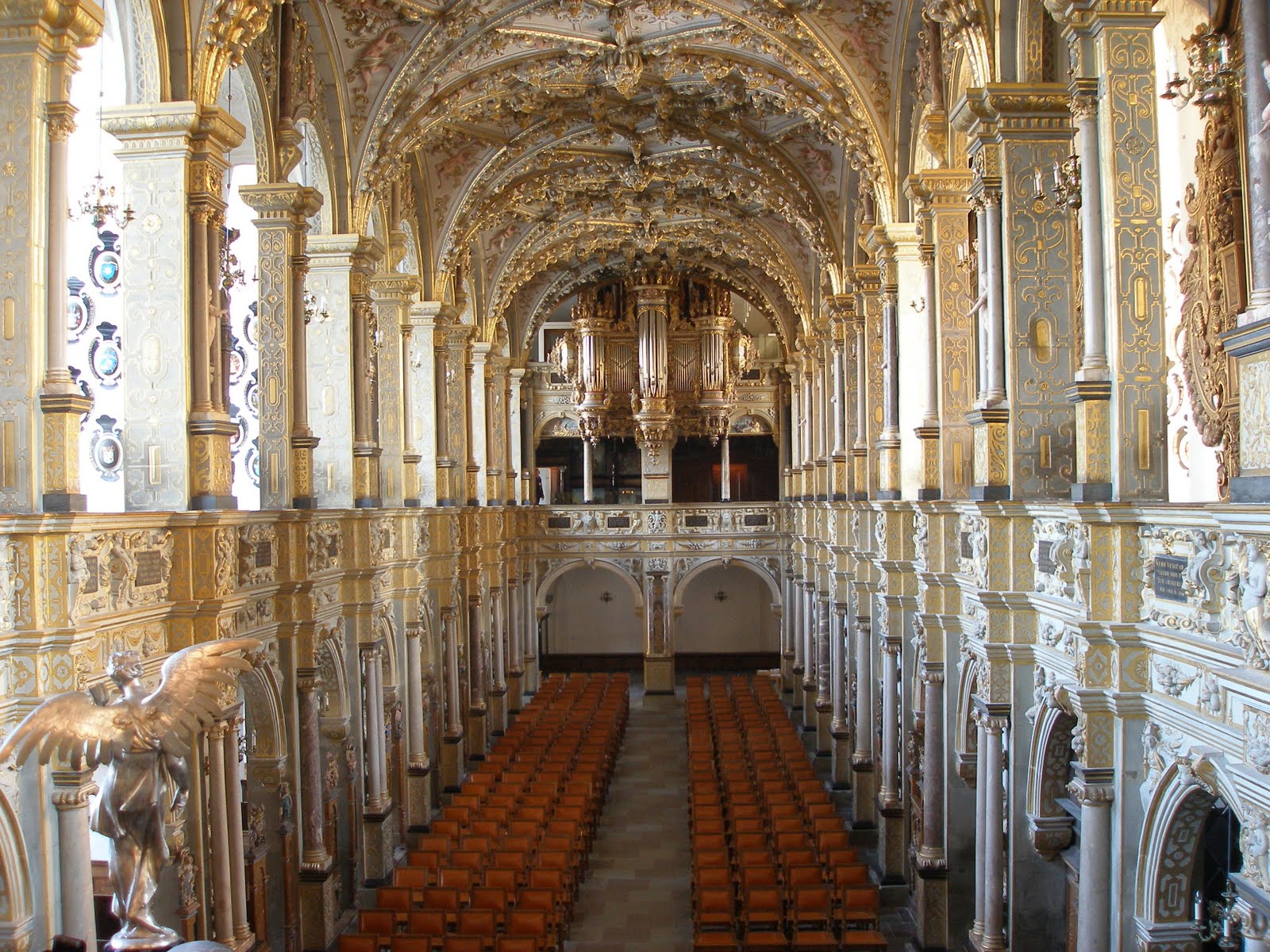
There are a handful of jaw-dropping rooms, most on a much larger scale than the town palace, and a few mostly original. The royal chapel is perhaps the most magnificent and the most authentic, with lavish decorations on the ceilings and walls so ornate you'd swear it was Christian IVs remarkable crown writ large. Similar to St. George's Chapel at Windsor, this is home to Denmark's highest order of chivalry (the elephant) and the window embrasures are decorated with the shields of current and former holders, a veritable roll call of the world's monarchies and heads of state.

Also of note is the vast great hall, with gleaming marble floors and ornate gilt plasterwork, lined with monumental portraits of past monarchs; a knight's hall called "the rose" (supposedly after the Roman concept of "sub rosa", a place where you can speak confidentially), darkly Germanic with its wooden paneling and lifelike freizes of deer and stags made more realistic by the insertion of real antlers; and an audience chamber with a domed ceiling down a long, window-lined passage, all white, Baroque and encrusted with floating putti.

Admission comes with an iPod-based commentary. It goes into great detail and reveals plenty of drama in the history of Denmark, but you'll realise about an hour into your visit that you've hardly seen a fifth of the rooms, and if you listen to everything you'll need two days to get through. With early closing hours in the winter we certainly had to pick up our pace by the time we reached the mid eighteenth century, and a procession of lovely rooms from the Napoleonic and Victorian eras, including a re-construction of Hans Christian Andersen's study, flew by. Up under the eaves is a 20th century collection, heavy on heroic stories of the Danish resistance and rescue of Jews in the second World War.

Outside, beneath the thick blanket of snow, we could see the outlines of the magnificent Baroque garden across the lake, reconstructed in the 1990s. Even had the weather been mild, I'm not sure I would have had the energy to explore, as the scale of Frederiksborg is so massive that by the end of the tourist route both my feet and my brain were near collapse. Like any great museum or palace, this is a place that needs more than one visit to appreciate its diversity. I look forward to a return.

Coming in the next entry ... the best of the rest of the sightseeing.

Tuesday, 21 December 2010

Winter woes make me one of Heathrow's holiday casualties

It's a small world these days. Most of us who've chosen to live an expat existence aren't particularly bothered. Technology puts us in constant contact with our home cities and hundreds of long haul flights a day can get us home. At the back of every expat's mind, however, lurks the same nightmare. What if something happens and I can't get home when I really, really need to?

Welcome to Christmas 2010.

This was always supposed to be a big one. As our relationship got ever more serious, it was a chance for my boyfriend and I to introduce each other to the towns in which we grew up (St. Louis and Copenhagen) and the friends and family there. A chance for us to meet the remaining special people in our lives. Those people had been planning for months, lining up a whirlwind of parties, dinners and special events.

Then things got more crucial. My mother landed in the hospital after her visit in November and has been there ever since. Things don't look good. Forget the holidays. I need to get to St. Louis for her.

But God, BAA and United Airlines seem to have other ideas. Sure, it's me and hundreds of thousands of others, I know. It's not easy for anyone. And at least I'm waiting in the comfort of my own home rather than the refugee camp that once was Heathrow. But that doesn't lessen the angst, the nerves, the nail biting.

My original Sunday flight was canceled. Because I caught it soon after the cancellation was posted (2:45 am, to be precise) I was able to get on another flight. So, if I'm lucky enough to have ended up on one of the 20% to 30% of flights that has been managing to get out of Heathrow, I'm scheduled to be on my way at 3:30 tomorrow. Piers' flight, however, was canceled this morning. And with the thousands more cancellations between my re-booking on Sunday and his need to do the same today ... there were no options left before the holiday. The trans-Atlantic is, quite simply, closed to new traffic until the New Year.

So tomorrow the weather and the airline industry's coping strategies will hand me a Hobson's choice. If my flight goes, I breathe a sigh of relief as I get to my sick mother's bedside, but leave my love alone for the holiday and abandon the big plans to introduce him to my family. If my flight is canceled, he and I are together, but my mother ... to whom holidays are precious things never to be missed ... is alone on what's likely to be her last Christmas.

It's out of my hands. I'll wait for fate to decide where I'm going tomorrow, and with whom I'm spending the big day.

Saturday, 18 December 2010

Imperial China's Dim Sum and the Theatre Royal's "Oliver!" top holiday festivities

With the slow creep out of recession, I was hoping to see some return to the wild old days of Christmas office party merriment. Alas, no.

I fear that media company parties at impressive London locations and alcohol-sodden agency bashes reminiscent of university fraternity raves may be consigned to history. I suspect that the recession gave them a chance to look at those huge expenditures and realise they weren't getting that much business off their largess. Instead, as with last year (see 20.12.09), holiday celebrations were limited to smaller team lunches, dinners and theatre outings. Far better for the liver but, given the quality of the restaurants in the mix, no good for the diet.

Christmas outing No. 1 (team lunch with my lead communications agency) was at The Duke of Wellington in Marylebone. A gastropub of the kind becoming classic in London: Scrubbed wooden tables, bit of modern art on the wall, big bar but clearly much more about dining than standing around drinking. There's a first floor dining room we didn't see, and I suspect that might be more in keeping with the high quality (and prices) of the food. But for a large Christmas celebration, the almost Dickensian feel of the ground floor, with its big Georgian windows overlooking classical terraces, was perfect.

The food was good (and has gotten many rave reviews in London papers) though, to be honest, on par with most other gastropubs of this type. The one wacky bit of innovation on the menu that day was lobster macaroni and cheese. Had to be tried, and was certainly edible, but left me thinking there's a reason Italians have made a rule that you shouldn't mix cheese and fish. It's just does not do either of them justice. Otherwise, hearty, seasonal food, nicely prepared and attractively served. If I needed something in the Marylebone, I'd definitely go back, but I wouldn't go across town for it.

Christmas outing No. 2 (lunch with a broadcast/media company) won the novel cuisine award. Eastern European restaurant Baltic was a perfect choice for a cold, snowy day and gave me an appreciation for how well that cuisine matches bad weather. I wasn't particularly innovative in my ordering, opting for gravlax with potato pancakes followed by beef goulash with lashings of sour cream. Talk about stick-to-your ribs food! No surprise that I was warmed, comforted and full after that (no room for dessert), though I could have used a nap. The goulash was excellent, but the potato pancakes were overdone and unexceptional; not a patch on my boyfriend's Danish version. The novelty of the place might see me coming back, however, as there were many other things worth exploring on the menu. And the range of flavoured vodkas behind the bar did make me think a weekend visit could be in order.

Outing No. 3 (lunch with the MD of one of our copywriting agencies) won the good food award. Imperial China is, by miles, the best dim sum I've ever had. It's in a tiny courtyard off Lisle Street in London's Chinatown, and first came to the notice of my host when he learned this was the place the Chinese embassy recommended for taking the ambassador and other officials when British executives entertained them. Certainly we were amongst the few European faces in the place, which is always a good sign. The procession of dishes was diverse, beautifully cooked and well spiced; I wrote down the order because I'd get the exact same again.

Prawn dumplings. Prawn dumplings with chives. Vietnamese spring rolls. Fried crispy squid with sauce. Baked pork cakes with sesame. Crispy cheung fun (a soft rice noodle roll with some crispy fried noodle in the middle). Cheung fun fried in XO sauce (fried sheets of rice noodle stir fried with bean sprouts in a spicy sauce). A veritable feast, coming in ... quite remarkably ... at less than £30 for the two of us. This place is a gem, worthy of becoming a regular haunt. Worth noting, however, that my host warned against coming here for dinner, when the prices shoot up.

Outing No. 4 (with the customer reference programme team) started at Joe Allen's and moved on to see "Oliver!" at the Theatre Royal, Drury Lane. Allen's is unavoidable for any American expat. An American chop house pulled right out of the New York theatre district (the original sister restaurant is there), it serves American classics in a brick-walled, subterranean place just off The Strand. Its decoration wavers between theatre posters and American sports heroes, and the old guy who fires up the piano bar with sing-along show tunes is legendary. The food is good but unremarkable, with two exceptions: ribs and cheesecake. They have the best versions of both these American classics to be had in London. I wouldn't order anything else here. A rock solid, dependable spot for pre- or post-theatre dining.

The production of "Oliver!" has been getting marvelous reviews since its revival. And they're deserved. This is, of course, one of the great musicals, crowded with memorable tunes and enlivened by an exciting plot with interesting characters and real drama. The actors in this production were excellent, particularly Oliver, the Artful Dodger and the rest of the gang of boys. The sets were as much of a star as the actors, with scenery moving in and out, back and forth to give a tangible, detailed London-scape. It is, in fact, a great improvement on the film, which drags heavily in the second half. This version picks up the pace and condenses the drama, still getting all the plot elements in but not giving you time to be bored. An excellent night out and well worth the ticket price.

Though I must admit that given the darker side of the plot, I was rather surprised by all the children in the audience. I wouldn't have recommended this one for an outing with younger children. I don't remember if they spin it this way in the film, but here Nancy was clearly a child prostitute, pimped from an early age by Bill Sykes. It gives a bit more reason for her inability to walk away from him, and adds even more poignancy to the tragedy. "Oliver!" may be the heart warming story of an orphan who discovers his family and comes out right in the end, but ... in true Dickens style ... it's also an exploration of the underbelly of Victorian London and a portrait of an abusive relationship that degenerates into a horrific murder. I wonder if all the parents in the room remembered that before booking?

And thus ends a quiet but enjoyable season of office parties. Now it's time to wrap up work, batten down the household hatches and get out for the big, bi-continental Christmas and New Year extravaganza we've been planning since April. St. Louis, Chicago, Copenhagen ... here we come.

Tuesday, 14 December 2010

Career choice opened the door to a more spectacular English life

It was in the Banqueting House in Whitehall that my career choice was validated.

The story starts earlier and further away, on a December night in 1985 in Evanston, Illinois. I'd just aced my British history final exam. Realising that I loved the drama and personalities of the island kingdom's story more than anything else, I called my mother and told her I wanted to stay in school to get my master's degree in the subject. Mom blew a gasket. She was a teacher, you see, and immediately saw a career in history as the path to a low-paying, unappreciated career in education. Journalism was already a disappointment from the legal career she'd wanted for me. But teaching history? Horrific. "Make England your hobby, for heaven's sake. Make your career something that will earn you some money."

Now slide forward to 1998. I've followed a career in corporate communications and through stubborn persistence have gotten a post in my company's London office. On this night I'm representing us at a fund raising dinner at the Banqueting House. There's a conservative MP on my right and a government minister on my left. Luscious food is coming out of the kitchen. A chamber orchestra is entertaining us with 18th century favourites. The windows through which Charles I stepped to his execution are open, allowing a gentle breeze to come in with the whir of traffic on Whitehall. The throne of England with its canopy sits behind me, symbolically indicating the presence of the Queen, and above us Rubens' magnificent ceiling stretches. Such dinners for the country's great and good were exactly why James I had Inigo Jones design this room, and we were using it for its original purpose. When normally, it was just an empty shell gawked at by tourists.

And then it hit me. Mom was right. Had I been a historian, I no doubt would have known this room well. But would I have been invited to a glamorous dinner that brought the past to life? Hell no. Taking the corporate track was consistently getting me into places, in ways, that I'd kill for as a teacher, but no doubt be denied.

I think of that validation every time I visit this magnificent room. It is one of the most gorgeous spaces in London, and one few people have made the effort to see. Last week it was perhaps a touch less majestic than usual, as it was filled with trader's stalls for a charity Christmas market for Children in Need. Such craft fairs have become a staple of Christmas here, and offer a way to buy unique gifts from specialty producers. I had gone specifically to visit one of my favourites, Shibumi, a maker of frock coats and waistcoats in marvellously flamboyant floral silks with vivid linings. (See what I'm wearing in the photo of the post just before this one.)

This is the season for markets in a variety of historic locations. At the southeast corner of Hyde Park, just were the Great Exhibition once stood, you'll find "Winter Wonderland", a mix of gift stalls, food and amusement park rides. It looks great, all festive lights and authentic Germanic stalls. But the crowds, at least when we went late on a Saturday afternoon, were claustrophobic. A better bet is the market at Winchester, tucked into the cathedral close. The Gothic walls looming above the traders remind you that such markets have been taking place here for 1000 years or more.

Of the three markets, shopping was probably best at Winchester. Although all had roughly the same stuff. Fashion trends are clearly favouring hand-blown or fused glass jewelry, and silversmiths. Scarves and hats are copious, as are booths selling clever and colourful wooden puzzles for children. Winchester offers the best balance of Christmas decorations, clothing, jewelry, food, toys and random gifts, and this is where I got most of my shopping done. Had I become that academic, I might have visited these markets but I doubt I would have spent much. Like everything in dear old Blighty, unique and hand-crafted gift items are pricey.

Another history-drenched event enlivened the first weekend in December: The British Military Tournament. There's certainly some chance that Ellen the history teacher might have made it here, as it was big on celebrating the past and open to any paying member of the public. It was obvious, however, that the majority attending had some link to the armed forces. This is a revival of a similar event known as the Royal Tournament, last presented in 1999. It's a blaze of pomp, circumstance, marching bands and sparking uniforms. In the old days it was funded by the Ministry of Defence as part of official PR outreach. Despite great popularity, it became too expensive and time consuming to continue. Now it's back as a privately run affair to benefit military charities.

My partner, who has cause to know these things, said it wasn't as impressive as the old show. I, having little to compare it to and easily impressed by gold braid, tall hats and pretty horses, was delighted. The highlight of the show for most people was the gun race. A re-enactment of a part of the Boer War when the Royal Navy had to get guns inland to relieve a siege quickly, participants have to race a gun (as in, a medium-sized cannon on wheels, with a big, wheeled box of ammo behind it) over walls, disassemble it to swing it, and the whole team, over a chasm, reassemble it, fire a few rounds, then go back the way they came. It's impressive.

But for me, not as jaw-dropping as the musical drive of King's Troop Royal Horse Artillery. More cannons, but this time it's heavy rigs carried behind a team of six horses, arranged in pairs and with a rider on each pair, dashing around at high speed. No brakes on those gun carriages and nobody steering them, so it's a feat of extraordinary skill and quite nail biting as the various teams weave patterns and get far too close to each other for comfort. There were other mounted displays, several marching bands and a re-creation of a typical exercise in Afghanistan (complete with a model of a Chinook helicopter dropping from the ceiling to pick up the injured). In general, a big affirmation of the accepted wisdom that the Brits do pomp and circumstance well. One of the factors that made me love their history so much, no doubt.

The final quintessentially British setting of recent weeks took me to the Lansdowne. One of the great London clubs, headquartered in a Palladian townhouse just off Berkley Square designed by Robert Adam, it's unlikely my professorial alter ego would have gotten in here unless she'd followed Simon Schama into TV academe. (Which, frankly, I would have been damn good at.) Fortunately my boyfriend is a member, so I get to enjoy the fruits of his lengthy association. In this case, for a champagne tasting.

Now there's a way to celebrate the holidays. Black tie. Lovely company. The managing director of Laurent-Perrier in the UK talking you through five of their champagnes, chosen carefully to match each course of your meal. (Should I win the lottery, their "Grand Siecle" would become my house brand.) Good food. Like the Banqueting House, the shades of history nearby. In the Adam-designed round room, now the bar, the Americanophile Lord Lansdowne sat down with Ben Franklin and Robert Adam to hammer out the peace treaty that ended the revolution. And just like the Banqueting House, a lovely merger of the historic environment with a social event of the elegance and sophistication to match the building's original purpose. I might have made it to this dinner as a history teacher. But I think my strike rate for such things is a lot better as a corporate hack who made English history my hobby.

Thanks, mom.

Friday, 3 December 2010

Lords' star seems premature, but it was still a worthy Thanksgiving venue

Of all the many things to be grateful for this year, top of the list is the fact that my mother is still alive almost two years after a terminal cancer diagnosis, and managed to make it to England to visit us in our new home for the fortnight around Thanksgiving. That called for some celebration. So as the traditional American holiday approached, the two of us took off to that most English of spots: The Cotswolds.

We stayed for two nights at Windy Ridge, the cozy yet elegant B&B near Moreton-in-Marsh I discovered this summer. (See 27.7.10) On the agenda: A bit of sightseeing, a lot of lounging in front of the fire and one special dinner at The Lords of The Manor, a nearby luxury hotel whose restaurant was just awarded its first Michelin star.

Though an excellent meal for a price below London averages (£58 for three courses), I fear Lords was awarded its star a bit too early, as there were inconsistencies throughout. We start in the car park, where there is no lighting. On a moonless night, it was a blind shuffle to the gap in the garden wall, indicated by the lights from the manor house below. The light in the garden was burned out, so it was a good 50 yards from the car before I could see where I was going. Not a great start.

The amuse-bouche served in the bar while perusing menus was fish and chips. One small goujon of fish, a cone shaped, paper-lined glass holding three french fries and a tiny dish of mushy pea puree topped with half a hard boiled quail's egg. I've seen several TV chefs take this gourmet approach to the English version of McDonalds, and acknowledge it can be a clever way of appreciating the simple. However, if you're going to elevate such basic and familiar ingredients to fine dining, they'd better be good. Unfortunately the fish was overcooked and oversalted, and the chips unexceptional, making the pea puree the star of the little plate. In the dining room, excess salt became a theme, with the bread and next amuse bouche being so laden with it we actually had to send a message back to the kitchen to go easy. To their credit, they did, but it seemed a basic mistake at this level. My mother's main should have been hotter, and the home-made macaroni on it was flabby and leaden, obviously made by someone who has no skill with pasta. Clearly, there were some problems in the kitchen.

And yet, the highs of the meal were lofty. Start with the wine list, the first I've ever seen with an extensive by-the-glass selection that makes recommendations based on food. If having scallops, try this one. Pigeon, try that. A great concept. The dining room is a calm, elegant place of neutral tones and a few colourful pieces of modern art, presided over by an excellent staff who provided copious service, gave us lots of information about our food and chatted enough to liven up the meal, without overstaying their welcome.

A second amuse-bouche once we were at the table was butternut squash puree with candied walnuts and bacon foam; a fantastic blend of flavours and as close as we would get that night to Thanksgiving tradition. The bread tray featured a wide variety of home made delights, with onion brioche with cheese and a focaccia of sun dried tomato and garlic complementing the usual white and wheat.

As with most Michelin star establishments these days, the chef here makes a big deal about locally sourced ingredients. It's an information-rich menu, and you'll know which farm most of the stuff on your plate came from; much of it from "just down the road". I went for a particularly English meal, starting with pigeon before a main of venison. The former was done "three ways", a grilled breast, a tartared quenelle and a bite-sized pastilla. All were excellent and could have easily been expanded into a bigger course. The venison was the star of my show, however, with chocolate and port sauce and beetroot and celeriac mashes. The sauce was succulent, the meat beautifully medium rare. A perfect dish. Mom's choices were more mixed. She declared the scallops on her starter to be the best she'd ever tasted, but the sea bass main with truffle foam was only average. And, as discussed, much let down by the cold, rubbery pasta.

Moving on to dessert, the waiter brought us a lovely little palate-cleanser of vanilla and honey creme fraiche, mandarin jelly and grapefruit ice, served in layers in a shot glass like a tiny parfait. My chocolate delice that followed was exquisitely beautiful and so rich I couldn't finish, which is a rare circumstance for a chocolate lover like me. Clearly, whoever was doing the sweets was as good at his trade as the pasta maker was bad at his. I paid the £9 surcharge for Mom to have the cheese, served from an impressive board featuring 21 English varieties. A fan of really strong flavours (epoisses being her favourite), she was particularly taken with the stinking bishop and the Isle of Avalon, while of the tastes I stole, the milder, goat-based cerney pyramid was my pick.

Finally, this is a place where it's worth paying that extra bit for coffee. You get plenty for your £4.50 extra charge. First the java. Then comes a contraption like a toast rack turned on its side, stuffed with sweet, parchment-thin layers of pastry in a variety of flavours. Next, they wheel out a burled walnut casket which, when opened, reveals colourful ranks of macaroons. But you're not finished yet. One more casket arrives, this one filled with exquisite hand made chocolates. The waiters are generous with their serving tongs, thus sending me home with quite a packet of goodies in my handbag.

A fine experience on balance, with all the little extras delivering great value for money. It was a fitting Thanksgiving dinner. But they were lucky I wasn't a Michelin inspector.

Back at Windy Ridge, happily, everything lived up to expectation. The place is just as magical with frosted lawns and trees surrounding, mostly because the fire in the sitting room dances merrily away and keeps things toasty. As this was mid-week in the lowest of low seasons, we had the place to ourselves, and spent some long afternoons occupying the couches with books in hand and glasses from the honour bar nearby. Theresa's enormous breakfasts are even better when they're stoking you up to go out into the cold.

We did a tiny bit of sightseeing. Christmas shopping in Moreton-in-Marsh, a visit to the Donnington Trout Farm, a drive around Bourton-on-the-Water. But mostly, it was just about relaxing. And giving thanks for being together.