Wednesday, 21 September 2011

Prince Maurice sets my new standard in luxury hotels

I wrote this entry after returning from Honeymoon, but the posting date coincides with when we were actually experiencing what's described here.

It's official. From this point forward, all hotel entries on this blog will be compared against a new model of perfection. It is the Constance Prince Maurice on Mauritius' east coast, and it can claim most of the superlatives I have to offer. Best service. Best view from the room. Most remarkable bathroom. You get the idea. Honeymoon is supposed to be the holiday of your life, of course, and I can confirm that this hotel made for a blockbuster start.

One story captures the levels of care and attention that go into making the guests happy. One morning we were sitting on the wide deck beside the pool, eating our breakfast and gazing out over the beach and lagoon towards the line of surf where the Indian Ocean broke over the reef. I saw six snorkelers close to shore, kicking their way from the boat dock towards the large, D-shaped area of water roped off for swimming. Once inside of it, they started snorkeling back and forth in a regular line. What were they doing? Cleaning the sandy bottom to ensure that nothing disturbed a guest's tender feet.

These are the kinds of things you can do with what we were told was a 4-to-1 staff-to-guest ratio. That's not the first thing you notice, however. Upon introduction, all you can really grasp is just how beautiful the place is.

Mauritius offers no impressive architecture on the way from the airport. It's neither traditionally tropical, nor charming, but modern, functional and very basic. All of which makes the luxury of the Prince Maurice even more striking. On the main road just past a ramshackle village, you find a plinth of volcanic stones with the hotel's logo set in a metal plaque. Turn in, and follow the road for about a mile through sugar cane, tea and potato fields. At last, you'll come to a sturdy gatehouse flanking elaborate iron gates, staffed by guards in smart uniforms derived from the 19th century age of empire. Nobody without a reservation, or employment on site, gets through. It's another half mile of driving now, but here the agricultural fields have slipped away and we're into tropical gardens, with palms and piles of volcanic tufa screening the village of apartments of live-in staff to the right. Finally, the main building comes into view.

It's a large, open-sided thatched pavilion with towering peaked roofs. Staff in pristine white uniforms know who we are already (thanks to those efficient guards), welcome us warmly with cool towels presented on a silver tray, whisk our luggage away and escort us into the main pavilion. We walk up the stairs of the formal entry, over a short wooden bridge that spans the moat-like reflecting pool, and onto the glistening marble floors of the reception area. It's so quiet the only thing you notice is the gurgle of the fountains in the middle of the room (cream marble enlivened by yellow and red hibiscus floating in the water) and the call of birds. Ahead of us, the far edge of the pavilion frames a view of the infinity pool, bordered by other thatched buildings, and beyond that the lagoon, a far tropical shore, the reef and the ocean. Yet another staff member, this one a beautiful young woman who could easily pass as a southeast Asian princess, sits us down on a wicker couch to enjoy the view while a waiter turns up with fresh fruit juice. I am, officially, in heaven.

The first five minutes set the pattern for the whole place. Architecture: Thatched pavilions with open sides to let the breezes and the birds pass through. Decor: Colonial chic with lots of wicker, teak, Asian art and fresh flowers. Staff: Constantly attentive without being intrusive. Mood: Quiet tranquility.

In fact, one of the marvels of the place is how they create the mood. This isn't a small place; there are more than 70 rooms. Given the staff-t0-guest ratio, even if only half of them are "front of house", this means that with good occupancy rates there are easily 300 to 400 people wandering around. And yet, aside from meal times, we often felt we were some of only a handful of people there. Both the price and the honeymoon nature of the place contribute to this mood, of course. Almost everyone here is in couples, and interested in a quiet, romantic time with each other, alone. There are no loud packs of friends on holiday together, and almost no children. We did spot two families with progeny, amazingly. Who spends almost 300 euro a night on kids? (Honeymooners get a 40% discount.) The staff, highly aware that a loud child could destroy the whole ambiance of the place with the force of a tsunami, circled around them like a private entertainment detail, managing to shut them up the moment they uttered much more than a gurgle of happiness.
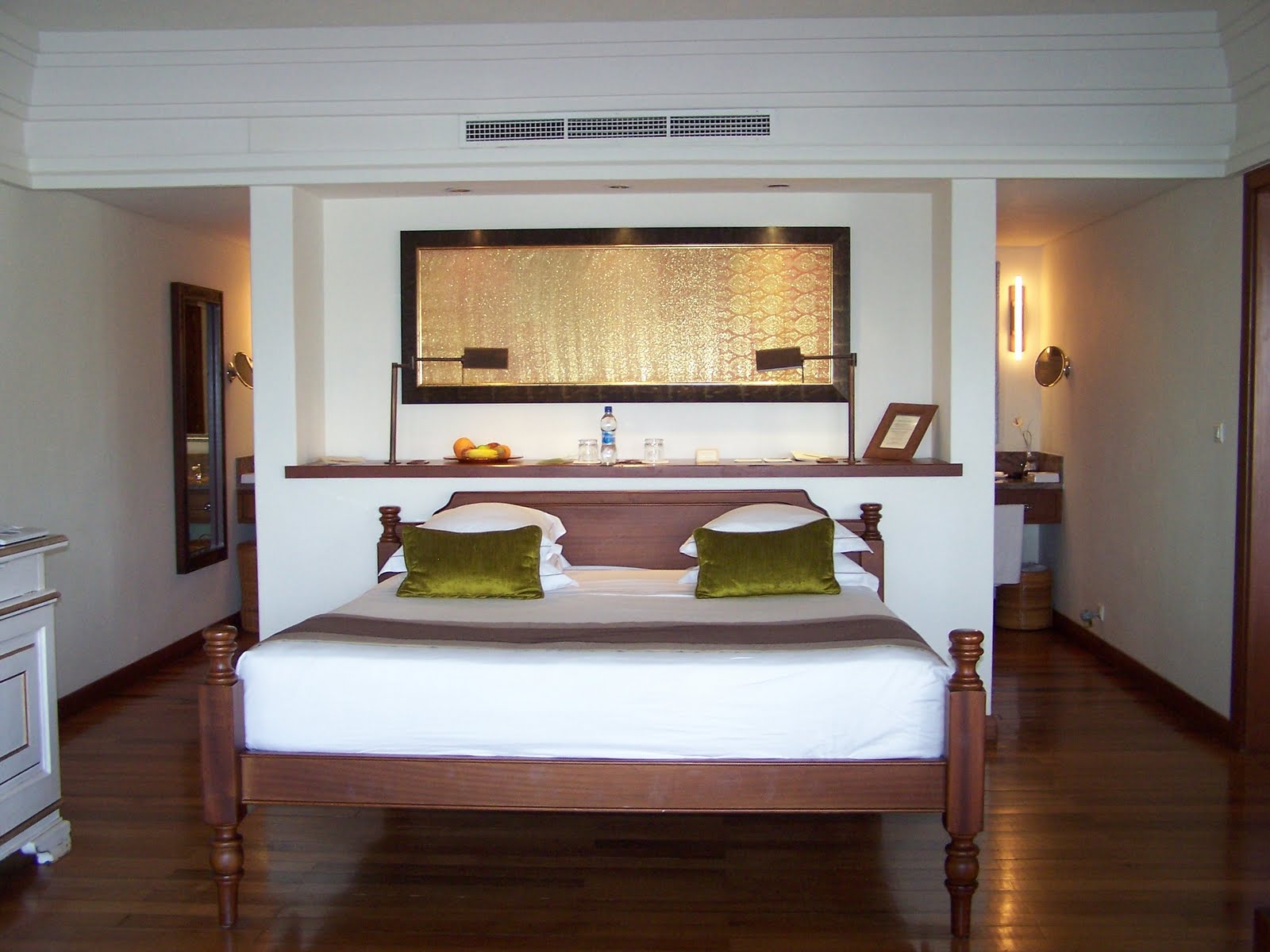
The standard rooms are billed as junior suites and are 70 square meters. The polished wooden floors, high ceilings and glass on three sides at the front (screened by wooden blinds for privacy), with french doors leading out to a large loggia with table, chairs, couch and gorgeous view, mimic the open air feel of the public spaces. Inside, in addition to the king sized bed, there's a sofa, coffee table (laid with champagne and sweets on our arrival), a desk and a large, flat-screen TV with internet access. (There's free wi-fi throughout the resort as well.) The view towards the lagoon and the mountains was the best part of our room, closely followed by the enormous and luxurious bathroom.

That had double sinks, his and her closets stocked with two dressing gowns per person (terry cloth for after bathing, cotton for relaxing), a large dressing area, separate rooms for shower and toilet, an enormous built-for-two tub complete with pillow for lounging and pot of lavender bath salts, and an oversized ottoman in the centre on which someone could sit to converse with the bather. We were delighted to spend many hours in our suite, and afternoon naps within it featured largely in our schedule. In fact, we were so immediately attached to the place that we ordered breakfast in the room on the first morning, which came with two waiters who brought not only food, but enough linen, china and silver to dress the table on our balcony as if we were in a top restaurant. Then they quietly disappeared, leaving us to enjoy our food and the view, swaddled in those cozy robes.

We didn't want to spend all our time indoors, of course. The beach called. The hotel features a long, completely private stretch of it. At the centre of things, overlooked by the pool and the main buildings, it's unoccupied except for a few dining tables in the sand. Want to have a formally served meal but not leave the beach? No problem. Relax under the umbrella and the staff will take care of you. On either side of this, stretching in front of the pavilions housing the accommodation, are large teak sun loungers with thick mattresses, arranged in pairs underneath big market umbrellas. Choose one, and a member of staff is there quickly with towels and bottles of cold water to help you make it your own. Lounge here long enough, and they may pop by with some ice cream or an offer to clean your sunglasses for you.

On one side of the pool are two restaurant pavilions and a bar, on the other side another bar. The latter had a small stage for entertainment, generally mellow jazz, plugged into a sound system that carried it around all the public areas. Further back, so to not squander the sea views, were several shops, the Air Mauritius office, the spa, a pitch and put green and a children's play area.

If you followed a raised walkway past our room for about a quarter mile, you walked into the lagoon, through mangrove swamps and to the hotel's floating restaurant. Four pavilions on pontoons, reached by bridges and lit by swaying lanterns, bobbed gently on the water as leaping fish added to the soundtrack of the night. We ate dinner here twice, and spent the rest of our time in the main restaurants.

A discussion of food, however, signals a transition to another entry. Mauritian dining, and our fabulous local cooking class, comes next.

Sunday, 18 September 2011

Mauritius is eastern-influenced melting pot with potential and disparity

I wrote this entry after returning from Honeymoon, but the posting date coincides with when we were actually experiencing what's described here.

I am fairly sure that I made it through my formal education never having heard of Mauritius, much less being able to identify it on a map.

I first encountered it in some history of piracy, no doubt. Its position in the Indian Ocean, between the southern tip of Africa and the Indian sub-continent, made it a perfect place to lay up while stalking trade routes. This is Captain Kidd territory. But it didn't come to prominence in my mind until we started discussing honeymoons. It is surely one of the Top 10 locations for European newlyweds who have the time and money for a long-haul trip.

And for good reason. The island, formed by a long-extinct volcano, has all the attributes of the stereotypical tropical paradise. Powdery white beaches bordered by swaying palms, hibiscus, bouganvilla and other exotic plants form the coastline. A reef rings much of the island, creating shallow lagoons glimmering turquoise and pale blue. Inland, the land rises to a central plateau dominated by sugar cane production, though fields of tea and all sorts of other vegetables intersperse. Like any volcanic territory, the earth is incredibly rich and well-drained; bananas, mangos and pineapple all grow wild by the roadsides to be harvested by locals as needed.

Pinnacles of black stone, their tips eroded into jagged, picturesque shapes, frame the horizon. Occupying the best coastal spots, as with most tropical paradises, are upscale resorts. Fantasies of thatched pavilions and infinity pools, staffed with graceful, smiling natives who provide unparalleled service. I'll get to that in a later entry.

But in this introduction to the island, it's important to say that dream world is just one small part of Mauritius, and not a representative one. We had excellent drivers on our one-hour transfers to and from the airport, and from them we got a good sense of what life is like beyond the resort gates.

The island is a true ethnic melting pot. It was uninhabited when discovered by Europeans, thus today's native population reflects the different peoples who came ... either as slaves, indentured servants or immigrants ... to work the cane fields. The faces are mostly African, Indian, Southeast Asian or a mixture thereof. It's a huge point of pride for the islanders how well everyone gets along. Most villages we drove through had a Catholic church, a mosque and, most impressively, a giddily-decorated, god-encrusted Hindu temple sitting cheek by jowl, and almost everyone will quickly use that as a proof point of community spirit.

Add to that the cultural overlay of colonialism: first Dutch, then French, then English. (Plus those pirates of every nation.) Today this is a part of the British Commonwealth and the official language is English. But, frankly, you'd never know that without a guidebook. In reality it's French that dominates here, and though everyone in the tourist trade pretends to understand your Anglo-Saxon words, a working knowledge of French will prevent a lot of misunderstandings.

This is no Shangri La, however. It's immediately obvious that this isn't a rich country. Once you're off the single main highway that cuts cross-island from southeast to northwest, the roads are winding, narrow and often bumpy. Look to the fields on either side and you'll see natives, many of them old women, hand harvesting with machetes and straw baskets. Villages are a haphazard hotch-potch of mouldering governmental buildings, tiny shops and snack bars, patches of waste land (some strewn with plants, others with rubbish) and brightly painted houses.

Many of these residences look surprisingly big for such humble villages, but this is because the Mauritians tend to live in multi-generational family groups; the average house may have 15 or 20 occupants. At least one of them is probably assigned middle-of-night water duties. Mauritius is suffering a drought, with global warming suspected to have interfered with the once-dependable annual rains. Thus while resorts fill their infinity pools with millions of gallons and sun-worshipping guests take multiple showers a day, the natives are limited to a couple of hours of running water daily, when they need to fill buckets to supply themselves for the other 22. They are philosophical about this, though. The hotels pay plenty for the water, the guests pay the hotels, it all puts money in the economy.

The villages are interesting to drive through, but offer little sightseeing. These are utilitarian places for living and putting food on the table, not Tuscan farm villages converted for picturesque exploring. In fact, you really don't see white (tourist) faces outside of the resorts and the official attractions. Indeed, one of our drivers confided to us that "whites" means rich people in Mauritian creole, even if they're Indian or Chinese. The average salary here is between £200 and £300 a month, roughly the same as most honeymooners are paying for a single night in their luxury suites. I suspect our view ... through a BMW window en route to and from manicured tourist spots ... was a typical tourist one. There's little trickle down effect to the "real" people from tourism, beyond the tips those in the industry take home. (And those, of course, can equal a month's salary in a few good days.)

Unlike many Caribbean islands, however, Mauritius isn't entirely dependent upon tourism. Those cane fields aren't just decorative; this is one of the world's major sugar producers. There's a thriving textile manufacturing industry, and the same geographical placement that made the island a hot spot in the days of sail is starting to come into play again as China and India continue their rise to prosperity. It feels like a place with great potential, yet it also, according to one driver, suffers the usual African problem of corrupt government. The rich and powerful are harnessing the country's resources for their own prosperity rather than for the general advance of the population.

In our limited exposure, we didn't hear or see anything to make that disparity a dangerous one. All the locals we talked to seemed happy, helpful, truly concerned that we were enjoying ourselves and inordinately proud of their homeland. Still, I left with a nagging concern for the future. There's clearly a lot of money pouring into this place, and tomorrow looks set to bring more. If that cascades down to help establish a comfortable middle class, then the potential here seems vast. If, however, all the profits stay in the hands of a few, then I have to believe that someday the Mauritians, despite their abundance of cheerful contentment, may lose patience and demand a bigger slice of the pie.

Friday, 16 September 2011

Honeymoon Overview: Balanced, idyllic and adventurous ... the trip of a lifetime

This entry was written after returning from Honeymoon, but the post date is the day we left on the trip.

Any regular reader will know that I'm a compulsive travel planner. It's a trait I got from my mother. As soon as one trip concludes, I'm online researching the next. I am inevitably the organiser of holidays, whoever I'm traveling with. So it was completely out of character for me to follow the age old tradition of running the wedding show, but leaving the honeymoon to the groom.

I am delighted I did. Not only did he do a fabulous job, but I didn't have to lift a finger. I just let the wonder of every day wash over me, unconcerned about what was coming but sure it was going to be great.

For two weeks of primarily laid back relaxation, there's an enormous amount to report on. So we'll start with this summary entry before dipping in to a series of articles on the specifics. Hopefully, you'll enjoy it, while the writing will help me hang on to the sun, service and romance for a little longer.

The trip divided into three distinct phases. First, soul-reviving sun and sea in Mauritius. Second, stimulating outdoor adventure in the South African bush. Third, foodie delight on the coast near Cape Town. We had generally good weather throughout, though the second week was a bit cooler than expected (making the fleeces we both purchased at the game lodge our major souvenirs of the trip.)

Our home for the first week was the Constance Prince Maurice, on the east coast of the island. A retreat of almost shameful luxury, we were told the staff-to-guest ratio was four-to-one. And though there are more than 70 rooms, the place is so well designed, and the spaces so generous, we often felt we were two of just a handful of guests. The hotel sits on a long lagoon screened from the ocean by a coral reef, providing the advantages of a private snorkeling area, wide, shallow swimming beaches and multiple water views.

Like so many tropical islands, there's a melange of culture here that makes it a cultural experience as well as a beach holiday. French, English, Indian and Southeast Asian influences all blend here, influencing food, architecture and social traditions. It ticked all my beach holiday boxes.

The exotic beach holiday had excited me most in the planning stages, but in the reality of travel, it was safari that brought the trip's most extraordinary moments. Mauritius and the Cape held elements familiar from other holidays; safari was completely unique. From the moment our private bush pilot met us at Kruger airport, walked us out to his six-seat Cessna, flew us over a landscape that had The Lion King soundtrack pounding in my head and landed us on a dirt airstrip he had to buzz once first to drive away the giraffe and warthogs, I felt like I was in a film. I had been on safari before (see 5.10.09), but this experience was vastly superior.

We were at Chitwa Chitwa in the Sabi Sand, one of a network of private game reserves to the west of Kruger National Park. There are no fences for hundreds of miles here. Wildlife wanders free, is fiercely protected and accustomed to the safari vehicles that accompany them each day. We saw the Big 5 (lion, leopard, rhino, buffalo and elephant) daily, often from a distance of less than 10 feet. The experience was enhanced by a knowledgeable and friendly staff, the handful of other guests and a jaw dropping suite that resembled our own game lodge rather than a simple hotel room.

I feared anything after this would be a disappointment, but the radical change of scenery and the culinary delights awaiting us in Hermanus were magical in their own way. This part of the Cape is, I suspect, what California must have looked like before humanity paved it over. A narrow coastal strip bordered by rocky cliffs, boulders jutting into the pounding surf and beaches in picturesque coves. Seals basking on rocks, flowers cascading along paths, mountains framing the view inland. In between those mountains, lush green valleys carpeted with vineyards and orchards. You'd be hard pressed to design a landscape more perfect than this one.

The point of Hermanus isn't just scenery and wineries, however. (As if that weren't enough!) It's whales. Specifically, Southern Right Whales, who spend their summers basking along this coast, giving birth, rearing young and mating to produce the next generation. The bay on which Hermanus sits is so full of the animals that there's no need for whale watching excursions. Linger on any cliff path bench, stare out to sea and it's unlikely you'll spend more than five minutes before spotting one of these giants send up a plume of spray through its blowhole, lift its fin out of the water for a bit of sunshine or breach with a massive splash.

I doubt there's anyplace more luxurious from which to watch this spectacle than Birkenhead House. Essentially an extremely upscale B&B. What was originally a private home atop the cliffs is now an 11-bedroom hotel built around a series of courtyards with pools and fountains, with a glamorous sitting and dining room, looking out on a wide terrace with infinity pool hanging over the bay. The meals served in that dining room were the best of our trip, with fantastic wine pairings.

We had one of the two oceanfront bedrooms. Quite small, and therefore lacking some of the magnificent bed frames we saw in the other rooms, but I'm a sucker for a view and this one was hard to beat. I saw my first whale before I got out of bed in the morning. The sliding glass doors on two sides of the room opened up a wide vista of sea and coastline, and we were welcomed with flowers strewn across the bed and a bottle of champagne. I was happy.

I have never had a better trip. Magnificent locations, complete pampering, succulent food and wine, and all in the company of my adored (and adoring, he adds in the editing process) husband. Flowers and champagne showed up on all the hotel beds, in fact. That's part of the magic of honeymoon. I suppose that a few nights in Bognor Regis would have been just as wonderful, given the extraordinary celebration of sharing my life with the man of my dreams. But I'm glad I didn't have to test the theory. One of the reasons he is my perfect match: he orchestrated this magnificent holiday, designed to trip every pleasure trigger I have. I fear the travel reviews in this blog will now be setting a much loftier standard.

For more on our adventures, stay tuned over coming weeks as I go into detail on the hotels, the food and the sights.

Thursday, 15 September 2011

Just as planned: Wedding is the party of a lifetime (with great music, too)

This entry was written after returning from Honeymoon, but posted on the date the activity described concluded.

Throughout the wedding planning months, Piers and I were captivated by a game show called "Four Weddings", in which four brides each attend the others' ceremony and reception and rate it to name a winner. Every bride always believes hers is the best wedding, and is incredulous when someone else wins.

I know how they feel.

My wedding day was perfect. It fulfilled fantasies I'd been concocting since my Disney princess days. The ceremony was grand, the reception elegant, the groom looked like a prince, everyone had a great time, everything went to plan. Let me tell you about it...

From the bridal perspective, the day started with breakfast at the Lansdowne Club, where the reception would later be. We started hair and make up at 8:45 in order to be ready by 12:30. Beauty is hard work.

The highlight of the morning: my lovely husband-to-be getting Classic FM to do a long dedication to us, noting how we met through the station's dating web site, how we loved (but debated over) opera, and wishing us well. Fortunately, this happened before my make up started, so I could cry all I wanted over E lucevan le stelle.

By mid-day I was kitted out in my bridal finery. Something old: Mom's wedding dress. Better than anything I saw on the market, the 1962 lines were elegant, demure and sophisticated. Something new: Diamond and sapphire earrings I had made to match the coming wedding ring. Something borrowed: The Hannegan family pearls. Something blue (and borrowed): Hannah Wright's garter. The BT-branded taxis turned up on time and traffic was non-existent, leaving us to wait around the corner from the church for 20 minutes so we weren't too early. Meanwhile Piers, resplendent in his new morning suit and Favourbrook waistcoat, was having a pub lunch with the boys and his family at the Duke of Wellington.

We had spent a great deal of time planning the service and it was, I believe, as magical and otherworldly as we had hoped. Certainly that's been the feedback from guests who, even if they weren't church goers, appreciated the drama and the majesty of "high church" ceremony. The sunny day meant that the nave was filled with light, colours from the stained glass reflecting on floors and walls while the gold on the altar and the clerics' copes glistened. Father David's sermon was masterful, poking fun at us for choosing "Simple Gifts" as our hymn for a ceremony that was anything but simple, then using the lyrics ... "by turning, turning, you come round right" ... to talk about how humanity and completion is found in the love of others. Yes, I cried. Again.

As expected, the choir was the icing on the ceremonial cake, the eight voices, organ and two violins swelling in magnificence. I'm partial, I know, but I don't think I've ever heard them better. After the traditional American hymn Simple Gifts, the bridesmaids processed in to Brahms' Variations on a theme by Haydn, which is also the Northwestern University song. That brought another touch of joy, as memories of all those wonderful times of youth rose to join with this day. The processional to Wagner's wedding chorus from Lohengrin, sung, was a triumph. As expected, most people had no idea that familiar melody had words. The choir was suitably operatic and my dress and veil were old fashioned enough to transport everyone back a century or two.

About half the service was sung or played rather than spoken, and most of that to Mozart's Coronation Mass. We added on two movements of the Exsultate Jubilate for the signing of the register; it was a special, quiet moment when Piers and I stood together in the vestry, where we'd adjourned for the signing, to listen to the soprano hit those stirring notes. The second hymn, to honour the English side, and Piers' rugby passion (and it's also his school song), was of course Jerusalem. Now into the musical spirit of things, the congregation performed their audience participation on this one with vigour. And finally, out to Vivaldi's Gloria, certainly in the Top 10 list for the most joyful piece of music ever written. To paraphrase Shakespeare, if music be the food of love, we left the church very, very full.

To add to the whole dreamy, fairy tale aspect of things, a cluster of little girls from the local school had been waiting outside to see me when I emerged. I did, indeed, feel like a Disney princess at that moment. We'd hired a classic Routemaster double-decker bus, so loaded all the guests on board and made our way to the Lansdowne.

At the club, all my recent joys were trumped for a moment upon my first sight of the cake. I'd worked closely with my baker, Rachel Hill of Planet Cake, to create something that was architectural rather than floral, evocative of the late Georgian setting and reminiscent of Wedgwood. It was perfect. And it tasted good, too!

As every bride who went before me predicted, the rest of the day passed in a blur. The first half of the cocktail reception was taken up with formal photos, the second with bustling my generous train and getting the veil off. (I almost had a spectacular tumble backwards off the stairs in the ladies' lounge when someone came crashing through the door before me, but my bridesmaids caught me.) I was too busy to try the canapes ... mini burgers and cornets of coronation chicken to acknowledge the Anglo-American nature of the wedding, crab because the groom loves it ... and soon found myself next to Piers ready to cut the cake. That's certainly one of the great ironies of weddings. All those hours searching for a baker and planning the cake, all her work, all that money, and it's on display for just 90 minutes before it's cut and whisked away to the kitchen. Thank heavens for photos.

After Dad's speech, our guests moved into the ballroom. We had seven tables, in addition to ours, decorated with bunches of hydrangeas in the centre, a sprinkle of dried hydrangea petals across the table and the traditional Italian favour ... five sugared almonds (two shades of blue, and white) in an organza bag with blue ribbons ... by the wine glasses. Two-tone ribbon ties around each napkin and silver chairs with blue seat cushions completed my Wedgwood colour scheme.

We made our formal entrance as Mr. and Mrs. Bencard to Brindisi, the drinking song from La Traviata. Most people couldn't hear it over the applause, but we'd printed the lyrics in both English and Italian in the menu card ("let's drink for the ecstatic feeling love arouses"), so hopefully people noticed. We then sat down to a hearty meal of ham hock and rabbit terrine matched with a cotes de duras sauvignon blanc, followed by duck breast and caraway cabbage with a Cointreau jus, paired with a vega del castillo merlot. The bride and groom didn't linger over their food, however, as we wanted to mix and mingle amongst the dining tables to greet our guests.

We broke up the speeches and added time for both the bride and the matron of honour, with Piers and I giving our toasts just after the starter, and Anne Bruneel and Robin Bencard delivering the main attraction after the duck. Evening guests started to arrive at 7:30, as Robin was finishing up his speech. We then all adjourned to the gallery next to the ballroom, where slices of the wedding cake (three flavours: fruit, lemon and chocolate) were laid out with a cheese board, coffee and port, while the band finished their set up and the staff cleared some tables for dancing.

Our second musical extravagance, the Sinatra-style band, was another fine choice. Paul Young and his backing quartet delivered a mix of the great classics in the first two sets before swinging into some classic rock and roll in the third. We did our first dance to Just the Way You Look Tonight. Two dance lessons and some practice made for a serviceable performance, though I don't think we'll ever qualify for the ballroom circuit. As a special treat, Kaci Machacyk, one of the American extended family, sung Someone to Watch Over Me and My Funny Valentine, a real highlight of the night.

And then, suddenly, it was over. Midnight struck, people were saying goodbye and the last few guests were lingering in the ballroom as the Lansdowne staff struck the tables around us. We were exhausted, but happy. It was the best party I've ever thrown. As it should have been.

Wednesday, 14 September 2011

Pre-Wedding festivities returned me to my English tourist roots

This entry was written after returning from Honeymoon, but posted on the date the activity described concluded.

It's all over. Wedding and glorious honeymoon, focus of more than nine months of planning, now complete and consigned to memory. You and I, dear reader, have a LOT to catch up on. Let's roll the clock all the way back to 8 September and start with the pre-wedding festivities.

The wedding was on a Thursday, and I decided to take the entire week before it off. I had a small but important group of family (and dear friends who deserve that title) coming in from the States, and I wanted to focus on them. After airport runs on Thursday night and Friday morning, we had a full house in Basingstoke, with Anne (matron of honour) and Mike Bruneel in the guest room and Dad on the couch.

Festivities kicked off Friday night at The Jolly Farmer at Cliddesden. (The Americans are justifiably impressed with the classic British pub, and a lot of them would feature in this week.) We've been searching for a proper "local" since moving to Hatch Warren and this, happily, fits the bill. A tiny place filled with locals, friendly ... if a bit daffy ... staff, big beer garden, good food. At a mile and half, still walkable. We had a great dinner, put down many pints and chatted with locals in the garden.

Saturday divided on gender lines. For the girls, it was off to Nirvana spa, where I treated my bridesmaids to a day of indulgence before the big event. This purpose-built spa just outside of Reading is one of the best in the area, and, when compared to similar spas at the luxury hotels, is much better value for money. It's most memorable for its series of pools, each with its own purpose and each in a room designed especially for it. There's the main relaxation pool, decorated on a Roman theme with columns and trompe l'oeil murals of temples and Italian countryside. A wall of arched windows looks out on the outdoor pool, also on the Roman theme and dominated by a little temple at its head. There's a more functional exercise pool, kept cooler and divided into lanes for energetic swimming. The jet pool has more than a dozen different jets that work on different parts of your body, all in deliciously hot water. Half an hour in here is like getting a full body massage. Sculptures of sea creatures and murals of tropical beaches put you in a Caribbean frame of mind.

Finally there's the zodiac-themed flotation pool. You need to pay extra for treatments in this one; it was part of our package. The water is filled with salt from the Dead Sea and the perfectly round pool has a gentle current. A limited number of people (there were six in our session) go in at a time. You float as if on a mattress, looking up at a ceiling decorated with stars copying the night sky. They say one session here is as restful as a full night's sleep. Elsewhere, there are treatment rooms for other services, a light and airy cafe and a relaxation room with heated, tiled loungers and a bubbling fountain at its centre, kitted out to look like a North African palace.

Meanwhile, the boys had been tramping around Stonehenge and discovering the smallest pub in England before returning home, so Mike could give Piers the BBQ lesson that came with the grill that was our gift from the American family. A magnificent dinner of smoked brisket followed.

Sunday was a day of pilgrimage. Anne and I had both been re-reading Jane Austen in the run up to the wedding, and a day dedicated to our literary heroine seemed appropriate. We started at Chawton Cottage, the house where Jane lived with her mother, sister and a family friend in her late 30s and early 40s, and where she did her most productive work. It's a charming red brick house in a quiet little village. The kind of place four people could live in comfortably, but certainly nothing grand. Jane's small writing table and chair is in the corner of the dining room. There, she spent every afternoon with a view of the centre of the village, writing some of the greatest works of English literature. We swooned.

Next it was off to Winchester Cathedral, where the great lady is buried. Even though she had started to gain recognition before her death, including an invitation to the Royal Library and a request to dedicate her next novel (it would be Emma) to the Prince Regent, who was a fan, her tombstone doesn't mention her writing. It's a brass memorial plaque nearby, established later by the Jane Austen Society, that tells the rest of the tale.

We adjourned to the Hotel du Vin for tea (funky, slightly Asian-boudoir decor, lovely garden, might be worth trying the restaurant for a nice night out in future) then took a meandering drive through the countryside before meeting the boys at The Mayfly. This was one of my favourite pubs long before moving to Hampshire. In fact, Mom used to insist on coming here to watercolour; the view of the Test River, bordered by reeds and meadows as it winds lazily along, is one of rich pastoral beauty. There was a chill in the air and potential for rain, however, so we sat in the conservatory and watched the twilight develop from there. Another long, peaceful evening, with good food and plenty of pints for those not driving.

The family decamped for Mayfair on Monday, so sightseeing moved into London. Dad was ready for a quieter day, and Piers was still working, so after getting Dad checked in to the Lansdowne and having my final pre-wedding meeting there, Anne, Mike and I set off on a walking tour of town. It was an exquisite day. As hoped when we picked our wedding day, the typical clement September had arrived with warm days and clear, blue skies. After a pub lunch in Shepherd's Market we set off on foot, wandering around Mayfair, Piccadilly and St. James before heading for Trafalgar Square and Covent Garden. I was trying to do my tour guiding best, peppering the walk with stories, giving a sense of how these areas had developed, doing some quick dips of high culture (the National Gallery's free entry means you can do a 10-minute glide through, pointing out the most famous stuff) and the modern world (the planet's largest Apple store, with free wi-fi for visitors; whip out that iPhone and send a message home).

On Tuesday we added Tricia Hannegan to the family group and kicked up the sightseeing pace. Another lunch at another pub in Shepherd's Market, then a stroll across Green Park to Buckingham Palace, for which we had tickets to the annual summer opening. The Palace deserves a whole entry to itself, of course, but with such a backlog of activity to catch you up on I'm afraid this is only a brief mention. It is certainly worth seeing, though it is my least favourite of the royal palaces. Windsor has far more variety and a better art collection, Hampton Court more history and architectural merit.

Built primarily to impress, designed in the late Regency and heavily remodeled in the early 20th century, the staterooms have an almost institutional feel to them. They're like grand hotel interiors, built on an oversized scale and coated with silly amounts of gold leaf. Still, there's no denying it's magnificent, and when you get past the most formal rooms (processional staircase, throne room, art gallery, ballroom) the drawing rooms along the back are exceptionally beautiful. In fact, the back of the palace overlooking the garden is by far its best side, architectural miles ahead of the unimaginative neo-Classical front most of the world knows.

The big draw this year was the wedding dress of the Duchess of Cambridge (formerly Kate Middleton), displayed with much pomp in the centre of the ballroom. With that comes films on its design and construction, display cases with accessories (how she stood all day in those shoes, I'll never know), and a model of the cake (beautiful, but I like mine better). There was also a fascinating little display on the family's Faberge collection, but the crowds made it impossible to see well without waiting for ages. This really should have been in the Queen's Gallery, where people interested in the art could have seen it without the throngs there for the dress.

Next, off to the London Eye. I've done this enough to be quite jaded, but it's always a delight seeing the interest of first time visitors. It really is a great way to get a sense of the spread of the city and how all the major sites you see in the tour books fit together on the ground. Management is quite clever about offering a variety of tickets; you can wander up on the day, buy the cheap ones and wait, or you can buy the queue-jumpers in advance and waltz right onto a pod. An expensive half hour (at £26 a ticket), but worth the money if you're on a tight schedule.

And we were, because we needed to be at the wedding rehearsal at 7. This was the first time the whole wedding party had been together, and the first meeting of the immediate members of the two families. So a rehearsal dinner after the session, to allow people to get to know each other, was essential.

We decamped to Madsen's (see 26.1.10). It seemed fitting that the private room at this Scandinavian restaurant provide the setting for the Danish-descended Bencards to celebrate. Guests could choose from a set menu of two choices for each course, all complemented with good wines and the requisite snaps for toasting. The two family groups mixed well and seemed to enjoy themselves, establishing solid foundations for the wedding to come.

The night before the wedding, the two families retreated to their separate corners. The Bencards hosted a dinner for their visiting Danish family. Elegant and sophisticated. The Americans went on a pub crawl with silly hats. Are you surprised? Joined by the last member of the team, like-a-niece Kaci Machacyk, we explored the upscale and charming drinking haunts of Mayfair.

We started at "I am the Only Running Footman". This used to be a wonderfully charming old place, with its Regency leaded windows, its cozy interior and its unique name (footmen used to gather here waiting for their employers to socialise in the fancy houses nearby). Sadly, it's been modernised in recent years, and is now all scrubbed light wood, pale colours and modern design touches. Horrified ... and feeling that the wealthy, suited locals were glaring at our illuminated hats ... I led us off to the Coach and Horses. Just a few hundred yards east on the other side of Berkley Square, this detached half-timbered building was built by history-loving arts and crafts movement backers to look old. The atmosphere here is much more pleasant and relaxing, much less of a poseur's spot.

We wound up the evening at The Grenadier, a classic popular with visitors and locals alike. (See 1.5.09). Charming and quiet, due to its location on a backstreet behind the Lanesborough hotel, yet surprisingly reasonable food prices for this part of town. And the cheerful Irish bartender didn't mind the hats at all. Or the fake mustaches that joined them later. Given that this was once the officer's mess for the Grenadier Guards, I suspect it's far from the worst behaviour they've seen here.

Wednesday, 31 August 2011

Where did August go? Someplace too busy to be writing about it.

"Uneventful" and "maniacally busy" are two states that, in combination, spell trouble for a blog. And thus has flowed August. Nothing exciting or distinctive enough to merit a full entry, combined with a life currently driven by "to do" lists, in which I generally rush through the day, accumulate more stress as I fall further behind and collapse into sleep on the couch by 9:30. So much for the glamorous life.

This state of affairs is, of course, partially due to the demands of my upcoming wedding; a one-time only (thank heavens) flurry of event organisation on par with anything I've ever managed at work. Work itself is a dire death march on an unexpected project; I remind myself that the pain pays for all the lovely experiences I write about in this blog, and refrain from sharing any of the boring details. Estate management back in St. Louis? Not going well, but not enough time to do much about it. Another niggling point of stress, constantly irritating like an itch just out of reach, festering there until I can clear time to do something about it. I begin to think I should take up some calming meditation, but I don't know where I'd fit it in.

Of course, plenty has happened in the past month that I could have cobbled into an entry had I had some time at leisure to write. There were those riots. The odd experience of sitting in leafy Hampshire, watching our capital city looted and burned by thugs. When I moved to this country 16 years ago, one of its advantages was a greater sense of security thanks to far lower rates of crime. Those days seem gone.

There was my hen party, an excellent time but fairly dignified, as these things go. This was completely due to the good taste of my bridesmaids, long-time travel companions Hillary and Lisa, who managed to weave in just enough ribaldry to honour tradition without making anyone look silly or feel embarrassed. I could have done an entry on what we learned at our chocolate making workshop, or one on the nature of sisterhood and friendship ... though if I were still a reporter I'd be chasing the story of why a university-educated software salesman chooses to work hen parties in nothing but an apron. Is he forced into it financially? Embarrassed to do it? Or enjoying it and getting easy money. It is a conversation I never had with James, our "Butler in the Buff", though those were the questions I wanted to ask.

The fine points of wedding planning bring new experiences and discoveries every day. Hair trials. Make up trials. The search for a reasonably-priced nail salon in Mayfair. The connundrum of how little you can spend on flowers while still producing something classy enough for your venues, and that doesn't make things look under-dressed. (Just short of £2000 would appear to be the painful answer.) Tracking down Cheltenham Chairs (turns out that's the formal name for those spindle-backed, traditional English banqueting chairs) in silver with blue cushions. Dealing with the disappointments of last-minute drop outs and the frustrations of invited guests who just can't seem to give a firm reply. And on. And on. I now have a much better understanding of how the industry can support so many magazines, "how to" guides and agony aunt columns.

While I have no extremely noteworthy new restaurants to report on, it's not because we've been cooking every night. Roussillon texted its regulars with a two-for-the-price-of-one offer on the summer seven-course tasting menu, an offer we couldn't refuse since we were just down the road at our church for more wedding planning and needed someplace to eat. No need for additional commentary on that fine establishment, other than to say they're still performing at described levels and retain their rank as my top restaurant in London. More often, when we've had a night in town, we've usually headed to the dining room at Piers' club. Excellent food, less expensive than the equivalent public restaurants, and offering a chance to slip into the empty ballroom afterwards to practice our first dance for the wedding. Being a private club, of course, my tipping you off to how good the food at the Lansdowne is will do you little good, unless you're a member, can use a reciprocal membership, or can hit up a current member for an invitation. If you have any of those options, I'd encourage you to use them.

The Lansdowne's figuring so prominently in my life recently, that when we took one day off from the relentless push of the "to do" lists over the bank holiday weekend, I suggested a visit to Bowood, the Lansdowne family's country estate. It's rare these days to be able to see the matched sets of aristocratic seat and London townhouse, with so many torn down and some of those that exist being tricky to get into. Doing so gives you a more complete understanding of political, artistic and social life in the Georgian era. Something I may return to on a quiet winter weekend when, perhaps, life will be uneventful, but not so busy.

Ahead lies a week and a half more of uneventful and maniacal, and then all hell breaks loose. Family starts arriving from Thursday 8 September. The 10th through the 14th are a mix of sightseeing, celebration and final wedding preparation. The big day arrives on the 15th, then we're off to Mauritius and South Africa. Major events aplenty deserving coverage. But will I have time to write?

Watch this space...

Wednesday, 3 August 2011

Siegfried's high on adventure, but unconvincing in romance

After a month of almost consistent rain and chill, the sun emerged in all its glory on Saturday. A day after the afternoon I'd planned sitting next to a pool. Instead, it was the same time I was due to spend four hours in a dark theatre taking in the third opera in the Ring Cycle. Which really leaves me wondering, is God a Wagner fan (sending good weather to bless the occasion) or a Wagner foe (offering sunshine as a clear signal I would have spent my time better outdoors)?

We shall never know for sure. We certainly have evidence, however, that the London critics are fans, at least as far as Longborough's production of Siegfried goes. And though I doubt I'll ever be in the first rank of Wagner fans, I'll concede it was enjoyable enough to be worth the sacrifice of a few peak tanning hours.

Siegfried is probably the most accessible of the four parts of Wagner's ring cycle, even though it's the one least likely to feature any music the average person has heard before. It's a an adventure with a dashing hero who forges a magic sword, slays a dragon and rescues an enchanted, sleeping maiden. Good triumphs over evil and there's a happy ending. Of course, it takes three acts and about four hours of performance time to get there, so the faint-hearted should probably just give Sleeping Beauty another spin in the DVD player.

Part of the length is due to the fact that this opera, though part of a larger cycle, could easily have been broken into three independent dramas. Act 1 is a coming of age story, as Siegfried confronts his evil guardian, discovers who he really is and establishes the foundation of his power. Act 2 could stand alone as a rip-roaring dragon quest. And Act 3 is both our princess quest, and a fascinating exploration of the fears of an independent woman ... the valkyrie Brunhilde ... who is terrified she's going to lose herself when she gives in to love. (I doubt Wagner intended the feminist interpretation, but these days it makes the last act unusually modern and relevant.)

The Longborough company delivered to the standards we've now come to expect, with innovative but low budget staging, fantastic singers and acting that connects directly to the audience. The last is particularly important in this former chicken shed turned opera house, where the most distant seat can still see facial expressions without artificial assistance. Particularly noteworthy was American tenor Daniel Brenna (pictured above), who played Siegfried as brash yet loveable, innocent yet dangerous ... the dumb jock whose skill gives him more power than his intelligence knows how to handle. It worked brilliantly for me in the first two acts, though was a problem in the last. How, I wondered, could the magnificent Brunhilde fall head over heels for this self-centred lug?

And here, Wagner's music doesn't help. He does drama and passion well, but when it comes to romance he leaves me cold. Siegfried and Brunhilde's discussion (I can't call anything that long a duet) as they are falling in love is bombastic and powerful, but in no way was I convinced these two people actually cared for each other. It's the same reaction I had at last year's performance of Die Walkure when Siegmund and Sieglinde (Siegfried's parents) were supposedly bonding for life. With apologies to my Wagner-loving fiance, I still argue that Wagner can't touch the Italians for putting true love on stage.

In many ways, now that I've seen half the wring cycle live and been exposed to the rest of it on TV, I think Wagner was born to early and working in the wrong medium. I can quite clearly imagine the man producing, writing and directing a 12-part operatic mini series on HBO, with the full-fantasy look of Peter Jackson's Lord of the Rings or the recent Game of Thrones.

You may think that's too niche to see the light of day, but the modern trend in Wagner is wildly avant-garde. We recently watched a production on Sky Arts that saw the vakyries sheathed in rubber, flying in and out on cherry pickers in front of a giant video screen flashing space images behind them. It made Longborough's sparse, industrial set look practically traditional. The Wagner community is up for risk, so why not?