Friday, 16 August 2019

Tivoli: the "original" Disneyland keeps a charm long gone from Anaheim

My first holiday with the man who would become my husband included a trip to Disneyland. Back in the early days of our relationship and still keen to impress me, he managed to repress his cool disdain of the place. A year later he introduced me to Tivoli Gardens, and I started to uncover how he really felt. Disneyland, in his mind, is just an over-commercialised copy of Copenhagen's historic amusement grounds and would never match his childhood days at Tivoli.

Given my own idyllic Disney track record in both Anaheim and Orlando, I'm never going to concede
victory to his opinion. After years of visiting Tivoli, however, I've come to treasure the place's distinct magic and understand why Walt copied it. Yes, copied. A stroll around the grounds makes it quickly obvious that the original Anaheim park did not spring solely from Disney's imagination, but evolved from his visits to this Copenhagen original.

There are the themed areas sweeping you to another part of the world with relentless attention to architectural detail. A balance of high-quality shows with rides. Attractions for all ages. Gorgeous landscaping lining winding walks between attractions. The Pirateriet (pirate ship) is a dead ringer for the sailing ship Columbia that plies Disney's "Rivers of America" and the Roller Coaster is the Matterhorn in miniature.

The similarity is even stronger if you are old enough to remember Disneyland in the '70s, when entry to the park was a reasonable admissions fee, on top of which you bought tickets for each ride. Tivoli still works that way, and it makes me nostalgic for those old days in Anaheim. The difference is distinct. Tivoli is a pleasure garden, not an amusement park. People come here just to stroll, appreciate the gardens or eat at one of the restaurants. Like Disneyland, Tivoli is an oasis completely surrounded by urban mayhem; though it's so much smaller that you can spot the towers of central Copenhagen from almost everywhere inside. This doesn't diminish the sense of quiet relaxation that permeates, however. I remember the original Disneyland being much like this. Grown-ups would go to dine, relax and shop, handing us books of ride tickets to go amuse ourselves. It all seems much more sophisticated, and far friendlier for the visitor's wallet.

Adult entry is £16. You can add an unlimited ride pass for about £30 pounds, though pricing varies depending on weekends, weekdays, whether there's a big concert on, etc. But you can grab a single ride ticket for around £5. So if all you want to do is have a wander and go on a couple of rides, it's a steal compared to Disney's modern all-inclusive model.
This was my fourth visit but my first to try a ride. Which had to be the proto-Matterhorn (photo above). Built in 1914, this wooden coaster is one of the oldest still in operation in the world and thus has earned the right to its simple name: the Roller Coaster. (Perhaps with an emphasis on "the".) The Alpine setting around the boarding area and the model mountain above you are a dead ringer for Disney's adaptation, though you're in regular cars rather than bobsleigh and it's only about a third of the size of its Californian daughter. But size isn't everything. It's still gives a fine ride, with plenty of speed, incline and plunges. Some of the journey, like the Matterhorn, is in the darkened interior of the artificial mountain, adding to the suspense. But here you have the satisfying "clickity clack" of the wooden tracks, which lends a charm that modern rides can't match.

There are plenty of modern options here, too. The Demon is a triple loop-the-loop in a Chinese fantasy land, with the option of virtual reality headsets if you want to enhance your chills and spills. Fatamorgana is a 45-metre tower with spinning cars and discs hanging off it, the Star Flyer is an 80-metre high swinging carousel (based on the planetary discoveries of Danish astronomer Tycho Brahe) and Vertigo's spinning arms take you on a high-G plane ride. On some future visit I'm particularly keen to check out The Flying Trunk, which in design looks suspiciously like It's a Small World and in description (travel through 32 fairy tale scenes!) sounds like it spun off about half the attractions in Fantasy Land. If you splashed out for unlimited rides you could certainly get your money's worth, with 28 attractions ranging from the high-thrill stuff to innocent, child-friendly pursuits like an old-fashioned carousel or two-person boats on the lake.

Plenty of people just come here for the atmosphere, restaurants and entertainment, however. Locals get a particularly good deal on season tickets, from as little as £5 a month. We chatted with one couple in the gardens who come regularly for concerts (there's a large hall that hosts both classical and popular artists) and to appreciate the gardens. And their fantastical backdrops. The Nimb Hotel is a particularly famous centrepiece, looming above dancing fountains like Ali Baba's palace.

This low-bar entry fee also makes Tivoli a logical place to go out to eat, meaning that restaurants here tend to be higher quality and better value than their Disney counterparts. (Though, to be fair, Disney does have some great places to eat, which I've written about here.) We whiled away the afternoon at the Bryggeriet Apollo (the Apollo Microbrewery), a charming place that looks like an old Danish
inn, or "kro", sitting on the lake just across from the pirate ship.
 There are decks along the lakeside with moveable shades and heaters, offering al fresco dining and drinking for much of the year. Indoors ... which was empty on the glorious summer day we were here, is all exposed brick, scrubbed wood and shiny copper brewing tanks. The Bryggeriet offers a variety of classic Danish open-faced sandwiches, including a delicious trio of seafood options. There's a heavier menu for dinner.

The home-brew is delicious and there's a separate snaps list for those all-important toasts. (If you're going for a proper Danish lunch, you drink both beer and the local acquit called snaps, saving the later to toast your friends and accompany your fish dishes.) They had some more unusual options including "Porse", or Danish bog myrtle, which is extremely herbal to the point of being medicinal. It reminded me of drinks made with another herb, genepi, in the French Alps. While it did provide a satisfying counterpoint to pickled mackerel, it's not something I'd order again. Certainly not when my favourite dill snaps is on offer.

While Tivoli's tiered fee policy brings the nostalgia of the Disney of my youth, is has changed, most notably in its opening days. My husband speaks fondly of an attraction that was only open during the summer, making Tivoli time something particularly precious. No longer. There's now a winter opening for the month of February, presumably to capitalise on Valentine's Day. When Easter is early there's a separate opening or, when late as this year, it's rolled in with summer. In 2019 the gates opened 4 April and will close 22 September. But not for long. The newest holiday opening is for Halloween, 11 October to 3 November. (This one leaves my husband sputtering with rage at the incursion of a commercialised American holiday into European traditions.) Then about two weeks later Tivoli re-opens for its Christmas extravaganza.

Considering that all of my visits before this one were in these extraordinary holiday times (twice at Christmas, once at Easter), I'm delighted about the change. In fact, though summer was a hazy, lazy joy, I think the other times are more spectacular. The Christmas decorations are magnificent, as is a holiday show on the lake with dancing water and lasers. It can also be bone-numbingly cold at that time; booths selling blisteringly-hot mulled wine every few meters make the outdoors survivable. Easter brings a display of bulbs just as impressive as the famous Dutch gardens at Keukenhof, though on a much smaller scale.

Whatever the season, Tivoli is one of the wonders of Copenhagen. Don't miss it.

Wednesday, 14 August 2019

Krebsegaarden, Relae show why Denmark pulls the food tourists

Early in the next decade the Danish chamber of commerce expects the country to have enough hotel beds to accommodate up to 10 million tourists at any one time. To put that in perspective: The population of Denmark is about six million. No wonder it's gained the dubious honour of being in the top 5 countries suffering "over tourism" (calculated by the ratio of residents to tourists).

What do all these travellers see in this tiny Nordic country? For many, it's all about the food.

Denmark has 27 Michelin-starred restaurants. Two-starred Noma has been named top restaurant in the world four times and three-starred Geranium currently sits at No. 5. (Noma lost its third star and slipped in the rankings while it closed for a year for renovation. Many expect it to regain its dominance this year.) Some of my most remarkable dining experiences have been here, including at the dearly departed Restaurant Herman at Tivoli and at Aarhus' remarkable Domestic. Whether the explosion in interest in Nordic cuisine sparked the tourism boom or vice versa is a "chicken or the egg" conundrum, but whatever the answer there's no doubt this one of the top "foodie" destinations in the world.

Thus it was no surprise that the top priority of travelling friends we were meeting in Copenhagen was restaurant reservations. Our challenge: use my half-Danish husband's insider knowledge, our travel experience and the big network of Bencard cousins to come up with some exceptional meals. We delivered with a traditional lunch at Cafe Petersborg (described in an earlier article here) and two fine-dining wonders: Relae and Krebsegaarden. Relae holds one Michelin star and is anchored by a Canadian. At Krebsegaarden your hosts are two Norwegian chef/owners Mats (pictured above) and Carsten. The food scene is a magnet for international cooking talent as well as diners.

We had the chef's tasting menu at both restaurants with the matching wine flight. Both restaurants have an obsession for local produce and lean heavily towards seafood. Both offer creative twists on preparation and source wines from interesting small producers. Both have charming servers who talk you through the dishes in as much detail as you want. The cost of both experiences was roughly the same (£120 per person; but note this reflects a very weak British Pound at the moment).

Krebsegaarden's quirky differentiator is art. It's a combined gallery and restaurant where the kitchen takes its inspiration from the seasonal exhibitions on the walls. There's a small a la carte menu and an invitation to let the chef design a multi-course tasting menu for your table based on your preferences and hunger. It looked like most people take the latter option. Mats chatted with us a bit, then started the food and wine rolling.

We opened with some delightfully fat scallops, seared with a coat of brown sugar and smoked salt and served with a puree of green apple, onion and dill. Next a salad plate of small pickled radishes, goats yogurt, salad leaves, caramelised walnuts and rye crackers; one of those plates that shouts out "you don't need animal protein to create something special." But there's no way I'd want to go pure vegetarian in a country with such great fish. So on to red fish "escabeche", sitting atop a sweet and sour melange of finely diced green beans, olives, capers and bell peppers, accompanied by a sweet potato puree. How good is this kitchen? That list features at least two things my husband dislikes intensely, yet as prepared here he savoured every bite. The meat course brought a stuffed guinea fowl breast with a "meatloaf" prepared from the dark meat, sitting on a creamy wild rice sauce and accompanied by a mix of carrots, peas and corn that looked exactly like the frozen, mass market stuff.  But tasted very different. As it was supposed to. Mats said the inspiration for the dish was the frozen TV dinners of their youth. They've done homage to the memory while creating something gourmet.

The table was liberated to personal preferences for dessert, with me going for their take on cheesecake (really a misnomer; it was a tangy, cream cheese-like parfait with fresh and pickled strawberries and some crumble for crunch) while others went for creme caramel and the plate of
chocolate petit fours.

There's no Michelin-star daintiness or formality here, and while the plates are attractive nothing is a work of art. With the way Mats and Carsten work the room, discussing inspiration for their dishes, where their ingredients come from and why the wine matches, you feel more like you're dining in their house than discovering a fancy restaurant. If you like something a lot they might bring out extra portions. If your taste leans towards one wine they might pour a similar one to see how you compare them. It was as intimate an experience as we had "private dining" in Grenada earlier this year. We loved everything about Krebsegaarden. This is not, however, a place for a quiet, romantic dinner or just being left alone. Mats is a big personality, and the discussion of what you're eating and drinking here is almost as important as the dining.

Relae is a bit more traditional in that respect, though you'll still have chefs explaining what you're eating and the room's exposed brick walls, natural wooden tables and world music mix are a world away from white tablecloths and old-fashioned fine dining. The presentation, however, leaves you no doubt you're at the high end of the culinary spectrum. From the custom-made tables with individual drawers for each diner's range of cutlery to a staggering array of beautiful plates and bowls to the food's exquisites presentation, Relae is gorgeous.

The restaurant's heritage traces back to Noma; founding chef Christian Puglisi came from the famous kitchen to start a place that was more approachable (and affordable) while still holding on to Noma's values. Those include a veneration for organic produce and local sourcing; so much so that Relae has its own four hectare mini-farm half an hour away and tries to raise as many of their menu elements as possible. It's impossible to miss this. When you arrive, you'll step down into a welcoming space with the kitchen on view and a large central table heaped with the day's produce, as artfully arranged as the displays in Harrods' food halls.

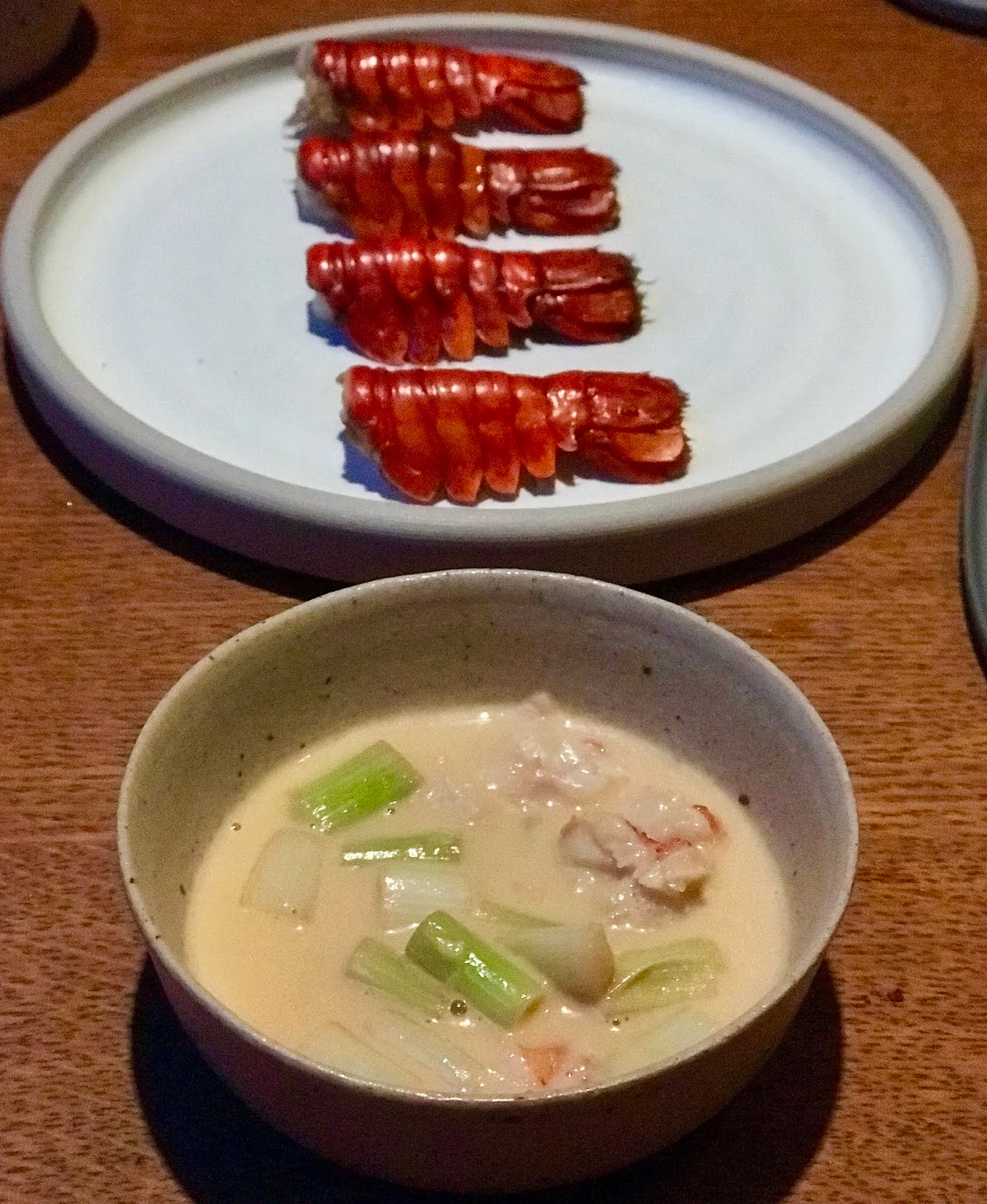
Canadian Jonathan Tam, another Noma alumnus, took over the kitchen three years ago. His Chinese and Vietnamese family roots give both menu and presentation a distinctly Asian feel. The amuse bouche of griddled cucamelon and spears of swiss chard showed the unusual preparation of ordinary veg that would characterise the whole meal. We chased that with shot glasses of potent tomato water before going on to slivers of cured mackerel wrapped in spinach leaves. Very Japanese. Next came freshwater crayfish, a passion of the Danes, served with a creamy crayfish soup that was one of the highlights of the meal. You can, however, get a bit carried away with the vegetable worship. The stack of grilled squash slices covered with cream sauce and sprinkled with marjoram leaves was beautiful, but didn't taste special enough to deserve its solo placement.

The meat course featured delicately flavoured, rare salt marsh lamb and a beautiful swirl of salad leaves plated to look like a crown. Excellent, but the friend who went for the pescatarian option here was the winner with rich turbot in a cream sauce. Vegetable madness let them down again on the sweet front. While incorporating chunks of cooked squash into lemon verbena ice may prove the point for the possibility of using vegetables for every course, it's an underwhelming end to a meal if you're a dessert lover.

If I were hosting a vegetarian, Relae would win hands-down. It's a more thought-provoking experience in the way it uses its ingredients, and is probably more "Instagrammable." But I'd give the edge to Krebsegaarden on the overall experience and my satisfaction across all of their dishes.


Monday, 12 August 2019

Even at its worst, Copenhagen is worth the effort

The Danish countryside in August is a vacationers paradise. While most of Europe heads south, this rolling land of farms, long beaches, comfortable manor houses, half-timbered villages and Viking heritage is little explored, especially after the Danes go back to school in the middle of the month.

The same can not be said of Copenhagen, which is now so firmly established as a capital of cool and a culinary hot spot that its normal crowd of visitors accelerates to a heaving mass in the summer holidays.

It's almost impossible to walk in a straight line down the famous pedestrian shopping street of Strøget. You'll wait in a long queue for one of those famous Danish hot dogs and every canal cruise leaving Nyhavn is packed to the gunnels. The crowds, unfortunately, seemed to bring out things I'd never noticed in usually pristine Denmark: beggars, rubbish blowing down streets, homeless people and crime.

Sadly, we were the victims of the last as ... returning in a taxi from dinner one night ... a man assaulted my husband on the steps of our hotel, stripped him of his watch and ran off. Two conscientious police officers were on the scene in 15 minutes, took a full report, collected the hotel's cctv of the event and even did a swab of my husband's arm in hopes of finding the bad guy's DNA. (Tourists, don't expect that in London!) Their care, and the horror of the hotel receptionist who saw it all, somewhat assuaged the shock of the whole thing. But we learned a lesson: tourists should be as wary in Copenhagen as anywhere else in Europe during high holiday season.

Fortunately, crowds are a relative thing. Nowhere in the Danish capital is going to be as unpleasantly jammed as Florence or Versailles, and most people stick to a very narrow tourism flight path. It doesn't take much to step outside of it and see other wonders. Though the area near the (underwhelming) Little Mermaid statue is uncomfortably packed, if you linger at the far more impressive Gefion fountain nearby you'll find a comfortable seat from which you can appreciate the cascading waters and watch busloads of tourists on the far side of the fountain trudging to and from the more famous landmark.
Walk a few yards Southwest and you'll be in the pretty Churchill Park, almost free of tourists. St. Albans, the English church on its edge, is well worth a visit. At the time of its construction Britain's Princess of Wales was a Dane (Alexandra), so the building went up with significant royal backing. Royal Doulton contributed a custom-created font, lectern and reredos, now recently cleaned and well worth a detour for decorative arts geeks.
So is a fantastic life-sized sculpture of a wind-whipped Valkyrie on horseback, on the other end of the park.
Even the main attractions aren't so bad if you bide your time to let the tour groups pass by. There are, however, more of them than ever to dodge. Copenhagen's tourism board said it expected a record 1.2 million cruise ship passengers to visit Denmark this year, almost all of them stopping off in the capital. Fortunately they're usually on tightly-timed, escorted tours so never linger long in one place. This was particularly obvious in the National Museum, a treasure trove of pre-historic and Viking artefacts and one of my favourite gift shops in town. I've written a full article about it here.

Even if you've visited the collection before, it's worth a return to check out the new "Meet the Vikings" galleries. They've divided opinions in Copenhagen, and in the Bencard family. Clearly feeling pressure to modernise and no doubt influenced by the reach of Amazon Prime's television show, the museum has turned three galleries over to a blatantly populist approach. Created by a Danish designer and TV presenter named Jim Lyngvild, the exhibition plucks some of the most significant pieces out of the collection and uses them to "dress" imagined Vikings. We see the characters and the artefacts in highly-detailed, oversized photos and in vividly-lifelike models (complete with tattoos, scars and showy moustaches.) Artefacts are in cases below and beside the characters. You're even invited to sit on the king's throne.

It's good fun and does bring this world to life, but there's a lot of imagining and "what if" going on here. I thought it was a fun way to spark the imagination and get kids (or simply the less interested) into the topic. My husband was irritated by the leaps into historical fiction. When it opened last year, a lot of serious art historians were frustrated than the museum poured money into this at the same time it eliminated more than 20 jobs. Visit the exhibit to make up your own mind; it's included in general museum entry.

You'll be both cruise-group and controversy-free at the Medical Museion, an unlikely destination unless you are in the health care field, studying to join it or have a relative who's a curator here. Our detour to say hello to my husband's cousin turned into an unexpectedly fascinating hour of exploration.

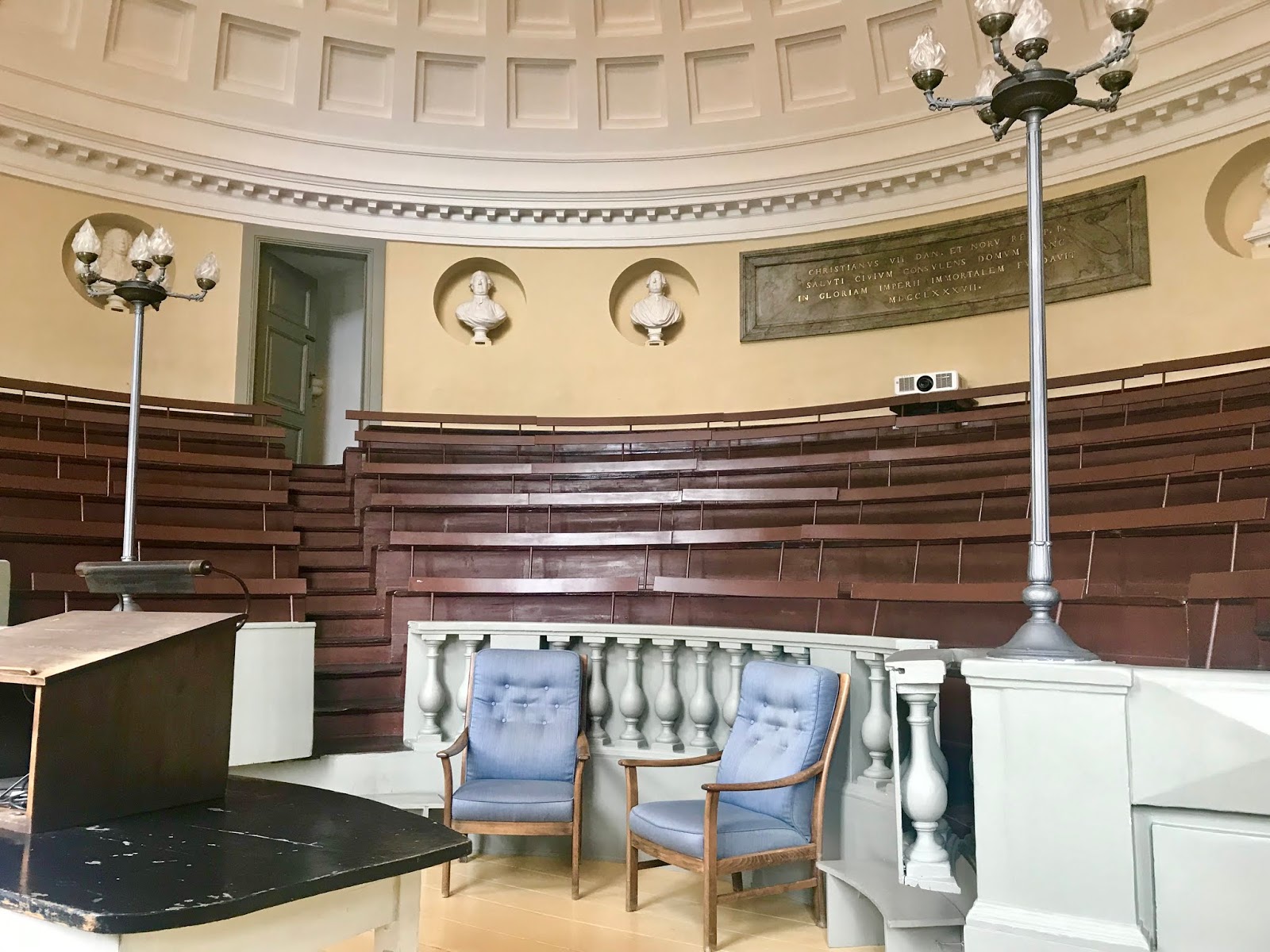
There's a large collection of medical samples, not for the squeamish, assembled by doctors a century or more ago to study the human body and its diseases. An architectural highlight is the neo-classical dissection theatre, a grand indoor amphitheatre facing a "stage" backed by tall windows letting in all-important light. In the basement there's an award-winning exhibition (curated by Adam Bencard) called Mind the Gut, which examines the relationship between the brain and the stomach. (Something I, sadly, have far too much experience with. Though it does provide you, dear reader, with a lot of fine restaurant reviews.) There's a lot of fun stuff to balance the academic inquiry here, including an artsy and entertaining film that shows how digestion works (yes, really) and an interactive quiz that generates your healthy mind and gut diagnosis.  I'm supposed to always remember to escape and not let ideas leak away. No change there, then.
Neither tourists nor locals seem to take much notice of another of my favourite sites in Copenhagen: the central train station. People make pilgrimages to see the station in Porto, Monet immortalised Paris' Gare du Nord, yet I find this building just as striking and almost unknown. There's little information in any guide books about it, other than revealing that it was built at the start of the 20th century and designed by Heinreck Wenck in what's known as National Romantic Style. This was a bit like the Gothic Revival in the UK, but when the Brits looked backwards, the Danes mixed their historic architecture with modern elements to come up with something more like Viking Art Deco.

The station is most striking for its wooden roofs, both in the main hall and the train shed, which give the buildings a grand yet deeply historic feel. The exterior is castle-like, and both interior and exterior share design elements recognisable from the collections back at the National Museum: Romanesque arches; ironwork in looping, Viking-style filigree, statues of Danes in historic dress, crests in glazed terracotta, stained glass windows. It's a delight. And is one of the easiest and most direct connections from airport to city centre in all of Europe. If you're flying to Copenhagen, don't waste your money on a taxi. Take the train into town and enjoy this architectural masterpiece on your way through.
There's a vast variety of hotels within a short stroll of the station, but it's worth appreciating some nuances of geography. To the North and East of the station's main entrance are some of the city's most expensive lodgings. The pleasure grounds of Tivoli and its world-class Nimb Hotel are literally right across the street from the Eastern exit from the main hall. Exit to the West, however, and you're in the old red light district. As such places go, this one is fairly innocuous and the city is doing its best to redevelop it into a trendy tourist area. In the blocks closest to the station it's mostly hotels and restaurants. There's none of Amsterdam's blatantly seedy sexuality on display, and the less observant wouldn't even note the change in neighbourhood. In the four square-block area between our hotel, the station and the neighbourhood dividing line of Vesterbrogade, there was one low-key sex shop and one "gentleman's club" with fairly upscale branding. I wouldn't have noticed the handful of working girls on the street corners had my husband not pointed them out.

Though the hotels here are just a few blocks from their posh counterparts, the subtle shift in neighbourhood brings the prices down. And perhaps makes management try harder. The Andersen Hotel here is my favourite of all the places we've stayed in four trips to Copenhagen. The staff works hard to earn their boutique branding, with hand-written notes welcoming you to your room, a free wine happy hour in the afternoons and an honour bar at other times, and a basket of knitting in the lobby ... which feels more like a living room or cocktail lounge than a hotel ... inviting you to make scarves for homeless people. The rooms have individual temperature control, including air conditioning, which is a bit of a luxury in old European buildings. The decor includes fun light fixtures and splashes of bright colour, a relief in a country where traditional Danish modernism can fade into boredom when applied on a corporate scale.

Unfortunately, I also have to factor getting robbed within clear view of the hotel's front desk into my review. (It was 11:30 at night. Late, but by no means unsociable hours.) The hotel staff was mortified, getting the police there quickly, apologising repeatedly and leaving a note and chocolates on our bed the next day. I would happily return here with my husband or a group of friends and keep my guard higher, but I wouldn't recommend it for a single female traveller.

Bottom line: Copenhagen is worth visiting at any time of year, but August can make this delightful city hard work. Spring and autumn are much better for drinking in the city's laid back aura.

Saturday, 27 July 2019

Mayfair's Umu celebrates perfection in every element

Obsession is a necessity for Michelin-starred chefs. Nobody survives in a gruelling industry that robs you of your social life, rises above fierce competition and delivers perfection night after night without a bit of mania over what they do. In my reading about Japanese culture in advance of our trip later this year, I've seen something similar. The gardeners who groom every leaf on a tree to a painterly perfection, the generations of swordsmiths who hand down and hone their skills to create the ideal samurai blade, the calligraphers who strive for years to get a character just right ... there's plenty of obsession on display.
I began to suspect that fine dining and Japanese food would be an eminently logical match. An evening at Mayfair's Umu validates that suspicion.

Head Chef Yoshinori Ishii does more than deliver exceptional food. He matches a range of pottery (some of which he's designed) and lacquerware to the food and its position in the parade of dishes to make a visual statement. His biography tells us he's also a keen calligrapher, so no surprise that one of the courses is served on top of a poem, written in bold calligraphy by Yoshinori, illustrated by his own drawings. If that sashimi tastes fresher than any you've ever tasted, thank his love of fishing in the traditional Japanese style. Not only has he found his own Cornish suppliers; he's taught them the art of ikejime ... dispatching a fish quickly with a needle into the nervous system, curtailing the fright and struggle that releases meat-toughening hormones and acids. When that fish comes to you as a hand roll, it's presented by a Yoshinori-designed wire arm, symbolically from his touch direct to yours.

Umu specialises in kaiseki, the highly-ritualised, multi-course gourmet tradition of Kyoto. The biggest splurge during our upcoming trip involves an exclusive ryokan (inn) in the hills above the ancient capital where our courses will be brought to our rush-matted, paper-screen-walled room by our kimono-clad hosts. Before diving in at the deep end in a language we don't understand, I thought it made sense to get familiar with kaiseki on home turf. It was also my husband's birthday; a two-Michelin-starred Japanese restaurant was suitably celebratory. (And the price of a full kaiseki meal definitely needs to be reserved for a special occasion.)

Our eight course (but nine dish; one course had two parts) celebration started with "mukozuke." From what my post-meal research tells me, this is the word for a small, intriguing snack served in or on an interesting piece of pottery, often with a rough but beautiful finish and some kind of artful deformity. Here, a battleship grey bowl with a slightly pitted surface and a slightly shiny glaze would have been a perfect circle had the potter not bent one side in, forming a shape like an apostrophe. It was a quirky and beautiful piece that demanded inspection before you ever paid attention to the food. Inside was a lovely melange of gently-cured sea trout, wafer thin slices of turnip, pickles and caviar. Two generous bites or four dainty ones, it was an elegant foreshadowing of all to come.
"Nimonowan" is a simmered dish or soup cup, here titled "Ocean Breeze" and served in an exquisite lacquer bowl with lid that you remove to create your own little tabletop drama. Inside, a layered disc of Cornish lobster, abalone and nori seaweed sat in a broth so clear it almost disappeared. Later, we both agreed that the menu probably had one course more than it really needed, and this is the dish my husband would cut. He's never been a fan of lobster and thought the example here was slightly overcooked and too chewy. (Which is what he almost always says about any lobster.) I suspect the chewiness was the abalone. Whatever the truth, it was still one of the most exquisite interpretations of soup I've ever had and very tasty.
The next course was the double dish. "Tsukuri" is the set up to executing a Judo throw. One assumes that implies a partnership with the course to come, or maybe the first plate set up the second, but nobody told us. My only real complaint with Umu was that the serving staff (entirely European, heavy on Italians) doesn't really give you much information on your food beyond the basics, even though they knew we were interested. Many Michelin-starred places will go into detail about their supply chain, the inspiration behind the dish or even how you're supposed to eat something. We could have used more of that in this delightful, but very alien, environment. It seems that's simply not their style.

Tsukuri started with slices of raw turbot. People often claim "you can read through it" when describing  how thinly they've sliced something. Yoshinori plays with that idea by serving the slices on top of a poem he's written about the joy of food. Unless you can actually read Japanese characters, you can't test the "read through" claim completely, but it's a fun touch. Delicious as the turbot was, the highlight here was my first taste of real wasabi. The stuff you get in almost all sushi restaurants is an industrially-produced approximation made from horseradish, mustard and food colouring. Real wasabi is a root, notoriously difficult to grow, that releases a piquant kick when grated that fades within minutes. Obviously, most restaurants don't want to dabble with an ingredient with no shelf life after preparation, even if it doesn't cost £22 for a thumb-sized piece. The taste of the real thing, grated into a paste by moving in a circle on a piece of shark skin, is a mind-blowing blend of sweet and hot.
The sauces and the wasabi stayed around for part two: sashimi. This is probably the ultimate expression of the idea that the best ingredients don't need much done to them. Five pieces of top quality fish, incredibly fresh, taken from the best part of the fillet. I've had a lot of great sushi in my life, but the only time I've come close to this freshness was when we tried slivers of the fish we'd just caught off Puerto Rico before we left the boat. When fish is this fresh, it's almost a crime to cook it. And every kind tasted significantly different from the other. (Something, let's face it, you don't really get at Itsu.) The most fascinating morsels here were the back and belly tuna, side by side. Belly is a rare delicacy, and I've had it before ... but never this rich or pungent. We're talking the foie gras of the piscine world here. Honestly, the flavour was too much for me; I could have happily substituted another bite of back, but am glad I tried it.

Next came my dish of the day. "Agemono" means deep fried food in Japanese, and I suspect we were into the comfort food section of the menu. The description was sweetcorn three ways. I am from a corn state. I have an annual moan about the poor quality of the corn in the UK while I indulge in memories of buying sacks full fresh ears from the fields down the road from my childhood home and eating them before they'd been off the stalks for four hours. As glorious as those Missouri memories are, they couldn't touch the expressions of that noble vegetable here. There was a kernel-stuffed spring roll, a quarter of a grilled cob and a croquette I can only describe as deep fried creamed corn. We may have been in a Japanese restaurant, but it's as if the chef had distilled the essence of the best of an American midwestern summer onto a plate. I almost wept with joy. And if that wasn't enough, you unrolled the husk to find a line of perfectly popped and seasoned corn. Four ways! And each perfect.
"Hiyashimono" followed: smoked and cured mackerel with somen noodles and Japanese ginger. I couldn't find a translation for this title, but this was my husband's favourite dish. I suspect he was experiencing a similar cross-cultural childhood flashback, given how essential mackerel is to Danish cuisine. It is, however, the dish I would cut. Not that I didn't like it: the mash-up of sashimi and cold noodle salad would be a huge hit with me for a summer lunch. But at this point I'd reached satisfaction point on the raw fish and didn't need more.
"Yakimono" means grilled or pan fried and brought us out of the ocean for the first and only land-based meat dish: lamb two ways, with accompanying sweetbreads. Regular readers will know I'm not keen on lamb or offal, though I'll soldier through anything on a chef's tasting menu. (Which is how I got familiar with sweetbreads in the Loire Valley.) A benefit of the Japanese love of bite-sized morsels is that anything's tolerable this small. In fact, the rump and fillet were both rare and delicately spiced, avoiding the lamb-y flavours I dislike. This bit of sweetbread was more solid, chewy and unadorned than the heavily sauced French version. Not bad, but still not anything I'd order for myself.
Kaiseki traditionally ends with a bit of white rice, which explains the seemingly odd appearance of sushi hand rolls as the final savoury dish. The menu delivers up two per person which is, frankly, more than even the biggest appetites need at this point. But the options are so tempting it was a relief not to have to choose just between the smoked eel and the tuna. This was the dish that came out held aloft by the wire hand, or "gohan".
While I love Japanese food, I remain sceptical about the cuisine's ability to deliver on the dessert front. Umu didn't change my mind. Their offerings were beautiful ... we actually had two since my husband's tomato allergy precluded the dish included in the kaiseki ... but a bit too experimental for satisfaction. Both had vegetal elements, which I always find difficult in dessert. As a work of art, however, "ajisai", or hydrangea, was a wonder. Tiny cubes of blue and pink jelly, coloured naturally by butterfly pea flower and pink amber tomato, covered a mound of sweet white bean puree. This looked remarkably like a hydrangea flower head, with a smooth, creamy and mildly floral taste. Unfortunately the shiso sorbet beside it didn't work for me. Even though shiso is related to mint, it was too much like having a salad on the plate with my pudding.
I thought my husband's dish was more successful: mango with a panna cotta-like cream and a caramel sauce. The experimental element here came with more wasabi, served as a whole root as a side with the grater. You were supposed to grate your own and add it to the sweet for a flavour contrast. It was a bit like putting pepper with strawberries and worked to an extent, but my husband found it tough to get the wasabi / mango balance right.
As usual with a blow-out tasting menu, we went with the matching wine flight. Except that at Umu, a sake flight is an option. That seemed too experimental for my husband, so he stuck with the grapes while I threw caution to the wind with fermented rice. I was the clear winner.

By course three it was obvious that sake in your bog standard Japanese is restaurant is to the good stuff what a wino's rotgut is to Burgundy or Bordeaux. Every glass was balanced and nuanced, with a range of subtle tastes. Most, in a blind tasting, could easily have passed for wine. And unlike my husband's selections, mine came with a fascinating array of cups, from rough pottery to cut glass to fine porcelain that looked like a sea urchin. I learned from our sommelier (who got more chatty once we determined that he was from a Sicilian village in the same mountain range where my grandfather was born) that though rice has some aspect of "terroir", variations in sake flavour have much more to do with yeasts, fermenting processes and production decisions. The variety was exceptional, from a bone-dry, almost mushroomy offering to a slightly effervescent lemon treat that was like limoncello re-invented for sophisticated grown ups.

Most two-starred restaurants tend to steer everyone to the tasting menu, and if they have a la carte it's often more expensive than the chef's choice. That's actually not the case at Umu. You could pop in here at short notice, grab a seat at the sushi bar and get a couple of dishes and a glass or two of sake for something that approximates the cost of an average meal elsewhere in Mayfair. Not cheap, but a lot less than the full blow out.

Sunday, 21 July 2019

Lime Wood lives up to the Angela Hartnett promise

There’s much hand-wringing these days about the effects of positive screening on social media. Because we only share the best of our lives, the idea goes, people are lured into a damaging, un-achieveable and unending cycle of keeping up with the proverbial Joneses. The hand-wringers seem to discount the possibility of any common sense that reasons posts are probably the best minute of an otherwise tough day, or understand those glamorous holiday photos as a reward earned after a year of earnest toil. Evidently we need to show our work to get credit on this exam.

Last week, I could have shared my disgruntlement with two consecutive commutes getting caught in train delays through Waterloo after days coping with London’s sticky heat. (The climate may be changing, but England’s ability to deal with a heat wave remains abysmal.) On the second, thinking I was being clever by re-routing through Paddington, I arrived at Reading to find the last train to Basingstoke cancelled. I could have done much better things with the £45 taxi fare it required to get home. Then there was the excessive tooth pain I was trying to mask all week with unwise levels of ibuprofen. Turns out a hairline fracture my dentist has had her eye on for years may finally be giving way. I’m not sure which will be more painful, the root canal to come or the bill that will equal 20% of my first job’s annual salary. Meanwhile, at work, a legal department’s excessive (IMHO) interpretation of data protection legislation just added a Herculean task to a project I thought concluded.

There was, in short, not a great deal worth celebrating last week. I could have Instagrammed a photo of my molar, but … really? Nobody likes a moaner. I suffered in silence. Thus I felt I was getting a bit of karmic reward when I discovered that the restaurant some friends were treating us to on Friday night was the Lime Wood Hotel. (That was on my Instagram feed before starters hit the table.)

Lime Wood is a country house hotel and restaurant sitting in classic Georgian splendour on the Northern edge of Hampshire’s New Forest. The restaurant here was my culinary hero Angela Hartnett’s first foray outside of London, with business partner and fellow chef Luke Holder. It had been on our “must try” list since she started her association in 2014, but we'd never managed it. To get there by unplanned serendipity was a treat.

This is a very different proposition from either Hartnett’s flagship Murano or her Murano Cafes, but her signature touches are there: tiny, succulent arancini as pre-meal snacks; traditional Italian four-course organisation (anti pasti, pasta, mains and dessert); and an Italian-style focus on simple dishes done well. But the menu (top photo) and décor take their inspiration from the house. There's no doubt you're in England here, with formal gardens and classic perennial borders on view outside, cozy upholstery, classic prints and warm wood inside.  The menu celebrates local ingredients:  Wooley Park Farm guinea fowl, Glenarm estate beef, catch of the day from the nearby coast. Everything was presented in a style that, like the room, balanced elegance and informality.

I started with an exquisite little deep-fried artichoke (above) served on a foundation of partially sun-dried tomatoes; they'd been dried enough to intensify their flavour and get a bit chewy, but still qualified as fresh produce. My veal chop main was succulent, pink and substantively different from beef ... something that, sadly, doesn't happen enough in this country. Italian-influenced cuisine typically isn't known for its sauces, but they made both my dishes. There were raves around the table for other choices: a barely-solid burrata on slices of fruit, the day's fresh-caught red mullet, that guinea fowl. Generous portions ... including refills on bread and arancini before the main meal ... left us too stuffed for desert.

We adjourned instead to the courtyard around which the square house was built. No doubt a service yard in its original creation, it's now a chic yet country-casual cocktail lounge with a glass roof that slides open on glorious days. Coffee came with little bowls of new season cherries, another nod to Hartnett's constant message that the finest ingredients need little embellishment. 

I was particularly impressed by the local nature of the place. Yes, there were obviously exceptionally well-heeled visitors staying in the hotel rooms. But our friends weren't the only regulars recognised and warmly welcomed by the staff. At a table near us, two such locals had popped in for a drink and a quick snack in the courtyard before heading off somewhere else. It's basically the local pub every foodie dreams of: Michelin-quality food in a laid-back atmosphere with a staff that remembers you and treats you as a beloved guest. It's a shame ... though probably a blessing for our wallets ... that Lime Wood is an hour away from our house. 

I wonder if Angela and Luke could be enticed to acquire one of Sherfield-on-Loddon's charming but deeply average pubs? Perhaps the power of positive thinking can influence them. I'd better get Instagramming.

Sunday, 14 July 2019

Bold and thought-provoking, this Giovanni is worth experiencing. Once.

I've experienced a lot of powerful emotions in opera houses. But never shock. Not, that is, until about 10 minutes into Longborough Festival Opera's new production of Don Giovanni, when I was recoiling with it.

By that point, the Don had violently raped three women, driven the handle of a broken squash racket into an adversary's stomach and was easing his victim's bloody entrails out in an almost loving caress while singing his first aria. In English. (Which was almost as shocking as everything else.) The men in the locker room health club where this was all set were turning complicit blind eyes, casually loafing in their terrycloth dressing gowns while groping the professionally-dressed female assistants who kept popping in to try to get them to focus on some work.

Longborough, the little company that defied expectations to become a Wagnerian powerhouse, has always made the point that it's not the typical country house opera. But they really threw down the gauntlet with this highly topical interpretation steeped in gender politics and rebellion against the patriarchy. At first I thought we were slamming Harvey Weinstein and celebrating #MeToo, especially when the masqueraders covered their faces with giant emojis. And then Giovanni's servant Leporello (sung by Emyr Wyn Jones in probably the strongest performance of the ensemble) laid the table for the final banquet scene with hamburger and pizza boxes and we were in Donald Trump territory. The U.S. president did, after all, justify abusive things he'd said about women as "just locker room talk."

The whole thing seethed with so much hatred towards establishment men, you could have knocked me over with the proverbial feather when I found out that the director was a bloke named Martin Constantine.

Giovanni is traditionally played as loveable rogue. He is a charming seducer, and it is usually implied that the women are complicit in his seductions. They only turn on him when he leaves them, breaking their hearts. In most versions I've seen, Giovanni's early murder of the Commandatore (a father who discovers and drives off Giovanni from seducing his daughter, Anna) is a mishap he would rather have avoided. Making him a sociopath is a bold move, and no doubt a taxing one for Ivan Ludlow, who not only has to sing this Giovanni (which he does well) but do far more acting than usual (successfully; this Don is hateful).

It's an audacious choice, well executed to make its political points. This is probably the bravest production Longborough has ever put on and the first I've thought the BBC might be interested in broadcasting for the way it updates a very old ... and supposedly elitist ... art form to take on critical modern issues. But it doesn't entirely work.

No matter how blackly they painted him in Act 1, too many plot elements of Act 2 hint at Giovanni's redeeming qualities to make him all bad. (His former lover Elivra's continuing devotion and belief she can bring him to a righteous life, Giovanni's impish refusal to become a monogamist because it wouldn't be fair to all the women he's yet to give pleasure to, and ... bluntly ... Ludlow's chiseled good looks.) The locker room set gets old and is less effective in later scenes. Most problematic is the ending, where the women grab microphones, karaoke style, and exult over their victory while the men resume the gym dressing gowns that had been discarded earlier and step to the front at the last minute, seeming to say they've given the women the impression of triumph but the abusive patriarchy embodied by the Don will continue.

Don Giovanni is usually a "feel good" opera. This interpretation sent me away angry and depressed, which I'm guessing was the director's intent.

The music, sadly, doesn't fare as well as the artistic impact. In Don Giovanni, Mozart gives us some of the most sublime and joyous music in the operatic repertoire. But, in much the same way your sense of taste goes when your sinuses are blocked up, the ears were deadened here by the political hijacking of the story and its translation into English. More than any other language, the musical nature of Italian makes the words themselves part of the score. Amanda Holden's translation is clever, at times funny and tells the story well. But it can't compare to the original. "Là ci darem la mano", probably the most exquisitely seductive duet ever written, becomes prosaic and clumsy when we understand the words as something closer to a teenager's fumbling attempts than beautiful love poetry. Leporello's attempt to dissuade Elvira with a catalogue of Giovanni's conquests "Madamina, il catalogo è questo" is a playful flight of fancy in Italian. Here, it's crude and coarse.

English, like all the director's other choices, makes the story ugly. As part of the overall political statement, it works. But, sadly, it also diminishes a great work of art.

I enjoyed how this production pushed me to think. Giovanni is one of the most frequently performed operas in the world; I've seen it live at least four times and I'd assume most people in the audience have consumed multiple productions. So it makes sense for companies to try something new. I applaud Longborough's innovation. As a "one off" it was stimulating, intriguing and provoked post-performance analysis far into the evening.

But would I ever want to see it again?  No. In giving the story modern political relevance, Longborough stripped the opera of its beauty. It was a worthy experiment, but I hope they don't make a habit of this kind of thing.


Sunday, 7 July 2019

Hampton Court "Show" to "Festival": What's in a name?

The world's largest flower show celebrated its 26th birthday with a rebrand. The Royal Horticultural Society's Hampton Court Flower Show became a "Garden Festival". Why? We were a bit skeptical.

Three marketing professionals make up this "we". We used to work together, love gardening and have been using Hampton Court as our annual reunion for a decade. We've done the RHS Chelsea Flower Show as well, either together or as individuals, but we've always loved the more laid-back, sprawling nature of Hampton Court. And, of course, the plant sales. There's no place better to find specialist varieties of everything and anything you might want to grow. It covers more than 34 acres, attracts more than 140,000 visitors per year and sells more plants per square mile than any other place or event in the UK.

One statistic in the RHS' media pack suggests a reason for the change: the average age of RHS flower show attendees is 55. Though 86% of them occupy the desirably affluent "ABC1" niche, that average age suggests a shrinking market. So the RHS has brought the British summer festival treatment to their blockbuster event, with more music, more shopping, more places to eat, drink and relax, adventure trails for children and a welcome to dogs on leads.

The only thing that's suffered is the show gardens. If that was your primary reason for coming to
Hampton Court, you're going to be disappointed. The "Festival" features fewer gardens; the event map implies there are loads, but many shown as gardens turn out to be displays in front of grower's stands. The sponsored and judged gardens were, on the whole, less impressive than years past. The message seems to be that if you want display gardens, go to Chelsea. Hampton Court is now about something else.

And that something is a chilled, garden-themed day of R&R. In many ways, the transformation was subtle. The layout of the show ground is essentially the same, the floral marquee remains unchanged and many vendors are in the same spots from which you've been buying from them for years. But taken together the RHS has created a very different event in just one year's transformation. Other than a few pinch points for crowds that they need to resolve (the rose marquee in particular was a nightmare), it was beautifully produced and appeared wildly successful.

The most obvious change is the music.

Music has been a part of the flower shows but it was always a bit of entertainment thrown on while you paused, exhausted, to re-charge your batteries. At both Chelsea and Hampton Court, the entertainment area was often the only place you could find to sit down. There are now four stages with musical entertainment at Hampton Court, and these acts aren't an afterthought. They're fantastic. We heard folky, acoustic guitar near the Floral Marquee. Energising pop on a floating stage in the
canal that divides the show in two. Classical guitar at another venue in the very heart of the show, next to a cocktail-shaking pop-up van, a face-painting salon and an art installation where you walked down a tunnel beneath videos of oversized blooms going through their life cycle in time-lapsed glory. A covered amphitheatre at the back, near the rose festival, appeared the biggest of all but was taking a break as we wandered by. There is even now a pianist entertaining shoppers in the craft marquee (always a magnificent spot to get started on your Christmas shopping).

All of these venues are surrounded by a much-welcomed increase in food and drink vendors and places to sit down. For the first time ever, we found chairs every time we wanted a break, and never waited in an excessive queue to quench hunger or thirst. Someone has clearly worked to increase the variety, too. In addition to the inevitable hog roasts, burgers and fish and chips, there were exotic wraps, cocktail-flavoured ice pops, smoked salmon bagels and, for those who planned ahead, the ability to pick up a Fortnum & Mason's picnic hamper to consume while listening to the acts on the floating stage. There's even a large, multi-point bottle refill station sponsored by Thames Water that ... for the first time in my event-going experience in the UK ... offered plentiful water without ridiculous queues.

For the first time, we agreed, Hampton Court has become something our gardening-ambivalent partners might enjoy.

I suspect that parents were thinking the same thing about their children. Fantastical figures on stilts now wander the show. There are adventure trails full of instagrammable photo stations. (We had to restrain ourselves from taking a photo with the Very Hungry Caterpillar. There's been some sort of gardening-related contest for schools at Hampton Court for years, but this year's bug hotel challenge was not only just as good as many of the "professional" displays but located at the very centre of the show.

I'm less sure about the appeal for dog owners. Hampton Court is still very crowded, and most humans find it a challenge to avoid getting stepped on or rolled over by the ubiquitous plant trolleys containing shoppers' treasures. My dogs wouldn't do well; Datchet and Bruno, at least, are best left at home.

All these changes have been implemented by a team with a sharp sense of design. The festival has a colour scheme (orange, slate blue, plum and an avocado green) carried through the grounds in bunting, pennants and stripped deck chairs. The RHS has also installed its own pop-up gardens throughout to add to the look of the place.

Wisely, they haven't tinkered with the one thing that's always been Hampton Court's USP: plant sales.  In fact, there seem to be even more nurseries than before, with both a packed Floral Marquee and plant "villages" at both of the main show entrances. This is the place for people on specific horticultural missions, as I was this year. My main hosta bed had two gaps that needed filling. (Thank you, New Forest Hostas, for Morning Star and Christmas Island.) And I had a new, small bed to plant from scratch. Wanting something different from the rest of my garden, I had decided on a mix of grasses swaying around an anchor rose, all in shades of bronzes, oranges and deep reds ... a distinct contrast to my mostly purple and pink garden. Mission accomplished, with the striking Peter Beales rose La Villa Cotta and a bunch of exotic looking grasses. (New plants in their new bed below. Not yet a show garden!)

Our opinion was unanimous: the Garden Festival is a change for the better. We didn't mind the de-emphasis on show gardens. (And there were enough there to maintain interest, particularly the people's choice award-winning Cancer Research plot.) We loved the more relaxed pace and the expanded scope. The big question now: do we let the boys in on some of our fun when our 11th annual outing rolls around? Stay tuned...