Friday, 23 July 2021

Broughton Castle shows how privately-owned houses can offer more to the serious tourist

I have been a member of the National Trust for more than 20 years. Given my passion for the history, art and architecture of England, contributing those membership fees every year is one of my ways of giving back. But there’s no denying that my interests and those of the Trust have moved apart over the years.

They’ve drifted ever further away from houses and history to environmentalism, “below stairs” stories, children’s activities and hosting holidays. The members’ magazine, which once I once consumed cover-to-cover, has been “popularised” to a lightweight skim. If this is what they need to do to get children and urban folk with no interest in history to support heritage, then so be it. Maybe someday, someone who came for the Easter egg hunt or a peak at Victorian kitchen equipment will thrill to Palladian architecture or the political machinations that took place in majestic halls. I will continue to give, because even light-touch heritage is better than none at all. But my expectations for what the organisation can offer me have shrunk.

Happily, I’ve discovered the Historic Houses Association to fill the spaces I’ve been missing. This organisation includes all of the blockbuster stately homes, like Chatsworth and Blenheim Palace, that are still in private ownership. But perhaps more importantly, the bulk of its members are owners of moderately-sized estates who have been valiantly keeping up the side. Few have the resources of the people who built these places. There are countless stories of remarkable innovation as families have expanded their stately home-based businesses in every way possible to keep heritage alive, both for themselves and the nation. The National Trust is in many ways a collection of the houses of people who gave up. The HHA offers up the survivors.

And in this variation, you get a very different sort of organisation. I’m guessing the HHA is a more homogenous membership than the vast Trust. Probably older, possibly better educated and certainly more focused on built heritage. The HHA unabashedly celebrates history, unashamed of the great names who lived in their houses. They don’t shy away from detailed knowledge: members are regularly invited to online lectures that dig into the history and architecture of the properties at a level that wouldn’t be out of place in a university curriculum. And yes, their somewhat more scholarly members’ magazine is something I lap up in its entirety.

The best part of HHA houses is that they are still lived in, and used for a variety of purposes. Which often makes them more interesting than the static stage sets of the National Trust. You also tend to find far more informed guides inside the houses. They’re often employees rather than volunteers, often having been associated with the house and its owners for many years, and they take their jobs seriously. I always learn new things from HHA stewards.

A glorious case in point is Broughton Castle, not far from Banbury in the Cotswolds. It is one of the most romantically picturesque stately homes in the country; a multi-gabled Medieval and Elizabethan confection of golden stone still entirely surrounded by its reflective moat. It’s at the bottom of a gentle valley, surrounded by pastures of swaying grass, sheep, and the odd, ancient oak sloping up to the treeline. It offers the instant deja vu of properties that have appeared in scores of historical films as someplace else; most notably in my awareness as Viola de Lesseps’ house in Shakespeare in Love. It has seen all of the battles and political intrigue that the word “castle” promises, though today it is a picture of sleepy peace and quiet.


The interiors are a pleasing pastiche of time periods, from medieval foundations to modern enhancements. (Another benefit of privately-owned houses: owners continue to update and add to collections for the future.) Much of its preservation is due to the fact that the family lost interest and let the place out through the late Georgian and Victorian periods; what you see now is a massive amount of sensitive restoration from the early 20th century. (In this respect it’s a lot like the equally magical Haddon Hall, another HHA member in the Peak District.) There is a delightful contrast between the great hall, where ghosts from the Wars of the Roses would feel at home, to the rooms along the upper gallery which are light, airy, and fantastically elegant. The place has been in the same family for more than 600 years, giving them the chance to collect a lot of fabulous stuff.

There are masterpieces aplenty here, from paintings and furniture to exotic porcelain and priceless hand-painted Chinese wallpaper in several bedrooms, two of which offered accommodation to visiting monarchs. But there is also quirky stuff like the oldest surviving top hat awarded in cricket for taking three consecutive wickets; an award that gave rise to the sporting term hat-trick. There’s a good collection of Civil War arms and armour, some impressive plaster ceilings and a couple of unusual English renaissance chimney pieces. The current owner, the twenty first Baron Saye and Sele, has commissioned a fantastic piece of modern woodwork as a new bed in one of the rooms with that Chinese wallpaper. You might expect a clash, but the elegant curves of the abstract frame somehow feel a fitting part of the forest through which those birds have been flying for 200 years.

The castle benefits from a particularly fascinating family full of creative and daring types. The name is Fiennes. (Technically Twisleton-Wykeham-Fiennes.) You might have heard of the ones who went into acting and directing. Or the famous explorer. The daughter of the house is a talented painter who’s been the official artist on multiple trips with the Prince of Wales. The current baron, now a venerable 101, helped liberate Bergen-Belsen. Those are just the living ones. 

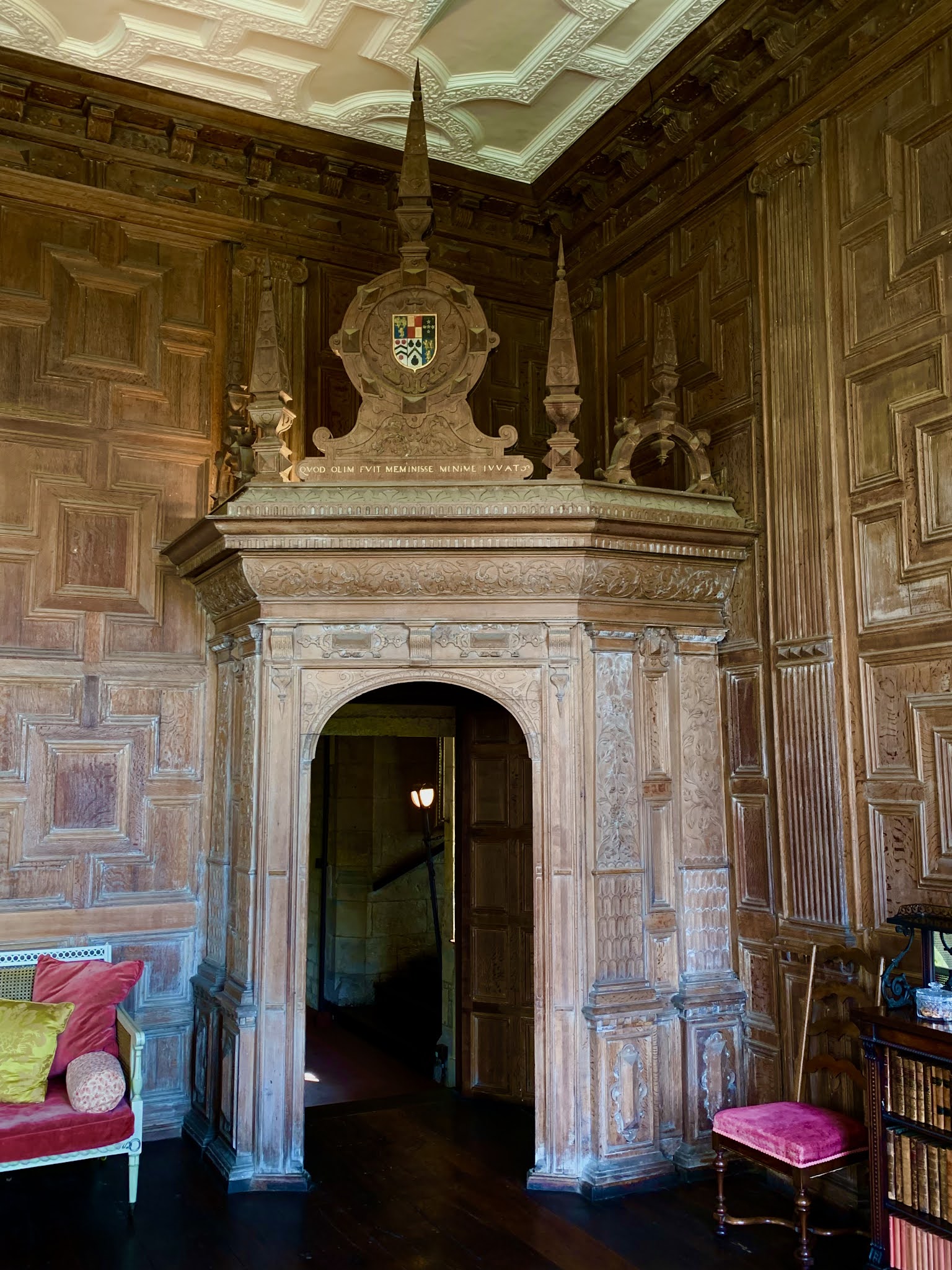
The head of household during the Civil War had a traumatic time trying to walk a sensible centre ground, getting into trouble with both sides and spending some time incarcerated in the Tower of London before being restored to his lands and pardoned by Charles II. He marked England’s eventual return to peace by redecorating the family sitting room behind the great hall … one of the castle’s most magnificent yet comfortable spaces, full of light from walls of Elizabethan windows on three sides … with sumptuous panelling and and interior porch with fanciful Jacobean pinnacles. (Top photo) The Latin motto above the door translates as “There is no pleasure in the memory of the past.” A fitting memorial for a soldier who wanted to put the past to bed and move on.
In addition to politicians, and the famous cricketer who won the hat, there are also a fair few writers in the family. Most notable to people who have studied English history is Celia Fiennes, Who explored England on horseback in the mid 18th century… a kind of tourism that didn’t exist for anyone at the time, much less women… and wrote a bestselling book about it.

The house tour exits into one of most romantic rose gardens I have ever seen, built within ruined walls with the castle looming above it and the moat glittering through old, empty windows. Seen in high season for the roses, it’s a bit like a Chelsea Flower Show garden; it seems too perfect to be real. This is a place for lingering, whether in the gardens, the tea shop in the building next to the guard tower through which you entered or out in the park looking back at the castle. I spent an hour in the shade of a gnarled oak tree trying … unsuccessfully … to capture the beauty of the scene in a watercolour. Fortunately, when it comes to this hobby it’s the doing rather than the result that brings joy.

Broughton would make few people’s Top 10 lists of attractions in the Cotswolds. It probably should. It’s a hidden gem that will warm the heart of anyone who loves the romance of English history. And if you want to get in for free, all you have to do is join the HHA.


Wednesday, 21 July 2021

A disappointing Hampton Court show prompts me to seek rose Mecca (and Arts & Crafts heaven)


Before I headed to the Cotswolds, I started my holiday at the Hampton Court Garden Festival. It was, to be honest, deeply inferior to past years. But it was so exciting to actual be at an annual milestone after 16 months of COVID cancellations ... and to be out in a crowd (limited to the fully vaccinated) ... that I could forgive its shortcomings.

Those included a decline in show gardens, sponsors and vendors. For the first time there were open plots where organisers obviously hadn't been able to sell space. The gardens themselves were bland in their near-uniformity. Everyone varied on the same themes: save the planet, and stay calm during a pandemic. The result was a lot of of shady spots for relaxation, outdoor kitchens, and naturalistic planting verging on the unkempt.

Only two gardens even inspired me to take out my camera. Tom Stewart-Smiths meadow planting gives a vision of the future of the UK that looks surprisingly like a field in central Missouri on a good day. I loved it, but even with climate change I'm sceptical about many of these heat-lovers would survive on our shores. The second I photographed for pure shock value. 

Its visual hook was an airplane crashed into a wheat field (representing genetically-modified monocultures) with luggage spilling from its severed tail. In case you missed the point, the "airline" branding was Homo Sapiens. Through the plane's shattered

cockpit you could see a small collection of plants that had survived multiple extinction events.  At the time I had a viscerally negative reaction, believing the wrecked plane was in spectacularly bad taste, but a week later it's the main thing I remember about this year's event. If a show garden is meant to get a message across, there’s probably never been better.

Amongst the vendors not attending was flower show stalwart David Austin Roses. Instead of their usual booth manned with staff ready to offer copious advice and sell you the year's latest varieties, they planted a curved bed of roses around some benches, put up labels with their flower show offer, and stayed home. Ironically, this decision on their part triggered the first day of holiday sightseeing on mine.

I had always wanted to get to their headquarters just north of Birmingham. It was rose season. From my Cotswolds starting point I was already halfway there. What the hell.

David Austin started selling his specially-bred roses in the 1960s and by his death in 2018 had become the leading light of the modern Rose world. His special genius was for combining the colours, shapes, and sense of old-fashioned roses with the repeat flowering of new ones. Today, I doubt there is a major garden anywhere in the world that doesn’t feature his creations. If gardening were a religion ... and for many, it certainly is ... then this might be its Mecca.


The gardens here are essentially the company showroom, demonstrating what more than five decades of patented roses look like in their full maturity. Breathtaking is a word that's lost its impact from overuse, but it's appropriate here. The beauty of this place in the middle of rose season is so overwhelming I was, briefly, physically overcome and needed to sit down to recover.

You start off on a patio full of enormous pots showing off the latest introductions. Beyond is the vast Long Garden, a connecting network of pergolas stretching more than 100 metres with three wide aisles, all packed with different roses. It's the biggest assemblage of roses I've ever seen in one garden. And I've seen a lot of gardens. Bushes, ramblers and climbers all jostle for your attention as they tumble together in a riot of colour. If the festive assault on your eyes isn't enough to overwhelm you, the scent will finish you off. It's incredible.

There are three walled gardens off this long walk, each walled to concentrate the aromas further. The Victorian Garden is circular, inviting you to explore different varieties in a contemplative spiral. The Lion Garden, named for a large sculpture at one end, is the most varied of the planting schemes with a mix of species alongside the headliners. The Renaissance Garden is the one I would most likely transplant to my own home, should I win lottery. A long, still pool runs from the main entrance to an Italian-style loggia. On either side of the water are aisles framed with undulating box hedges from which roses spill. A pergola runs down one side. Combined with the framing walls and the back of the loggia, it’s an exceptional stage for climbers. Here, as in the Long Garden, roses bloom at every level your eye rests upon, overwhelming both eyes and nose.
There are plenty of benches throughout for lingering appreciation. If you need more significant sustenance there is a lovely little café surrounded by more roses and staffed by locals who radiate pride in their garden. They serve simple country fair done well. Soup, sandwiches and cakes, all obviously handmade rather than from an industrial kitchen.

The purpose of these gardens is, of course, to sell roses, and this is one of the world's better examples of exiting through the gift shop. Austin’s greatest hits are organised by type in an enormous outdoor garden centre. I have bought many of these roses from garden centres and have been delighted, but the quality here is even better. I doubt that the “Boscobel” I purchased will ever look as good as it did in its pot at its birthplace. These gardens aren’t just special because of the roses, but because of the care and knowledge of the experts who tend them. Every spent bloom is dead-headed, soil beneath is turned gently, branches are pruned in the optimum spots and I’m sure every bit of feeding is done to its proper schedule. I must do better.
If you are making a long drive to get to David Austin’s, you may want to expand your day with a visit to a fascinating National Trust property that is only 20 minutes down the road on the outskirts of Wolverhampton. Wightwick Manor is probably the most beautiful of the small handful of Arts and Crafts houses on the heritage circuit. 

That it has few peers is probably down to a visceral hatred of Victorian art and architecture that ran through much of the 20th century. I admit many Victorian interiors can be gloomy and overwhelming but Arts and Crafts, embraced by industrialists who wanted to be seen as edgy, intellectual non-traditionalists, is different. The combination of William Morris, his colleagues in the decorative arts and the pre-Raphaelite painters brings a lightness of touch, a confidence with colour and a devotion to romance and comfort. My instinctive reaction in an Arts and Crafts house is to snuggle on a sofa with a great book. (To match the environment, probably something by Oscar Wilde.) Here, I could do so for a very long time.

Though Wightwick was built with all of the “mod cons” available in 1887 (electricity, central heating, proper bathrooms), it is meant to feel like a fairy tale bower. William Morris’s lush floral wallpaper surrounds you, and there are several original drawings from his tapestries.
His fabrics beckon you onto overstuffed chairs and sofas. Stained glass windows and de Morgan tiles around fireplaces send shards of jewel-toned light across rooms. One of the best collections of Pre-Raphaelite paintings in the country brings those fairytales to life on the walls. One of the unique elements of Wightwick is its large collection of female Pre-Raphaelite artists, and these days they really celebrate that part of the collection. On my visit the gallery in one of the outbuildings was dedicated to the little-known wife of William Morgan, Evelyn, who was an accomplished artist whose work inspired her husband’s pottery.
Outside, the house is all romantic gables, half timber and and mellow brickwork. Master craftsmen were as much at work here as inside, evident in carved animals and decorative bits that adorn the timbers. 
There are some pretty rose gardens here. Though they pale in comparison to David Austin’s.

The staff inside the house were both chattier, and more knowledgeable, than your usual National Trust volunteers. Maybe it’s the extra time they’ve had in lockdown, or maybe just a deep pride in this region that isn’t really on the tourist track. If you are anywhere near here, especially in rose season, it is worth a detour. Both these sites are jewels that deserve to be better known.


Monday, 19 July 2021

A week of solitary sightseeing in the Cotswolds takes me back to my English roots

The United Kingdom is caught in the grip of a collective case of cabin fever.

Last summer, everyone embraced “staycations” with a Blitz spirit. We were all doing our bit in the battle against the pandemic, felt virtuous injecting some cash into local attractions deprived of foreign tourism, and actually had a bit of fun discovering British locations that could rival continental hot spots.
More than 15 months after the first restrictions, patience is running out. One summer of local holidays was charming, but nobody expected a second. The closer summer came, the more confused the travel picture grew as regulations shifted back and forth with little notice. The only dependable option is getting in your car and staying local again, if you can manage to stay clear of the NHS’ increasingly notorious Test and Trace app surprising you with your own personal quarantine. (As I write, the app had pinged half a million people in just one week, with rising numbers ignoring its advice because the overwhelming majority of the population is now fully vaccinated and precautions are starting to feel pointlessly excessive.) Every news broadcast features disgruntled holidaymakers, British-owned businesses on the continent facing bankruptcy without this summer season to refill their coffers, or frustrated owners unable to get to holiday homes in France and Spain.

The Bencards aren’t attempting to break our island shackles until September (and I have no real confidence that trip will take place). For a much-needed summer pause, we headed for the Cotswolds.

Regular readers will know this is familiar territory for BencardsBites. We spend at least two weekends a year at the Longborough Festival Opera near Stow-on-the-Wold. Thanks to both being able to work remotely, we thought we would mix things up for our second opera of the year by decamping to Stow for a whole week. We’d work during the day, enjoy someplace different in the evenings, and get a feel for what living in the Cotswolds might be like. (One of my long list of retirement fantasies.)

It didn’t go quite as planned. A 10-day COVID quarantine as June turned to July knocked me out of my annual girls’ trip and forced my husband to reschedule some important appointments into the week scheduled for our Stow residency. The result: I took the whole week off with the unused girls’ trip time, but was on my own for the first four days and solo sightseeing for the whole week.

It was an unexpectedly pleasant trip down memory lane. On my earliest expat assignments in England, any moment I wasn’t working or sleeping I was exploring on my own. Unencumbered by the interests of others I threw myself into historic sites and wandered miles down country lanes in search of some much-lauded view or quirky ruin. Often the only conversation I had across a whole weekend was with guides in historic houses about some interesting artefact or architectural nuance. And that’s exactly how I spent much of my week.

With no-one’s patience to try but my own, I could drive almost two hours just to see one garden. (Of that spectacular visit to David Austin’s headquarters, stay tuned for my next article.) I could indulge my love of the Arts and Crafts movement with a lingering visit to Wightwick Manor and savour every layer of history at the beautifully curated Sudeley Castle. Many might find Broughton Castle too similar to do in the same week, but not me! I could take the long and winding route to wherever I was heading, down tiny lanes, regularly pulling over to take in a view or let traffic that actually needed to be somewhere hurry by. I could linger unbothered in the seconds area at Whichford Pottery, debating how big a flaw I was ready to accept in exchange for a proportionate discount. (With no one to question whether or not I actually needed new pots.)

One of the great delights of this trip was aimlessly strolling around some of the smaller, particularly picturesque villages. Places like Bibury, Upper and Lower Slaugher, Great Tew and Lower Swell have made the Cotswolds famous the world over. Golden-walled, slate-roofed, rose-covered cottages of mellow antiquity gather around tiny village greens or line little streams crossed by ancient stone footbridges. Wrought iron gates offer views of  gabled and pinnacled manor houses that might have welcomed Elizabeth I. Fields of golden wheat, hello rape, blue flax, sheep and cows extend up the encircling hillsides. 
For years, these little slices of heaven have been partially destroyed by the worshippers who travel here to drink in their atmosphere. Rural charm is hard to preserve in the face of busloads of tourists alighting to photograph every angle and stick their noses against people’s windows. At their worst, foreign crowds can make these places feel more like the British pavilion at Epcot real communities. This summer, with foreigners mostly absent, these idyllic villages retained their original charm. And I made the most of it, strolling slowly to take in architectural details and picturesque scenes, or finding a comfortable spot from which to draw or watercolour for an hour or two. (My attempt at the famous row of cottages in Bibury called Arlington Row is below.)
I even indulged in the takeaway curry that used to be my staple on those long-ago sightseeing weekends. Now that I am married to a man who is allergic to tomato and doesn’t like spicy food, an Indian takeaway has become a rare and solitary indulgence. A Sunday-night order from Stow-on-the-Wold’s excellent Prince of India kept me going until the husband’s arrival Wednesday.

While I have no desire to return permanently to the solitary travels of my 30s, I enjoyed the self-indulgence of my week enormously. You, dear reader, can look forward to a stream of articles in coming weeks as a result.

Our home in Stow-on-the-Wold was called The Little House, and little it was. In square footage, it was about half the size of the flat that we rented at The Unicorn up the street when we came up for Wagner last month. Just a small kitchen, sitting room and loo downstairs, and a snug double, single and bathroom up. Basic rather than luxurious, but excellent value for money at £540 for an entire week in contrast to around £300 for two nights at the  boutique hotels we’ve typically used for weekends.
The Little House is in the lower part of Stow-on-the-Wold, just up a lane from The Bell pub. It was only a few hundred yards beyond the main circuit most tourists take around the little market town, and yet the “neighbourhood” felt more local. It was quieter, parking was easier, we discovered new restaurants and pubs, yet we were still within easy walking distance of all of our regular favourites.

Despite my celebration above of the lack of foreign tourists, I am happy to report that those visitors … particularly Americans … are missed by the hospitality industry. In several conversations with locals I heard the same refrain. Local tourists are different. It’s not as simple as Brits spending less money than the foreigners. (Though I was assured most of them do.) The big differences came down to research and appreciation.  People who invest in plane tickets and spend a week or two in the country put effort into preparing for their holiday. They plan what they want to see and often read about things in advance. They research comparison sites for hotels and restaurants and generally have set their expectations accordingly. In summary, foreigners are coming for a heritage and cultural experience, while Brits are looking for new places to kick back, eat and drink. (I suspect what heritage sites are losing in revenues, pubs are making up.) I was both delighted and saddened when one of the guides at Sudeley Castle volunteered that the Americans who visit almost always have a better grasp of British history than the natives wandering through at the moment.

There’s plenty of history to come. And gardens. And one particularly fine new restaurant tip. Read on…


Thursday, 24 June 2021

Tower of London is much improved by COVID restrictions

On an average summer Sunday, 12,000 visitors stream through the Tower of London's gates. With social distancing in place, entry tickets were limited to 1,700.

The results were perhaps the most dramatic of all the pandemic-restricted sites I've visited in the past 18 months, precisely because the Tower is always so uncomfortably crowded. Now, the amusement park-style queuing system outside the Crown Jewels stands empty. Haven't had your fill and want to go again? Beefeaters smile indulgently and let you circle around inside the exhibition rather than enforcing strict traffic control. Tower Green has become a place of quiet, restful contemplation where you can catch the off-duty residents playing with their children and dogs. Footsteps echo in the silence of the restored Medieval palace. The chapel in the White Tower ... one of only two Norman religious spaces left in London ... is once again a place for quiet contemplation. 

Even the ravens seem more approachable.

As with Westminster Abbey, tours have been suspended because there's no way to deliver them without packing people together. So you have to do without one of the best bit of a visit to the Tower: the wit, authority and tale-spinning of the military men and women (technically Yeoman Warders, aka Beefeaters) who live here. Though they are on duty and happy to answer questions and have a chat. Few people could need a guided tour less than us, of course. Two history buffs, one strong on the monarchy and architecture and the other with deep expertise in arms, armour and military history, with a combined total of more than a dozen visits between us including small, behind-the-scene events through our respective work places. We know the place.

Still, it's good to be back for a proper ramble. When you're here for The Ceremony of the Keys or corporate events your access is limited and your attention more on people than artefacts. 

The crown jewels are the highlight of the place for most people and there's no denying they're magnificent, though the crowd management tactic of displaying them between moving walkways can be phenomenally irritating if you're trying to study details. Don't miss the before and after. George IV's coronation robes and the royal "plate" (a collection of outrageously opulent decorative bits for banquets, including a silver-gilt wine cooler most people could bathe in) are just as interesting, if not so jewel-encrusted.

Our combined interests, however, found us even happier in the White Tower. I'd been under the mistaken impression that the best of what used to be in London had been moved north to the Royal Armouries museum in Leeds.  I was, happily, misinformed. There's enough armour, jousting kit, swords, cannon, etc. to keep the interested busy for hours. Bored by the trappings of warfare? No problem. Much of this stuff is decorative enough to appeal on a purely artistic basis, and the displays are engaging. 

There are even some modern updates, including a magnificent dragon assembled from a variety of arms and armour and a case of modern, highly decorative firearms that proves the point that money and good taste often occupy different planets.

With the queuing necessitated by the usual crowds, it would be tough to see everything in one visit. Not so at the moment. After the jewels and the armour, my favourite bit of the Tower is the reconstructed medieval palace. I remember this causing huge controversy when they created it in the late '90s; while the French are happy to re-create interiors to delight tourists (witness most of the chateaux in the Loire), the British tend to renovate and preserve whatever is there. I'm delighted that people went against the trend here, giving us a king's bedchamber and a throne room packed with colour and life. I wish there was more. 

Walter Raleigh's tower has some excellent audio-visual interpretation to help you understand his time here, while the wall walks around the northern edge of the complex have interesting mini-museums dedicated to the Tower's role in the World Wars, and its history as a zoo. The latter is also evoked through the whole complex with chicken wire sculptures of wild animals who once lived here. It's a fun touch.

We skipped the Fusiliers Museum, the Torture Museum and the Chapel Royal of St. Peter ad Vincula, the latter because we've been lucky enough to spend time there in recent years at carol services and the others because after our extensive lingering in the White Tower we'd reached an elegant sufficiency of history. 

One thing about our visit saddened me profoundly. And made me feel very old. Today, from wherever you stand in the Tower complex, the London skyline bristles above you, with the Shard only slightly more intrusive than the cluster of office blocks from the adjoining City. When I first visited in my teens and twenties, none of that existed. The only building I remember being able to see from inside the walls was Tower Bridge, and the Victorians built that as an architectural match. It was easy, therefore, to lose yourself entirely in the history and imagine you were travelling back to Tudor or medieval times. You need a much better imagination to do that now. But if you're ever lucky enough to be here with limited crowds, just keep your eyes low, find a quiet corner and indulge in a bit of dreaming. 


Tuesday, 22 June 2021

Westminster Abbey shows off the English talent for cultural mixology


The English have a magic at picking and mixing the best from other cultures and blending those elements into something so thoroughly their own that they forget the influences were even foreign to begin with. Dig deep enough into almost anything in this country, from culinary traditions to village names to family bloodlines, and you’re likely to find roots leading somewhere beyond this island.

My homeland of the United States, of course, is a nation of immigrants and imports. But hyphenated Americans hold onto their roots. (Witness American tourists in Ireland coming “home” 160 years after their ancestors couldn’t wait to shake the sod off their heels.) The English assimilate. Maybe not immediately, but slowly, steadily and permanently.

A brilliant case in point is the climax of any visit to Westminster Abbey: the Lady Chapel. This triumph of English Perpendicular Gothic is arguably the most beautiful single interior in the whole country. As a representative of the architectural style only King’s College Chapel at Cambridge can come close.

With its soaring windows, delicate tracery and ceilings like bunches of hanging lace, Perpendicular Gothic became so synonymous with the English that when the Victorians sought to kick out all of the foreign neo-classicism of the 18th century it was their go-to “local” style for the rebuild of the Houses of Parliament.

And yet…

If you look hard at Westminster Abbey’s exquisite culmination of Perpendicular Gothic you’ll see a Welsh-born king buried at its centre, who important Italian iron workers for his tomb, surrounded by a style originally created by the French, based on a pointed Arabic arch. (All, of course, glorifying a god born in the Eastern Mediterranean.) Yet, somehow, English gothic is distinctly English. There’s a playfulness and lightness to it that’s completely lacking in, for example, the royal tombs of Ferdinand and Isabella in Grenada that are from the exact same time period.

If you only linger over one thing in the vastness of Westminster Abbey, this magnificent room is it. In addition to the tomb of Henry VII and Elizabeth of York, founders of the Tudor dynasty, the side chapels are encrusted with additional royal and aristocratic tombs like barnacles on an old boat’s hull. But these are exquisite barnacles, bristling with spires, angels, faithful dogs, heraldic beasts and grieving relatives.

The chapel is also the formal centre of the heraldic order of the Knights of the Bath, with gorgeous mahogany choir stalls topped with helms and each members’ banner. Any lover of architecture and history could easily spend an hour just in this one small chapel.

But this is Westminster Abbey, national burial place of the great and the good, and the Lady Chapel is just a small fragment of what there is to see. Tombs are the thing, and a solid working knowledge of British history … or a good connection to Google … is hugely helpful. Beyond identifying the kings, signage is sketchy and the famous verger tours … where experts tell you who’s who … aren’t running because of social distancing. The most magnificent tombs don’t necessarily commemorate people whose fame has lasted, so you may end up playing detective. (Only bother laying out £5 on the audio tour if you are coming with absolutely no prior knowledge. It’s extremely basic.)

Medieval worthies lie beneath stone effigies of themselves in armour or their best court clothes, faithful hounds at their feet. Most of those have lost their original colour but William de Valence, a half-brother of Henry III, opted for bronze with enamel accents and still rests his head on a brightly coloured and patterned pillow.

Henry V is, sadly, on a perch too high to get close to, but the gothic chantry chapel forming a bridge above your head is spectacular.

The Tudors and Jacobeans loved colour, too. A riotous variety of their monuments show off not only the bodies they wanted remembered but exuberant architecture and decorative elements attesting to their wealth. But it’s the Georgians who really start getting extravagant, with sculpted scenes of the climactic moments in their life (a long-forgotten sea captain has a naval engagement in high waves so vivid it looks like the set for a play about to open) or extraordinary creatures either mourning or winging them to heaven. One of my favourites is the monument to General Wolfe, hero of the Battle of Quebec, whose tomb is guarded by two of the most emotionally stricken lions it’s possible to imagine.

Another favourite is David Garrick, superstar of the Georgian stage, who is shown full length and life-sized (at least it appears that way from the ground), throwing aside the theatre curtain to take his applause. Even the most self-obsessed “luvvie” wouldn’t have the confidence for such eternal self promotion these days.

The thing that was once the centrepiece of the whole church … the tomb and shrine of Saint Edward the Confessor … isn’t much to look at now and is in a raised area blocked off to visitors. That won’t matter to most because the tomb that now stands in his place in the veneration stakes is that of the unknown warrior, near the front door and near a memorial to Churchill. Framed with a perpetual border of poppies, the warrior’s is the only tomb in the Abbey nobody is allowed to walk on.

While the tombs could keep you busy for days, it is worth remembering that you’re in one of the great medieval cathedrals of Europe and paying some attention to the architecture. One of the most precious things in the building is something neither signage nor the audio tour give enough attention to: the magnificent Cosmati pavement.

The Cosmatis were a family of Roman craftsmen who reinvented the idea of mosaic for their own age. Rather than the tiny square tesserae the ancient Romans used to bring detailed illustrations to life on their floors, the Cosmatis went for a more abstract approach inspired by Islamic artists in North Africa, and used reclaimed bits of ancient Roman buildings for their materials. They were particularly famed for figuring out how to take thin discs off ancient columns, as if they were slicing a salami. You can see many of those big circles in the Westminster pavement.

Cosmati work is rarely found outside of the Italian world, went out of fashion by the high Middle Ages and the Westminster example is unique for having inscriptions set into the marble made of brass letters. It really is quite extraordinary to be able to see such a complete example, and another proof point of the English comfort with assimilating foreign styles.

The current, pandemic-driven low density of tourists gives visitors a chance to appreciate the stark beauty of the bones of the place. Look up from the tombs and notice the elegant simplicity of the black columns beneath the white vaults. I leave it to you to decide whether the exuberant Victorian choir screen and the towering organ enhance or take away from the scene. On the way out you’ll go through the old cloisters and the Chapter House, deft examples of English skill with an older, more French version of gothic than you see in the Lady Chapel.

A socially-distanced visit has its drawbacks. No guided tours is a problem in a place with so many layers of history. The chapels containing Elizabeth I and Mary I on one side and Mary, Queen of Scots on the other are closed because their tight spaces don’t allow enough room to keep people apart. And these are amongst the top 3 things you want to see here. The staircase up to the Queen’s Diamond Jubilee Galleries is also closed because of unenforceable social distancing, and was the one new thing in the Abbey I’d been wanting to see. The views are supposed to be fantastic and there’s a whole new design of the old museum to appreciate.

So as much as I loved the low-crowd visit, this is still a place I need to return once regulations loosen.

Monday, 21 June 2021

In the battle between saint and sinner, curious visitors come out the winners

With the prospect of all COVID-related restrictions lifting in late June, my husband and I decided there was never going to be a better time for a sightseeing weekend in London. Major tourist attractions were open, but visitor numbers were strictly limited and foreign tourists still absent. Like most people who live here, we hadn’t bothered with many of London's "star sights" for ages. I will put up with shrieking mobs of children on school trips, or aggressive power sightseers elbowing me out of their way for the perfect photo, when someplace new. But on my own turf? Not worth the hassle. Social distancing, however, meant no hassle ... so it was time to take advantage of one of the few benefits of pandemic.

We had a packed weekend. The British Museum after work on Friday, Westminster Abbey on Saturday, and the Tower of London on Sunday. Add dinner at the renown Cinnamon Club on Saturday and a relaxing stay in a junior suite at our club for a proper mini break.

It’s no surprise we started things at my favourite repository of culture, of course. Granted, the British Museum does not fit onto that list of the long-avoided. Between my membership, a fabulous members' lounge, and my continuing love of the ancient world, it is instead one of my boltholes for seeking respite from London's madness. But it's even better when near empty. Until regulations lift, all attendance must be booked in advance for either the main galleries or special exhibitions, and there is a one-way system throughout. Even with cavernous spaces and lofty ceilings, social distancing regulations demand sparse numbers. So sparse, it reminds me of the days when my mother worked in museums and we could wander through galleries before they opened to the public. Bliss.

Our objective: a double dip into current exhibitions. The infamous Roman Emperor Nero is in residence in the main exhibition space on the ground floor, while saintly Thomas Becket holds court in the smaller gallery above the rotunda. Both shows are excellent, but I give the slight edge to Becket for the completeness of its concept and storytelling.

But first to Ancient Rome. Nero is legendary as a monster who persecuted Christians, murdered his mother, kicked his pregnant wife to death and fiddled while Rome burned. Nero: the Man Behind the Myth's main objective is to remind us that history is written by the winners. And in the late 1st century AD, those were people with no love for Nero or the dynasty he ended. Thus it's credible to imagine the last Julio-Claudian Emperor was not as bad as his press.

Nice premise, but there wasn't enough evidence here to completely exonerate one of history's great villains. Though they did bring balance and if you don't know a lot about him to start out with, this may be an eye-opener. 
The displays throughout felt more like an illustration of Roman life at the time than any specific defence of the young emperor. Nero was the titular head of the army, so here is a gallery with lots of military memorabilia. Nero liked and staged lots of gladiatorial contests, so here’s an excuse to show some gladiators' armour. He fancied himself a great musician, so we get a wall fresco of Romans playing music. It all looks great, but it wasn't shifting the weight of history for me. 

I felt that Nero's position in the arts was particularly underplayed. The section dedicated to the architecture he left behind in Rome … the Renaissance-era discovery of which sparked design trends that lasted for centuries… was beautifully designed to sit in an octagon beneath a gauzy dome. This mimics Nero's famous octagonal room with its rotating ceiling reflecting the heavens. But the materials on display below it were sparse. Someone could have put video to work so much better here. Why not project an artist's interpretation of the famous room for me to walk through, rather than leaving me with a ghostly remnant? In the music section, why not offer us a reproduction of the ancient water organ Nero loved to play, or give us an audio track of what that instrument might have sounded like?

The section on the great fire in Rome is where the exhibition really hits its stride. Here we do have a creative audio visual interpretation showing us the progress of the fire over days, with contemporary sources confirming Nero wasn't even in town when the fire started and revealing the help he gave to his people. An atmospheric soundtrack gives us the crackling of fire and distant screams of people running to safety. The show needed more moments like this.

The British Museum also missed a trick not finishing with an exploration of the impact Nero has had on Western culture. That was a surprise, considering the vast exhibition space seemed quite sparsely filled and the pop culture angle is a frequent closer there.  We could have been treated to Nero on film (there is a large picture of Ustinov playing him at the shows entrance but we get no more of that), on stage and in music. Where were the box sets of I, Claudius in the gift shop? Monteverdi gave us a more-balanced-than-usual Nero in his Coronation of Poppea, and if had featured we could have been treated to one of the most beautiful duets in the whole operatic repertoire while enjoying the artefacts. And then there is the influence of the art and architecture. Think of the fiddly, brightly-coloured style of wall painting with garlands, arabesques, mythological characters and dancing goddesses, beloved of everyone from popes to English aristocrats to late 19th century hotel designers and you're thinking about copies of the paintings in Nero's palace. The original meaning of "grotesque" meant this style of design, from the cave or grotta, before it took on its more sinister meaning. Such an example of the shifting nature of language might have helped the argument about the shifting nature of Nero's reputation.
Granted, I know a lot more about Nero than the average punter. But my husband felt equally undernourished and unconvinced by what was on offer. It is a pretty show to look at, but we both wanted more depth.

We got it upstairs with Thomas Becket: Murder and the making of a saint. This may be because the curators aren’t trying to prove anything here. They are simply telling Thomas Becket story as most of us know from school, or from the epic film with Richard Burton and Peter O'Toole, with artefacts, illuminated manuscripts, and video projections. (If you haven't seen the 1964 film, Becket, make the effort to do so before seeing the show to bring things to life.) 

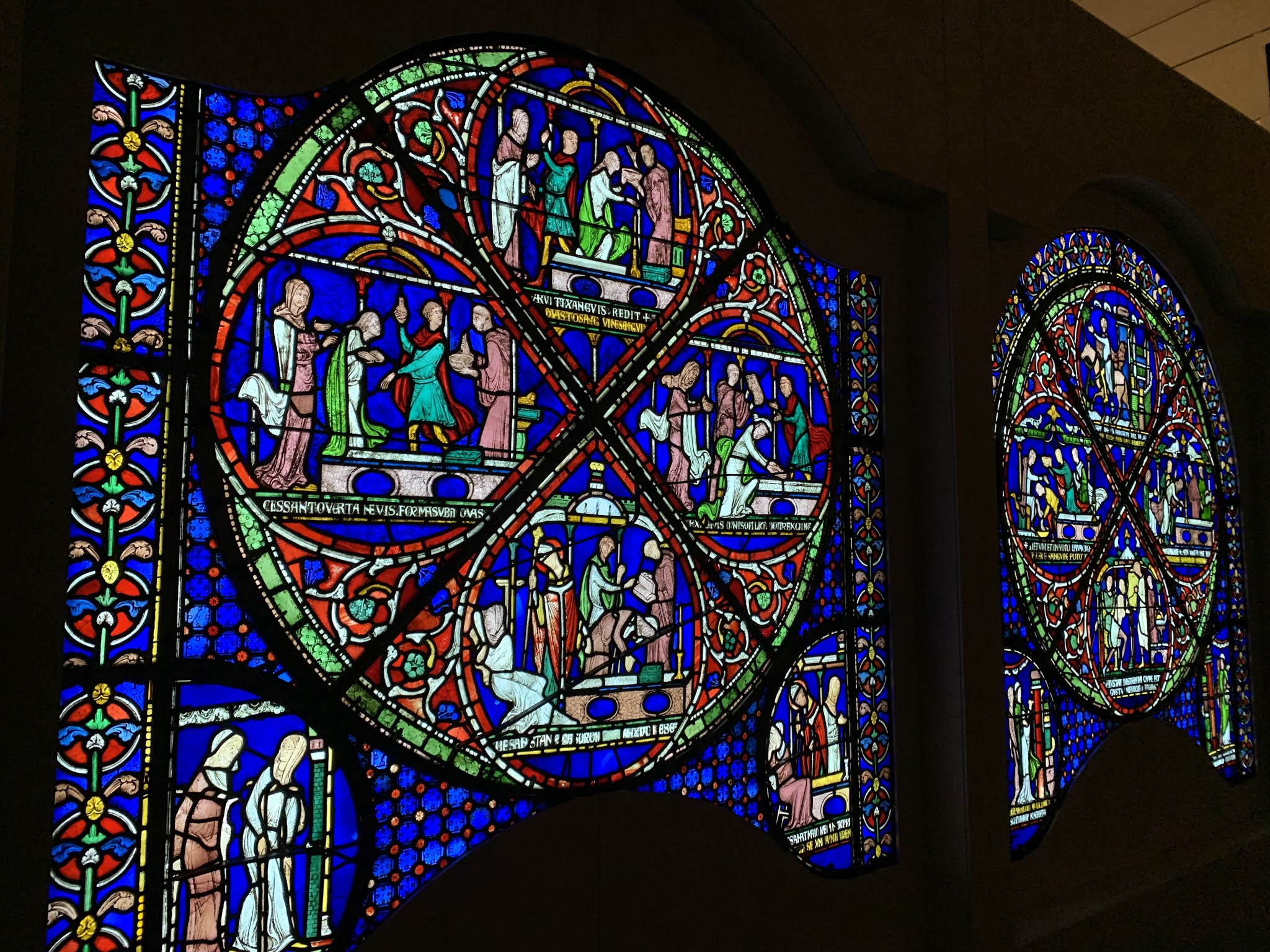
A series of medieval stained glass windows taken from Canterbury Cathedral, cleaned and restored for this show, is reason alone to make the effort to visit. They are exquisite, and provide a strong rebuttal to anyone waffling on about the blue in the windows at Chartes being unique to the French. Here is proof that the English could produce the same heavenly work. (We just lost so much more of it in our internal religious battles than the French did).

The windows, however, are late in the show, and there are plenty of goodies to fill your eyes until you get to them. Four knights murdered Becket in 1170 ... whether or not on the king's direct orders may never be resolved ... and canonised just three years later. His cult spread quickly across Europe, its flames fired by anyone who was for the pope or against England's Henry II. The king's estranged wife, the magnificent Eleanor of Aquitaine, and his daughters were active supporters of the new saint and Henry was generally held responsible for killing. His PR was so bad he opted for a spectacular show of public penance in 1174, submitting to a beating from the monks of Canterbury Cathedral. 


Such a delicious scandal triggered the equivalent of a modern media feeding frenzy, with every artist of the time taking on the subject. It was an era of lush decoration in fabrics, interiors, reliquaries and vividly coloured illuminated manuscripts. The exhibition is full of examples. They illustrate Becket's story but are also lushly beautiful in their own right. (This is something that Nero, mostly full of austere statuary and architectural fragments, could not match.)

With these beautiful visual aids, the curators take us through Becket's youth, his unlikely conversion to servant of the church, his rivalry with the king and eventual death as a political martyr. The death itself is a dramatic midpoint of the exhibition, told through a striking animation. Afterward comes the explanation of his growing cult, and some interesting insight into its spread beyond England. There is a bit on the Canterbury Tales, of course, and a fabulous animation of what the shrine would have looked like in its glory days. Though, like Nero's Golden Palace down below, I think they missed the potential of the technology by not projecting a life-sized image for us to gawp at.

The smaller display space suited the story well, with each enclosed area revealing one chapter before you moved through into the next. It builds drama, and made the story more manageable. I suspect Nero suffered from the vast main exhibition area, and might have been better if broken into the same bite size chunks as the Becket show.

Either show is worth your time if you have an interest in their time periods, and both show how far curators working in the UK have come in the last decade with show design and storytelling. With current Covid regulations remaining in place until mid-July, they still offer the glorious opportunity to linger over displays without crowds. 

Make Becket your priority not just because it is the slightly better show, but because it closes on 22 August. Nero and his world are with us until 24 October.


Monday, 7 June 2021

Pandemic produces a Walküre of intense emotion and rare intimacy

That necessity is the mother of invention has been proven repeatedly throughout the pandemic. Nobody has done it so brilliantly, in my experience, than Longborough Festival Opera in their new production of Die Walküre.

I wasn't expecting that. Yes, the idea of a weekend away in the Cotswolds, of a hotel, of being in a theatre again hearing live music, inspired joy. But the prospect of four hours of Wagnerian opera with no staging and people just singing filled me with trepidation. How wrong I was. Because this was so much more than "just" singing.

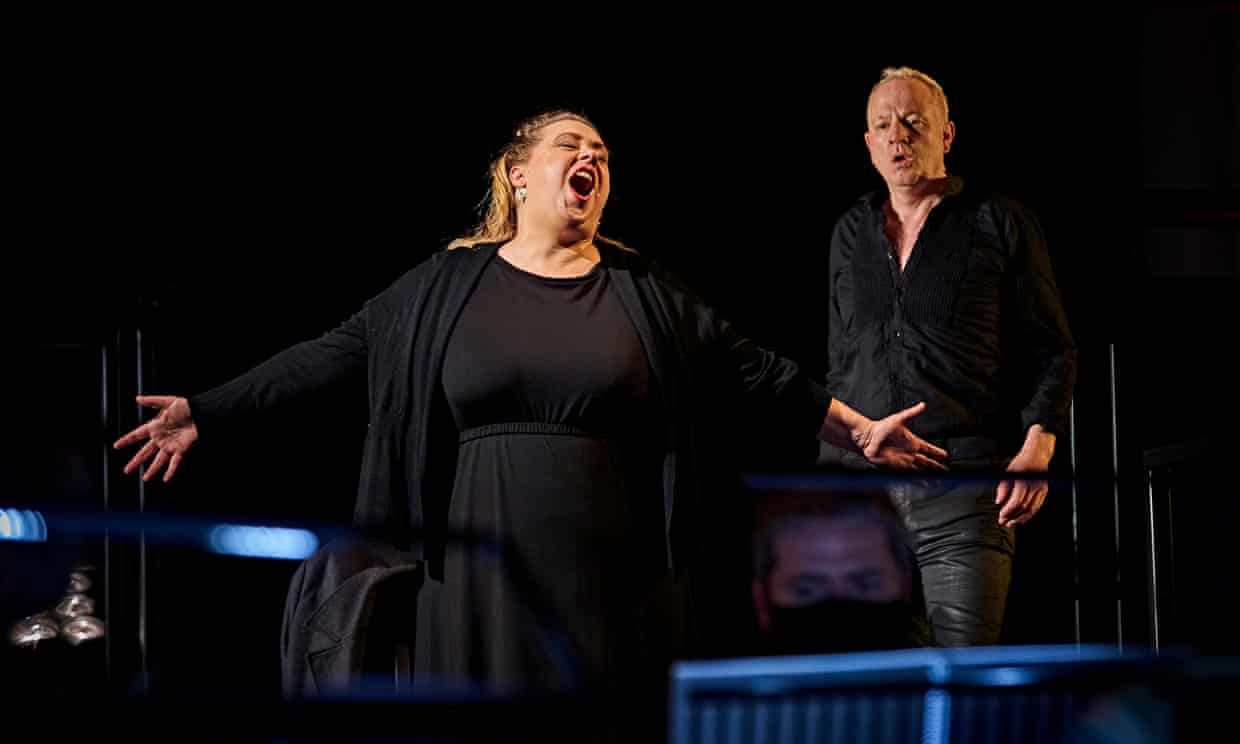
Performers kept a guideline-respecting two metres from each other, but they moved ingeniously around the stage. Metal gangways on three levels at the back and two aisles to spaces at the front corners of the stage allowed for plenty of movement, and even something approaching a crowd when the Valkyries gathered. The performers weren't just moving, however, but acting. Acting with every muscle of their bodies and every twitch of their faces. Social distancing only added to the frisson. As Sarah Marie Kramer's Sieglinda and Peter Wedd's Seigmund fought their instant but forbidden attraction they danced towards the limits of their 2-metre barrier and retreated like moths around a flame. Even as they gave in to their passion, the distance was there, reinforcing the brevity of their union and the tragedy to come. 

The emotion in the last act was even more intense, as a fiercely defiant Brünnhilde (played by Longborough regular Lee Bisset, in particularly fine voice) and angry, defensive Wotan (the magnificent Paul Carey Jones) brought all the trauma of complicated father-daughter relationships to glorious life. Once again the inability to touch brought added poignancy, as the vulnerable and ultimately defeated father had abandon his favourite child only because she acted on what was in his heart. It was one of the most emotionally charged moments I've ever experienced in an opera. (And will forever destroy my argument that Wagner can't do love or emotion as authentically as the Italians.)

This Walküre, however, transcended both Wagner and opera to touch the longing and emptiness of the pandemic itself. A whole world hungering for, and striving towards, the forbidden touch of others. Anyone who doubts the art of centuries past can't be relevant to today should have been there. No wonder there were so many moist eyes as the privileged audience reeled out of the theatre into the June dusk.

Scoring Wagner tickets at Longborough must always be described as a privilege. Since we discovered the Cotswold-based country house opera festival 11 years ago it's climbed into the heights of Wagner interpretation, regularly acclaimed alongside giants like The Met or Bayreuth. I don't have statistics to prove it, but I doubt there's much chance at tickets without the advantages membership. We certainly learned years ago that stepping up to patron level was the only way to be sure of weekend seats in the intimate 500-seat theatre. 

This year, social distancing guidelines reduced the audience per performance to about 150. On the main floor, every other row remained empty and two seats separated each group of ticket holders. Boxes were at normal capacity as long as they were filled by groups who came together. Thus we had the rare delight of being able to welcome friends into this rarified world; even Wagner patrons can normally only purchase two Wagner tickets.

The audience might have been limited and the sets foregone, but there was no skimping on the orchestra. Strings swelled, brass stirred the senses, percussion thundered and boomed. Longborough maestro Anthony Negus wouldn't have allowed any less. So the string sections sat on stage with the action taking place around them, while the rest of the orchestra sat in the pit directly below. From the nerve-wracking edginess of the chase scene that opens the opera to the intensity of the lovers' themes to that iconic Ride of the Valkyries, every note surrounded us in richness and reminded us that no matter how good a home sound system, there's nothing quite like live to touch your soul.

While my appreciation for Wagner has grown steadily with our years at Longborough, I was never sure I'd be up for the whole ring cycle at once. This Walküre decided me. When they put on their next ring cycle in 2024 I'm ready to decamp to Stow-on-the-Wold for a week and binge watch the whole thing. Because I really need to see this production again. Next time, I'll be armed with a box of tissues.