Saturday, 19 September 2020

A famous gardener and a now-exotic London outing make this birthday/anniversary special

My husband is not typically a creative gift giver. Like many men, he likes the safety of working off a list provided by the recipient, and loved the efficiency of having something delivered direct from Amazon ... not minding if it’s sans card or gift wrapping. Thus it was quite a shock this year when, for my birthday and our anniversary ... which happen on the same day ... he came through with a customised surprise to make the most romantic gesture seem trivial: a 45-minute private garden consultation by Zoom with Alan Titchmarsh.

American readers may need some context here. Imagine hanging out with Martha Stewart to get home style tips, receiving batting coaching from Albert Pujols, or rap instruction from Lin Manuel-Miranda. Titchmarsh is the UK's favourite gardener, a humble, working-class lad from Yorkshire who went from flower beds to horticultural journalist to TV star. When I moved to the UK in the late '90s he was omnipresent, hosting the annual Chelsea Flower Show coverage, running a wildly-popular garden makeover show called Ground Force and hosting the weekly broadcast (and national institution) of Gardeners' World. Now 71, Titchmarsh has moved solidly into national treasure territory, and is in theory semi-retired though he still hosts a radio show on ClassicFM, writes garden columns, produces the occasional novel, pops up on TV and promotes charitable causes.

It's the combination of charity and ClassicFM that provided the opportunity for my birthday present. He'd donated the consultation to the station's charity auction and my husband spotted his opportunity to procure a gift to make his wife swoon.

My call was far more than just a brush with fame. Titchmarsh's experience is abundant and he delivers it with the skills of a master consultant. He manages to tell you what's wrong without implying an ounce of criticism to your gardening skills. In fact, his praise of my efforts thus far made me bloom with pride at the same time he was able to tell me exactly what I'd done wrong and how to fix it. It was all terribly appropriate, since much of the knowledge I used to design and take care of my garden has come from his broadcasts and columns over the years. He also radiates a genial kindness that marks him out as one of the true good guys in this world, a hunch confirmed by a friend who used to work with him at the BBC.

So what's wrong with my garden? The same thing I've been hired to fix at work. Too many things competing for attention. I need to do more with less. It's ironic that I can see and attack the problem so clearly in my professional life, but didn't spot it in my own herbaceous borders. But, as my new best friend and horticultural coach consoled me, when you truly love plants and don't have a lot of room, you try to pack in everything possible. 

This autumn will see me stripping out about a third of my plants and making a few tweaks to create bigger blocks of colour. The same applies to my pond, which already looks better after sending armloads of reeds, water lilies and oxygenating plants to the compost heap. My least successful bed (pictured below) lacks a strong focal point; I'll be digging the whole thing out, investing in the recommended Japanese maple and planting around it. And while there's no rescuing my espaliered apple tree (planted in too shady a spot and now too established to move), the west-facing wall I've ignored until now could support three carefully-chosen fruit trees.

My date with Alan Titchmarsh took place several weeks before my birthday, leaving the day itself for other treats. I went up to London for the first time since the world shut down in March to meet a friend for lunch (in a nice parallel, the same one who used to work with him at the BBC). The experience was a bit surreal, at once both familiar and alien. I long ago lost count of the number of times I’ve gone from Basingstoke to Green Park station, and the Wolseley is one of London’s most comforting, long-running, establishment venues for a business lunch. And yet the trains running 1/3 full, the empty, echoing corridors of Underground stations, the blank advertising spaces and the closed up shops felt like I was walking through the zombie apocalypse. London without foreign tourists is an oddly alien place and, frankly, glorious. But not economically sustainable; at least not as it was at the year’s opening.

The Wolseley, always a favourite with a traditional English crowd, was having no issues. Every table was packed, with a time limit to prepare for the flip to afternoon tea. They might have moved the tables a bit further apart, but one of the advantages of the Wolseley for business meetings has always been the generous space between tables so it was hard to tell. The most obvious signs of these plague times were an airport-security style contraption you had to face off to have your temperature taken before preceding to your table, and the individual portion of hand sanitiser waiting atop the crisp linen napkin. 

This is one of the grandest dining rooms in London. A glorious testimony to the madness of boom and bust cycles in the 1920s, it was originally built as a car showroom. The opulent Venetian/Florentine palazzo inspiration is a reminder that motor cars were originally the preserve of the super-rich. The black-and-white marble floors, black marble columns, white vaulted ceilings, shining brass railings and grand chandeliers are properly palatial. Wolseley Motors went bankrupt in five years, however, so Barclays took the building on as its Mayfair branch. The original architect returned to update the decor with Japanese lacquer and other Oriental gewgaws that were high fashion by the late ‘20s. It’s a bizarre but merry combination that works particularly well in the afternoon when the place is functioning as a high class tea room. 

Food here is inspired by the grand cafes of Europe, with a menu very similar to that of sister restaurant The Delauney. They’re particularly known for their oyster and shellfish bar and for having breakfast favourites like eggs benedict and kedgeree on the menu 24/7. My friend swears by their chopped salads (hers did look tempting), while I opted for a classic steak tartare. Schnitzel is always on the menu as is a proper baked cheesecake. 

One of the reasons the Wolseley has remained so popular with punters since it opened in 2003 is its pricing. The prix-fixe menu is only £19.95 for two courses and £24 for three, and main courses tend to be in the mid £20s. Sure, you can have a blow out with lobster, chateaubriand and champagne, but you can also enjoy grand elegance and feel like you’ve had proper value for your money with most choices. Which is actually far truer to the English establishment who once dominated Mayfair than the Ritz across the street, which has pumped up the gold gilt, escalated prices to the stratosphere and targets cash-splashing conspicuous consumers. Who are rarely English, and seldom old establishment.

Back home, my husband celebrated our anniversary by cooking dinner ... the next night. The breakfast bar in the kitchen where we normally eat might fall short of the Wolseley’s decor and our plating is too generous to be called fine dining, but I think our black and white granite counters are a bit grand and Mr. B’s salmon en croute with a lemon cream sauce wouldn’t be out of place in a grand European cafe. 

Yes, he’s a keeper. Even before the Titchmarsh consultation. Maybe I should take him to the Wolseley.


Sunday, 13 September 2020

The show must go on ... and West Green makes it happen

England's legendary country house opera season is yet another victim of the COVID-19 crisis. From internationally-acclaimed productions at Glyndbourne and Longborough's renowned Wagner interpretations, to many small, humbler efforts, everyone got shut down this year. As prohibitions loosened some outdoor performances became possible, and while full operas couldn't be rehearsed and organised (or made to break even) in the circumstances, venues sprang into action to take advantage of any opportunity they could.

Our nearest, West Green House near Hartley Witney, Hampshire, managed to whip up a six-concert summer season in August and September, of which we took in the last: Mozart in Love.

It's hard to overstate just how glorious is was to hear live music again, surrounded by the soft murmur of an appreciative crowd. Even if that music was limited to one singer and a pianist, and the pre-booked attendees had been channeled into appropriately sized boxes chalked onto the lawns, socially distanced from their neighbours. 

Soloist Kirsty Hopkins (who also co-developed and directed the whole series) delivered an hour-long programme of 10 of Mozart's best soprano arias, from the heart-wrenchingly poignant Dove Sono I Bei Momenti to the enraged passion of Ah. Chi mi Dice Mai! Each came with anecdotes and back stories from Hopkins, adding context to the simple but powerful performance. She returned with an encore of the Alleluia from the Exsultate Jubilate, the music we used for the registry signing at our marriage. It always turns both our knees to jelly, but was particularly powerful in this rare event for 2020, just days before our anniversary, with the sun shining and swans gliding across the nearby lake.

With gates opening at 11am, music at noon and the ability to linger in the gardens until 4pm, the concert series allowed for one of the raisons d'etre of country house opera: elegant picnics. We were actually slumming it a bit, as many others had shown up with tables, cloths and full place settings, while we made due with plates on laps. But I'd wager our bbq chicken, arancini, barley salad and lime tarts were on par with anyone else's culinary efforts.

Of all the country house opera venues I've explored, West Green has the finest garden. (Yes, better even than Glyndbourne.) That's probably because opera here is a recent addition to venerable and well known horticultural efforts. At its heart is an enormous Victorian walled garden, with outlying paths, a lake, water features and follies. It's not a big place, but one where thoughtful design has given every section impact and clever vistas and borrowed landscape make it seem larger. Its most distinctive feature, however, is a light-hearted sense of humour.

Vegetables grow side-by-side with flowers. The palatial chicken coop has an Imperial Chinese theme, including willow-pattern water bowls.

A section of grassy mounds along a pathway looks like a recently-abandoned hobbit village. Classical portrait busts lurk at ground level amongst the greenery. 

Most amusingly, if you’re made aware of the joke or if your Latin is particularly good, there’s a column with a Latin inscription noting “this monument was built with a great deal of money which otherwise someday would have been given into the hands of the tax collector.”

The snarl against excessive inheritance tax came from former owner Alistair McAlpine, a Tory grandee in the 1980s responsible for the initial renovation of the garden. These days credit goes to Marylyn Abbott, an Australian immigrant who’s both a keen gardener and the former marketing manager of the Sydney Opera House. It’s she who started the opera tradition here. 

Both leased the house from the National Trust, which still owns the place and allows members into the gardens for free. (Others £9 and extra charges for events, of course.) It’s not the typical NT property, however. The lovely, Georgian brick house isn’t open to the public and is relatively modest in size, more like the places you see for sale in Country Life than the sprawling historic piles of the tourist trail. The Abbotts are regularly present for events and take a very personal hand in running the place. This also means there’s a more creative run of events than the usual NT property, with apple festivals, a car show, craft workshops and Christmas illuminations all on offer later this year. 

If COVID-19 allows, of course...


Sunday, 6 September 2020

Fancy cocktails with the aristocracy? Keep an eye on the real Downton Abbey

Our recent holiday to Yorkshire and Northumberland glittered with visits to notable film sets. Much to our surprise, we continued the trend when we got home. 

Inspired by Harewood and Alnwick, we’d started streaming Downton Abbey ... filmed at both ... from our hotel room on holiday evenings. Highclere, “the real Downton Abbey”, is local to us. While familiarity certainly has not bred contempt, we haven’t given the place the hallowed ground status our American visitors accord it. For us, it’s most notable for its annual Battle Proms, sadly cancelled this year. (I’ve mentioned the event several times in this blog; here’s the best overview.) But with Downton and film set tourism on my brain, I thought I’d check out Highclere’s website to see what else we could appreciate at this local gem. 

Which is how we ended up quaffing cocktails with the earl and countess of Carnarvon on their lawns on Friday night. Compared to the thousands thronging the grounds for their Battle Proms, there were only about 20 of us at the event, and we’d swept up the drive to park immediately in front of the house rather than queuing to occupy the pastures. Yet another surprisingly delightful opportunity thrown up by the oddities of COVID-19.

Highclere Gin sparked this one. By now we’re all familiar with the sad stories of people who’ve launched products or businesses in the past year to have their whole plan ... and sometimes life savings ... endangered by the global pandemic. Here’s another. More than a year of development preceded last year’s Highclere Gin launch and 2020 should have been filled with marketing events; particularly in America and to its visiting citizens. The idea came from an American gin producer who the Carnarvons then worked in partnership with, and they’ve prioritised US distribution channels.

Not only are the Americans still obsessed with Downton Abbey but, as the earl pointed out on Friday, their gin market is far less saturated. A visit to our local (Basingstoke) Majestic validates his point, with three shelves of gins from Hampshire and Surrey on offer. It’s a tough market to attempt to penetrate with something new, especially when the pandemic eliminated the promotional possibility of live events, bars and restaurants.

The Carnarvons responded with Facebook live broadcasts on Friday nights during lockdown (photo above), inviting viewers into rooms so familiar from Downton to share virtual cocktails. Our event evolved social media into the real world, offering guests the chance to try the gin and chat with the earl and countess face to face. (With proper social distancing, of course.) 

The videos that inspired the parties ... especially the early ones ... are charmingly authentic. No slick marketing production, no obvious edits, just two very authentic people and the occasional dog talking about what they’re drinking and sharing cocktail-related stories. As a cocktail lover, I’m entertained by their videos and have found the recipes on their Facebook page a real treasure trove. As a marketer, I’m impressed and more than a bit amused that an earl and countess in a venerable stately home ... people you’d think would be the last to grasp the power of peer-to-peer marketing and social media .... are embracing it in a way that many corporate execs in cutting edge companies with abundant marketing resources at their command are not. Most business pundits agree that it’s the people who flexed their business models quickly and tried new things during the COVID-19 crisis who will come out ahead; the team at Highclere certainly deserves to. 

At £75 per ticket and a cash bar after the first drink this wasn’t a cheap night out. But I still haven’t normalised not needing to commute, so the £150 weekly “bonus” I’m getting from not paying Southwestern Railway logically transfers to treats like this. 

Entry included the first cocktail from a varied menu heavy on classics from the ‘20s and ‘30s, a light dinner and a copy of the countess’ At Home at Highclere book which is a combination of recipes, lavish photos and stories about the house. I was expecting perfunctory corporate event nibbles, so was particularly impressed by the food. Luscious, velvety onion and black truffle soup, cured salmon and one of the best scotch eggs I’ve tasted (avoiding the usual mistake of too much breading) made an excellent dinner. These were followed by a particularly elegant take on Eton mess and a chocolate pot with a butterscotch base and popping candy top that could trigger a diabetic coma, but might be worth the health crisis. As you might expect, the service was top notch and the team made you feel like a proper house party guest rather than a paying punter.

Of course, what you’re really buying at events like this is exclusive access. For frequent visitors to big events here, there’s a real high to parking in front and walking around to the private bit of the house. Though the skies were a bit gloomy, it wasn’t raining and it’s hard to beat quaffing cocktails on emerald green lawns below remarkable architecture. Having the family’s 1930s Rolls Royce parked on the lawns added to the atmosphere. I suspect the earl and countess had hoped for more than 20 guests, but the small numbers gave each guest plenty of quality time with them.

What’s the gin like? Created to reflect the estate, the most notable aromatics are lavender ... a staple at Highclere going back to the Middle Ages ... and citrus inspired by what’s grown in the Victorian orangery. There are also, uniquely, oats, reflecting the current earl’s work as a producer of precision-milled oats for racing thoroughbreds. I couldn’t pick it up on the nose or the tongue, but the idea of it being in there is great fun. 

At £37.50 it’s on the high end of the gin price range. Despite the Carnarvons excellent insight into the world of cocktails, it feels like a waste to hide such high-end stuff in the strong flavours of a negroni or an aviation. I’d stick to a simple martini or a gin and tonic, where you can better appreciate the balance of aromatics. I might pair it with a mild cured salmon on oat cakes to see if I can bring out those interesting grains.

And what’s it like to spend time with a real earl and countess? Not that much different than anyone else, to be honest, though I did feel my years of reading Country Life and listening to The Archers probably gave me a conversational advantage. Lord and Lady Carnarvon both have an easygoing charm, skill at talking to strangers and an ability to make people feel comfortable that they share with anyone who makes their living interacting with the general public. In fact, they reminded me much more of the rugby stars, ex-politicians and famous authors I’ve worked with putting on corporate events than any stereotype of staid, formal English aristocracy.

Personal exposure has only boosted my admiration for how the Carnarvons have parlayed their Downton Abbey association into a variety of business lines that will, hopefully, keep this historic estate thriving ... and employing locals ... for decades to come. I came away with new cocktail recipes and a characterful Christmas gift idea for friends, particularly Downton-crazed Americans. Not bad for a local Friday night out.

Saturday, 29 August 2020

Saying goodbye to man’s best friend never gets any easier

The first week back from holiday is normally notable for ploughing through the work email backlog, washing piles of laundry and vowIng to maintain your newly-heightened levels of activity while knocking off alcohol intake. This time, sadly, it was dominated by the precipitous decline of our elder dog, Datchet, who we had to put down yesterday.

As this blog has become the “newspaper of record” for my life, I couldn’t let what will inevitably be one of the most significant happenings of 2020 go by without acknowledgment.

Datchet was particularly special because he started life as my mother’s dog. Her first request after being diagnosed with terminal cancer was that we take the then 8-month-old puppy from St. Louis to England when her time came. Datchet’s unusual early years marked his life and ours. Though Mom, barely ambulatory after heavy chemotherapy treatments, couldn’t walk him and could barely care for herself, she refused to give him up. Unwavering canine adoration was as good as drugs when it came to helping her face both her medical trials and her impending death.

Lack of enough exercise, however, made Datchet a runner, and his early years were filled with panicked neighbourhood mobilisations to find him after he slipped his lead to escape at high speed. The closest I’ve ever been to a heart attack was probably a madcap sprint after him as he dashed for the main road by Mom’s house; I heard squealing breaks on my approach and broke through the trees to find a trembling, frozen pup sat in the middle of the road staring at the SUV that had managed to hit is brakes just in time.

Datchet’s first three years saw prolonged stays in kennels and with friends when Mom was in hospital, and during those good periods when she embarked on her bucket-list travel before the end. It made him more aloof and less of a snuggling lapdog than the average cavalier King Charles spaniel, and certainly wary of his new life when we brought him to England in 2011.

We joked that he was the most expensive cavalier in Hampshire, given the £2,000+ in transport fees plus other incidentals we racked up getting him here. But for me, it was like having a little piece of my Mom still around after she’d gone. And for my husband, who was never forgiven by my first cavalier Mr. Darcy for becoming the alpha male in the house, Datchet could be our dog. His presence certainly softened the blow when Darcy went to the grave just four months after my mother.

Since then, Datchet’s had an existence that outstrips the quality of life standards of 80% of the human population. The exchange, of course, is that he consistently made our lives better ... as dogs do ... whether with simple companionship, a warm snuggle on the couch or his fierce, wildly amusing, attempts to do battle with swans, sheep and wood pigeons. He even forgave us for bringing Bruno into the house, though I think his attitude would be characterised as “long suffering” rather than happy playmate.

We could have upped the price tag on Hampshire’s most expensive dog significantly. After being active and seeming healthy throughout our trip to the North, 12 1/2-year-old Datchet collapsed with exhaustion when we got home. Within 48 hours he had lost the use of his back legs. Our vet suspected a spinal injury and suggested we could consider an MRI and a canine neurologist. (Yes, they exist.) I thought about it, despite the thousands it would rack up. But within another 48 hours his front legs weren’t working either, and an enormous lump was rising beneath his rib cage. While he wasn’t in obvious pain, he was clearly exhausted and we had no doubt there were multiple, fatal things wrong.

This is the third time I’ve had to make the decision to end a beloved pet’s life, but I had no doubt it was the right and humane thing to do. It’s funny how dogs’ deaths tend to be more humane than human ones. He went to sleep gently in my arms, and was no doubt then racing at high speed towards his first owner. The greatest consolation in his loss is believing that they’re together again.

Thursday, 27 August 2020

Castle Howard’s interiors are poor value for money; stick to the grounds

The last stop on our Northern “staycation” was yet another stately home made famous by its use as a film set: Castle Howard.

I’ve always been a bit underwhelmed by the place, which I feel lives almost completely off its Brideshead Revisited associations without doing much to build upon them. On my last visit in 2009 they’d caught a fresh wave of attention on the back of the new film version the year before and had updated attractions at the house dramatically. Nothing has changed since. In fact, several of 2009’s highlights had disappeared (garden tours with access into the follies, special exhibitions and film sets). This may have been due to COVID-19, of course, but unlike the Percys who’ve dropped the price of admission to Alnwick to reflect the current limited offer, the Howards have kept their tickets at a lofty £22, at the top tier of cultural attraction pricing. To add insult to injury, with post-COVID reopening they’ve actually eliminated free entry to Historic Houses Association members that all the other member houses we visited continued to honour.

Regular readers of this blog will know I have no problem spending money on cultural experiences ... indeed, it’s the raison d’etre of my paycheque ... but I want value for money, and Castle Howard’s interiors do not occupy the exalted place their price tag to visit promises. The only thing of distinctive significance here is Vanbrugh’s soaring central hall and dome, and the two corridors off of it filled with the family’s collection of Roman sculpture. There’s no denying that this is one of England’s architectural masterpieces. But the garden-facing rooms off this core are basic spaces renovated by film companies during their work here; fire gutted the core and the house’s East wing in 1940. 

A handful of drawing rooms in the West wing survived the disaster, but they’re unexceptional. Damask-covered walls hung with a mix of family portraits and landscapes, mahogany furniture and stately chimney pieces. All very nice, but there are no memorable masterpieces here and you’ll see similar ... indeed better ... examples of English country house interiors at nearby Beningbrough, Newby or Harewood, all of which charge less and offer more. Vanbrugh’s vast, echoing library/hall exemplifies the problem here: fine architecture, but similar to his much better example at Blenheim Palace and with little to look at within. If ever a house was ripe for the addition of modern art or alternative collections, this is it. A distinctive chapel and some bedrooms could have added value to the ticket price, but they were closed due to social distancing requirements.

Unless you are a big Brideshead or Vanbrugh fan who hasn’t been here before, you’ll be far better served by the £12.95 grounds admission.

This is one of England’s greatest designed landscapes, carefully created to mimic the Arcadian scenes dotted with classical buildings that were so popular at the time of the house’s construction. Long, dead-straight entry drives coming from both North and South are both dignified with obelisks, triumphal arches and other Roman ephemera, creating the feel of the Appian Way heading for the imperial capital. 

At the center isn’t the forum but the house, unique beneath its enormous dome and encrusted with classical columns, pilasters and ornament. The Caesars would feel at home. A formal garden with parterres and an enormous fountain of Atlas with the world on his shoulders sets off the back of the house, while lawns sloping down to a man-made lake dignify the front.

It’s the broad, grassy lanes radiating from the house to architectural highlights in the landscape that really make the place a delight to explore, particularly for dog walkers. The stroll up to the Temple of the Four Winds, your way marked by a procession of Roman statues on plinths until you get to the noble building and are rewarded with views over magnificent landscape towards the Howard Mausoleum (yet another idealised Roman temple) is one of England’s greatest walks. 

There’s also a vast walled garden here. Once the practical, hard-working engine behind the house’s kitchens and floral arrangements, now it’s sub-divided into a chequerboard of different garden rooms, each with distinctive colour schemes, designs and ornaments. These gardens are as exceptional an example of the potential of a walled garden as the staterooms are underwhelming representatives of their type. And it’s worth noting that the grounds are open for a couple of hours after the house closes, meaning you can enjoy something near solitude at the end of the day.

And thus ended our 2020 staycation, as full of new sights, high culture, fine food and great wines as any  foreign holiday. 

Throughout the ‘80s and ‘90s, when I was still resident in the United States, I was obsessed by England. I spent as many vacations here as I could and talked my way into every British work assignment I could get, primarily to enable manic weekend sightseeing. Since moving to the UK permanently at the turn of the century, however, I’ve gone increasingly native, equating “holiday” with places where people speak foreign languages, produce olive oil and need sun protection. I can’t deny a wistful hunger to head to Heathrow and end up someplace where they make more wine that they drink. But our adventures in Yorkshire, Durham and Northumberland have reminded me why more than 40 million foreign visitors a year descend on this little island to sample its delights, whatever the weather. Closed borders are simply no excuse for not feeling like you’ve had a holiday.  

Wednesday, 26 August 2020

Alnwick's Cookie Jar should banish pining for foreign destinations

If the historic sites and natural wonders aren't enough to lure you to linger in Northumbria, this luxury boutique hotel might do the trick. The Cookie Jar is exemplary in its class: high-end design, extreme comfort, fantastic food and a management team that makes you feel like honoured guests in their home rather than paying hotel clients.

It came as no surprise that one of the owners was a former chief executive of both Malmaison and Hotel du Vin; you'll find all the things here that make those chains great but on a more intimate scale, a more personal touch and a lower price point. Robert and Debbie Cook are regularly present to cater to guests and ensure the attention to detail that extends to everything, from the in-the-moment, personal-sized bottles of hand sanitizer near the door to take with you on outings to the Hypnos beds to the jar of fresh chocolate chip cookies you'll find in your room when you return from your day's adventures.

The Cookie Jar's location is ideal: throwing distance to Alnwick Castle's main (pre-pandemic) entrance, within easy walking distance of the town centre, but on the very edge where building gives way to countryside. A five-minute walk takes you over Alnwick's famous Lion Bridge and into the pastures along the river Aln below the castle, a landscape so beautiful it's as if you're strolling through a painting. The edge-of-town location means it's also remarkably quiet; we were on the front of the building but slept peacefully with windows wide open.

This is one of those boutique hotels that looks like it’s fallen out of the pages of a high-end house and garden magazine. It's likely to give you decor envy and design ideas in equal measure. The colour scheme is a bold blue and white, flying in the face of the received design wisdom that blue is a “cold” colour inappropriate for interiors. (I had a bit of a battle over this idea with my mother-in-law, a respected interior decorator, when I insisted on a blue, grey and white sitting room. The Cookie Jar not only validated my decision but has me thinking I could be bolder with the blue.) Whether in the rooms, the cozy library lounge or the bistro-style dining room, it’s the interplay of fabrics and decorative items in the highlight colours that bring the scheme to life. 

Strikingly different patterns work together because of their shared colours. Blue and white plates in a range of modern designs, both abstract and figurative, ring the upper walls of the dining room. Rather than a single chandelier in the gracious staircase hall there are three enormous bird cages at different levels enclosing the lights. Tripod lamps look like they’ve been converted from arcane surveying equipment. Our otherwise traditionally-appointed bedroom had an alcove in one corner transformed into a glass-walled shower room, made even more delightful by the Penhaligon toiletries provided.

Each of the 11 rooms is distinctively decorated, all within the blue and white theme but each very different in size and shape. (And cost) And just as if you were staying in some peer's ancestral pile, each has a name rather than a number. We stayed in Bamburgh, a generously-sized room on the first floor with three towering sash windows across its length. (£253 per night.) We took a sneaky peak into The Chapel, the room that confirmed my suspicions that the building had once been a convent. This enormous room ... a family of four was just moving out ... was indeed built into an old chapel, complete with an arched roof and stained glass windows. But a super king bed now occupied the nave and a free standing bathtub, with glass shower room behind it, had replaced the altar. The website reveals that the other rooms are equally distinctive, if not quite so dramatic. 

I found The Cookie Jar while searching "dog friendly boutique hotel" and was delighted to be able to sink into this level of luxury with pets at my side. The reason for the policy becomes clear when you realise there's a gun room on the first floor and kennels at the bottom of the garden. Though all canines are welcome, the prime motivation for their inclusion is the gun dogs who come with guests on the Duke of Northumberland's shoots. The staff, kitted out in matching tartan waistcoats, are all dog people and make a suitable fuss over your furry friends. They also, of course, take fine care of you, from suggesting the best dog walks to secret local beaches and the lesser-known sightseeing gems.

Alnwick, however, doesn't give them much scope to recommend restaurants. A foodie town, this is not. Fortunately the kitchen at the Cookie Jar is just as good as the decor and service, meaning we were perfectly happy to settle into dinner, B&B for the entirety of our stay. The menu has a set price for two or three courses (£34.50 and £42.50), changes subtly every day and completely every three or four. Seasonal variety drives what's on offer, especially on the fish front where options depend on what was in port that morning. Thus we ate here for six nights but never repeated ourselves. Unsurprisingly, the seafood stood out, particularly local lobster and scallops in a lobster bisque. But duck breast in a luscious sauce was another winner, and the best desserts made the most of late summer berries. My only culinary disappointment was the cheeseboard, which seemed a bit generic in its brie-cheddar-blue range. I'd hoped for some local revelations, but it could be there aren't many options in the county. (We're spoiled by local cheesemakers at home in Hampshire, so I can be a bit picky.)

As you might expect, breakfast went beyond the standard "Full English". Though that was very good, distinguished this far North with exceptional black pudding, it was the range and quality of the other options that stood out. I ran through the whole menu. I'd never had kippers before and fresh-smoked options from nearby Craster are, I'm informed, about as good as they get. They are pungent, firm and imbued with so much smoke you'd think you'd swallowed a Weber kettle. I couldn't eat them every day, but grilled in butter and served with brown buttered bread they were a treat that fuelled you all the way to dinner. Scrambled eggs and avocado on thick slices of sourdough were delicious, and their attempt at American-style pancakes was pretty good ... though as a Midwesterner I can never really get on board with the fussy "dollar size" variety generally thought of as American throughout the UK. Yogurt pots with fruit compote and home made granola were a treat. 

Many Brits have felt deprived of a proper holiday this year, "trapped" in the UK and pining for the glories of a foreign escape. If you want proof that a staycation can be just as special as anything on the end of a plane journey, do give the Cookie Jar a try.


Sunday, 23 August 2020

Northumbria’s castles are full of history, ghosts, drama and English eccentricity

Game of Thrones fans will know that England's Wars of the Roses were the original inspiration for George R.R. Martin's fantasy epic. It doesn't take much from there to identify the Percy family as the Starks and their gorgeous castle at Alnwick as Winterfell. 

Fortunately, although winter is coming it's unlikely to feature dragons or ice zombies. And although there is a wall, Hadrian's legacy is stone rather than ice, it's actually below Alnwick and it doesn't take much magic to climb over it along much of its length. There are parallels, however, in how different this country is from the soft, sunnier South, the fact that it was once its own kingdom, and ... though they never sat on the throne ... the Percys cast a Stark-like shadow over all that goes on here. It's been centuries since they played the kind of power politics immortalised in Shakespeare, and which saw family members imprisoned, executed or stripped of their titles. But the Percy’s have been one of the great survival stories of history, and these days provide the hinge on which much of the local economy swings, from tourism to agriculture to agenda setting.

With its dramatic castle, town gates and Georgian centre, Alnwick is charming but it's no capital of the North. I suspect tourists are more likely to stop here on their way somewhere else than make it a touring base. Which is a real shame, since there's an abundance of things to do. My only complaint would be a curious lack of places to eat. Pubs tend to be of the old boozer type, with fruit machines, loud music, limited menus and sticky floors, There are plenty of casual lunch places, and a few cute tea rooms, but the restaurant scene was so uninspiring we ended up eating in our hotel all six nights (which was no sacrifice).

Other than that, I'd heartily endorse Alnwick as the base for a week-long holiday. In my article on the great outdoors I've already told you about the beaches, Hadrian's wall, Cragside and the nearby moors. And when I wrote about gardens I covered what is now the biggest tourist attraction in town by visitor numbers, the Alnwick Garden. If you’re a castle-lover, however, you have some treats in store. I’ll stick my neck out and say that this is the best region in Britain for castle visiting, considered by density, historic significance and variety; better even than castle-studded North Wales.

Alnwick Castle

This is one of the great fortifications of England and, like the similar Arundel Castle on the South Coast, is a popular filming location that can easily stand in for Windsor or other palatial seats. It's been 18 years since Alnwick appeared as Hogwarts in the Harry Potter franchise, but tourists still flock here on that link and can participate in daily broom training sessions on the exact spot in the keep where Madam Hooch first taught Harry and the gang to fly.

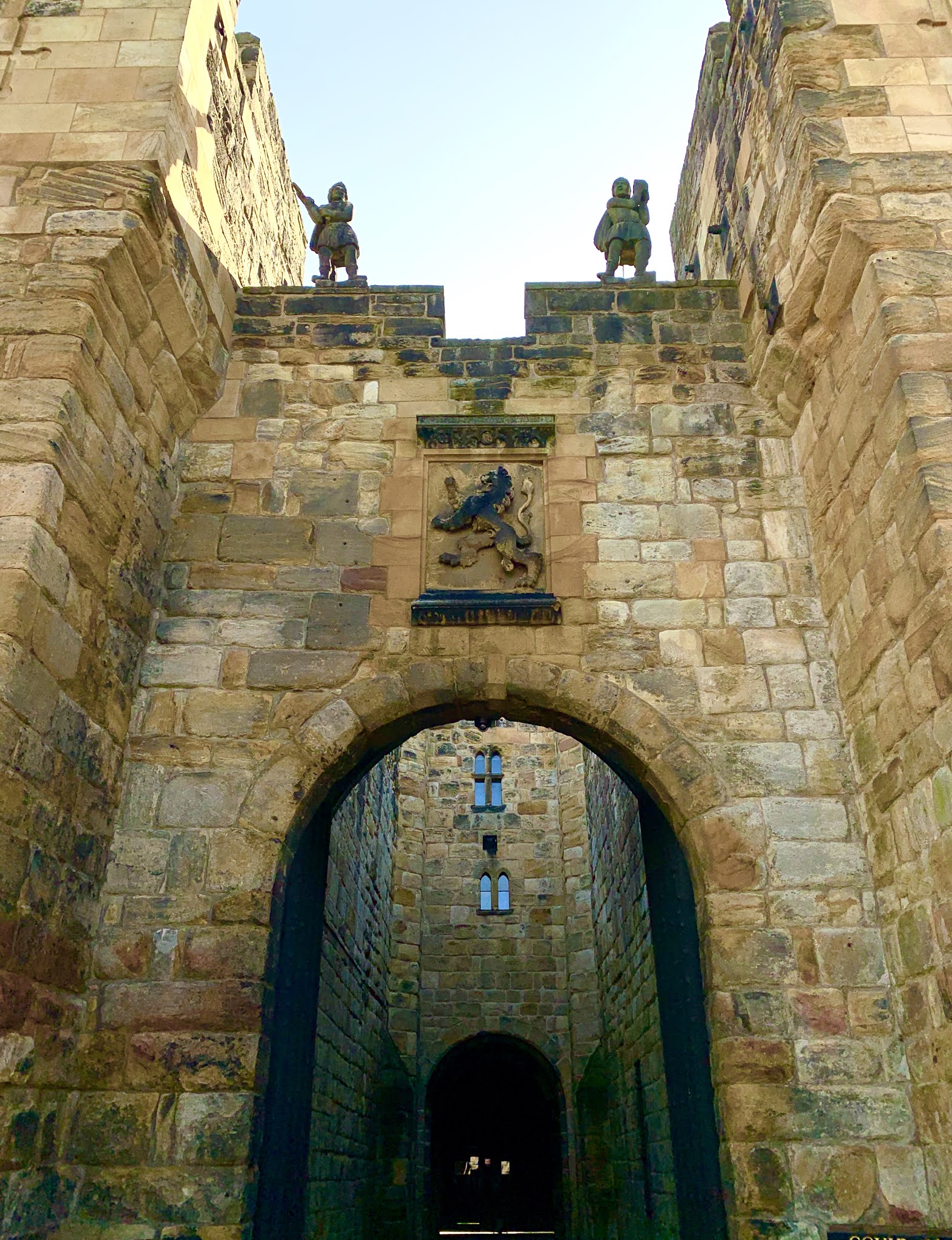
The castle complex itself is a fascinating one, dating from just after the Norman conquest and home to Percys since 1253. While it all looks Medieval, it was a derelict ruin by the 18th century so what you see today is the result of major renovations then, and again in the 19th. The most authentic element left of the original defensive castle is the main entry complex, with double gates, portcullis and a variety of booby traps designed to keep out the enemy. (Usually the Scots, but sometimes the other English side in civil wars.) The decorative stone figures that dot the battlements add to the antiquity, unique to Alnwick and just two other, much smaller castles.

It's a lovely exterior to observe from all angles. If you don't want to pay for admission, walk out of town past the lion bridge and turn into the pastures, where you can have a peaceful stroll along the River Aln and see the whole complex reflected in the water. There's another excellent view, and lawns to sprawl upon, between the castle and the Alnwick Garden. (Where you'll also find a field where you can pay to practice some archery.) Pay to get inside, and you'll find two emerald-lawned baileys unfolding like butterfly wings from the main bulk of the castle. 

There are various attractions in the outbuildings, including a family archaeology museum, a chance to see the family's state coach and a stable courtyard where food trucks pull in to offer lunch options. But if you've paid for admission and aren’t taking broomstick lessons, your main objective is probably the state rooms.

They are among the most impressive of any of England's stately homes, and distinctive in their style. I know no other house in the country that looks so ... Italian. The fourth duke was a passionate Italophile and decided that the interior of his quintessentially English castle should look like a late Renaissance palazzo, complete with marble walls, terrazzo floors, intricately carved wooden ceilings and an Italian-heavy old masters collection bought lock, stock and barrel from the Camuccini family. If it weren't for the portraits, the comfortably English library and the fact that everything is in such good repair, you'd be forgiven for thinking you're in Rome. 

Much as I love Italy, I find it hard to warm to these palatial rooms. (Other than the libary.) Though that might be due to unresolved anger at the 4th duke for what he swept away. The 18th century renovations had been by Robert Adam and were that great architect's only foray into the style known as Strawberry Hill Gothick. (Read about my visit to Strawberry Hill here.) I weep for what now exists only in a handful of sketches and plans.

Note that the state rooms had just reopened after their COVID-19 closure when we visited and at that time you couldn't buy tickets in advance. It was first come, first served when you arrive, so lengthy queuing may be in order.

Chillingham Castle

Nearby Chillingham shares a lot with Alnwick: foundations in the Middle Ages (12th century), more than 700 years in the same family (though ownership has sometimes passed through the female line); an illustrious history including royal visits and pesky Scots; a film location (Elizabeth used both); interiors restored from a derelict state; even a shared garden designer in Capability Brown. But Chillingham's interiors are as quirky and eccentric as Alnwick's are grand and traditional, and its restoration came far more recently.

Sir Humphry Wakefield married into Chillingham's Grey family in 1974 and bought the castle off of them in 1982. A track record with Christie's in London, and then as director or chairman of various antique dealing firms, made him an ideal candidate to restore and furnish a crumbling pile, and what you see today is a hotch potch of family knick knacks and items he's collected. The variety and density is almost overwhelming; those familiar with Snowshill Manor in the Cotswolds will feel they've found its larger, Northern twin. Elephant armour and a full-sized horse and rider in a mix of Indian and Arabic armour grace the dining hall. 

A collection of dog collars and spurs fills a landing. Old hats, walking sticks, sports equipment, hunting trophies and bits of Asian temples fill corners and landings. A French bathtub once owned by Mick Jagger serves as a bar. In a two-bedroom semi, this would be chronic clutter; in a castle it’s maximalist luxe.

Many of the rooms you tour don’t seem particularly liveable, between the exposed stone walls, the eyes and horns of many a deceased creature and more than a hint of damp, though there are a couple of panelled and carpeted drawing rooms at the top of the house that approach a more traditional look. That is, before you notice that bathtub, or the glass eyes of the taxidermised leopard staring at you from the back of the sofa. It is a delight, full of distinctive personality. There’s even a family museum with hand-written explanations from Sir Humphry of why the ephemera is worthy of notice.

Though you get to clamber around much of the building, when you return to the courtyard and look up at the four wings of the castle around you, you’ll realise that you’ve missed a lot. My guess is that there’s much warmer and dryer family accommodation in other wings, and a look at the web site’s promotion of the eight holiday apartments on site shows a less eccentric, more liveable space if you want to pay to spend some evenings here. Something that may be of interest to those interested in the paranormal, as Chillingham markets itself as one of the most haunted castles in England.

Outside, there is a very pretty walled garden originally planted to impress the visiting King Louis Philippe of France. Somewhere in the grounds there’s also a famous herd of Chillingham cattle, supposedly the last truly wild breed left in the world. Wild means potentially belligerent with dangerous horns, so they can only be visited with their warden in pre-booked tours. Political junkies may also be interested to know that this is the home of Dominic Cummings’ in laws. Which may or may not evoke parallels to his policies. I’ll leave that to the reader to ponder. 

Bamburgh Castle

As with both Alnwick and Chillingham, Bamburgh was restored from a ruin. But there was much less of the original structure to work with, so of the three this is the one that seems most decidedly modern. Sir William Armstrong (who we’ve already met on this trip as the owner of Cragside), bought Bamburgh in 1894 and essentially built new on old foundations. It is an Edwardian house in the shape of a castle, built with modern technology to suit modern tastes.

That doesn’t take away the place’s history. Bamburgh is far older than either Alnwick or Chillingham, starting life as a Celtic fort and reaching its apogee as the seat of the Anglo-Saxon Northumbrian Kings. It passed into Viking hands, becoming the imagined home of Bernard Cornwell’s hero Uhtred of Bebbanburg, was destroyed and then rebuilt by conquering Normans. It is the epitome of the maxim “location, location, location”, occupying a rocky spur on an otherwise fairly flat stretch of coast. Thus it looms over its village and all around it, visible for miles on a clear day. 

Those external views, and the overall atmosphere of the place, are arguably far more interesting than the interior. Which is big, functional, has a few interesting decorative objects but no real star sights.

 The most interesting bit for me was a museum room full of bits Armstrong had excavated while working on the castle, including what’s thought to be pieces of the ancient throne of the kings of Northumbria. There’s a modern copy outside the main keep where you can have a seat, and get a feel for being a monarch of mystic ages.


What we missed

A week in Northumberland simply wasn’t enough. At least not if, like us, holiday includes sleeping in, leisurely breakfasts, and being back at your boutique hotel by 5pm for a nap or a cocktail. Or both. And, of course, Covid-19 was still cramping everyone’s style. 

I would have liked to have seen the interiors at Cragside, which ... from photos and videos available on the internet ... seems to be where Armstrong put most of his decorating attention. Bamburgh, clearly, was the pared back beach hut. Dunstanburgh Castle, just south of Bamburgh on the coast, is an atmospheric seaside ruin and also allows a wander around Craster, famous for its kippers (traditional smoked herring). We made it to the smokehouse to buy some fish, but the day’s dense fog blocked any view of the castle. 

A boat journey to the Farne Islands to see nesting seabirds would have been grand. Lindisfarne wouldn’t have even needed a boat to reach it, but you do need to get your timings right to get on and off the island when its causeway is revealed by low tide, something we didn’t manage. Once there, you can see the ruins of the monastery that created the famous gospels and another castle restored by Edwardians, this one by the founder of Country Life magazine so I assume decorated in exquisite taste.

Not far over the Scottish border is Abbotsford, Sir Walter Scott’s home. I visited on my first trip to Britain and remember thinking that only a writer of historic fiction could create such a romantic fairy tale of a house. There are miles of quiet beaches to explore, and still-working fishing villages with historic pubs and chippies that, my Northern friends tell me, dish up the best fried fish in England. Something we never managed to indulge in because the breakfasts at our hotel were so lavish. For that story, read on ...