Wednesday, 8 November 2017

Three essentials for a Donostian weekend

While you could easily spend a week or two in San Sebastián ... especially for a summer beach
holiday ... we headed there for a long weekend. This seems a typical time frame for many visitors. With just a few days on your hands, what should you do? (Other than eat, of course, which will be the topic of stories to come.)

Three things: walk around a lot, delve into the San Telmo Museum, and relax in La Perla spa.

Walk
19th century beach resorts were all about promenading, and it's worth planning plenty of long, leisurely walks around Donostia ... to use its Basque name. This is a town that rewards pedestrians. The views are magnificent, combining the glories of raw nature (surf, sand, hills) with artfully planned gardens and impressive architecture. You can walk almost anywhere you'd want to go in under a mile, though we were clocking five to seven a day cumulatively. Fortunately, this is a town laden with interesting bars and coffee shops when you need to rest your feet.

The most obvious walk is around the crescent moon-shaped La Concha beach, as anticipated by 19th century town planners who created a tidy embankment risen high enough above the beach to give you sweeping views. There are broad pavements, ornate street lamps and some suitably frivolous Belle Epoque architecture. Surprisingly, there's little shopping on this stretch. Unlike Cannes' Croisette, which rings the beach with back-to-back posh shops and cafes fronting the hotels behind, La Concha's seafront is quiet and heavily residential. On the east side, closer to the Old Town, there's a lovely garden in front of the Town Hall.

I'd suggest deferring La Concha, however, to walk around the headland of Mount Urgull first. Start in the northeast corner of the old town, by the San Telmo museum, head out to the Paseo Nuevo and turn left. The steep hill with the fort on it will be to your left, and the sea to your right. There's nothing to break the waves between here and Nova Scotia, so even on a relatively mild day the surf crashes with some spectacular spray against the walls below. There's a plaza at the northeast corner of the peninsula you're circling (look for the roundabout with bus stop) that offers hypnotic wave watching. To your right, watch the breakers roll onto Zurriola beach, and the show of surfers atop them. To your left, look down on a roiling cauldron of water surging around giant blocks of stone. Keep circling the hill and you'll come to another sharp turn, marked by sculptor Jorge Oteiza's Construcción Vacía, a wonderful illustration of how bold, abstract art can add drama when it's in the right place.

From there, you turn back towards town and the whole sweep of La Concha hits you, with fanciful towers and rooflines rising up the hills behind. At the same time you're getting a great view of the little Santa Klara island that sits in the middle of the bay and is responsible for calming the surf on the beach beyond. A bit further on and you're now looking down into the old harbour, and scrambling down steps to return you to the Old Town. You can continue onto the more genteel circuit of La Concha from there. Although I'd nip into a bar for a drink and some pintxos first.

Walking through the urban centre can be just as spectacular, thanks to Donastia's eclectic and highly decorative architecture. The biggest attraction in the Old Town is the remarkable density of pintxos bars. But there's also a pleasing jumble of venerable buildings, a noble rectangular plaza that used to be the setting for bull fights, and a couple of churches worth popping your nose into. (San Vincente, free, is all brooding, dark Romanesque lines and glowering, martyr-driven Catholicism; Santa Maria, €3, is a more cheerful, light-touch baroque building with a museum and some interesting modern art amongst more suffering saints.) Don't miss the exceptional fish market, now in modern quarters down an escalator beneath the grand old building that once held it. You'll weep that you don't have a kitchen.

Drift south from the Old Town into the Centro, a bonanza for shopping in independent boutiques
while gazing up in appreciation at the architecture. No two buildings are the same. As you near the cathedral the neighbourhood gets more residential. Mums with prams, grandparents with toddlers and youngsters fresh out of school played around fountains or along tree-lined streets. Meanwhile, lots of grown ups seemed to be enjoying the freedom of flexible working from WiFi enabled cafes on Reyes Católicos, the street that runs straight from the back of the cathedral. (Don't miss Old Town Coffee, the kind of independent cafe most of us can only fantasise about calling our local.)

San Telmo Museum
Start your trip here, if you can, and plan for two or three hours at the beginning of a day when you're still full of energy. There's a lot to see.

Spread through an old Dominican convent and a modern addition, this museum is tucked in a corner of the Old Town hard against the wooded hillside of Mount Urgull. It covers the history of the area but ... more specifically ... the history of Basque culture. It's an unabashed celebration of a people who are, lest you forget, not Spanish.

Spend some time admiring the haunting collection of pre-historic grave markers in the cloister before you delve into Basque co-existence with the Romans and the stresses of the Middle Ages. This was the closest the Basques ever came to having their own country, but the Kingdom of Navarre eventually got sucked in to Castilian Spain.

There's a theory that the lack of a political identity at home sparked the Basques to great things abroad; the galleries on the Age of Discovery are where you'll really start to be impressed. The Basques were master ship builders and explorers who gave us salt cod (a food that transformed the modern economy), long distance travel (the first captain to circumnavigate the globe was not Magellan, who died en route, but Basque Juan Sebastian Elcano) and the rubber-cored ball (transforming tennis and many other sports). Back home, women ran things in a society that had been matriarchal since pre-history. Basque women were known for their assertive, showy nature and my favourite display in the place was of traditional headwear, arranged by modern Basque designer Balenciaga. And in turns out Saints Francis Xavier and Ignatius Loyola were Basques. Suddenly, I understood the Jesuits a lot better.

Historical galleries proceed through the industrial revolution, where Basques punched above their economic weight once again, and on to the civil war, where the Basques suffered horribly. (Can we talk about Guernica?) The modern galleries leave you with an upbeat sense of a people who are grabbing every opportunity for success. Specialist galleries offer collections of Basque art, looks at folkloric traditions and an introduction to a unique set of Basque sports. The convent's church was closed when we visited, but is set to re-open with a new exhibit on local hero Balenciaga.

Your €6 admission fee includes an audio guide with detailed English commentary.

La Perla Spa
If your idea of a great spa is torrents of hot water pounding you in a dazzling variety of ways, La Perla is for you. Four main pools offer jets, bubbles, waterfalls and whirlpools directed at every body part imaginable.

This being a continental European spa, it's more about health than R&R. La Perla offers serious thalassotherapy, trumpeting the positive effects of sea water. One of the main pools takes you down a line of jets, each one with specific instructions for how to relieve stress in the targeted part of the body. In another, you can push through a waterfall to lie on a row of beds frothing with bubbles. Fancy something less exotic? There's a plain-old whirlpool bath, but it's big enough to seat 20 comfortably and sits in the middle of the central pavilion with a sweeping circle of windows looking out over beach and bay.

Another level down you'll find a grotto-style area with cool blue lights and a pool with special aqua gym equipment. Bicycles, cross-trainers, weight machines, all used under water for a joint-friendly experience. It's my dream gym! This level also has saunas, a cold sea water plunge pool and a relaxation room. There's even a bizarre but amusing twisting, tiled corridor you explore while intermittent jets of hot and cold water surprise you from different directions while the lights shift from blue to red to total darkness. (Clearly, health and safety rules are different here.)


Add fantastic views and great architecture: the original building forms part of the seaside embankment, with a grand central rotunda and two wings ending in matching pavilions. On the main floor, everything is flooded with light and looks out over the beach and the water. You can descend from one of those wings onto the sand and head out for a dip in the bay, which I did despite the bracing temperatures of late October.

While the exterior has changed little from its 1912 opening photos, inside you're in state-of-the-art health club territory. Entering from the street, you're actually at the top of the building. Descend one floor for the gym and regular members' entry, and two for the spa visitor area.

La Perla is surprisingly good value for money: Five hours in the spa and a one-hour full-body massage was £87. (The equivalent would be around £150 in the UK.) That's probably because of some important cultural differences. Knowing about them in advance is key to really enjoying your time here.

The locals use this as a health and fitness facility. They go in, do their aqua workouts and leave. There is no tradition here of lounging around with books and magazines, or taking long naps on heated loungers. I counted only 16 places to sit down in the whole facility, and the "relaxation room" (eight elevated beds with water mattresses) features disturbingly loud spa music that discourages lingering. Which also explains why the girl showing us around was so discouraging about us bringing in kindles, books, glasses, etc.

To enter, you have to put your dressing gown and other items through a chute while you walk through a shower lane. You also have to keep your La Perla swimming cap on the whole time. We were amused that they were so obsessive about cleanliness in those ways, but insisted everyone leave their flip flops outside and walk around barefoot ... something you'll get reprimanded for in British spas. They also don't provide towels, presumably because they think you're going to get into the water, stay in until you're ready to leave, then go shower. There's no drinking water anywhere in the spa, much less a restaurant or bar. That's all outside, for afterwards.

Armed with the knowledge of experience I would have skipped the massage, which was perfectly pleasant but nothing special. (And lost any lingering benefits the moment I was forced to put a sodden dressing gown on to return to the dressing room.) I definitely recommend the pools, but treat them like locals do. Go for a two-hour slot for €27. Bring a water bottle. Skip the reading material. And pinch a towel from your hotel.


Sunday, 5 November 2017

An introduction to San Sebastián: So much more than food and beach

San Sebastián started its journey to fashionable acclaim when 19th century Spanish royals adopted it as their summer beach resort. Early this century, a little restaurant in the nearby hills called El Bulli was named the best in the world, and its chef, Ferran Adrià, spearheaded a movement to make this bit of Northern Spanish coast a culinary capital.

And that's pretty much what I was expecting on our 17th annual girls' trip: a Spanish version of Cannes with more innovative food and drink. I found so much more.

Deep and varied history. Fascinating architecture. Dramatic landscape. A tradition of craftsmanship that goes beyond the food to clothing, accessories and home decor. The hip edginess of a youthful surfing culture blended with the sophisticated elegance of ancient traditions. A surrounding region stuffed with things to see and do. Fiercely independent shops and restaurants keeping global brands at bay. Game of Thrones filming locations. All connected by highways, WiFi and 4G availability that put England to shame.

The delight of new discovery filled our days. Here are six reasons San Sebastián exceeded my basic expectations, and a tip for a fabulous boutique hotel from which to enjoy it all.

This is a different country
I'd heard of the Basque Country, but I hadn't appreciated its uniqueness. For all that I understand the factors driving the desire for Catalan independence, I have to confess that Barcelona feels like Spain to me. San Sebastián and its surrounding coastline does not. I quickly appreciated that we shouldn't even be talking about San Sebastián. Donostia is its real, Basque name.

Thickly forested hills proclaim a climate closer to Wales than sunny Iberian holiday spots. Much of the architecture ... peaked rooflines, half-timbering, broad, square farm houses ... feels almost Germanic. You hear a lot of Basque being spoken and it's on all the street signs. (I don't recall noticing significant Catalan conversation in previous Barcelona visits.) There's a vibrant community spirit obvious on even a short visit as you notice community dining clubs and musical groups gathering in public spaces for spontaneous performances. They even have their own unique sports traditions; it turns out the Jai Alai I know from Miami started here. It's a place that feels familiar yet totally alien at the same time, and the uniqueness of Basque origins ... oldest indigenous people in Europe, language related to no other ... adds to the mystery of the place.

You can get an excellent introduction to Basque history and culture at Donostia's San Telmo museum, of which I'll write a bit more later. It's also worth getting a local guide to understand more of the nuances. We used Ikusnahi (more coming on their wonderful tour, too.) Savvy travellers (I was not) will read Mark Kurlansky's Basque History of the World before going.

So much more than food
Architecture fans will be entranced. Donostia is a city of grand apartment blocks; the architects here were obsessed by rooflines and corners. Fanciful spires, balconies, turrets and windows span everything from gothic to art deco to brutalist modernism. There's a preponderance of Belle Epoque, that golden age between the 1870s and World War I when buildings and wedding cakes seemed to converge. The opera house looked promising; I'd consult the schedule before another visit.

There's a rich and complicated history (queue the Basques again) to delve into that stretches back long before the royal beach holidays. That patronage, however, has left a top quality spa that any fan of a soak in bubbling hot water needs to check out. (Story to come.)  Meanwhile, sporty types will welcome hiking trails, cycle paths and surfing beaches. While our four days in town was enough to cover the basics, there's more here to keep your attention.

Pintxos are not tapas
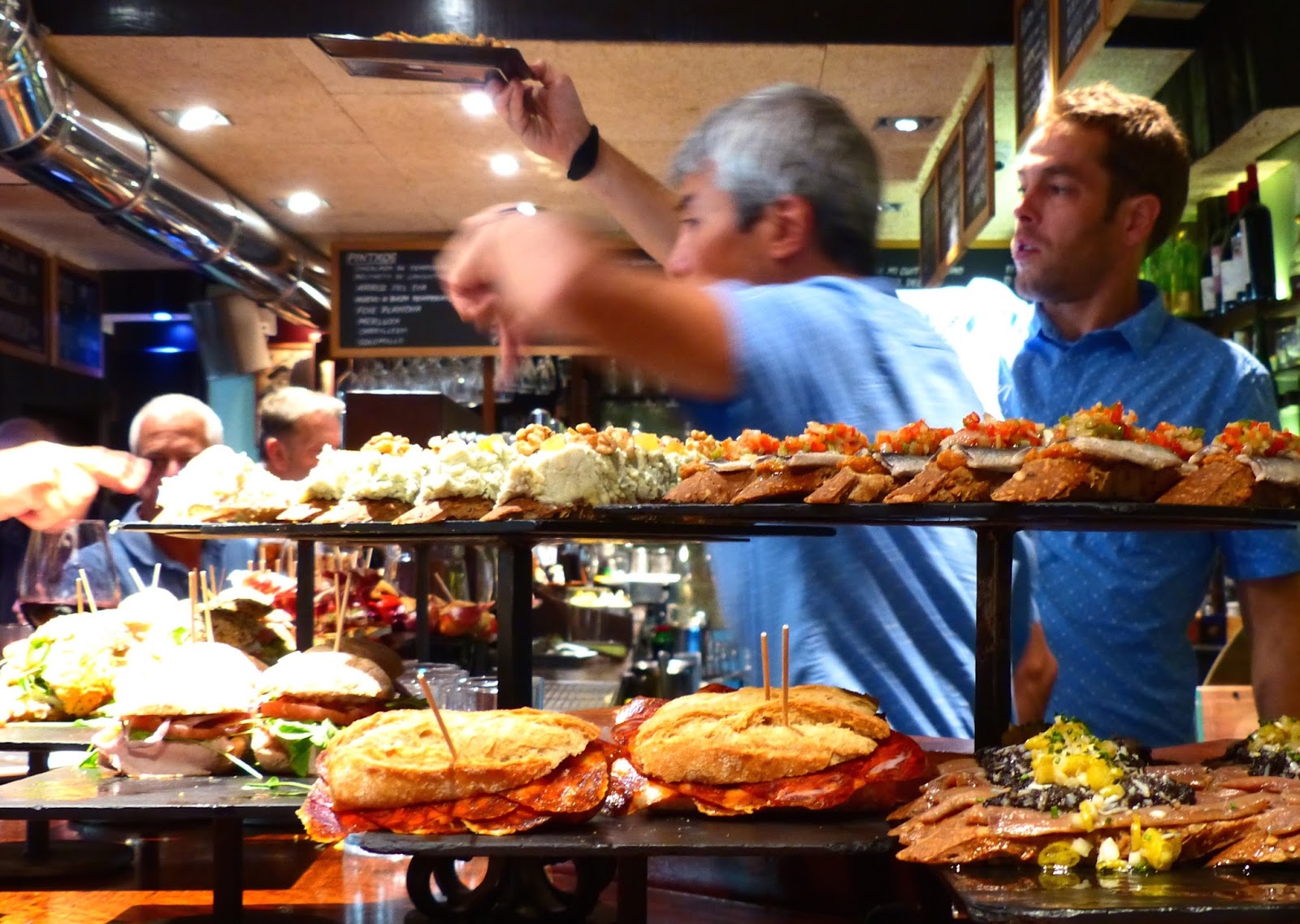
If you're at all into your food, the word you'll hear time and again in relation to Donostia is pintxos. (Pronounced peen-chos) People typically describe them as "Basque tapas" but they are far more sophisticated. Cold pintxos are much closer to the Danish smørrebrød; artfully prepared, open-faced, finger-sized sandwiches that are a work of art on their own. Hot pintxos require a bit more bravery as you actually have to order rather than self-serving from the bar, but reward you with a lesson in the locals' mastery over beef and pork.

It's no wonder that Adrià was at the forefront of the revolution that turned fine dining plates into works of art; many individual pintxos are as beautiful to look at as they are to eat. Forget the tapas comparison. Pintxos are closer to fine dining in miniature.

But a word of warning: vegetarians need not apply. This is a land in love with protein, whether from land or sea. Vegetables exist to supplement those glories, not to stand alone. If you don't at least eat fish, you're going to be reduced to plain bread, tortilla and plates of mushrooms. Though you'll have to specify the preparation on the latter, because they're likely to wrap a few in bacon and throw them in the deep fryer. Everything is, after all, better with bacon.

Dramatic landscape
The green, misty mountains come right to the sea. It's easy to see how right up until modern times there was little transit between towns unless you went by water. It's an hour's drive from the airport in Bilbao, and I spent most of the journey marvelling at the feat of building a highway through this landscape. The tough terrain breeds both tough, practical people and magnificent sailors. Who was the first ship's captain the circumnavigate the globe? You may remember the name Magellan, but he doesn't count as he didn't live to complete the journey. It was Basque Juan Sebastián Elcano, born just up the coast from Donostia.

And what an exquisite coast it is. Golden beaches alternate with dramatic cliffs of striated rock thrust heavenward by continental drift. Unsheltered beaches see dramatic waves and violently churning surf. The glory of Donostia, however, is a crescent-shaped beach called La Concha with an island blocking part of the entry from the sea. Bathers come here, while surfers head for the more agitated waters on the city's second beach to the east.

Not fussy
Given the legacy of the 19th century beach resort, I was prepared for something like Cannes. And though I've had a lot of fun in that city over the years, you can never shake off that feeling that it's the creation of supercilious French snobs who take vast pride in two centuries of over-charging the English for their holidays. Donostia's only real resemblance to the French Riviera is the Belle Epoque architecture. The natives are gracious, cheerful and delighted to be helpful. Though they will make it clear that they have their own way of doing things. Trying to take a Kindle into the spa or being too creative with a pintxos order may earn you a firm but polite rebuke.

Though both the people and the architecture are fantastically elegant, there's a laid-back, casual vibe to the place. You get the feel of a practical people who take life as it comes and enjoy every day. Our guide explained that the Basques have a long history of both egalitarianism and women's rights; the class system and excessive formality are things that came with Castilian nobles parachuted in by a distant government.

Shopping
In a planet marching towards the uniformity of global brands, Donostia is a delight. For every logo you recognise, there are two or three independent boutiques. Clothing boutiques are elegant little collections of individual taste, usually hung by colour so you can get a sense of how to put an outfit together. In these shops I saw no recognisable brands, and several boasted of clothes designed and made in the region. The clothing was beautifully constructed, often with distinctive design elements and gorgeous fabrics. They even ... quite remarkably for the Iberian peninsula ... had some sizes for the generously proportioned. We found sales people who were wonderfully skilled at quickly figuring out your taste, then pulling stuff out that would look great on you. For the best example of this, check out Minimil.

Small jewellery stores featured makers at work benches and one-of-a-kind creations in the windows. Bookshops basked in Art Nouveau splendour, bristling with hand-written recommendations on shelf fronts. The fish market will make you weep that you don't have a kitchen. Home stores and galleries are filled with quirky decorative items and beautiful works of craftsmanship. And, even with the abysmal Euro-to-Pound exchange, prices weren't excessive. The combined forces of the annual girls' trip haven't done this much shopping in many years.

WHERE TO STAY

We splurged on the Hotel Villa Soro, a boutique hotel in a converted 19th century mansion about a mile and a half from the heart of the old town. This delivered exactly what we were looking for: extreme comfort, attentive staff and plenty of cozy public spaces to lounge around when we weren't sightseeing. There's a main house and a modern block across a small courtyard behind it. We upgraded to the house and I suspect it was that plus our five-night stay that saw us in what must be the two best rooms in the house. Rooms 12 and 14 are at the front corners, with 18-foot ceilings and grand windows overlooking the front lawn. 14 has a large patio we put to good use on sunny days.

The decor is a gentle mix of Spanish late-19th century (there's a stained glass ceiling above the entry hall and a stained glass holy family illuminating a little room I assume was once a chapel on the landing of the grand stair), English country house and modern (striking abstract sculpture in key locations). The enormous sitting room could comfortably seat three to five distinct groups without crowding, though we were almost always on our own there. While we settled in, other guests ... mostly American and a few Germans ... tended to stay for only a night or two. Villa Soro provides limited restaurant facilities, but acknowledges that in a town with such good food you're probably only going to bother with them if you're simply too tired to go out. They put on a fine breakfast in their two-room dining area, including plenty of cooked options. However, the quality of bread (the tumeric-flavoured was fantastic), pork products, local cheese and fresh fruit meant that we skipped the cooked options most mornings.

The staff came through with excellent restaurant recommendations and managed to get us a table at one well-known spot that was booked up through regular channels. Taxis arrived quickly, there were bicycles to borrow, the barman made top gin and tonics and the bathroom was stocked with Molton Brown products. It's worth noting that the photos on the web site have been artfully shot to disguise the fact that the house is in a densely-packed area on a main road. I was initially worried about traffic noise but outside of rush hour all was quiet. Getting to the centre of town is a 20-minute walk or a 10 euro taxi ride; we tended to walk in (it's a gentle slope down) and taxi back. The steep hills behind the house held my favourite restaurant of the trip, Zelai Txiki, and closer than the Old Town is the trendy Gros district and the pounding breakers of Zurriola beach, the surfers' favourite.

Saturday, 21 October 2017

British Museum's Scythian show brings mythic people to life

If you share my opinion that the British Museum is at its best when it's exposing us to mysterious cultures about which we know little, then you'll love the current Scythian exhibit.

Hold on, I hear you say. They're not mysterious. Horse people? Russian Steppes? Attila, Huns and the fall of the Roman Empire, right?

Close, but no. The Scythians were indeed mounted, nomadic warriors who occupied an informal empire that stretched from modern China in the east all the way to Greece in the west. But they roamed the steppes hundreds of years before the Huns; they were active from about the 9th c BC to the  1st c BC. Their contemporaries were Alexander the Great, the Ancient Greeks, and Persian kings like Darius and Cyrus rather than the last Roman Emperors and terrified medieval monks. And while the Huns produced some gorgeous portable art and did us the favour of inventing the stirrup, Scythian art makes the later stuff look simple and crude.

More intriguing, the Scythians almost disappeared from history for more than 1,000 years and are still little known today. Thanks to Ghengis and Attila (perhaps the ultimate example of the idea that "no press is bad press") the Huns blaze a trail through Western civilisation. Most people know at least a little about them. When it comes to the Scythians, there wasn't much in the historical record beyond a few mentions by Herodotus, and no physical remains. Many people assumed they were a myth. Then, under Peter the Great, Russians started digging into burial mounds and unearthing astonishing treasure. The tsar was captivated, and declared all Scythian excavations to be the property of the crown. In the 19th century, construction of the Trans-Siberian railway unearthed more magical stuff, again sent straight to royal hands. Keeping the entire archive of a culture in a private collection for two centuries, then having it fall behind an iron curtain for almost a century, is not a recipe for global awareness. Even in post-Soviet Russia, the only way to see this stuff was to seek it out in the Hermitage and ... fabulous as they are ... the Scythians probably don't make the Top 10 list in most tourist visits to that great museum.

Thus this treat, on loan mostly from the Hermitage, feels more like the discovery of a mystical race from a fantasy novel than "real history". Nomadic equestrian societies are, after all, a staple of fantasy fiction, from Tolkein's Riders of Rohan to Game of Thrones' Dothraki to David Edding's Algars. The Scythians would fit comfortably beside any of them, though probably trump them all in
their lush artistic sensibilities.

The most striking thing here is the gold work. All nomads are distinguished by carrying their wealth with them, but I've seen no more glorious example than the Scythians. They wore enormous golden belt buckles that told adventurous stories of hunts and mythology. There's magnificent jewellery: torques, earrings, pendants. They developed a clever production method to mass produce small, but beautifully detailed, golden images that could be sewn onto clothing like shimmering sequins. These all share an extraordinary ability to portray both animals and the human figure. Horses leap with energy, stags seem ready to toss their antlers, huntsmen are about to spring towards their prey. Curves are sinuous, definition sharp, gems set with fine precision. This stuff is extraordinary, and if the show was only about the gold, it would be enough.

But there's a whole world here. Siberian permafrost does as good a job of preservation as Egyptian sands. Thus we have beautifully preserved, modular furniture and cooking utensils. Beautiful woven cloth, stitched hides and furs. There's a pair of women's shoes with rich patterns in crystal and glass beads on the soles. If you spent your life in the saddle, or sitting around a campfire, why not show off the bottom of your feet? There's a teepee-style tent made to go with a charcoal brazier; Scythians evidently unwound their stresses by throwing hemp seeds onto the fire and sniffing the drugged fumes contained in the tent. They were also particularly fond of wine (trading the Greeks for it is part of what earned them Herodotus' notice), and the drinking horns and cups here are exquisite.

Unsurprisingly, the equestrian trappings, armour and weapons are impressive. The Scythians were
horse-borne warriors, after all. There's a particularly striking wooden helmet topper of a menacing dragon's head. If having a warrior riding at me at full pelt weren't horrifying enough, seeing this towering above him would scare me into immediate submission. They've even transported the massive wooden logs of a burial chamber here, the primeval size of the tree trunks adding to the mythic quality of it all.

Perhaps most striking are the human remains themselves. We come face to face with a real Scythian warrior, skin tremendously well preserved through permafrost mummification. Though his inner-workings of his limbs are long gone, his skin is spread flat here to show off his tattoo scheme. Whether on jewellery, utensils or themselves, these people loved pattern. Later on we come across particularly lifelike funerary masks.

 Rarely have I encountered a show that paints such a well-rounded picture of a whole people. My only complaint? No audio guide to add more depth to the experience. Given how little most of us know of the topic, a way for the public to dive more deeply into it seems a no-brainer. At least I got there early. Scythians: Ancient Warriors of Siberia is on at the British Museum until 14 January, so there's plenty of time for a return visit to learn more about this compelling society.

Tuesday, 3 October 2017

Luscious Alma-Tadema show transports you to a gloriously realised ancient world

I must have been a peculiar child.

At the same time my friends were captivated by their Barbie collections, I was becoming obsessed with Greek and Roman mythology. Like many only children, I had an active imagination and created playmates in my head; but mine were younger versions of classical deities, and I concocted adventures on which I joined them as a young Vestal Virgin or a huntress of Diana. It's a shame I never wrote them down. I could have beaten the Percy Jackson franchise to market by decades.

On a childhood trip to LA, I was just as excited to explore the Getty Villa as I was Disneyland (I've written about the villa previously here). This perfect re-creation of the enormous Villa of the Papyri at Herculaneum allowed me to walk within my fantasy world. And on its walls I found the work of an artist who seemed equally obsessed: Lawrence Alma-Tadema's Spring.* A poster version of the scene of young Romans processing through grand architecture bearing armfuls of flowers ended up sharing wall space with my Sean Cassidy and Donny Osmond posters when I got home. It outlasted the pop idols, staying with me through a progression of university dorm rooms until it fell to tatters.

I've loved Alma-Tadema ever since, but he's a difficult artist to see in any profusion. One of the most successful and prosperous painters in Victorian London, he built his career on perfectly-imagined, highly-detailed scenes of the classical world. Though he dabbled in Egyptians, Greeks and Etruscans, the Romans were his bread and butter. The British, at the height of Empire and confident in themselves as the New Romans, couldn't get enough of him. Queen Victoria even gave him a knighthood (despite the fact that he was a Dutch native). But he fell quickly and resoundingly out of fashion after his death.

As the post-WWI establishment embraced modernism, Alma-Tadema seemed to embody all they rejected. All Victorian painters followed a similar trajectory, but the Dutchman's celebration of history and ancient empires drew particular contempt. At his reputation's low point, the owners of his magnificent The Finding of Moses cut out and discarded the canvas because they could only find a buyer for the frame. Thus Alma-Tadema's work rarely shows up in any profusion. Many are still in private hands; museums tend to own one or two as an example of a genre type. There are no big collections of his work.

Which is why the Leighton House Museum's current show, Alma-Tadema: At Home in Antiquity, is such a rare joy. It's the first time there's been any sort of collective exhibit of the artist's work in London since 1913. There are more than one hundred paintings here (sadly not including the Getty's Spring), given added context by being displayed throughout the exotically decorated home and studio of Alma-Tadema's contemporary, Frederic Lord Leighton. The men were friends with similar tastes. Alma-Tadema's home in St. John's Wood is much changed and not open to the public, but the layers of opulent decor, William Morris patterns and wood paneling at Leighton House provide the same environment these paintings would have been created in, and for.

The show takes us through Alma-Tadema's career in chronological order, starting with a precociously talented child who found his fascination with history early. His young imagination haunted the Dark and early Middle Ages, with a style pinched from the Golden Age of Dutch Art. He repeated the techniques deployed in genre scenes by great masters like Vermeer and Rembrandt to create luminous slices of life, caught mid-story and cropped tight on the action. One early work shows a dramatic scene from the obscure tale of the Merovingian Queen Fredegonda. She's schemed to have a trouble-making bishop eliminated, but her assassins haven't completed the job. Here, she sits cool and dignified in the bishop's bedchamber, facing down his accusing pointing finger as he struggles up from his bed, still bleeding from the head. It's Game of Thrones, Victorian style.

In 1863 Alma-Tadema married and headed off on an extended honeymoon around Italy. It would revolutionise his life. He fell in love with the glory that was Rome, washed in bright light, the blue seas, the white marble, and coloured mosaics. For the next 50 years, his work would be dominated by the classical world.

He quickly became known for his astonishing ability to handle texture. This is beautifully displayed in A Roman Lover of Art. Brass under a connoisseur's inspection shimmers with a dull metallic gleam. Water splashes brightly in a sun-drenched fountain. You know the linen folds of the togas would be heavy and crisp, while little irregularities in the mosaic floor would scratch your bare feet. The marble cladding of the walls in that shadowy corner would provide a cool retreat. It's this kind of reality that pulls us in to a world of storytelling as compelling as any historical film.

We encounter couples in the middle of intense conversations, a girl hiding from her suitor as her sister blocks the door, Hadrian visiting a British pottery to endorse the local economy, people engaging in religious ceremonies, the architect of the Coliseum caught in contemplation. In each, the artist captures a scene at a pregnant pause in the action, much as the best modern news photographers do. You can't help but imagine a continuing storyline for yourself.

Alma-Tadema became particularly famous for his ability to paint marble. There's a wonderful pair of  paintings displayed together that shows off both this, and the artist's frustration with patrons not understanding the breadth of his vision. A wealthy northern industrialist commissioned the painting which becameAn Audience with Agrippa; the general and close friend of Augustus strides formally down stairs overlooked by a monumental statue of the Emperor, followed by his staff and awaited by his clients. The industrialist wasn't happy. Too many people, not enough marble. So Alma-Tadema painted the scene again, but After the Audience. The supplicants have gone. We catch Agrippa's back and the rest of his staff trailing away in the shadows. The industrialist's new version was a big, empty stage set: plenty of marble, story over.

The artist could afford that kind of precociousness because he'd become one of the most famous people in London. His homes and studios were lavishly decorated settings for both his painting and sophisticated parties drawing the fashionable and artistic of the age. Several rooms in the exhibit plunge us into his life, introducing us to his wives (both pre-deceased him, but the second was a well-known artist in her own right and worked beside him for decades) and his artistically talented daughters. We see interiors of his ridiculously lavish home in St. John's Wood, which leaves little wonder why the never-married Alma-Tadema daughters ended their days in straightened circumstances. The artist was clearly as good at spending his money as at making it.

But Alma-Tadema isn't just about beautiful gateways to other worlds. His use of realism to draw you into a story stirs real emotion. Many of his works are gently soothing; beautiful women gazing out to sea or stretched on the atrium floor contemplating fish in the pond. There's a rare contemporary scene called 94 in the Shade (that would be 34 for you celsius users) that shows a young man reading in the shade next to a freshly-mown wheat field; it's the distillation of all the delight of a lazy summer's day. But there's heartbreak here, as well. After his second wife died, he painted a young woman who resembled her sitting alone and sad on a shady bench while the sunny fields beyond are filled with people at play. Less subtle is the dramatic The Death of the First-Born. The Egyptian Pharaoh occupies his throne in a dim room given a ghostly glow as low light bounces off golden interiors. His dead son sprawls in his lap, his weeping wife slumped over the body. The priests who have failed to save the boy sit around in various stages of depression and horror. But Pharaoh looks directly at us, deadened with shock and eyes glistening with tears.


It's perhaps the most powerful painting in this exhibit, and it probably looks familiar. In fact, even if you've never seen any Alma-Tadema, all of this stuff will tug at your awareness. The penultimate room of the exhibit explains why. Even as his paintings were rejected by the art world, Alma-Tadema quietly became the patron saint of historic film set designers. A continuous loop of film clips proves the point. Cecil B. DeMille blatantly copied The Death of the First-Born and Alma-Tadema's other Egyptian imaginings for his epic Ten Commandments. Pretty much every early sword and sandal epic used him as a guide. Ridley Scott's team admits to returning to this source for their vision of Rome in Gladiator, and no doubt did the same for the less-worthy but equally beautiful Exodus: Gods and Kings. And though it's not included in the clips, I'd be shocked if the design of Kings Landing in Westeros didn't have some roots here.

Alma-Tadema's reputation has, thankfully, rebounded. The once near-worthless Finding of Moses became the most expensive Victorian painting ever sold at auction six years ago in New York. It's here, restored to its frame in all its glory. Hanging beside the luscious Roses of Heliogabalus, these two huge canvases anchor the final gallery where we're surrounded by the glory of the artist's last decade.

Even with recovering popularity I doubt we'll see many more Alma-Tadema exhibits in one lifetime. Many of these paintings come from private collections. Getting their owners to loan them, plus assembling others by ones and twos from across the world, was a monumental task I don't expect to be repeated. So if you're at all intrigued by time travel to the ancient world, get to Leighton House before 26 October.

Leighton House is run by the Royal Borough of Kensington and Chelsea. Admission is £12, though National Trust and Art Fund members get a significant discount. Be sure to lay out the additional £1 to get the audio guide, which has far more detail than is available in the free show programme or the display labels. 

I wrote an earlier article about the museum here.

*Since my first discovering it, Spring has moved to the Getty Centre in LA, while the Villa's collections are now restricted to art from ... rather than evoking ... the ancient world.

Saturday, 30 September 2017

Killer Queen brings a legend to life with near-perfect illusion

Ah, the irony of middle age.

I'm still hip enough to be at a rock concert on a Thursday night, trying to download the concert lighter app on my iPhone to wave in appreciation. But my aging eyes can't see the details without my reading glasses, and the concert is a tribute act to a band led by a guy who's been dead for 26 years. And, rather amazingly, I'm on the young end of this crowd.

Welcome to a night with Killer Queen, one of the oldest and most respected of the tribute bands that tour the world re-creating concert experiences of iconic acts that are no more.

It's an extraordinary evening. Queen's hit-laden catalog stretches over 20 years; this concert is packed with anthems everyone knows. The illusion is near perfect. Costumes, wigs, moves and voices bring the band to vivid life (circa the late '80s). The guy who plays Freddie Mercury both sounds and looks the part. Brian May's doppleganger is a tremendously talented guitarist. This isn't lip-syncing play-actors; these guys are obviously talented musicians.

So dedicated are they to creating the illusion, in fact, that they've purposely hidden their own identities. Unlike the Fleetwood Mac evening that first introduced me to the merit of tribute bands, there are no pauses here to discuss the original band or introduce the modern musicians. (The one exception is a reverent performance of These Are The Days of Our Lives during which the background screens are full of images of Freddie and the band in their glory days.) It's pure concert performance. Even a search on Killer Queen's website doesn't reveal much. Though the band's been going since 1993 and is obviously wildly successful (they tour globally), there are no biographies of the band members to be found.

Of course, reality pokes a few holes in the illusion. The intimacy of the 1,400 seat Anvil auditorium in Basingstoke means every seat is a great one, but it's hard to conjure the electric buzz of tens of thousands of screaming fans in a stadium. And though the crowd was on its feet dancing at times throughout the evening, the preponderance of white heads and their propensity to sit down to enjoy the show definitely edged us solidly into the theatre category. The years roll back by the time you get to the inevitable encore/closer of "Bohemian Rhapsody", "We are the Champions" and "God Save The Queen", however. With Freddie in crown and ermine-edged robe and everyone on their feet, bellowing at the top of their lungs, everyone in the audience has regressed to their 18-year-old selves. (Except for a few actual teenagers, gazing at the elders who brought them with curious speculation.)

My only real complaint was the badly balanced sound production. The lead vocals were swallowed beneath the instruments, and none of it seemed loud enough. It was another irony: last week we were at Kingsman: The Golden Circle worrying that our ear drums were going to be blown out. Here, where our bodies should have been throbbing to a near-physical wave of sound, it was all very sedate. I don't know whether this was a one off, a complication of The Anvil or a trait of the band, but it was a shame. Our "Freddie" had a beautiful voice ... obvious in a few quiet bits when he accompanied himself with the piano ... and he deserved to stand out more.

I admit I came to Queen's music late. My youthful musical tastes weren't particularly sophisticated, leaning to bubblegum pop. As a somewhat geeky kid who read sci fi and fantasy, I was mainly aware of them through the Highlander and Flash Gordon soundtracks. They weren't as big in the States, of course; it took moving to the UK for me to start to grasp the magnitude of their talents. Marriage to a huge Queen fan completed the journey. He enjoyed the evening even more than I did.

If you're even a moderate fan, see these guys if you get the chance. Just remember to download the concert lighter app before you go.

Saturday, 16 September 2017

Series of stumbles suggests L'Ortolan is losing its touch

L'Ortolan is one of the grand old dames of British fine dining. It first gained a Michelin star in 1982, when there were just 17 in the country. In the late '80s, it briefly held two. Six notable head chefs have led the kitchen, while time there turns up on the CV of many a culinary star. It's also the only fine dining restaurant in an area where the next best dining options are chains or serviceable gastropubs.

Thus the restaurant, tucked away in the former vicarage of a pretty rural village on the southern outskirts of Reading, has become the "go to" destination for generations of locals marking special occasions. That's certainly the case for us. I've been to L'Ortolan more than any other Michelin-starred establishment, and my evening at its extraordinary Chef's Table makes it on the list of the Top 5 dining experiences of my life.

But nothing lasts forever. I saw several signs last night, as we celebrated the double delights of my birthday and our wedding anniversary, that the venerable spot might be going through a rough patch.

The first warnings had nothing to do with the food. As we sat in the bar with our pre-dinner drinks,
we noticed a gash in one of the leather sofas, frothed with its escaping upholstery stuffing. At the table, the beautiful hand-turned wooden bowl holding our bread was obviously broken, with four inches of one edge snapped off. These may seem like little things, but at a place that stakes its reputation on perfection, they shouted. Though one of the private rooms was buzzing with a party, there were empty tables in the main room on a Friday night, while nobody occupied the esteemed chef's table. These early indications hinted that L'Ortolan was no longer at the top of its game.

We opted for the chef's menu and the matching wine flight. As expected: elegant presentation, classic French tastes, interesting matches with insightful commentary from the sommelier. The standards remain exceptionally high. Mackerel with beetroot, raspberries and a sliver of meringue was a beautiful balance of strong and soft, sweet and savoury. Who can argue with duck liver parfait, or a main of perfectly cooked duck with sides of succulent "bon bon" made of confit leg meat? That classic main got a modern boost from pineapple chutney and bok choy with a soy glaze. Chocolate tart with goat's cheese ice cream is an inspired combo of rich, sweet and tart flavours. I've had many of these elements in different combinations here over the years; the duck bon bons have earned praise on this blog before.

But all was not perfect on the plates, either. The fish course stumbled: stone bass with sea veg and caviar needed more texture, particularly as the skin was soft and flabby rather than crispy; the date puree that accompanied it was too sweet to integrate smoothly with the rest of the dish; leaving the tempura soft shell crab, meant to be a slight garnish, as the standout element on the plate. The balance seemed off on the duck liver, as well, where we had too much liver with not enough secondary elements to temper the iron-rich punch. The walls of ginger tuile were exquisite, but needed to be thicker to impart an essential sweet crunch to the dish. Mackerel, beetroot and fruit is a classic combo, but were the slices of raspberry meant to be still frozen? I suppose this could have been for texture, but something frozen that solid is both a jarring shock to the mouth, and relatively tasteless.

Repeated ingredients across courses also diminished my enjoyment. Of five courses and two amuse bouche, mackerel appeared in two and duck in two. The mackerel as a snack of crispy skin with dots of flavoured mayonnaise and that first course with beetroot. In between was a rather insipid little bowl of savoury custard topped with haddock foam. Heaven help anyone not fond of fish if presented with this opening triple salvo. The two duck courses were separated by the stone bass. Unlike mackerel I can happily enjoy much repetition of this lovely bird, but it does seem a shame to repeat when there are so many other options to explore. I found myself fondly recalling an otherwise unimpressive dinner at the French Laundry, where they bend over backwards to never repeat an ingredient from one course to another. Call me a cynic, but I had to wonder if L'Ortolan is doing a bit of cost cutting.

It could be that I was just in an exceptionally picky mood. With our magnificent meal at Denmark's Restaurant Domestic still fresh in my mind, my expectations had been ratcheted up and L'Ortolan fared badly. Within its specific context, however ... as the only top quality restaurant in its area and a place that delivers London-quality food at somewhat smaller prices ... L'Ortolan delivers. I'm not ready to abandon it yet. But I'm also in no hurry to rush back, and whenever that next special occasion calls for local fine dining, I'll be watching carefully to see if our latest experience was a quirky one-off, or sign of an ongoing decline.


Friday, 1 September 2017

Dining around Denmark: Our restaurant round-up

I've already written of our gourmet dining experiences on our Danish holiday: the extraordinary Restaurant Domestic in Aarhus, and the intimate delights of the Ruths Hotel fine dining restaurant in Skagen.

They were exceptional ... but not surprising. From humble hot dog stands to brew houses and local inns, the food throughout our exploration of the Danish countryside was uniformly excellent. It's what I've come to expect. In fact, I'd say that only an Italian holiday is better at delivering meals that provide consistently high value for money without demanding much restaurant-hunting effort from the tourist.

Much of this is down to the dependability of the traditional "Kro", or inn. These are roughly the same as the British gastropub: charming, historic building; a place to have a quiet drink; but majoring on delicious meals, locally sourced and individually prepared. In England, unfortunately, a good gastropub is the exception to the pub rule ... we have three pubs in our village and none have better than average food ... and can often be as expensive as a fine dining establishment. Perhaps we were just lucky, but every Kro we stumbled into in Denmark was excellent.

In addition, Denmark is following global trends with the rise of small local breweries. Every town we visited had one, offering a range of craft beers that had this wine drinker happy to embrace the hops. Most also have restaurants, usually with a range of traditional food.

Top of the traditional list, especially if you're having lunch, is smørrebrød. I had originally confused this tradition with "smorgasbord" which, though Swedish in origin, has degenerated in America to mean an all-you-can-eat buffet, often of marginal quality. Though you sometimes find smørrebrød in a buffet, usually these artfully-crafted open-faced sandwiches are ordered individually. In the same way that tiramisu can be a benchmark dish in Italy ... everyone does one, the quality and details can vary widely ... I'd put forward the prawn smørrebrød as the Danish equivalent. That, with a glass of beer and a small shot of snaps if not driving, is our go-to lunch order. I don't know what it is here, but the small prawns are of a radically better quality than any we get in the UK. (My guess: locally caught, never frozen.)

You can also reliably depend on pickled herring (if you haven't tried it, you really should; it's much better than you'd expect), additional interesting takes on pickling and delicious mixes of fruit with meat. The base cuisine is Franco-Germanic: roast meats, sauces, potatoes. You'll find schnitzel on almost every menu. But it's usually done with a lighter touch than German versions. You'll come out of a Danish restaurant satisfied, but rarely stuffed.

And, of course, there's pølser.  The Danes are mad for hot dogs; this is a cheap and cheerful go-to meal if you're in a hurry. Roadside stands abound, and whether it's motorway rest stops or vans serving in car parks, you can usually get a delicious combo of meat, bread and essential crispy onions.

The ubiquity of resolutely Danish culinary traditions is fading as global influences spread. And, let's face it, while we want to eat Danish food when we visit, the Danes themselves are probably relieved to find more variety than their traditional repertoire. Sushi places abound. Roadside vans are as likely to be roast chicken or burritos as pølser. In both Aarhus and Helsingør, when we were keen to find classic Danish food we stumbled into markets providing a range of global options, from Thai stir fry to American pulled pork. Without a local to accompany them, two friends of mine recently returned from Copenhagen and, when I asked them about the food, could only reply: "what is it about the Danes and pizza?"

If you want quality traditional food, all of the places below are worth a try. None of these are worth a special trip (as Ruths' or Domestic would be), but if you're in the area already, then seeking them out will reward your efforts.

Aalborg - Søgaards Bryghus
The town's microbrewery sits conveniently on the central square in the old town, in a 16th-century red brick building with tall gables a stone's throw from the main church. The decor inside is more modern, echoed in a fun, informal take on a traditional menu. Excellent value for money: we've never had a bigger platter of pickled herring (we easily could have shared one portion) ... three versions, all tasty, and a beautiful excuse to try the range of beer and snaps.

Aalborg - Bøf og Vin
Does what it says on the tin: beef and wine. Good steaks, some fine seafood options for starters, a salad bar and a solid wine list. On the main road into the historic part of town, near the waterfront.

Gillelej - Adamsen's Fisk
If the sun's out, bypass all the charming restaurants in town and head for the harbour. Adamsen's is a hut attached to a seafood shop, walk up to the window and order from what's fresh. We had battered, fried place on a generous bed of salad with a bread base, garnished with lumpfish roe. Simple, delicious and enhanced by eating at a picnic table bathed by sea air. Reminded me strongly of Captain Kidd's in Redondo Beach, California.

Ribe - Kolvig
Restaurants in the picture-postcard town of Ribe are curiously tipped towards burger bars, kebab shops and Chinese buffets. I suspect this is due to German tourists on bargain caravan holidays. One nicer option is this bistro, down a flight of steps next to the river. Delicious classic food with a French flair and very serious drinks: boutique gins, home-made tonic and a sophisticated wine list. My husband, in a moment of weakness brought on by too much sightseeing, made the mistake of leaving the wine matching completely up to our waiter. He obviously asked with an air of affluent comfort. We ended up with an exceptional bottle of Gevrey Chambertin which we were too embarrassed to reject. It was a profligate splurge, but thankfully delivered at a lower cost than online wine guides had us fearing. Kolvig lets diners order additional bottles to take away for half their menu price ... though we called it quits at one.
Rønnede - Rønnede Kro
The best prawn smørrebrød we had the whole trip, served in an exquisite historic building furnished like a grand 19th century house. Obviously a favourite event venue, this charming thatched inn is less than an hour south of Copenhagen.

Rungsted - Rungsted Kro
Very much like Rønnede, but to the north of Copenhagen. A stone's throw from the Karen Blixen museum and where the author used to put up guests when her house was full. It's recently had a major renovation, so the charmingly crooked walls and windows are now shining like new. I was introduced to biksemad here: literal translation "tossed together food". It's essentially a meat and potato hash served with a fried egg. Delicious, seriously stick-to-your-ribs stuff; this was the only time I left a Danish restaurant uncomfortably stuffed.

Skagen - Solnedgangskiosken
Translated as the "kiosk of the setting sun", this beach hut in old Skagen is this trip's best example of great food coming from humble places. (Top photo.) Delicious hot dogs enjoyed with boutique bottled beers from Skagen Bryghus, consumed at picnic tables screened by dunes and with a clear view of the North Sea. Try the liquorice ice cream for dessert, it's a Danish classic that packs a flavour punch. Resist, however, the temptation to have it with the traditional "guf" topping. This is something like uncooked Italian meringue, slathered thickly atop the the ice-cream and sweet enough to trigger a diabetic coma; the sugar punch had killed my tastebuds before I got to the excellent ice cream.

Stege - Slagter Stig Stoeberiet
This clever butcher has knocked through to the shop next door to create a restaurant with a healthy self-serve ethos. Help yourself to a smørrebrød buffet. Serve your own drinks with an electronic key linked to your tab. There's even a pile of candles and a lighter to so you can build your own hygge. Or pick something out of the butcher's case for them to cook up. Exceptional hamburgers.


Stevns - Traktørstedet Højeruplund
Tiny and rigorously traditional, the low ceilings and groove-and-plank walls make it feel like you've been invited in by a local sea captain for dinner. Hearty soups, delicious prawn cocktail and one of the biggest plates of schnitzel I've seen outside of Bavaria.

Vedbaek - Nautilus
A laid back yet elegant restaurant on a pier. The style and sophistication match the location: we're in the heart of Copenhagen's most affluent commuter belt. Excellent seafood, as you'd expect.