Showing posts with label Chapel Down. Show all posts

Sunday, 24 April 2016

Let's make St. George's Day a national holiday ... with this as the national feast

If there's one thing I could change about my adopted homeland, it would be patriotism. The Welsh, Irish and Scots revel in distinct identities, national symbols, local traditions and flag waving. Doing the same in England, outside of the sporting arena or proms concerts, is highly suspect. I understand imperial guilt, and the fear of association with the far right, but I think it's time to embrace the positive.


I'd start by making St. George's Day a proper national holiday. Give people the day off work. Bring back old traditions (yes, including Morris dancing) and invent new ones. Create a focus ... as the French have with Bastille Day and the Americans with July 4th ... for a celebration of being English.

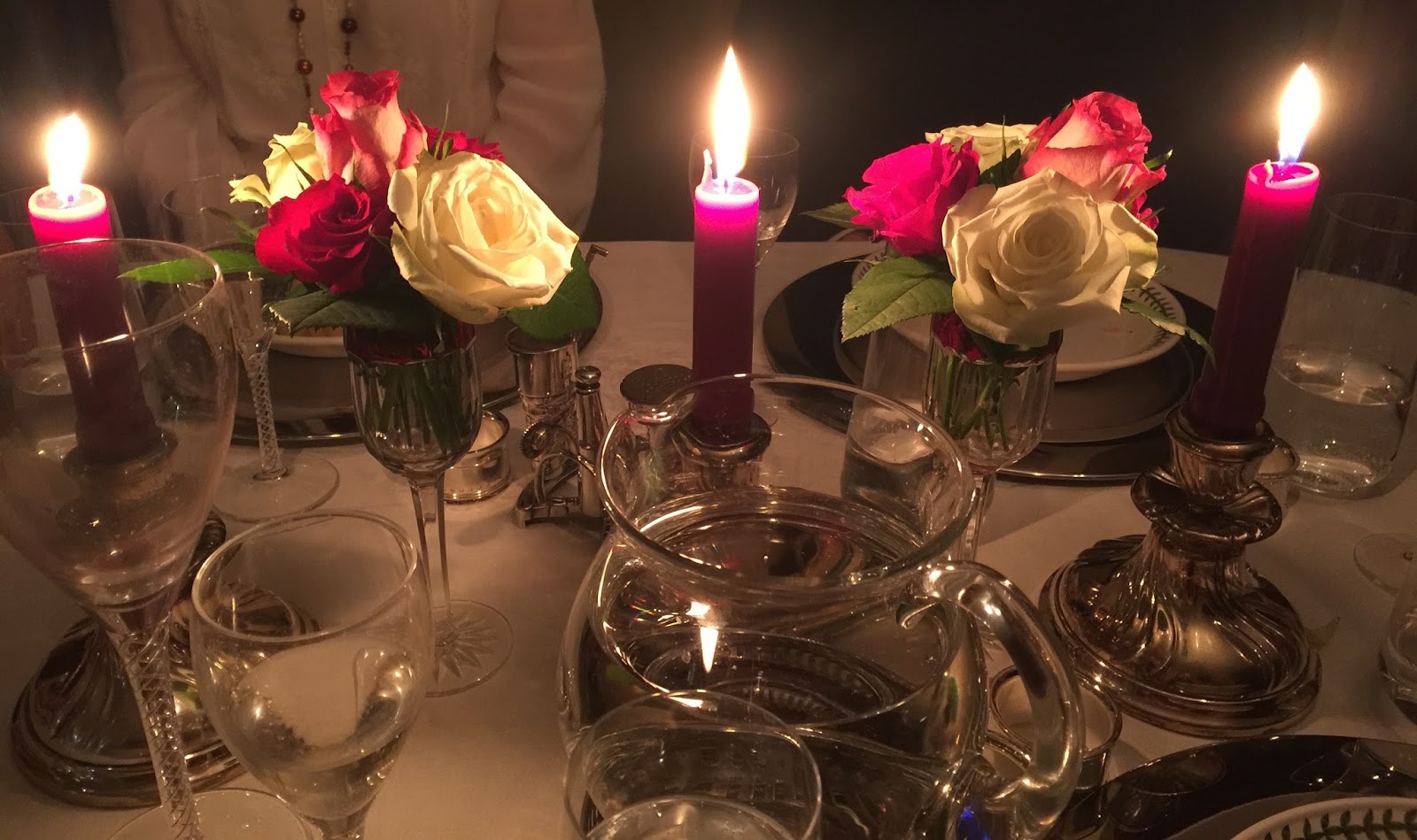
We did our part here in North Hampshire with a pull-out-all-the-stops dinner party. Our celebration of English cuisine was traditional, seasonal and sourced locally. Almost everything was English. We made two exceptions ... Gascon foie gras and Bordeaux wine ... something we decided to allow because Eleanor of Aquitaine made both territories English for a while. And because, no matter how good English wine has become, we've yet to find a red with the body and deep fruit necessary for a hearty, beefy main.

Here's the menu.

The amuse bouche:
Minted pea soup (served in shot glasses) and home-made pork scratchings
served with Hambledon (Hampshire) Classic Cuvee

The soup is very easy to whip up (recipe here) and can be done well in advance. In fact, it's best made the day before to let the flavours marry. And it's good cold, too, so an excellent choice for summer parties and picnics. We use Tom Kerridge's recipe for the pork scratchings ... one of those things where, once you have had it made at home, you'll never want a commercial variety again. Just be prepared for the mess it makes of your oven. The Hambledon is one of our favourites of all the English sparkling wine we've tried, and made less than an hour from our house.

The starter:
Cornish crab and Mayfield (Sussex) cheese soufflé, shaved salad of new season asparagus
served with Kenton Vineyard (Devon) Estate White 2014


This recipe worked beautifully, with the souffles puffing up more than double their size. The trickiest bit is getting them out of a hot bain marie, onto a plate and to the table before they collapse too far. Crab is in season right now, and you can get picked white meat in Cornish Fishmonger. The salad looks elegant and "cheffy" but it's actually ridiculously easy: use a vegetable peeler to create ribbons of asparagus stem. Quickly poach and chill the asparagus tops. Dress the raw veg with olive oil, lemon juice and pepper. Add in the tops, and serve.
bulk, delivered to your door, from the

The Kenton is an excellent choice if you want to go English with a white table wine that's fruity, light and flexible with most starters. At just a bit over £10 a bottle, it's also better value for money than many of the equivalent English labels. We sourced ours from Caviste at Newlyns Farm Shop.

The main:
Beef Wellington, bubble & squeak, broad beans on pureed wild garlic
served with Frank Phelan, Saint-Estephe, 2004

Wellington is my husband's "go to" special occasion recipe. (It was the centrepiece of the first meal Newlyns, who will cut to order to exactly the size and shape we want), and brushing it with a coat of spicy mustard adds a bit of piquancy that balances the richness of the other ingredients. Mr. Bencard's latest innovation is mixing the mushroom duxelle (which we make with fresh chestnut mushrooms and dried porcini, to deepen the woody flavour) with the foie gras to make a combined paste. It's much easier to coat the beef with than using two separate elements.
he ever cooked for me.) There are many variations of the recipe online; my biggest advice is not to skimp on the ingredients. I've had some Wellingtons ruined by mealy liver pate. We always try to get our hands on proper foie gras and, if we can't, use the best and smoothest duck liver pate we can buy. Obviously, really good fillet steak is a given (we love the butchers at

We got a case of the Bordeaux as a wedding gift in 2011. Wine expert Oz Clark wrote in his 2016 guide that it was at peak and ready to drink. He was right.

The pudding:
St. George's tart, clotted cream ice cream
served with Chapel Down (Kent) Nectar, Late Harvest, 2013

I confess I used shop-bought ice cream. And I'm still perfecting my frangipane tart. It's something I learned at Gascon Cooking School last year and it's essentially very easy but, as with any recipe, you need to remember those little nuances. Like how you must cream the butter and sugar first, and only then add the egg a little at a time (which I did remember) and how you should blind bake the pastry cases as well as refrigerating them for half an hour (which I didn't). The great thing about frangipane tart is that you can do variations with most fruit. I find it particularly good with rhubarb. To create the cross of St. George, I put rhubarb jam on the bottom of the tart, then the frangipane. Then I used batons of rhubarb, which I'd roasted in the oven with lots of sugar until they were soft, but not falling apart, to create the cross.

The Nectar is a fantastic dessert wine, sweet but not too cloying. You can read about our visit to the winery here.

As a celebratory feast, I don't think it gets much better. And it would be hard to get any more English.

Once established as an official holiday, I'd suggest moving the big meal forward to mid-afternoon, like Christmas or American Thanksgiving. Then everyone could adjourn to the sitting room for a post-prandial national viewing of Shakespeare. Who, quite fittingly, was born and died on St. George's Day. This being the 400th anniversary of his death, the BBC did exactly the kind of celebratory broadcast I imagined last night. But we were cooking and feasting. Shakespeare is a treat I'll save for later in the week.

Wednesday, 26 August 2015

Chapel Down lets English wine hold its head high

Global warming may bring drought, species extinctions and flood, but there'll be at least one upside: Excellent English wine.

There's no denying that our climate has become more like the continent's over the past decade.  Our South Downs have the same geography as some of France's great wine regions.  So why not?  The only thing missing is vines with some venerable age.  And it turns out we have that, too, as many of the vines in Chapel Down's 100 Kentish acres are older than the winery itself.  Founded in 2001, they're now the leaders in English wine production, fighting an impressive battle on both quality and PR fronts.


On the first, Chapel Down produces a variety of wines that would compare favourably with their French cousins.  Their Bacchus, a native English grape, would be indistinguishable by even most experts from a continental Sauvignon Blanc.  Their sparkling wines are directly comparable to Champagne, and their Pinot Noir reminded me of a Beaujolais.  I would be happy to serve any of these at a dinner party to wine-afficianado friends.  But Chapel Down knows that reputation may be English wine's biggest problem, so they're on the offensive.  Most impressively, they've embedded their wines in prestigious locations like The Royal Opera House, The Donmar Warehouse and Gordon Ramsay restaurants.  And their operation at headquarters sends a clear message that they're as good at this wine thing as any foreign brand.

At their main site just outside of Tenterden, they do a vineyard tour that's perhaps the most informative I've ever been on, followed by a guided tasting matching wines to local cheeses.  Our guide managed to seamlessly mix the history of wine in England (right back to the Romans) with specifics about Chapel Down, horticultural lore, insight into which grape varieties do best in England and, of course, a thorough tour of the production facilities. We learned to be wary of labels:  British wine means wine made in this country from imported fruit or juice; English wine means it's local from vine through to bottle.

Regular vineyard visitors will be intrigued by the way the vines are pruned.  The vines are allowed to grow much higher than I've seen elsewhere before their flowering stems are spread horizontally.  This creates more air flow, discouraging mildew.  (Roses are planted throughout as early warning detectors of that pernicious danger.) Blooms are only allowed to develop on the lowest line and the leaves above are pruned judiciously to allow as much sun as possible to pour onto the fruit.  Crazy English weather is still quite a variable.  Our record heat burst in July saw the quickest flowering to fruit setting in production history, but abnormally cold weather has followed since and late August brought a month's worth of rain in one day.  Who knows?  Assuming we get a long and clement autumn, all the fruit we saw will ripen and be harvested by hand; one vine roughly equates to one bottle.

Chapel Down is the giant of English production, responsible for 1/6 of the roughly six million bottles we produce each year.  Which sounds like a lot ... until you realise that the French match us with six to seven billion.  Which points to Chapel Down's biggest challenge, in my opinion.  Their wines are comparable to French offerings, but they can't match the French economies of scale.  Which means that, as impressive as our award-winning local wines are becoming, what we tasted was roughly 30% more expensive than a comparable foreign wine, and at a price point where you could get something more special for the same money.  But you're not going to be buying Chapel Down if you're making a cost-based decision.  This choice plays to novelty, patriotism and local sourcing.

The vineyard has a restaurant and an upscale farm shop to make a day of it.  The Swan serves traditional British favourites (of course) and seasonal produce; their signature dish is Yorkshire Pudding the size of a deflated football.  My crab salad starter was excellent and the roast pork solid if unremarkable.  Deserts were, sadly, disappointing, but a three-course Sunday lunch for £24.50 makes it tough to complain.  Especially when you have the novelty of local wine matching, and views over picturesque vineyards.  Modern and purpose-built, the restaurant is above the shop, with big windows taking in expansive views.  I wouldn't go out of my way for the restaurant alone, but it's an excellent conclusion to a tour and tasting.  Make sure you make reservations, however, with only 80 covers the tables here go quickly.

What we thought worth buying
Blanc de Blancs 2010 - Sparkling wine with aromas of fresh and baked apples on the nose; intense fruit characteristic of chardonnay grown on chalk soil. A special occasion bubbly on par with anything from Champagne.  £26.99

Pinot Noir 2013 - A warm and sunny growing season yielded a wine light in colour and low in tannin.  Delicate red fruit and violet on the nose; strawberry, cranberry, subtle oak and liquorice edge in on the palate.  £13.99

Nectar 2013 - We found their dessert wine to be the stand out of the day, and the one thing we tasted that was better than continental or Australian competitors.  Jasmine, rose and honeysuckle aromas with lychee and gooseberry coming in on the palate.  Pleasantly sweet but not sickly, will work as well as an aperitif as with dessert and should be stunning with foie gras.  This is going to see a lot of action at Christmas time.  £13.99 (for 50 cl)

Honorable mention must go to the English Rose 2014.  Probably the best rosé we've tasted this season but, sadly, it's for drinking now.  The Bencard cellar has enough rosé to get us to the first frost, so we had to pass on this one.