Showing posts with label wine. Show all posts

Sunday, 26 July 2020

Newbury’s Vineyard fights back with opulent tented restaurant, food and wine to match

Forty four years ago, in a blind wine tasting that would become known as “the judgment of Paris”, French judges selected Napa Valley winners for both their red and white contests. The unexpected result rocked the wine world, proved a catalyst for moving California’s top wines into the quality category they occupy today, and provided the plot for an excellent film called Bottle Shock. It also inspired a marvellous restaurant near Newbury, England, called The Vineyard.
Opened in 1998 by Sir Peter Michael, a British businessman who’d established a working vineyard in Northern California the decade before, his English Vineyard is a five-star hotel with luxuriously sophisticated rooms in a modern building that has a faint whiff of French Château about it. All the rooms are named after California wineries, and the place is tastefully decorated with the Michael family art collection and a fabulous array of wine bottles and paraphernalia. There’s a spa, and a small conference facility, but the beating heart of the place is its extraordinary wine cellar and the restaurant that accompanies it. You can’t miss it; 20 steps across the lobby from the front door and you’re in a glass-framed hallway-cum-wine-cellar with bottles on either side and below your feet. Beyond is a life-sized mural of the judgment of Paris, with Sir Peter ... who was not at the real event ... painted in, benignly looking on like one of those art patrons included in medieval nativity scenes. 

As a restaurant, The Vineyard reached its apogee in the early 2010s under head chef Daniel Galmiche, who won them a Michelin star and Decanter’s Restaurant of the Year award while gaining publicity as a frequent guest chef on the BBC’s Saturday Kitchen. Galmiche and the star have gone, though the restaurant still holds a Michelin plate (one step below) and remains noted for a wide-ranging wine list with an unusual number of wines-by-the-glass and what I’d guess is England’s best range of Californian wines. This includes bottles from Sir Peter’s eponymous label and Schramsberg and Honig, vineyards we visited (and I wrote about) on our Napa tour. I’ve had the good fortune to at The Vineyard three times for work events, but my wine-loving husband had never gotten to join in the fun. It seemed a perfect venue to celebrate his birthday. 
We are only three weeks past the government allowing hotels and restaurants to open in England, and the rules for indoor spaces both dampen the atmosphere of restaurants and make profit margins a challenge. Outdoor dining is the only way to approach the conviviality and turnover of pre-pandemic days, but that’s always a gamble in the English summer. The Vineyard has risen to the challenge by filling their garden with a magnificent tent, its spiked dome, sinuous roof line, lanterns and painted canvas wall panels like something out of an upscale, fine-dining version of The Arabian Nights. It would have been a treat whatever the circumstances and, to be honest, is much more fun that their tastefully understated but unremarkable regular dining room. The only drawback was a slightly wobbly plank floor that sent a tremor through our table whenever anyone passed, but given the circumstances driving the alfresco pop-up, it’s a small irritation easily forgiven. 

We had started indoors, sinking into the deep upholstery of the country-house-style lounge to peruse the wine list before settling on a bottle of sparkling golden Schramsberg to take us from there right through our starters. Once inside the fairy tale pasha’s palace, made all the more surreal by all of the masked servers, I started with a beautifully presented and very tasty pork terrine while the half-Danish husband opted for cured salmon. “Someone in that kitchen understands the Nordics,” opined the arch critic. “ This has been home cured to a proper recipe.” So much of restaurant salmon would be hard to differentiate from packs you can buy at Waitrose. This was in a different league, with the curing reducing the original fillet to perhaps half its starting thickness, concentrating the salmon flavours and imbuing it with aromatic herbs and spices.
We reverse-engineered the main courses around the next wine.

A 2011 Chateau Musar occupies a price point I normally wouldn’t consider sane, even for a special
occasion, but four months without restaurant dining has left a budget surplus that could handle the momentary insanity. Lebanon is one of the world’s oldest wine producing regions and Musar its most famous house. The result is pretty much what you’d hope for from 4,000 years of accumulated experience. Tannins melted away to an intense berry richness but with subtle hints of mushroom and earth that reveal its core of Cabernet Sauvignon. Mr. B was an English purist with a ribeye and triple-cooked chips, while I strayed closer to the Mediterranean with a beef shin ragout with freshly-made tagliatelle. With each mouthful-following sip, I thought “If I could only have one wine for the rest of my life, this would be it!” You need the right food, however, to bring the Musar to its full glory. We both had a few sips left after we finished our meal, at which point spices that had meshed seamlessly with the beef became so noticeable as to be almost overpowering. Validating our menu choices and the kitchen’s talent.

We split a custard tart with pink rhubarb sorbet. The former was pleasant but paled in comparison to the sorbet, served on a trail of golden crumble to deliver a hit of both sharp/sweet fruit and satisfying crunch.

One of the great joys of the “restaurant with rooms” concept is that you don’t have to kill your buzz, either literally or metaphorically, getting home. Push back your chair, enjoy a short, post-prandial walk and slip between some high thread-count sheets that someone else has had the chore of ironing. Bliss. The suites at The Vineyard have all those subtle, small touches that add up to the label (and the price tag) “luxury hotel”. The crisp bed linens and deep feather pillows. The classical music playing over a good sound system when you enter. Decor that’s streamlined and modern but not at all corporate. Tasteful lighting in multiple places to change mood and focus. (There was even a subtle nightlight glowing over the step between sleeping and sitting areas to prevent late-night mishaps.) A palatial marble and wood bathroom with a tub so big I could barely touch the end. Nice shower in a separate alcove, too, though people as tall as my husband will have to duck beneath the shower head.
I don’t think I’ve ever brought my dogs to a five-star hotel, but The Vineyard excelled there, too. Waiting in the room was a dog bed, food and water bowls, their own bottled water and pedal bin for used poo-bags and a fresh tennis ball. Needless to say, the canines enjoyed the outing as much as the humans.
The traditional British hotel breakfast buffet is another infringement of COVID-safety standards; many establishments seem to be switching to a policy of everyone taking breakfast in their rooms. At The Vineyard this means a wooden wine case left on a luggage rack outside your door. Flipping its brass latches revealed croissant, sourdough, jams, butter, milk and orange juice. A Nespresso machine in the room added DIY caffeine. If you order a cooked breakfast (a supplemental charge to your room rate) it arrives at a scheduled time and is well worth the extra cost. Mr. B’s breakfast featured “bacon” that was essentially a thick, cured slice of grilled pork belly that had his eyes glazing over with delight and scrambled eggs he reported as perfectly “baveuse“. (Too runny for me, but I know he ... and any other European serious about food ... considers American scrambled eggs horrifically overcooked.) I had gone for a different style of American: Californian Eggs were poached sitting atop pillow-like home-made English muffins slathered with crushed avocado and a spicy tomato salsa.
Our last pleasant surprise came with the bill. Which, of course, is delivered by email and charged to your pre-registered card upon agreement, to eliminate the need for human contact. Thanks to current government stimuli, there was no VAT (sales tax) on the room or food, only on the alcohol. When you’re pushing out into the luxury end of the market, this can be an enormous saving. So if you’ve been thinking about splashing out on a fine-dining-with-rooms experience, now many be the time to do it. While the pandemic makes the experience more unusual, the novelty can also be quite special, and up to 20% off the final bill adds to the delight.


Friday, 14 October 2016

Head to Porto to discover the range, beauty of Portuguese wines

We went for the wine.

Porto has innumerable charms, and we planned to sample them all. But everything came back to this region's oldest and most famous export. We wanted to understand fortified port wine beyond the ubiquitous ruby splashed into end-of-banquet glasses, grasp more of the process and be able to differentiate better between styles and labels. We wanted to learn more about the non-fortified wines; back home, everything we tasted from Portugal was always great ... why was it so little-known? We even immersed ourselves in a vinous hotel: The Yeatman is part of the Taylor's Port empire and was founded to promote the local drink in all its forms.

If you, too, are a wine lover, you'll need a minimum of four days here ... though I'd recommend a week. (Your liver will thank you for a fortnight, however, so you can drink in a bit more moderation.)

Here are my wine-lovers' top tips for Porto.
1) Spread your port tasting across the trip, doing a bit each day
2) Find a local wine bar to be your tasting HQ
3) Head upriver to check out the wineries, spending at least one night there
4) Indulge in some nice meals with matching wines
5) Splash out on a tutored tasting at the Yeatman

Port Tasting
Port is a wondrous thing. It is also very strong and extremely sweet. Even if you spit rather than drink (and the lack of spitoons here suggests that's rare), most people's taste buds would move beyond the ability to differentiate much after the second port house. One or two houses a day, ideally visited just after lunch, is the ideal schedule. Some of the port houses also have restaurants, so you can combine the two.

Though you'll find port everywhere in town, you'll want to go to the source and do your tasting at the lodges on the south side of the Douro. All of the big names, and some you've never heard of, are clustered together. Climate, geography and shipping conspired to establish a tradition of making wine upstream, then bringing it to this district of Vila Nova de Gaia for the critical aging that produces the magic. Most houses offer a tour ending with samples. They all follow the American style of paying for tastings, whether you go on a tour or not, but you get a lot in your glass for your money. Your tasting will usually include the house's ruby (mass produced, inexpensive) and an LBV or young tawny (a bit of wood aging gives depth). It's important to note that you don't have to go on the tour to taste; while there are variations, once you've seen the inside of one lodge they are much the same. While tastings are reasonable, don't buy bottles here. Quick internet searches at each place (all provide free WiFi) showed that prices were always better at home on brands available in the UK. Also note that you can upgrade your tasting to the nicer stuff.

At Sandeman's, for example, you can go on the standard tour and then upgrade your tasting. We splashed out €35 for their tawny tasting, where we could work our way through their 10, 20, 30 and 40 year-olds. The tour here is nothing special, but the tour guides wear the brand's iconic Zorro-esque hat and cape, which makes it quite atmospheric. The tour up the hill at Croft's was superior. They seem to get much less traffic here and the guides are more experienced. Ours had been with the company for decades and was delighted to delve into whatever areas of detail we wanted to explore. Taylor's tour is an audio guide, disappointing on the personal interaction front, though I would have appreciated it more had I done it later in the trip. Because it's self-paced, it allows you to dig into much more depth than the others, so better after you've learned the basics elsewhere. They have the most beautiful tasting room we visited, however: a Regency-style tent-ceilinged cellar looking out onto rose gardens, peacocks and the old family mansion.

If you take the hop-on-hop-off bus tour you'll get a free tour and tasting at Cockburn's, which will explain why their enormous tasting hall has the noisy feel of an Octoberfest beer tent. Ramos Pinto has another pretty room, and a great branding story with their artistic posters, but even their old tawnys have a cherry cough syrup finish we disliked intensely. Ferreira's has a resolutely Portuguese story in an Anglo-heavy industry, but their local tradition includes closing for a long lunch, so plan accordingly. (We didn't.) For the ultimate port-tasting indulgence, swap the tours and tasting rooms for Vinum restaurant at Grahams. Magnificent view, great food, impressive wine list and a port cart to choose from at the end of the meal. The three of us each tried a different version and shared, though we did not splash out on the 90-year-old, nor on the 19th-century tipple in the customised crystal decanter.

Our conclusions on the taste front? Nothing swayed us from our existing preference for 20-year-old tawny, which has a combination of woody depth and lightness we love. And though we tasted some excellent ones, nothing was distinct enough to woo the Bencards away from our current Berry Brothers own label as our regular brand. The 40-year-olds were like Christmas in a glass, and we noted much more variation here between the houses than with the younger ports. But the 40s' distinct flavour profile limits them to drinking on their own after a very special meal. Cockburn's has a surprisingly tasty ruby, somehow managing to get a bit of depth and sophistication into this entry-level product. White port is a fabulous aperitif that deserves more attention, and is particularly good when mixed with tonic and some orange peel (the classic port tonique).

The Local Wine Bar

Our standard modus operandi on our girls' trips is to find a nearby bar with friendly, talkative locals who enjoy giving advice. In Porto, it was Vinofino on the Rua das Flores, not far from the central train station. In a region with such a vast array of wines, this place helps you to navigate. There's a wide array of bottles open for wines by the glass, far more than appear on any menu. Trust the staff and let them help you explore. They're great at asking about your preferences and then suggesting options. I spotted plenty of other wine bars with extensive by-the-glass selections. I suspect they were equally good. Find one and become a temporary local; the service and recommendations will get better on each successive visit.

Head Upriver
The Douro valley is one of the most dramatic wine regions in the world. The vineyard slopes are impossibly steep, only made workable by a crazy-quilt of terraces. Sometimes they're only one row of vines deep, but continue all the way up the mountains, giving the whole valley the appearance of curving green staircases plunging to a narrow band of water below. Even if you never tasted a sip of wine, it would be worth coming here just to see the remarkable countryside.

It is not, however, an easy trip. We splashed out on our own driver, who was also a guide. (€300 for the day, plus tip.) Given the fact that it take nearly two hours to get to the heart of the region, and that the driving once you get there features a challenging procession of hairpin turns at high altitudes with frightening drops to one side, we were delighted with the choice. Roger filled the long drive with stories of Portuguese history, wine and culture. Our wine tasting also benefitted from his insider knowledge: when slow service at our first destination crashed into the scheduled time for our second tasting, Roger found a better option.

Aneto Winery was the highlight of our day, and the kind of place almost impossible to find without insider tips. Winemaker and owner Francisco Montenegro started developing his little piece of heaven in 2001, but worked as a wine making consultant at bigger brands until more recently. Now he operates from a beautifully-designed little winery where modern architecture sits comfortably with tradition. Upon entry through a cement-and-glass cube of a lobby, you'll look out onto a modernist storage area cradling a resolutely old-fashioned store of hand-crafted oak barrels, beyond which a giant glass wall lays the valley before you. Next door, the equipment may be the latest, but the newly-harvested grapes were awaiting the tread of human feet. This most ancient of pressing techniques is still widely practiced in the Douro, where winemakers insist that nothing else works so well in getting the juice out, while not crushing the stems and pips. Maybe that's why the wines here tend to have both rich fruit and subtle complexity, without harsh tannins. You'll need to make an appointment to come here, but the tasting and the intimacy of the experience is worth the effort. So's the wine: we all shipped bottles home.

Earlier in the day we visited Quinta Nova, one of the better-known producers in the area. We were less impressed by the wines, but have rarely done a tasting while taking in a better view. We enjoyed the tour ... especially since it was mid-harvest so we saw production going on ... and had a great lunch. No surprise they've turned this beautiful place into a luxury B&B as well.

Given the winding roads and the travel distance, B&B for a couple of nights would be an even better way to visit the vineyards.  Other possibilities are to take a boat from Porto (there are multiple options, but it's a full day trip and you spend a lot of time going through locks) or to take the train.

Great Food
I talked to a local who was emphatic about this point: "We don't drink without eating. Portuguese wines are made to go with food and are best enjoyed that way." While I, personally, would disagree ... the fruity, rich-yet-mellow-reds are all the accompaniment I need while curled up with a good book in front of the fire ... she has a point. Because the locals think this way, restaurants are a great place to do your wine tasting. Not just in fancy places with sommeliers, but in everyday spots. In this, I think the Portuguese may be better than most.

I've found French service to be curiously ignorant of food and wine pairing. The onus is on the diner to make the selection; if you ask them to match for you, you may simply be relegated to whatever is opened. The Italians will usually default to terroir, recommending whatever is grown and produced closest. The Californians are keen to oblige, but their prices will break the budget. The Portuguese not only know their wine and food pairing, but even nicer restaurants have great choices in the €20 - €30 range.

All the restaurants we visited had generous wine lists, and we saw little repetition across them. The number of producers here is staggering, which is another reason to trust the staff. I'll write a separate entry on restaurants, but here I'll call out Cantinho do Avillez and Largo Sao Domingos, both in the historic city centre, for a reasonably priced and impressive experience. If you want to go high end, head toward the beach for Restaurant Pedro Lemos in Foz. The wine flight here matches the chef's menu with all the confidence and quirky innovation you expect from a Michelin star restaurant, but draws the majority of its choices from those little-known Portuguese producers who deserve wider acclaim.


Tutored Tasting
For the ultimate in Portuguese wine education, put yourself into the assured hands of the staff at the Yeatman Hotel. The place is owned by a wine dynasty and exists to promote the wines of Portugal. The staff and the wine cellar are full of the quality you'd expect. They have plenty of wine-related events ... just check their web site for a schedule ... and you don't have to stay here to attend. They're also happy to customise tasting events to your wishes.

The first part of my trip marked a friend's 50th birthday. Our gift to her (and to ourselves!) was a tutored masterclass with hotel sommelier Elisabete Fernandes. Our trio settled into the Yeatman's glamorous wine cellar, surrounded by natural stone and thousands of bottles, ancient grape vines twisting along the ceiling above. We sampled two whites, three reds and a port, with examples coming from across Portugal. The generous spread of meats, cheeses, nuts and pastries was ample to play around with flavour matching and as a substitute for lunch. We learned an enormous amount, from the nuances that distinguish Portuguese wine to the quirky stories of individual producers to specific details of what was in each glass. It was hard to pick a favourite, as each was as tasty as the one before. Until we reached the summit of our tasting: a 1966 Croft vintage Port in honour of Lisa's birth year. It was a privilege to taste. A pure amber in colour, far less sweet yet almost syrupy thick, full of complex notes of spice, wood and nuts.

Prices for customised experiences change depending on the details. Don't be put off by the room rate of the hotel; the wine events are more reasonable than you'd think. While the tasting was a splurge, it also provided value for money when we considered the cost of six special glasses and accompanying food. Add on Elisabete's expertise, totally devoted to us, and it was a bargain.

Sadly, most of the wines we tasted were difficult ... if not impossible ... to track down in the UK. The Yeatman offers a wine club to get around this issue. We signed up, of course! There are varying levels and prices. We're having four cases a year delivered to Hampshire, a mix of bottles of the Yeatman's choice. Delivery is included and the cost comes out at an average of £14 a bottle, though I suspect a case will comprise a range from high-end reds to more affordable whites. A reasonably-priced way to remember an extraordinary wine trip.

Saturday, 8 October 2016

5 reasons to put Porto on your bucket list

We have a rule for our annual girls' trip: if you're marking a birthday year that ends in "0", you get to choose the destination. My friend Lisa's desire to stay at the legendary Yeatman Hotel, and to explore the wines made upriver from there, prompted my first trip to Portugal.

What a discovery! It's perhaps shameful that a place so close to England in distance and allegiance can seem "off the beaten track", but the truth is that Portugal's profile is far lower than its more popular European neighbours. Of the handful I know who've visited, most went for the Algarve, a top British pick for beach holidays. Despite its long links to England, few are familiar with Northern Portugal and its chief city of Porto.

Here are five reasons why you should move Porto further up your holiday priority list.

ONE: IT'S EUROPE'S GREATEST WINE SECRET
Port makes it unsurprising as a wine destination. If you're English, this place's eponymous drink has probably concluded many of your life's most memorable meals. The sweet, fortified wine is made further up the Douro valley, shipped down to Porto for aging and then on to the rest of the world. The British have loved it for centuries, and political circumstance put them in charge of many of the biggest makers in the early 19th century.  Today, clever marketing departments have ensured a great port tourism experience, with the traditional port lodges on the south side of the river offering tours and tastings to meet every budget and level of interest.

But there's much more here than the sweet stuff. The Douro is one of Europe's oldest wine growing regions; their first big export market was ancient Rome. The locals even claim to be the inventors of the DOC system that restricts the ability to brand a wine according to its region. Many vineyards have vines older than a century, the starting point for fabulously rich and complex products. Steep slopes formed of easily cracked schist rock create perfect drainage while capturing the sun, while their unique terraces are spectacular to see. In fact, they whole region is a UNESCO World Heritage site because of their architectural impact on the land. Further north, you'll find some of Europe's greatest easy-drinking whites. They're all available in Porto, which has enough wine-by-the-glass offerings to keep your body in a constant, gentle pickle across your whole holiday. Best of all, most of these "table wines" (as the locals call all their non-fortified wines) are little known, rarely exported and fantastic value for money. I don't expect this state to last, so visit now to make your discoveries and invest while the price is cheap.

TWO: IT'S FAMILIAR YET EXOTIC
Portugal is a mainstream a European country that's had a continuous alliance with England since 1386 (the world's oldest). At first it all seems very familiar. Lots of churches, windy streets, picturesque architecture, sidewalk cafes. Plenty of words on signs are familiar. Most people speak English. And yet, it's not like anywhere else. The language as spoken is full of "shush"es and strange cadences, like someone mixed Spanish, Russian and some mysterious ancient texts to come up with a new dialect for a race from a fantasy novel. The architecture is as elegant as Paris or Rome, but the tiled exteriors are unlike anything I've seen elsewhere in Europe, and the churches are so encrusted with precious metals they feel almost pagan. Beautifully restored buildings sit cheek-by-jowl with crumbling ruins being reclaimed by strangling carpets of blue-blooming morning glories. This lends the city a slightly seedy decadence reminiscent of Naples or Palermo, but the locals have the sophisticated style of Milan or Madrid.

Much of the food seems familiar, yet there are oddities. Like their proud ability to cook a different salt cod recipe for every day of the year. (Why the passion with dried fish when the whole country is a narrow strip next to the aquatic larder of the Atlantic?) They outdo even Greece with their abundance of octopus recipes, and I've never visited a country more in love with the egg. It seems to dominate everything, from the custard tart that is the national pastry to fried versions lobbed atop most sandwiches. With their snack of lupin beans I discovered my first completely new food in years. The nation's history brings similar surprises. Most of us have some sense of Portugal during the Age of Discovery, their colonisation of Brazil and their role during the Napoleonic Wars. But there's so much more to discover. They have glorious heroes, romantic poets and wildly dysfunctional royals. Turns out St. Anthony of Padua ... who I was raised to respect as the most Italian of saints, and whose statue occupied all of our homes ... was Portuguese. Discovering Porto's unique take on European culture was like finding out that my favourite, long-dead author had written a series of books I somehow missed.

THREE: IT'S EASY ON THE EYES
Porto offers one of the world's greatest urban riverfronts, in duplicate. Both sides clamber up steep slopes, providing views from the opposite bank like the architectural capriccios of artists' imaginations. Stolid 18th century warehouses, Baroque fantasies encrusted with ornament, grim Romanesque piles, 19th century statements of financial confidence, modern apartment blocks all contribute to the pastiche. Harry Potter fans are delighted to discover that J.K. Rowling lived here while drafting the first book in the series. Twisting cobbled alleys, caped college students, an extravagant fountain of winged lions and an opulent neo-gothic bookstore with a sinuous, fairy-tale staircase all influenced the style of the wizarding world. The river gorge is spanned by bridges that are truly wondrous in their architectural daring; the oldest by Gustave Eiffel of Parisian tower fame. Most days dawn with ghostly fog dancing up the Douro, burning off by mid-morning. The sun sets where the river flows into the sea, painting the sky with extraordinary colours every night we were there, gilding the river and the windows of the city with the same gaudy sparkle on display in their church altars.  Head upstream, and the system of steep terraces gives you some of the most spectacular wine country on the planet. It's a dramatic, luscious, theatrical set of a place.

FOUR: NATIVES OFFER AN ABUNDANT WELCOME
If he was lying, he did it well. "We love the English!" Our driver insisted. You are our oldest allies.
Your families settled here and still run some of our biggest businesses. You rescued us from Napoleon when the Spanish betrayed us and our own royal family ran away. (The peninsular war monument topped by a bristling, confident English lion ripping the neck out of a tragically submissive French eagle leaves no room for mis-interpretation.) "You are more like our cousins than people from another country!" Whether this was true or a spectacularly fine line for the tourists, we chose to believe it. Certainly we've rarely met more uniformly cheerful, helpful and enthusiastic service. From luxury hotel to inexpensive restaurant, wine bar waiter to nun-on-the-street, it seemed that the driving ambition of everyone we met in Porto was to go out of their way to make us love their city. Nobody was ever in a hurry ... stopping to chat with us seemed more enjoyable than whatever they were off to do. Waiters were keen to offer details on the food, keener still to tell us what was best that day whether or not it was on the menu and could even be talked into offering wines by the glass from special bottles they probably shouldn't have opened.

It helps that almost everyone speaks good English. The exception, oddly, are the taxi drivers, most of whom speak only Portuguese and make it painfully obvious that Portuguese pronunciation is very different from the written word. Having your destination written down for them is a good idea, as is a strong set of nerves as they endanger their brakes and transmissions careering around precipitous, cobbled corners.  In eight days I encountered just two grumpy people. Both had tedious jobs ferrying tourists up, down and across the Douro. Otherwise, this seems a charmed place where everyone seems to love their jobs.

FIVE: GOOD VALUE FOR MONEY 
Even with a plunging pound, Porto offers bargains. Restaurants seemed to be about 20% cheaper than their London equivalents. Taxis are a bargain, rarely costing more than €10 to get from one side of town to another and about €20 to get in from the airport. If there are two or more of you, it's not worth wasting the time checking out public transport. All of the port houses charge for tastings, but it's a nominal fee compared to Northern California's wineries and the pours are generous. Reasonable wine prices prevail from Michelin-star restaurants to humble wine bars, as if the industry has colluded to encourage you to drink as much as possible. Even at the magnificently luxurious Yeatman Hotel (the catalyst for this whole trip, where rooms are a blow-the-budget extravagance) you can get wine by the glass for €4. The equivalent at a London hotel with that kind of view would be €12 or more.

Tempted yet? If not, in coming days I'll write more about wine, sightseeing, architecture, food and accommodation. Like all those cheerful Porto natives, I want you to be thinking about booking your visit before I'm finished.

Sunday, 10 July 2016

California Wines Part 2: Seven wineries to sample three valleys

Tasting at Honig
Happily, our tastings exceeded my expectations. I'd been warned not to look for deep expertise in the marketing-led tasting rooms. The pourers had their set schpiels, and were unlikely to want ... or be able ... to talk in further depth.

This was certainly the case in our first, and only unplanned, winery stop. Bartholomew Park was picturesque, a stone's throw from our rental property and had pleasant if unremarkable wines. Our pourer was a retired lady who was doing this for some part time cash; friendly, but uncomfortable with any wine conversation that went beyond the official tasting notes. To be fair, this was also the cheapest tasting we did: $10 for the standard range and $20 for the premium. But it had me worried that it might set a standard for the region.

Fortunately, we could rely on local expertise to up the game for the rest of our tastings. In Napa, we hired professional guide Dean Gross to organise a full day's exploration of the valley. In Sonoma, two of our party had once lived here and could take us to old favourites and spots tipped by their friends. And in the Russian River valley, some wine-obsessed new friends who were also Bay Area residents got us in to two wineries that impressed every local who heard the names. Here's a roundup of those visits:

NAPA

Honig - A small, family-run operation with a fresh attitude and a sparky staff. The most enjoyable tasting we had in terms of conversation; Casey clearly loves what he does and sparkles with the enthusiasm of sharing his knowledge with others. His ability to talk in depth about Honig's wines, but also put them in the context of his wider understanding of Californian and world wines ... all with a wonderful sense of humour ... was exceptional. Lead winemaker Kristin Belair is one of a growing number of women in the industry; a change in which California is far ahead of Europe.

Schramsberg - One of the oldest wineries in continuous operation in the valley, German immigrant
Jacob Schram built a business so respected in the late 19th century that visiting literary star Robert Louis Stevenson dropped by. It left family hands at the turn of the next century and didn't do much significant production until the late 1950s, when the Davies family took the place over with a dream of producing sparkling wine to rival Champagne. Twenty years later, they were the brand President Nixon took on his diplomatic mission to China, and their reputation was made. The family home is a historic landmark, the gardens are lushly beautiful and the tour of the cellars does a fine job explaining this fascinating process. My one criticism: the tasting takes place in the the musty cellars, where the strong scents of mould and mildew can overpower the delicate tastes of the wine. Two of our party with minor allergies had significant breathing problems after half an hour; I don't want to think what the lungs of the workers who spend their days down there look like.

Krug - Another winery with historic origins, Charles Krug and Schram were friends and colleagues; Krug's vineyard slightly pre-dates the higher-altitude Schramsberg fields. German heritage passed to Italian in the 1940s when the Mondavis bought the winery. It's still in the family. The vines might be old but the winery building and tasting rooms are some of the most modern in Napa, fresh from a multi-million dollar renovation. It's a dramatic, modern space that plays with dark and light, with massive glass walls separating the working winery from the tasting area. You're welcome to bring your own food to take advantage of the shaded picnic lawns and great views out front, as long as you buy a bottle of their wine. You can also explore the herb garden of the Culinary Institute of America, which occupies a hill across the street. I would happily have lingered longer here.

SONOMA

Gundlach Bunschu - Another winery with roots in 19th century German immigration, this one has been in the hands of the same family since its founding in 1858. The foundation story is wildly romantic: Jacob Gundlach bought the land, returned to Bavaria to marry his childhood sweetheart, then they spent their honeymoon collecting European rootstocks before returning to California to get to work. The Bundschus married in later. Today you do your tastings beneath pictures of the fifth, sixth and seventh generations. It's obvious the team feels a part of this family spirit and is hugely proud of their story.  The hillside location has stunning views and a hip, casual vibe. With lots of live music and a variety of outdoor seating, this is the one I'd be most likely to hang out at if I were a local.

Ledson - It's wine tasting at Hogwarts! Ledson's "castle" is the California wine region captured in architecture. (It's the lead photo in my last entry.) Grand European tradition, lovingly crafted with high quality standards, implemented with technology and featuring all the mod cons. The family has a long history as farmers and building contractors in the area, becoming more famous for their winemaking after the opening of the castle in 1999. Ledson specialises in small varietal lots and has an unusually large range of wines on offer. This is a great place to sample how traditional European varieties like viognier, riesling or petit verdot adapt to California. There's a great shop, a deli with tasty sandwiches and lovely grounds to explore, making this the quintessential "destination winery".

RUSSIAN RIVER
We liked the pinots from these wineries best, and it was here we were able to really taste the kind of dramatic, terroir-based variations in vintages we're used to in Burgundy. With our limited experience, it's hard to say if that's because the Russian River wines are better overall, or if the friends who organised this day picked the best wineries of the broader region. Certainly, it's an endorsement when the sommelier at the French Laundry raises his eyebrows in appreciation and tells you you're off to two special places.

Littorai - I have a sweet spot for this place because it was started by a writer (reflected in its name) and has a passionate attitude towards organic gardening. The vineyard tour is a gardener's delight. Herbaceous borders next to the vines are stocked with flowers to attract pollinators or to draw pests away from the vines. Other plants are grown because they rot down to make organic fertilisers or provide early indicators for disease control. They move goats around the vineyard to munch down the weeds, and recycle all their waste water through a reed bed. It's the place at which I most wish I would have had a notebook. Not for the tasting notes, but for the gardening tips.

Merry Edwards - The only place where we bought a bottle. The queen of California's growing ranks of female wine makers, Edwards has been at her craft since the mid '70s and is a legend in these parts. Her winery was most similar to our European experience. No distracting shops or adjunct activities, no "destination" pitches, no wine clubs. Just very serious wine, best known to the sommeliers of very serious restaurants. This was our most detailed, traditional tasting, providing loads of information on soil qualities, growing conditions and how those elements transferred into what we were tasting. Here we found true variety across terroir, exploring how pinot noir could change dramatically from place to place. If you're serious about your wine, this is the place to seek out above all others.

Friday, 8 July 2016

California Wines, Part 1: We're not in Burgundy any more, Toto!

I apologise to any American reader who thinks I'm a snob.

My objective in this blog is to evaluate great food, travel and culture against the value it delivers for money. That is inevitably going to be coloured by my perspectives and experience, which are European.

"But you're American!" You cry. True, born and raised. But I started taking on European assignments at 30, and had moved to London full time a few years later. American Ellen, with her junior exec salary, her auto loan and her big new mortgage, lived in Dallas, drank beer and thought Macaroni Grill was a special night out. These days, Ellen drinks wine. I live an hour's train journey from one of the world's great capitals, a quick flight from all of Europe's best wine regions and tend to get to three or four Michelin-starred restaurants a year in the normal flow of life. I came to my cultural and culinary maturity in Europe. This is the only experience I have to compare American wine regions and fine dining with. So please, believe me, I'm not starting with any prejudice against America. I'm simply relating my experience from a European perspective.

That experience found the California wine country to be equal in quality to its European rivals, but far worse value for money and far more conservative in its outlook. That's not meant as an insult to any American reader, just an honest observation based on my experience. If I were living in St. Louis, and Burgundy was a once-in-a-lifetime trip rather than a jaunt for a long weekend, my perspective would no doubt be different. But I can only write from what I know. So there's my warning. Americans may be a bit offended by the next three entries. Europeans will find them more useful. Mea Culpa.

That caveat delivered, let's talk Californian wine. This entry offers some general observations, the next covers the specific wineries we explored.

While the quality of the wine, the belief in the concept of terroir and the producers' passionate dedication to their craft is the same as in Europe, there are some radical differences. Here's a mind-blowing statistic: more than 90% of California wine is drunk within 24 hours of purchase. When you're tasting quality wines at European vineyards, one of your first questions is: "when should I drink this?" The expectation is that you're tasting something still in development. The game is to imagine how it will mature. The finer the wine, the truer that is. In California, though it can age, even the really good stuff is meant to be drunk now. Hotter growing conditions yield higher sugar content, leading to higher alcohol levels and earlier maturity.

In America, you pay for tastings, which are usually conducted by marketing staff rather than the winemakers. In Europe, with rare exceptions, you're tasting for free with the unspoken understanding that, unless you really hate what's on offer, someone in your party will probably buy at least one bottle just to be polite. In all but the really big vineyards, your tasting is likely to be conducted by either the actual winemaker, or someone fundamentally involved with the production. The level of detail you can get into ... if you can speak the language of the country in which your tasting ... is vast.

The average price for a tasting in Napa and Sonoma seemed to be about $35, rising to as much as $65 if you threw in a vineyard tour or chose the makers' premium line.

With the ability to rack up serious costs for tasting, you need to be careful.  There are more than 600 Dean Gross, who will help you find the better experiences, do your driving and generally take the stress out of your day.
To make the most of your time,
use an experienced guide like
Dean Gross
wineries with tasting rooms in Napa and Sonoma, and though they all charge (unless you're with "wine club" members who can get you a free tasting), what you get for your money varies greatly. It's a salutary warning that the only winery we approached on a whim, without research or a local's recommendation, was the least satisfying. A cheerful marketing rep was skilled at making small talk, but couldn't tell us much beyond the tasting notes she offered on beautifully printed cards. If you're serious about your wine, I highly recommend working with a local guide like

Once you've made your choice, what will you be tasting? Pinot Noir is the acknowledged star of the region, a dominance solidified by its celebration in the 2004 film Sideways. (Witness the power of popular culture. According to Dean, in the mid '00s many acres of merlot ... much maligned in the film ... were ripped out and re-planted with pinot to match the shift in taste the screenplay triggered.) And there's no arguing that California pinot is lovely. When you're used to the challenging, young pinots of Burgundian tasting rooms, it's a real delight to try something that already has its full fruit in evidence, and is ready to drink. Two- and three-year old Californian pinots taste like Burgundians twice their age. The majority of our tastings featured six wines, and three or four of them were typically pinot noir.

I found the zinfandels more interesting, however. They're more uniquely Californian. The grape is cultivated by southern Italians under the name primitivo, but it's in California where this jammy, strong red gains complexity and sophistication. Cabernet Sauvignons also make frequent appearances; bold yet comforting, often with dangerously high levels of alcohol. Almost everyone starts with Sauvignon Blancs, though after that the white varietals go off piste. We saw vermentino, picpoul, gruner veltliner ... whites seem to be an area with less accepted norms, where winemakers feel more freedom to experiment.

Small or large, Napa and Sonoma vineyards tend to have a far more sophisticated marketing operation than your average European house. Maybe when you're charging for tastings, you're more aware of needing to deliver value to your customer. It could be the fierce competition, or the fact that American culture is just naturally more aggressive with sales and marketing. Wineries here are more likely to be destinations for a lingering social outing. Expect beautiful tasting rooms and tastefully landscaped gardens. Some allow you to bring your own picnics as long as you're drinking their wine, others offer food, from simple deli options to full-service restaurants. Many have shops. Going well beyond wine sales, you may encounter wine-related gifts, local gourmet food items, clothing, jewellery or art galleries.

The most fascinating difference in marketing, however, is the wine club. Given the high tourist footfall in the region, it was a brilliant move to cut out the middleman and sell direct to visitors. Don't worry about finding a distributor in your region, we'll ship direct to you. Club members typically sign up for multiple shipments of wine every year, get free tastings and other benefits when visiting the winery, and extra communications. Most taste pourers have their pitch ... some less subtle than others ... and it's clear that converting visitors to subscribed, mail-order buyers is a critical part of the wineries' sales plans. It's a masterstroke. Wine lovers from Kirkwood, Missouri or South Bend, Indiana can combat a bitter winter's night by uncorking memories of sultry summer days on golden hillsides, and differentiate themselves from the guy buying wine at the local grocery store because they have a direct line to their special winery. I wish European wineries would embrace this approach. The only thing I've seen that comes close is the shareholder scheme at England's Chapel Down.

The most shocking difference for Europeans, however, will come with the price tags. At a typical tasting, entry-level white wines might start at $25 a bottle, mid-range reds would quickly jump to the $60s, and it wasn't unusual for the best wines to be in the low $100s. Going direct to the source in Burgundy or Tuscany, you'll only find those kinds of prices at venerable names with serious reputations. In California, they seemed standard. Why so shockingly expensive? Our waiter at Volta offered three reasons:

One: American farmers get no help from government. (Back in Europe, a full 50% of European Union funds go in agricultural subsidies.)

Two: Californian vineyards tend to have much higher levels of debt. Compared to Europe, the industry is a very new one. Owners still have mortgages on vineyards, and have fresh costs of new vines and equipment. The owner might be a Silicon Valley billionaire, but he still needs to pay off that debt.

Three: Because they can. Favoured weekend destination for Bay Area money. Beloved holiday spot for America's prosperous cultured class. No real competition without a long haul flight. If you want to do fine wine in America, you pretty much have to do it here. Prices reflect that captive market.

Next entry, I'll talk about the specific wineries we visited.


Monday, 22 February 2016

Remarkable Roscioli wine tasting is a must for any Roman visit

If you're a wine lover, there's one name you need in Rome: Alessandro Pepe.

Alessandro is the sommelier for Roscioli, a family-run collection of restaurant, bakery, deli and wine-tasting facility in the winding streets near the Campo de Fiori. His knowledge of Italian wines is, unsurprisingly, encyclopedic ... but he's well versed on the rest of the world's offerings. Combine this with stereotypically Italian passion and enthusiasm, a fantastic sense of humour and completely fluent English and you get one of the most informative and entertaining wine tastings I've ever attended. With Alessandro's assurance that he regularly switches out his wines, this is the activity I'd put on the top of my list for a return trip to Rome.

Roscioli's comprehensive tasting is aligned with food matching; you're not just sampling wines here, but dining on a series of small plates that show off some Italian classics and provide the foundation on which Alessandro builds his bottle selection.  At 70 euro per person for a minimum of eight wines (we ended up tasting 10) and a long progression of nibbles that adds up to a substantial meal, this would have been good value for money even without the enlightened commentary. There's also the delight of the company. The tasting takes place around a large, high table that accommodates up to 12. You all love wine and food, or you wouldn't be there, and that's inevitably the start of good conversations. By the evening's mid-point, it felt more like a dinner party of friends than a table of strangers. That's a feeling encouraged by Alessandro, who's great at drawing all of the guests into the conversation. At the end of the evening, you're all left to help yourself to anything left in bottles (there was plenty) and it becomes a proper party.

My wine revelations from the evening? Unsurprisingly, my love affair with the Sicilians continues. The sparkling wine that started the evening (Terzavia, Marco de Bartoli) was made from grillo grapes and gave off a heady whiff of apricot. It comes from the same region that produces Marsala, a product almost exclusively made for the Anglo-Saxon market. The Italians cleverly keep the sparkling grillo for themselves. Two courses later, as we tried Sicilian reds from Etna and Noto, I was delighted to realise that my trip tasting 'round the volcano meant I could identify the distinctive taste of the area. You get the woody, chocolate and liquorice tones of a heavy red wine, pulled to lightness by the minerality that the vines suck out of the volcanic soil. Served with a taste of red tuna preserved in peppery olive oil, and sweet-and-sour caponata, the combination demonstrated how wine is almost as good as travel. A bite, a sip, close eyes ... and I'm back on the balcony in Taormina.

Alessandro's enthusiastic championing of the Barolo region, plus tastes of Sobrero's Ciabot Tanasio 2011 and Palladino's Ornato 2010, have me thinking this should be the location of our next girls' tasting trip. A small region, passionate about quality, restricting space and resisting the temptation to incorporate lesser quality fields into their DOCG, this bit of Northeastern Italy between Genoa and Turin mirrors the quality and tradition of Burgundy. The wines are dark and fruity, yet with enough earthy, woody tones to bring an interesting complexity.

The standout of the night for me, however, was my old, hard-to-find friend, schioppettino. I've loved this grape variety since being introduced to it many years ago by the manager of Venice's Enoteca al Volto (that city's best wine bar, IMHO), and have jumped at it whenever it's on a restaurant wine list. It's a choice that will always surprise and impress sommeliers, since it'a a tiny-production secret few have been let into. The standard description of schioppetino, which means "little gunshot", is a medium-bodied, Rhone-like wine with a dark colour and notes of violet, raspberry and pepper. The Bressan 2008 lived up to expectations, my only disappointment being that the spicy sausage we tasted with it was too bold for its subtle sophistication. This is a wine that deserves an equally special food; perfection with stuffed rabbit loin or grouse. But that's far beyond the complexity of the food you'll enjoy at Riscoli.

That's not to criticise it; simply to acknowledge that when you're getting a series of small plates at a moderate price, you shouldn't expect elaborate main courses. The menu is mostly cheeses and cured meats, true to Roscioli's origins as a salumeria. If you think Italy is summed up in prosciutto di parma, mozzarella and grating-quality parmesan, come here to have your eyes opened. The most unique of the tastes that evening was the burrata.

The majority of Italian meats and cheeses travel well, and if you have a good Italian store (like The Italian Shop in Maidenhead, England, or Viviano's in St. Louis, USA) you can get your hands on most things. But burrata is supposed to be consumed within 24 hours of its creation, and is considered past its prime at 48 ... so is not easy to find. It's been a trendy feature of high end menus in London for the past year or two, but I've never eaten it as fresh as it was at Roscoli. Firm mozzarella on the outside, a core of gooey, buttery cream spilling out when you puncture its sphere, burrata is the cheesy equivalent of a chocolate fondant.

Other cheeses included fresh ricotta served with different orange jams, buffalo mozzarella, cravanzina, a wonderfully pungent pecorino from Monti sabini, a 36-month-old parmigiano regiano only recently cut and therefore still "living" and testun ... a mix of sheep and goat's milk ... wrapped in chestnut leaves. There was proper pesto genovese, four varieties of cured pork and two warm dishes: pasta all'Amatriciana (simple, well-balanced tomatoes and chili) and a traditional Roman meatball. Which seemed remarkably similar to my mother's traditional Sicilian meatball. I didn't confirm if their recipe combined ground beef, pork and veal slow simmered in a pot of tomato sauce for hours, but I wouldn't be surprised.

My only warning about the wine tasting at Roscoli: if you have any allergies or special needs, be very assertive. I'd emailed in advance about my husband's tomato allergy (always a challenge in Italy), while the couple next to us had notified them that he was a vegetarian. The standard menu came to both. Roscioli managed impromptu work-arounds on the tomato front (double pesto, more prosciutto) but the vegetarian had to skip quite a few courses. I suspect multiple and more assertive emails could have sorted that in advance.


Wednesday, 26 August 2015

Chapel Down lets English wine hold its head high

Global warming may bring drought, species extinctions and flood, but there'll be at least one upside: Excellent English wine.

There's no denying that our climate has become more like the continent's over the past decade.  Our South Downs have the same geography as some of France's great wine regions.  So why not?  The only thing missing is vines with some venerable age.  And it turns out we have that, too, as many of the vines in Chapel Down's 100 Kentish acres are older than the winery itself.  Founded in 2001, they're now the leaders in English wine production, fighting an impressive battle on both quality and PR fronts.


On the first, Chapel Down produces a variety of wines that would compare favourably with their French cousins.  Their Bacchus, a native English grape, would be indistinguishable by even most experts from a continental Sauvignon Blanc.  Their sparkling wines are directly comparable to Champagne, and their Pinot Noir reminded me of a Beaujolais.  I would be happy to serve any of these at a dinner party to wine-afficianado friends.  But Chapel Down knows that reputation may be English wine's biggest problem, so they're on the offensive.  Most impressively, they've embedded their wines in prestigious locations like The Royal Opera House, The Donmar Warehouse and Gordon Ramsay restaurants.  And their operation at headquarters sends a clear message that they're as good at this wine thing as any foreign brand.

At their main site just outside of Tenterden, they do a vineyard tour that's perhaps the most informative I've ever been on, followed by a guided tasting matching wines to local cheeses.  Our guide managed to seamlessly mix the history of wine in England (right back to the Romans) with specifics about Chapel Down, horticultural lore, insight into which grape varieties do best in England and, of course, a thorough tour of the production facilities. We learned to be wary of labels:  British wine means wine made in this country from imported fruit or juice; English wine means it's local from vine through to bottle.

Regular vineyard visitors will be intrigued by the way the vines are pruned.  The vines are allowed to grow much higher than I've seen elsewhere before their flowering stems are spread horizontally.  This creates more air flow, discouraging mildew.  (Roses are planted throughout as early warning detectors of that pernicious danger.) Blooms are only allowed to develop on the lowest line and the leaves above are pruned judiciously to allow as much sun as possible to pour onto the fruit.  Crazy English weather is still quite a variable.  Our record heat burst in July saw the quickest flowering to fruit setting in production history, but abnormally cold weather has followed since and late August brought a month's worth of rain in one day.  Who knows?  Assuming we get a long and clement autumn, all the fruit we saw will ripen and be harvested by hand; one vine roughly equates to one bottle.

Chapel Down is the giant of English production, responsible for 1/6 of the roughly six million bottles we produce each year.  Which sounds like a lot ... until you realise that the French match us with six to seven billion.  Which points to Chapel Down's biggest challenge, in my opinion.  Their wines are comparable to French offerings, but they can't match the French economies of scale.  Which means that, as impressive as our award-winning local wines are becoming, what we tasted was roughly 30% more expensive than a comparable foreign wine, and at a price point where you could get something more special for the same money.  But you're not going to be buying Chapel Down if you're making a cost-based decision.  This choice plays to novelty, patriotism and local sourcing.

The vineyard has a restaurant and an upscale farm shop to make a day of it.  The Swan serves traditional British favourites (of course) and seasonal produce; their signature dish is Yorkshire Pudding the size of a deflated football.  My crab salad starter was excellent and the roast pork solid if unremarkable.  Deserts were, sadly, disappointing, but a three-course Sunday lunch for £24.50 makes it tough to complain.  Especially when you have the novelty of local wine matching, and views over picturesque vineyards.  Modern and purpose-built, the restaurant is above the shop, with big windows taking in expansive views.  I wouldn't go out of my way for the restaurant alone, but it's an excellent conclusion to a tour and tasting.  Make sure you make reservations, however, with only 80 covers the tables here go quickly.

What we thought worth buying
Blanc de Blancs 2010 - Sparkling wine with aromas of fresh and baked apples on the nose; intense fruit characteristic of chardonnay grown on chalk soil. A special occasion bubbly on par with anything from Champagne.  £26.99

Pinot Noir 2013 - A warm and sunny growing season yielded a wine light in colour and low in tannin.  Delicate red fruit and violet on the nose; strawberry, cranberry, subtle oak and liquorice edge in on the palate.  £13.99

Nectar 2013 - We found their dessert wine to be the stand out of the day, and the one thing we tasted that was better than continental or Australian competitors.  Jasmine, rose and honeysuckle aromas with lychee and gooseberry coming in on the palate.  Pleasantly sweet but not sickly, will work as well as an aperitif as with dessert and should be stunning with foie gras.  This is going to see a lot of action at Christmas time.  £13.99 (for 50 cl)

Honorable mention must go to the English Rose 2014.  Probably the best rosé we've tasted this season but, sadly, it's for drinking now.  The Bencard cellar has enough rosé to get us to the first frost, so we had to pass on this one.

Friday, 26 June 2015

Newbury's Vineyard is a food and wine revelation

Given the passion I share with my husband and friends for combining fine food with just the right wine, it's amazing that it's taken me this long to discover The Vineyard. This is, no doubt, because it's on the outskirts of Newbury, well out of any of our regular routes and a town not really known as either a cultural or dining destination.

"Discover" isn't quite the right word.  I encountered The Vineyard by association five years ago when I was treated to dinner at Coworth Park created by chef John Campbell, who'd just been lured from The Vineyard ... where he'd gained two Michelin stars ... to run the kitchens at the new Dorchester property (story here).  The Vineyard's loss of its two stars after he left was big news on the foodie scene. And current head chef Daniel Galmiche turns up occasionally on Saturday Kitchen.  So I knew about it, but had never made the effort to get there.

It's a worthy destination.  The food is classic, elegant Continental cuisine.  Exquisite tastes, delicate portions, artful presentation. This is, admittedly, like many fine dining establishments.  The differentiator is the wine ... and the puzzle that they haven't re-gained at least one Michelin star.

Proprietors the Michael family also own the Peter Michael Winery in Sonoma, and there's no doubt they're serious about their craft.  The 30,000 bottles in their cellar here are used as a design element, with long walls of wine tempting you to exploration.  Their award-winning wine list looks more like a soft-bound version of Larousse's wine encyclopaedia, with comprehensive global coverage and choices from classic to quirky. They offer an unparalleled (in my experience) 100 wines by the glass.  A large mural of The Judgement of Paris ... that famous blind tasting that saw California beat France and inspired the film Bottle Shock ... is the first thing your eye sees when you enter the lobby.  The interiors have a Californian vineyard feel about them, all stone-washed elegance, big windows, tasteful modern art and exquisite wrought iron grape vines providing balustrades, balconies and handrails.

As this was a serious business lunch, we had a glass of wine each, with pre-printed discs placed beneath each glass to tell us what we were drinking.  I immediately wanted to collect a set.  The menu was full of enticing wine flights and special offers for tastings and classes.

The classic chablis chosen by our host was a multi-functional crowd pleaser well suited to stretching across the variety of two courses.  But the menu's tempting variety offered a range to spur the imagination.  How would they pair with the ever-tricky artichoke?  How to counter the bitterness of that endive?  Would you honestly put that upstate New York wine with anything?

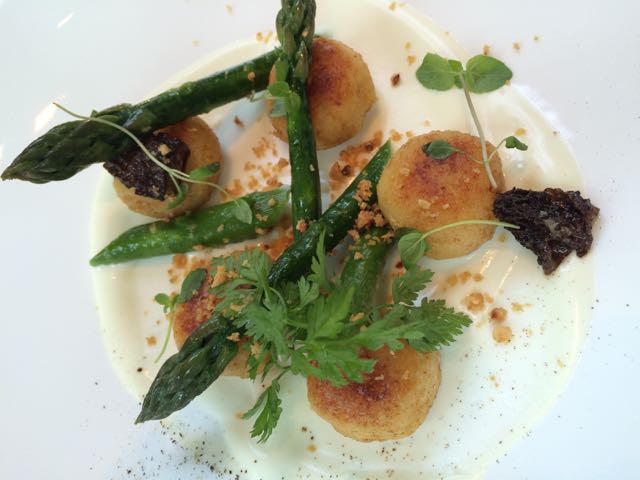
Having just had a rotten weigh-in at Weight Watchers, I attempted to go light on my choices.  I avoided the bread-crumbed ball of foie gras on pickled red onions in a pond of creamy sweet onion volute, though the look of satisfaction on my colleagues faces told me I would have loved it.  My more virtuous pressed rabbit terrine with confit and pickled heritage carrots was delicious, though I could have used a bit more savoury balance to the very sweet veg.  The presentation, however, was perfect.  Thanks to our ridiculously cold spring, I could still indulge in seasonal asparagus for the main; thin, grilled shoots served here with some light-as-air parmesan gnocchi and morels.  My only complaint? More morels, please.  But who wouldn't say that?  Virtue, however, collapsed in the face of dark chocolate and salted caramel.  This combo has been overdone of late and can easily fail if you don't get the ingredients in balance.  Here, the dark chocolate was both bitter and sweet, the caramel layered more sweetness with just a hint of salt, biscuit bits gave texture.  A masterful marriage, and a small enough portion that I like to think I didn't do too much damage.

The dining experience closest to The Vineyard?  Le Manoir au Quat'Saisons.  (My review here.) The same elegance, the same quality of food.  Similarly assured staff, assuming that you share their passion for food and wine and guiding you through the experience with insight.  Both attached to luxurious Relais & Chateaux hotels (though The Vineyard has a far more modern vibe and a big spa).  Both surrounded by lovely gardens allowing for pre- and post-prandial al-fresco drinking (though the Manoir's gardens are far more extensive).  The Vineyard has earned plenty of accolades, but at this point it has still failed to re-gain any Michelin stars.  Which, especially given the similarity to the Manoir, I find deeply puzzling.

The advantage to that lack, however, may be price.  The luncheon menu is £29 for three dishes, £39 for four. Dinner is £65 for four, £75 for five, and the pull-out-all-the-stops eight-course tasting menu is £99.  All significantly less than the Oxfordshire venue. Gardens aside, I confess I'm far more intrigued by the possibility of a return to The Vineyard.  With wine flight, of course.

Friday, 15 May 2015

Like many of its wines, Bordeaux would have been better with a bit more time

Bordeaux has been a savvy commercial centre since Roman times.  It's a river town with an
enormous port on a wide, slow bend in the Garonne.  This Mississippi-like river snakes through Southern France, providing a watery highway linking Toulouse, Bordeaux and the Atlantic.  The Bordelais have exploited their geography by becoming pragmatic brokers and traders.  Their most famous export, of course, being wine.

This commercial heritage is reflected in an efficient tourism office, one of the best I've ever experienced for offering agendas and sorting details.  We gave them a simple mission: "We're here for a day and a half, we'd like to get an introduction to the region, but we're most interested in tasting and buying wine."  I suspect that penultimate word triggered an increased level of attention.

Of course, our first visit to Bordeaux undoubtably deserved more than 12 hours of sightseeing, and the logic of the map said we should have stopped here ... the 2/3rds point between the Normandy Coast and Gascony ... en route.  Instead, logistics forced us to squeeze it in to the two nights between the end of cooking school and the beginning of our week-long cottage rental.

The tourism office has a dedicated wine desk, unsurprisingly in what's arguably the world's largest production area for fine wines.  We quickly ended up here, where the desk manager sorted a tasting for us that afternoon, and an all-day tour the next day that would cover the city highlights before heading out to the august wine region of St. Emilion.

There are a bewildering number of places to taste wine in Bordeaux, of course, but most are introductions to the region that give a similar overview.  Compare and contrast the left and right banks, end with a Sauternes.  We'd done an excellent starter course with Berry Brothers in November (covered here), so wanted something more specific.  We were looking for interesting wines from smaller producers that didn't export much; reasonably-priced jewels we could lay down and reveal with a story at a dinner party in a few years' time.  The tourist board sent us to The Wine Corner, a small shop in a street running north from the cathedral which, we were assured, did highly personalised tastings and specialised in smaller vineyards.

Appearances deceive
Our first few minutes weren't promising.  The shop wasn't much bigger than a galley kitchen, we had to wait for other customers to clear out even though we'd made an appointment and the girl serving us was no local, but a Russian.  But all was not what it seemed.  Experts from all over the world come to this oenological Mecca to hone their skills.  She knew her stuff.  The shop front was the tip of an iceberg; when you wind down some circular stone stairs you find yourself in a warren of 18th century cellars with a cozy tasting alcove furnished with two plushly upholstered bar stools.  Our Russian spent time upstairs diagnosing our tastes and talking through possibilities.  After identifying the four we wanted to try, it was downstairs to the cellar, where she put the wines in a sensible order and walked us through the tasting notes and cellaring potential of each.

We'd opted for an organised tour the next day based on two warnings you always hear about Bordeaux.  First:  It's a huge area, and if you don't know where you're going you can spend hours driving aimlessly amongst the vines.  Second:  Few vineyards are open to walk up trade; you have to arrange tastings in advance.  There was a third tip we heard repeatedly:  Go to St. Emilion.  And so we were off, on a 25-seater mini-coach, for a short city tour followed by lunch at a St. Emilion vineyard, a drive around the AOC and a wander in the eponymous town.

The city tour was an excellent idea.  Bordeaux is not your typical provincial wine town like Beaune, Greve-in-Chianti or Napa.  It's France's 6th-largest city, with history, additional industry and government (it's the regional capital) to add to the wine.  The city centre is walkable, in theory, but the bus covered everything faster, with commentary.  The mostly 18th-century riverfront is gorgeous; the Place de la Borse and its fellows as palatial as Versailles, but built to celebrate commerce rather than monarchy.  The Alee de Tourny is a gracious rectangular space of the same period that called Piazza Navona to mind.  In fact, there's block after block of magnificent 18th century architecture that makes it clear this place was dripping with money while Paris' poor were storming the Bastille.  It's no wonder that the Girondin movement, a counter to the lead revolutionary party, was based here.  They lost, but they're commemorated in a stunning memorial column.

Other eras pop in to mix things up.  There are two city gates Eleanor of Aquitane would recognise, and though the cathedral where she contracted her marriage to Louis of France has seen several makeovers since her time, it's still resolutely gothic.  As are a whole string of impressive churches across town.  The Romans exert their presence with the ghostly remains of an amphitheater.  There's even a modern district similar to Paris' La Defense, and a Richard Rodgers-designed courthouse with funky inverted towers that mimic the Medieval tower next door.  Getting a feel for the place in a morning, or even a day, was a bit laughable.  Turns out Bordeaux has 362 official monuments historiques ... only Paris has more.  But the bus made a valiant attempt and left us with the understanding that there's plenty to see here before you even start to think about wine.

Then it was off to St. Emilion, the 30 minutes of highway driving before we saw a vineyard validating the warning about how big this place is.  The next surprise:  it's quite flat.  Every wine district I've toured relies on steep slopes, and I've accepted the general rule of thumb that the good stuff comes from high up, while the vines in the valleys yield the cheap table wine.  That's definitely not the case here, where some of the world's most expensive wines are grown in flat fields or gently rolling hills.

Our winery tour took place at Chateau Grand Corbin-Despagne, a grand cru in the northern part of the district close to the border with the equally-famous Pomerol.  The tour was standard:  start in the vineyard to discuss growth and harvest, into the room with the fermenting tanks to go over the making, finish with the barrels to talk about ageing.  The regional difference seems to be an obsessive degree of quality control.  From regular pruning of each vine to control exactly how much sun each bunch of grapes gets, to sorting the fruit grape by grape, to minutely varying the temperature of the fermenting vats as needed to moving the wines through different barrels, this is a high-intensity wine making process.  You can certainly understand why something so labour-intensive demands such a high price.  Although a sceptical voice inside of me was thinking, surely you can produce equally nice wines in other regions without all the faffing about?

The class of '85

Perhaps, but doubtless not with this sophistication and ability to age.  Over a buffet lunch we tasted four different wines, going all the way back to their 1985.  That one was a tour-de-force of complexity, giving entirely different experiences from first taste to finish and showing off why good, old wines are so treasured.  And so expensive!  These days they produce both a showcase wine and a secondary and we actually preferred the junior partner, bringing a case home to age.  It's classic Bordeaux, with light tannins, red fruits, earth and even a hint of liquorice that should mellow and deepen with laying down.

Our postprandial drive wound us through St. Emilion's extensive vineyards, dotted with historic chateaux, humble farmhouses and the mid-sized producers between them.  There's plenty of gorgeous architecture to marvel at, the landscape has enough variety to be constantly interesting, and the tour guide was a treasure trove of historical titbits about what happened, where.  One thing was certain: the whole region is doing very, very well.  Our Russian wine tasting hostess and the Chinese ads we saw for wine tours made it clear that the international super-rich are pouring in here, buying expensive labels to prove sophistication.

The top-end wineries are responding to the trend, building lavish additions, investing in their operations and producing ever more complex wines to justify the escalating prices.  Our guide, however, told us a salutary tale.  The super-rich she's been exposed to aren't interested in the nuances of taste, or the complexities of food matching.  They're ticking an acquisition box that validates their wealth.  She's had people say to her, "I've already bought and drank a €300 bottle.  Why should I buy another?  They all taste the same."  I fear that by escalating prices to take advantage of a current trend, the wine makers of Bordeaux may have a problem when the high rollers drift to the next "must have".

Our final stop was the town of St. Emilion itself, which ended the day on a sour note.  I suspect this is one of these places like Taormina or San Gimignano that transforms back into a picturesque stage set at night, after the group tours leave.  But in the middle of the day, with every street body-to-body with tourists, it's horrible.  The Medieval ruins, stately towers and giddily-angled streets fade beneath the braying hordes.  Few seem to have any interest in what's around them.  They're eating ice cream, browsing through tacky, wine-themed gift shops or stopping to block traffic as they debate where to go next.  In a square at the heart of town, a busker "entertains" in a voice so irritating we thought he must be asking for money to stop. We found the whole place charmless and irritating, and were happy to have so little time there.

Fortunately, there was one redeeming feature.  The monolithic church is worth pushing past the crowds to see.  A local nobleman returned from the first crusade so impressed by the church of the Holy Sepulchre that he decided to create his own version in St. Emilion, hewing a Romanesque church out of the living rock to house the bones of the monk who gave name to the place.  It's an other-worldly, subterranean wonder, unlike anything I've ever seen.  It's more like a Game of Thrones set than a recognisable piece of European history, even with the modern incursion of the metal struts necessary on some of the columns to keep the whole thing from collapsing.  And, best of all, access is limited and only by ticketed, guided tour.  Meaning it's the only place in St. Emilion where you can find space to breathe, while being with people who appreciate their surroundings.

We packed an enormous amount into a day and a half, found plenty to enjoy and bought several cases of treasure for the wine fridges.  But, bottom line, we like Burgundy more.  From the sightseeing to the vineyards to the style of wine, the other famous wine region touches our heart a bit more.  Bordeaux, doubtlessly, deserves more time to prove us wrong.  But we had to go.  A cottage back in the sleepy Gascon countryside was calling.