Saturday, 15 August 2020

Alnwick, Harlow Carr celebrate garden innovation in England’s Northeast

England’s most famous gardens tend to be long-established. Sissinghurst, Hidcote and the famous planting schemes of Gertrude Jekyll have roots in the Edwardian era. Visitors flock to see landscapes designed and planted by the Georgians. At places with layered histories like Hampton Court, you can see gardens stretching back to the Tudors ... though the plants have been refreshed in modern times. English garden tourists are likely to tell you, with grave sincerity, that a really great garden needs many decades to sink its roots into the must visit list.

It’s quite a surprise, therefore, that the two most noteworthy gardens in England’s Northeast are newcomers. The Alnwick Garden (above) only opened its first phase in 2001, with its core complete less than 15 years ago. The RHS gardens at Harlow Carr are similarly young; though there had been gardens here for years, the RHS only took over the site and started its redevelopment in 2001. Both places, therefore, benefit from the kinds of conveniences many older gardens don’t have: ample parking and dining facilities, digital guides, modern shops and learning centres and adventurous approaches to design.

Given that the Royal Horticultural Society is best known for its flower shows at Chelsea and Hampton Court, where designers magically create pop-up show gardens that look like they’ve been in place for decades, I suppose it’s no surprise that Harlow Carr, just west of Harrogate, appears far more established than its years. The site is a long, gentle, rectangular valley, once the spa gardens for a now defunct hotel and later trial gardens for the Northern Horticultural Society. The topography means you can stroll along the brow of the hill where the entrance is located, looking down into most of the gardens and taking in long vistas without much exertion. This is unlike the main RHS garden at Wisley where, though there are grand spaces, they tend to be separated into more distinct sections by hedges or architecture. Harlow Carr serves up most of its delights in one extraordinary panorama. 

Those who know Wisley will find the main elements of its Northern sister familiar. There are deep, long perennial borders, alpine houses, rock gardens, demonstration fruit and vegetable sections, shade beds and an arboretum. I didn’t have time to explore it all, but I loved what I saw.

I have a theory that Northern gardeners like a brighter colour palette than Southerners ... perhaps building on a legacy of vivid Victorian annual beds in public parks that didn’t go out of fashion here as they did down South. Harlow Carr certainly supports my theory, particularly in its “sun border” planted meadow-style with poppies, cornflowers and other semi-wild favourites in a density that recalls the “mille fleurs” style of Medieval tapestries.
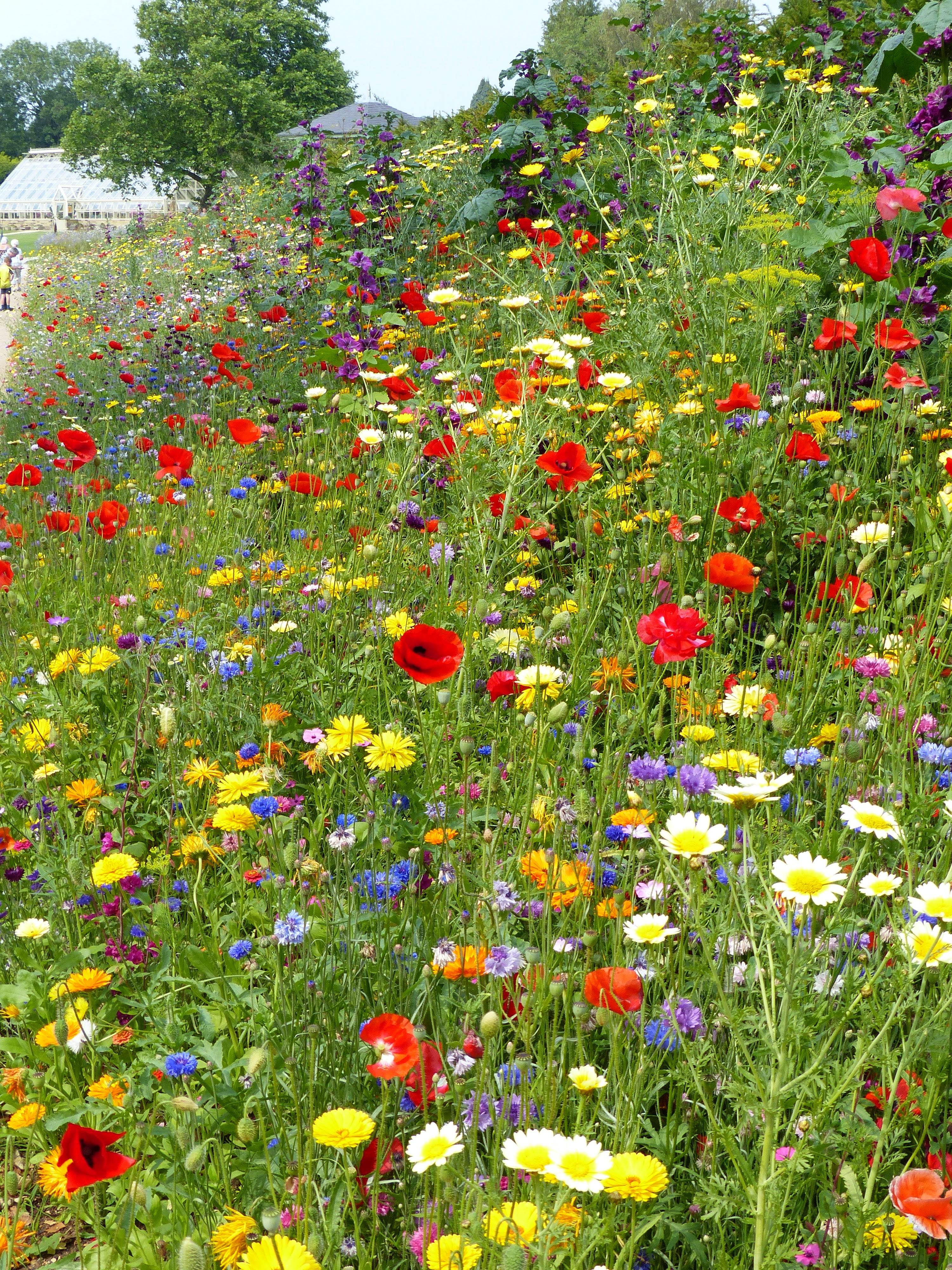
Elsewhere, abundant dahlias in bright purples, reds, yellows and oranges .... and shocking combinations thereof ... were often planted side-by-side with equally bold canna lilies, reinforcing a love of colour. Things are a little calmer along the stream that runs through the valley bottom, where my favourite section mixed hostas with a variety of Japanese maples. Though the palette was more muted, there was still a vast variety of leaf colour.

Like Wisley, this is a vast, diverse garden that would reward multiple visits. And like all RHS gardens this is a place for learning, full of interesting plants to inspire horticultural experimentation. Unlike Wisley, it’s also the home to branches of Harrogate’s famous Betty’s Tea Rooms, so you can break your wandering with a hot drink and one of Betty’s famous “fat rascals” purchased from a hut in a woodland dell at the far end of the valley. There’s also a full tea room and a take-away bakery counter outside the paid entry point, the former with views over some of the gardens, so there’s a shortcut for killing two Harrogate tourism birds with one stone.

The Alnwick Garden has less horticultural variety and less interest in its planting schemes, but is far showier in its hard landscaping. This is, fundamentally, a water garden, with an enormous cascade at its heart. Jets put on a Vegas-style “dancing waters” show roughly every half hour, with wide lawns at the bottom intended for families to lounge, picnic and watch the show. Children are encouraged to splash and paddle, whether in the corridor through the middle of the cascade where you’re never sure when plumes and jets will come on to drench you, or in gentler streams and fountains to the side and top of the cascade. Locals clearly know this and treat the garden like a water park, with cautious parents kitting their kids out in wellies and waterproofs while others let their progeny strip down to a bathing costume and get drenched.

I couldn’t help thinking with wry amusement of the Princess Diana memorial in Hyde Park, which was designed for children to play in its streams but changed its rules soon after opening due to Health and Safety fears. The Northerers are clearly made of sterner stuff.

This all provides for much spectacle and amusement, but it inevitably means that this isn’t a particularly calming garden. Even at the very top, in a walled garden divided into grids of different colours and plant types, where serious gardeners will find the greatest horticultural interest, you’ll also find children stomping down cobbled rills of flowing water and reacting with gleeful delight to the central water feature that bubbles intermittently, like a pond in a geyser field. 

Water features sprinkled around the garden all have different points of interest, from one that seems to drain like a sink from its centre to another that’s reminiscent of a giant water clock and sends jets up and out when its reservoir fills. Many of these are in, or led to by, towering walls of hedges that give much of the garden the feel of a giant maze.

Two areas offer a respite from aquatic merriment. There’s a large and diverse rose garden, dominated by David Austin varieties, planted in a spiralling pattern in a walled corner of the garden behind more screening hedges. It’s not at its best in August, though I enjoyed the secondary bloom on some varieties, highlighted by clematis planted throughout to add late summer colour. In late May and early June, however, it must be spectacular. 

The other “quiet” area is the poison garden, for which Alnwick is probably most famous.

Though the link isn’t made overtly, most people will associate the poison garden with the Harry Potter franchise and its potions classes, given that the neighbouring Alnwick Castle stood in for Hogwarts in the first two films. The concept stands on its own, however, and is a fascinating exploration of plants that can do harm. Many are obvious: there’s hemlock, henbane, monkshood, deadly nightshade and others that fans of Poirot, Miss Marple or Brother Cadfael will recognise as devious paths to murder. There’s also a wide variety of plants common to many gardens, and only dangerous if treated in certain ways or exposed to specific types of people (like pregnant women). These include rosemary, hellebores, foxgloves, lily of the valley and daffodils. Perhaps most interesting are the plants that can be used for medicinal purposes but are often abused to the detriment of our health, or lethal overdose. The coca plant, khat, hemp, marijuana, tobacco and the opium poppy all grow here, and are the focus of a local programme encouraging teenagers not to do drugs.

Access to the poison garden is limited, you’re not allowed to touch or smell anything and it’s small enough for the guides working there to keep an eye on everyone. The only negative? It’s not actually a very attractive garden. Many of these plants look like struggling weeds; or at least they did in August. The garden scores high on intellectual interest but low on visual appeal. 

Alnwick and Harlow Carr were created for two very different purposes, and they serve them beautifully. As the RHS anchor in the North, Harlow Carr carries on its organisation’s wider mission of education while giving members an HQ for horticultural events in the region. The current duchess of Northumberland created Alnwick (despite sceptical criticism) as a major tourist attraction that would draw visitors North and as a community garden with a variety of outreach programmes for locals. In both cases, it’s great to see England’s grand old tradition of gardening being used to bring new, fresh and exciting life to the areas these gardens beautify.

Friday, 14 August 2020

Religious sites tap into the ancient heart of England's North

The North of England feels older than the South.


It’s not, of course. Most of England can tell tales of the Stone Age, Romans, the Dark Ages or Roman Catholic glories. But the crowded, prosperous South has re-invented itself so many times ... and shifted so often to align with London trends ... that these ancient roots are harder to see. From Yorkshire on up, whether through lack of funds, a deeper appreciation of tradition or a pugnacious desire to go your own way, Northerners display a deeper, older history.

Roman Hadrian’s wall snakes through the countryside between Newcastle and Carlisle. Ruined abbeys and castles dot countryside and coast. The sinuous, writhing patterns of Anglo-Saxon, Celtic and Viking art are still prominent; Bamburgh Castle shows off a re-creation of the throne of the Northumbrian Kings. It's a thing of alien beauty closer to the Vikings or Tolkien than anything you’d immediately identify as “English”. 

The most obvious place to see this difference is in the Northeast’s great cathedrals, where muscular Romanesque architecture, Celtic patterns and local saints held out longer and harder against outside trends, whether they were pushing up from London or Rome.

Durham Cathedral is the greatest example, and without doubt the grandest Romanesque building still standing in England. The enormous, muscular, patterned columns in its nave (above) and low, round arches on its lower levels speak to a distant, misty past more suited to King Arthur than Tudors or Georgians. The banner of the sainted King Oswald that hangs in the chapel where his head is interred looks more like the Norse god Odin than a traditional Catholic icon, complete with spooky ravens.

When I first saw this cathedral more than 30 years ago, I found it dark, mysterious and impossibly ancient. Since then, they’ve illuminated the upper stories of the building’s interiors to show off the architectural details. That has transformed the nave and called attention to the later gothic additions. It helps you appreciate more of the building, though it is a lot less atmospheric. I’ve also travelled Europe a lot more in those intervening years, so realise that though this Romanesque style is relatively unique to England, when compared to Italian churches it has a familiar feel.

Thus something different inspired me on this second, more mature visit. The virtuoso chapel of nine altars is a high Gothic addition that practically bolts a separate church onto the rear of the original, starting a level below and soaring above the back of the choir of the main church. The chapel of Oswald and the more famous Saint Cuthbert jut out into it, almost seeming to float in the massive, light-filled space. Though its pointed windows, tracery and vaulting have familiar parallels in the South, I’ve never seen a juxtaposition quite like this and the nine altars are dedicated to Northern saints, many of whom, like Oswald, aren’t recognised by the Roman church. So even in its grand, newer parts, Durham retains a mysterious sense of the other. 


Ripon Cathedral is even more ancient than Durham, the current building’s foundations dating from the late 600s. Ancient Romanesque architecture features here, as well, and the original crypt is supposed to be magnificent, but it was still closed for pandemic safety due to its small, cramped proportions. This cathedral is most famous for its early gothic facade, comprised almost entirely of lancet windows and judged one of the best church exteriors in England by the architectural critic Nikolaus Pevsner. I’d recommend heading straight for the choir, however, where Ripon has managed to preserve one of the best collections of late medieval wood carving in the country, despite suffering the usual damage from reformers and civil wars through the years. 

Carved during the time of Henry VII, the monks’ places were crowned by graceful, pinnacle-studded canopies. The ends of rows are marked by fanciful finials, one a monkey said to poke fun at a pompous church official, another a magnificent elephant with 11 apostles in a castle on its back while Judas is being strangled in its trunk.

The most precious carvings are hidden below, where ledges called misericords jut from the bottom of monks’ upturned benches to help them stand for long hours. Because of their little-seen nature, carvers were allowed to stretch their creativity on misericords, which often feature scenes of everyday life, jokes, or wild imaginings from myth and legend. One here features a rabbit and mouse being chased down a hole by a griffin, and is said to have inspired a young Lewis Carroll ... whose father was a clergyman here ... to later create the fantastic inhabitants of Wonderland.


Ripon is full of similar touches of quirky individuality. Jutting from the organ above the west side of the choir is a wooden hand, which the music director could use to direct singers even though he had to face away from them to play the organ. I’ve never seen another, and the guide insisted it’s unique in the country. 

There’s a wonky arch where the architect got his measurements wrong. The Medieval stonecutters fixed it by inserting three bridging columns, then capped each with a laughing head to make fun of the mistake. A more poignant form of individuality stands above the high altar, where a Christ carved at the end of WWI is clean shaven, fresh-faced and short-haired, honouring the men who died in the trenches.

At the moment, Ripon’s greatest glory is its newest. A modern art installation called “On a wing and a prayer” invites worshippers to write prayers related to the current health crisis, and thanks for critical workers,  on pieces of paper to be folded into bird shapes. Those have then been strung above the nave, a growing flock of white doves of peace hovering between us and heaven. It’s beautiful and tremendously moving.

Even if you stay away from the active cathedrals, religion looms large in the Northeast. Ruins of communities shut down in Henry VIII’s dissolution of the monasteries are strewn across the landscape. Many, like Byland, are just a few picturesque walls left standing in remote villages, deep down country lanes and accessible to any who want to stop.

Others are major tourist attractions, most famously Fountains Abbey. Not far from Ripon and Harrogate, what was a massive Cistercian foundation is now a monumental set of ruins set in emerald lawns at the bottom of a deep, wooded valley beside an idyllic river. In summer, it is a place of spectacular peace and beauty, though it must have been hard going in the winter. Especially for monks who were only allowed a brief stint in the warming house after hard labour outdoors. Otherwise, that marvellous but cold stone architecture must have made hard going.

Today you can appreciate not just the substantial ruins of the Abbey church but enough of the outbuildings to give you a proper sense of the sprawling complexes the monks built to create a self-sufficient community. One of the most complete structures at Fountains is the enormous, vaulted cellars, which are beautiful in their own right and tell a story about just how rich these establishments became. (And why they attracted the government’s greedy eye.) 

In the 18th century, a local aristocrat made Fountains’ ruins the focal point of some exceptional water gardens. Visitors can explore those as well as the Abbey, wondering for miles along geometric pools of water, classical follies and woodland paths designed to open up at just the right point to offer artistically arranged views. This vast, outdoor area is perfect for sightseeing in the time of COVID-19, but even here numbers were limited and advance booking required. Most notable was the lack of diversity in accents. The families walking the paths or spread out on the lawns with picnics were overwhelmingly local. There were no bus tours, no large groups, and one assumes the handful of foreign accents I overheard were ... like mine ... current British residents who were born elsewhere. This lack of jostling, aggressive sightseers was one of the great joys of this holiday. And also made for some spectacular, people-free photos.

Though most of the Northern religious sites are either ruins or more tourist attraction than working religious space, we dropped by one notable difference. Ampleforth Abbey and College is one of the best-respected Catholic schools in England, and of particular interest to me as it is the “mother house” of the Saint Louis Priority, at which my mother taught and which my school considered our “brother” institution when we needed a co-educational experience. (Most notably, dates for school dances.)

English Benedictines maintained their traditions in exile for almost 300 years, returning to Yorkshire in 1802 to establish this beachhead for the renewed tradition. The majestic complex of buildings climbing a hill, with stretches of uninterrupted countryside as far as the eye can see, gives the visitor an idea of what the ruined abbeys might have been like had they survived. 

Under normal circumstances, Ampleforth is bustling with more than 600 students, plus teachers and the monks in the Benedictine community. There’s a visitor centre, access to the Abbey Church, a cafe and a shop selling the cider, apple brandy, beer and honey made by the monks. Sadly, this was all closed due to the pandemic, so we had a little wander around the exteriors, struck up a conversation with a septuagenarian monk who’d been there since he was a lad at school and let him show us around his garden. 

He, like so much of this part of the country, seemed imbued with something older and more mystic than life in the South. The profound sense of beauty and calm I found in the North’s religious sites would follow me throughout our trip.

Wednesday, 12 August 2020

Harrogate defies Southern prejudices about “The North”


From its grand architecture to its sweeping parks with opulent flowerbeds, its grand hotels to its lanes of upscale shopping, Harrogate proclaims elegant affluence. That’s a salutary message for Southerners whose ideas of England above the Watford Gap are shaped by headlines about joblessness, low property values and other extreme disparities between struggling North and rich South. There’s much more in these higher elevations than bad news stories and stereotypes.

Like the more internationally-known Bath, Harrogate owes its initial prosperity to the upper classes’ love of “taking the waters” for their health. Though its iron- and sulphur-rich waters were known from the 16th century, the town really took off in the 19th, when late-summer shooting retreats to Scotland became part of high society’s social season. Harrogate was a half-way point on the journey from London, providing a soothing respite from the fashionable whirl. While Bath is a ready-made backdrop for Jane Austen film adaptations, its Northern sister could be the set of Victoria.

Like England’s other spa towns, the economy here has moved beyond the waters, though Harrogate’s Turkish Baths (sadly closed at the moment due to COVID-19) do continue the spa tradition. Unlike other spa towns, however, Harrogate refused to accept genteel decline and focused on the conference industry instead. Its exhibition centre is one of the largest in Europe, bringing more than 350,000 visitors and £150 million in revenue annually (pre-pandemic). All of which means that Harrogate will take a disproportionate hit from the 2020 pandemic, though our experience was of a cheerful, resilient city getting back up to full speed as fast as possible. It will be a long time until anything normal can return, however, given the conference centre is currently kitted out as one of the country’s pop-up Nightingale Hospitals.  

It’s a great town for simply loafing about. Green spaces not only ring, but cut right through, the historic centre. Valley Gardens is the most notable; an idyllic spot for strolling planted into a steep valley that widens out into broader fields. It’s dotted with Victorian bandstands, benches, pergolas and tea houses. Flower beds celebrate both the Northern love of vivid annuals and more blowsy, pastel drifts of herbaceous perennials. 

Montpelier Gardens, spilling down a hill of the same name, features more cheerful annual bed designs and scores of people on deck chairs or simply sprawled on the lawns. The weather was glorious and Spirit of Harrogate, the Slingsby Gin shop, was distilling cocktails from their storefront beside the park.

Montpelier Parade, with Betty’s famous tea house at the corner, marks the edge of the Montpelier District, an architecturally charming few blocks full of independent boutiques and restaurants. (Harrogate has the national chains, too, but they tend to be up and across the brow of the town centre’s hill, with the more upscale brands on James Street.)

Affluence and a thriving conference business fuels a cosmopolitan food scene. Visitors are almost required to try one of Betty’s “fat rascals”, somewhere between a scone and a rock cake, studded with currants and candied fruit. If the queues are too long, it’s worth noting that Betty’s has a presence at the RHS Harlow Carr gardens as a full restaurant, a take-away bakery counter (both outside the garden walls and accessible to all) and a stall within the garden itself. The last is probably the easiest way to try this Harrogate icon without a long wait. 

Farrah’s Sweet Shop at the bottom of the Montpelier Quarter is equally famous, in this case for toffees sold in a distinctive blue and silver tin. The shop, lined with glass jars of different sweets and colourful tins of premium teas, looks like it hasn’t changed since Victoria’s Diamond Jubilee. 

On the restaurant scene, I’d enthusiastically recommend Domo, a small and very authentic Japanese place in the heart of the Montpelier district. (Booking essential) We had beautiful sushi cut and prepared by a proper master behind a counter, grilled Tokyo-style eel on rice, light-as-air tempura, and takoyaki (fried octopus balls) as good as we had in Osaka, the city famed for them. In fact, I can honestly say that this is the best Japanese food I’ve ever had in the UK. (With apologies to our local and much loved Kyoto Kitchen in Winchester, to which renown food critic A.A. Gill awarded that accolade.)

Lucia’s Wine Bar and Grill is also worth seeking out, on Ripon Road as it climbs up a hill, out of the centre of town, past the conference centre. Harrogate isn’t all Victorian, evidenced by this purpose-built modern restaurant that can open much of its glass front to the fresh air. (Handy in a pandemic.) The chef has a solid grasp of Italian basics ... excellent mushroom arancini and a succulent spaghetti with prawns and fennel sausage in a fresh tomato sauce ... but there are also local adaptations. Smoked haddock puttanesca was a bit too innovative to tempt me, but I was glad to see creativity on the menu. 

Sadly, I can not recommend our hotel. In fact, I’d warn anyone to avoid the Doubletree by Hilton Majestic Hotel at all costs. This is counter-intuitive, as The Majestic is one of the grandest remnants of Harrogate’s Edwardian splendour and dominates the town with its striking, pale-green dome. You’d expect that something so historically significant and well located would live up to its legacy, but the service is woeful and housekeeping haphazard. (The latter a bit worrying in a pandemic situation.) The interiors are magnificent, but most of the grand spaces are set aside for conference or wedding use. Our room enjoyed enormous Edwardian proportions with French doors leading out onto a balcony, but the doors were sealed shut and the room lacked enough furniture or decorative touches to give it any character. If you have the misfortune to stay in those second-floor rooms during a heat wave, you’ll be cursed with warmth of another type, as the sealed doors mean the only air coming into the room is from a small transom above each. 

The much-advertised spa is a small indoor pool with a steam room, sauna and whirlpool off the pool deck. All would be crowded with any more than four people using them, and everything but the pool is currently closed due to COVID-19. The £10 “deal” to get in that’s advertised in hotel promotions as a benefit feels like a rip-off once you’ve paid it. You might attempt to assuage your frustration by taking advantage of their two-for-one cocktails in the very attractive bar, frescoed with scenes of Georgian lords and ladies frolicking in the spa towns of England. But don’t be in a hurry, as the hapless bar staff may take half an hour or more to serve you. We had some decent food in the restaurant, but it tends to come out of the kitchen in erratic bursts, and with a casual disregard to allergies or what you ordered. 

Despite the travails of our accommodation, we loved Harrogate. The area is so rich in tourism possibilities that our five days flew. We opted to explore the grand seat of the Lascelles family at Harewood House, the RHS’ newest garden at Harlow Carr, the atmospheric ruins and gardens at Fountains Abbey and the delightful cathedral at Ripon. You can also do highly picturesque driving tours of the Yorkshire Dales and North York Moors national parks. We were blessed with good weather and magnificent views for the first, but fog and mist were so heavy for the second that my entire impression of the moors is a strip of road with a narrow margin of heather and sheep.

For more on these glorious sights, read on...


Sunday, 26 July 2020

Newbury’s Vineyard fights back with opulent tented restaurant, food and wine to match

Forty four years ago, in a blind wine tasting that would become known as “the judgment of Paris”, French judges selected Napa Valley winners for both their red and white contests. The unexpected result rocked the wine world, proved a catalyst for moving California’s top wines into the quality category they occupy today, and provided the plot for an excellent film called Bottle Shock. It also inspired a marvellous restaurant near Newbury, England, called The Vineyard.
Opened in 1998 by Sir Peter Michael, a British businessman who’d established a working vineyard in Northern California the decade before, his English Vineyard is a five-star hotel with luxuriously sophisticated rooms in a modern building that has a faint whiff of French Château about it. All the rooms are named after California wineries, and the place is tastefully decorated with the Michael family art collection and a fabulous array of wine bottles and paraphernalia. There’s a spa, and a small conference facility, but the beating heart of the place is its extraordinary wine cellar and the restaurant that accompanies it. You can’t miss it; 20 steps across the lobby from the front door and you’re in a glass-framed hallway-cum-wine-cellar with bottles on either side and below your feet. Beyond is a life-sized mural of the judgment of Paris, with Sir Peter ... who was not at the real event ... painted in, benignly looking on like one of those art patrons included in medieval nativity scenes. 

As a restaurant, The Vineyard reached its apogee in the early 2010s under head chef Daniel Galmiche, who won them a Michelin star and Decanter’s Restaurant of the Year award while gaining publicity as a frequent guest chef on the BBC’s Saturday Kitchen. Galmiche and the star have gone, though the restaurant still holds a Michelin plate (one step below) and remains noted for a wide-ranging wine list with an unusual number of wines-by-the-glass and what I’d guess is England’s best range of Californian wines. This includes bottles from Sir Peter’s eponymous label and Schramsberg and Honig, vineyards we visited (and I wrote about) on our Napa tour. I’ve had the good fortune to at The Vineyard three times for work events, but my wine-loving husband had never gotten to join in the fun. It seemed a perfect venue to celebrate his birthday. 
We are only three weeks past the government allowing hotels and restaurants to open in England, and the rules for indoor spaces both dampen the atmosphere of restaurants and make profit margins a challenge. Outdoor dining is the only way to approach the conviviality and turnover of pre-pandemic days, but that’s always a gamble in the English summer. The Vineyard has risen to the challenge by filling their garden with a magnificent tent, its spiked dome, sinuous roof line, lanterns and painted canvas wall panels like something out of an upscale, fine-dining version of The Arabian Nights. It would have been a treat whatever the circumstances and, to be honest, is much more fun that their tastefully understated but unremarkable regular dining room. The only drawback was a slightly wobbly plank floor that sent a tremor through our table whenever anyone passed, but given the circumstances driving the alfresco pop-up, it’s a small irritation easily forgiven. 

We had started indoors, sinking into the deep upholstery of the country-house-style lounge to peruse the wine list before settling on a bottle of sparkling golden Schramsberg to take us from there right through our starters. Once inside the fairy tale pasha’s palace, made all the more surreal by all of the masked servers, I started with a beautifully presented and very tasty pork terrine while the half-Danish husband opted for cured salmon. “Someone in that kitchen understands the Nordics,” opined the arch critic. “ This has been home cured to a proper recipe.” So much of restaurant salmon would be hard to differentiate from packs you can buy at Waitrose. This was in a different league, with the curing reducing the original fillet to perhaps half its starting thickness, concentrating the salmon flavours and imbuing it with aromatic herbs and spices.
We reverse-engineered the main courses around the next wine.

A 2011 Chateau Musar occupies a price point I normally wouldn’t consider sane, even for a special
occasion, but four months without restaurant dining has left a budget surplus that could handle the momentary insanity. Lebanon is one of the world’s oldest wine producing regions and Musar its most famous house. The result is pretty much what you’d hope for from 4,000 years of accumulated experience. Tannins melted away to an intense berry richness but with subtle hints of mushroom and earth that reveal its core of Cabernet Sauvignon. Mr. B was an English purist with a ribeye and triple-cooked chips, while I strayed closer to the Mediterranean with a beef shin ragout with freshly-made tagliatelle. With each mouthful-following sip, I thought “If I could only have one wine for the rest of my life, this would be it!” You need the right food, however, to bring the Musar to its full glory. We both had a few sips left after we finished our meal, at which point spices that had meshed seamlessly with the beef became so noticeable as to be almost overpowering. Validating our menu choices and the kitchen’s talent.

We split a custard tart with pink rhubarb sorbet. The former was pleasant but paled in comparison to the sorbet, served on a trail of golden crumble to deliver a hit of both sharp/sweet fruit and satisfying crunch.

One of the great joys of the “restaurant with rooms” concept is that you don’t have to kill your buzz, either literally or metaphorically, getting home. Push back your chair, enjoy a short, post-prandial walk and slip between some high thread-count sheets that someone else has had the chore of ironing. Bliss. The suites at The Vineyard have all those subtle, small touches that add up to the label (and the price tag) “luxury hotel”. The crisp bed linens and deep feather pillows. The classical music playing over a good sound system when you enter. Decor that’s streamlined and modern but not at all corporate. Tasteful lighting in multiple places to change mood and focus. (There was even a subtle nightlight glowing over the step between sleeping and sitting areas to prevent late-night mishaps.) A palatial marble and wood bathroom with a tub so big I could barely touch the end. Nice shower in a separate alcove, too, though people as tall as my husband will have to duck beneath the shower head.
I don’t think I’ve ever brought my dogs to a five-star hotel, but The Vineyard excelled there, too. Waiting in the room was a dog bed, food and water bowls, their own bottled water and pedal bin for used poo-bags and a fresh tennis ball. Needless to say, the canines enjoyed the outing as much as the humans.
The traditional British hotel breakfast buffet is another infringement of COVID-safety standards; many establishments seem to be switching to a policy of everyone taking breakfast in their rooms. At The Vineyard this means a wooden wine case left on a luggage rack outside your door. Flipping its brass latches revealed croissant, sourdough, jams, butter, milk and orange juice. A Nespresso machine in the room added DIY caffeine. If you order a cooked breakfast (a supplemental charge to your room rate) it arrives at a scheduled time and is well worth the extra cost. Mr. B’s breakfast featured “bacon” that was essentially a thick, cured slice of grilled pork belly that had his eyes glazing over with delight and scrambled eggs he reported as perfectly “baveuse“. (Too runny for me, but I know he ... and any other European serious about food ... considers American scrambled eggs horrifically overcooked.) I had gone for a different style of American: Californian Eggs were poached sitting atop pillow-like home-made English muffins slathered with crushed avocado and a spicy tomato salsa.
Our last pleasant surprise came with the bill. Which, of course, is delivered by email and charged to your pre-registered card upon agreement, to eliminate the need for human contact. Thanks to current government stimuli, there was no VAT (sales tax) on the room or food, only on the alcohol. When you’re pushing out into the luxury end of the market, this can be an enormous saving. So if you’ve been thinking about splashing out on a fine-dining-with-rooms experience, now many be the time to do it. While the pandemic makes the experience more unusual, the novelty can also be quite special, and up to 20% off the final bill adds to the delight.


Wednesday, 8 July 2020

Isle of Purbeck offers an ideal escape from lockdown

COVID-defensive tourism is almost enough to make me welcome the virus. Hotels and restaurants opened under strict guidelines on Saturday, and we were amongst the early adopters with a weekend excursion to Dorset. I might have put it off a bit longer had opening day not coincided with the 4th of July; I always feel a bit homesick around my home nation’s big day, and this year we should have been luxuriating in a Longborough Festival Opera weekend. With that cancelled, but hotels re-opening, I fancied a trip to the coast.

Despite news coverage of crowds ignoring social distancing guidelines, we found sparsely populated tourist attractions and rigorously enforced safety measures. All National Trust properties require booking ahead for a limited number of slots, which requires ruthless advanced organisation; tickets for the following 10 days come online around 12:30 am on Fridays and are generally sold out by 9am. But your efforts are rewarded by easy availability of parking, people-free vistas and spots for quiet contemplation. Pubs are operating more like restaurants. You’re met at the door, shown to one of a restricted numbers of tables in operation, encouraged not to move from there if you can help it and directed to order and pay online. Leave out the back door to keep things a one way system. It might lack charm, but the delight of sitting in a historic pub that’s quiet and not overcrowded, is a rare joy.

Later at the hotel, limited numbers meant the bar/lobby area never got above a gentle buzz, every “household” got its own cluster of sofas and armchairs and service (masked, naturally) was prompt. The dining room featured Perspex screens between every table, creating barriers without removing light. Staff everywhere was cheerful and attentive, delighted to be back in business and supporting a fraction of the people they’d normally serve. It was a tourist’s dream. But is undoubtably still a nightmare for the hospitality industry, as I can’t see any way that anyone we visited over the weekend could be breaking even with the reduced custom.

I’m enjoying the quiet, but hope it’s a short-term blip or many of these places won’t survive to welcome us when the virus runs its course. Meanwhile, if you’re looking for “staycation” options, I recommend the Isle of Purbeck heartily.

The anchor of this outing was The Pines Hotel in Swanage. We stayed for just one night, allowing us to enjoy the short road trip (about two hours from our house) without making a single long a day of it. The hotel is at the end of a lane to the East of the town centre, making it the last building before property gives way to a protected landscape. Thus it’s blessed with magnificent views, gives easy access to some striking walks and allows forays into town without sitting in the hustle and bustle of seaside holiday makers. Best of all it has a private staircase down the cliffs to the beach, roughly the equivalent of four stories below. Between Covid and the lack of easy public access, the stretch of sand here was almost completely empty. We couldn’t linger, but if I had it to do again we’d stay two nights, have lawn chairs in the car and sit on the beach for the day.

The Pine’s architecture will win no charm awards (I’m guessing an Edwardian core with an inter-war addition) but our first-floor room was large and had the advantage of sliding doors leading out onto the lawn edging the cliffs. The supreme convenience when travelling with dogs. We ate in the restaurant. It was fairly simple fare plated with some fine dining tricks to add a big city look. Almost the definition of provincial but, frankly, all the sophistication I needed. The homey touch of the staff and their tangible joy at being back at work warmed my heart.

Swanage lies at the end of the Isle of Purbeck, which is geographically a peninsula but may deserve its “isle” moniker for how separate it feels from the rest of the country. With its deep lanes, thatch-laden villages, expansive views and old-fashioned feel, Purbeck is strongly reminiscent of the Isle of Wight, which you can see just off its tip. (See May and June of last year for articles about holidaying on Wight.) While mostly agricultural, Purbeck has long been famed for the quality of its limestone, which has been shipped North to build many a Palladian country house and government building, but also contributes to a pleasing uniformity of pale grey stone architecture across the peninsula.

The historic heart of the area is Corfe Castle, a natural crossroads between deep hills that’s been fortified and inhabited since Roman times. Today it’s one of the most picturesque villages in England, with a massive ruined castle standing above a picture-book village built from matching stone. Much of it salvaged from the castle after its destruction in the 17th century Civil War. Dramatic events unfolded here, from the murder of the Saxon King Edward (who became “the Martyr”) to the spirited defence of the castle by Lady Mary Bankes, an English heroine who deserves wider renown. The property is now managed by the National Trust and there are useful signboards and listening stations throughout that tell the story.
In the village you’ll find a wealth of historic pubs and a good range of independent craft shops, though the latter weren’t open, presumably because crowds hadn’t yet returned. This place is usually a nose-to-tail traffic jam in the summer, but I was able to step into the street and get a shot of the castle without anything on the roads. I suspect that’s been almost impossible since the 1950s. The pubs, thankfully, had welcomed their “Independence Day” this July 4th and were all open for trade again. We had a delicious lunch at the Greyhound Inn, on the market square immediately below the castle entrance. Local crab salad, juicy, fully-loaded hamburgers and cold pints of locally-made beers and ciders. (Dorset Blush from the Purbeck Cider Company is a real treat.)

On our return journey the next day we wandered around Kingston Lacy, the area’s most impressive stately home and a logical extension to a Corfe Castle visit. Despite Lady Bankes’ defence, Corfe Castle eventually fell to Parliamentary troops and was “slighted” (purposely destroyed with massive explosions) to prevent it from being re-fortified. The family managed to hold on to most of their surrounding land, however, so when the king was restored they were able to celebrate by building this new, modern home. There aren’t that many Carolingian homes around (compared to the abundant Georgian selection) so its novelty is a treat for architecture buffs. Interiors still aren’t open but if they had been, we would have seen the original keys to Corfe Castle, plus a blockbuster art collection and a memorable room “papered” in embossed and gilt leather.
Instead, we wandered around the gardens, which balance French formality near the house with Arcadian landscapes spreading away from it. There is enough here to offer hours of happy rambling.

It’s been at least 15 years since I’ve wandered the Isle of Purbeck. It’s possible that, without a pandemic, it’s as crowded as other tourist hot spots. But I doubt it. The COVID crisis is reminding me that there are wonderful escapes very close to home. Get exploring!

Saturday, 4 July 2020

Hosta specialist softens loss of Hampton Court show

I should have been at the Hampton Court Flower Show this week. My venerable annual tradition always starts with a leisurely catch up over a champagne breakfast with my friends Alex and Philippa before we wander across the road to the world’s largest flower show, drink in the new trends and shop ‘til we drop. Then we rest, fortify with a restorative jug of Pimms, and keep shopping.

Not this year. Yet another annual milestone fell to the pandemic axe as 2020 moves towards being the year that never happened. We shared breakfast over a Zoom call, but it’s not quite the same.

Lockdown has been steadily loosening, however, and garden centres were some of the earliest businesses released from shackles. So this year I still took my flower show day off, but rather than visiting all the specialist vendors in one place I picked one of my favourite suppliers and went to them.

New Forest Hostas specialise in a plant that claims a soft spot in my heart. Also known as the plantain lily, these shade-loving, broad-leafed plants are native to northeast Asia, but the centre of modern hybridisation is the United States. They were common sights in the woodland gardens of the American Midwest, including my childhood home. One variety ... its name lost in time and its simple appearance dating from an age before showy hybrids ... has moved with my family through every house we’ve owned since my grandfather planted it in the early ‘50s. Taking divisions of the plants was the last thing I did before leaving my childhood home to its new owners. For 40 years there, my mother had fought an ongoing, usually unsuccessful, battle with the deer who would emerge from the trees behind our house to feast on the tender leaves. She was trying to mimic beneath her own oaks the winding, multi-variety beds that snaked through the Missouri botanical garden.

In England, my wars are with slugs and snails. Gardeners seeking an easy life often avoid hostas, given their popularity with multiple predators, but that would be a mistake. They grow in shady spots many other plants refuse. They come in a beguiling variety of leaf colours and patterns, in sizes from miniatures to single plants that demand several square meters.
Some hosta miniatures by my smaller pond
Though foliage is the main point of hostas, they do send up spikes of white, blue or purple blooms in late July and August. They’re great value for money, with the typical plant doubling in size every three to four years, allowing you to separate and plant out (or give away) the spares. While predators may leave the leaves holed or gnaw them to the ground, hostas are amongst the toughest of garden plants and difficult to kill. They flourish in the ground or in pots. A well-planned hosta bed can be a soothing study in green, from deepest blue-greens to pale yellowish shades, sparked with the occasional white. Every year breeders come up with new varieties to tempt gardeners like me.
My main hosta bed
My only criticism? They die back over the winter, leaving bare earth on view for several months. And, of course, the endless battles with the predators. My garden in England is walled, so I don’t have to worry about Bambi and friends. (Though to this day I still feel the victory of revenge whenever I eat venison.) Most people used to control slugs and snails with poisonous pellets, until we got smart to the fact that the frogs and birds who eat the pests were getting poisoned, too. Now gardeners debate their favourite organic defences, from rings of copper, stones or crushed egg shells around plants to garlic concentrate spray to beer traps to a regular dose of nematodes, a microscopic organism that likes to eat slug and snail eggs. Encouraging frogs, hedgehogs and birds into your garden helps. In my experience, growing hostas in pots produces the best results, but that hasn’t kept me from trying beds as well.
Hosta alley; my potted collection
New Forest Hostas is one of a handful of English hosta experts who show up at the big flower shows. Your average garden centre might have five or ten varieties, while these specialists will have more than 100, along with vast knowledge of what grows well where, disease resistance, legacy and speed-to-division. New Forest is a young contender compared to Suffolk’s Mickfield Hostas, who hold the national collection and have been in the specialist game for more than 20 years. But New Forest hails from my current home county of Hampshire and I’ve had a soft spot for them ever since I met one of the owners at a local plant fair and she talked me into what’s become my favourite hosta in my garden: Cathedral Window. (Top photo.)

New Forest Hostas impressive collection
They’re only open to the public on certain days and the shopping area is just one shaded poly tunnel with three aisles. But that’s more than enough for an addict. The first aisle is dedicated to their show plants ... champion specimens in pots ... and the other two a tidy supermarket-style array of plants for purchase arranged by name.  All in a Covid-safe one-way system with plenty of hand gel on offer, of course. I spent at least an hour pottering about in deep contentment. Without Alex and Philippa to restrain me (their usual role at Hampton Court when we get to the hosta stands) I had to police myself. I was there to try to identify two of my plants for which I’d lost the name and buy no more than three additions to my “hosta alley”. 

Mission almost accomplished. One of my missing IDs was “Geisha”, the other probably came from Mickfield and remains anonymous. I emerged with “Georgia Sweetheart”, an unusual yellow hue I don’t have anywhere in my collection, “Coloured Hulk”, a deep blue that’s likewise under-represented, and “Sting”, a white centre with multi-coloured green edges I couldn’t resist. I also learned that hosta like constrained roots, and I’ve probably been retarding their growth by putting them in pots that are too big for their current size. A flurry of re-planting followed my trip as I sunk pots within pots to create some squeeze.
Along the Lymington

New Forest Hostas is a little over an hour from my house and provided an excellent excuse to drive down to that eponymous area of ancient woodland. One excellent effect of the pandemic’s social limitations has been to remind me of what’s on my doorstep. Between the annual round of events and holidays that always start with a passport check, I’ve fallen out of the habit of sightseeing in my general area. The forest that was “new” in the 11th century when William II enclosed it as a hunting ground is now a charming hybrid of national park peppered with private properties, charming villages and hotels. It’s a popular place for picnics and walks. I didn’t pack my lunch but I did enjoy a spectacular walk in the woodland next to the Lymington River, a stretch so picturesque in its mossy, sun-dappled solitude you’d think Disney’s early animation artists had visited to sketch their backdrops for Snow White and Sleeping Beauty. (Any of the National Park car parks on the B3055 just to the east of The Pig restaurant and hotel will put you next to this path. Just park and walk into the woods with your back to the road.)

I miss normal life, but my garden and my local knowledge are improving with life’s current limitations.

Saturday, 13 June 2020

Let's support diversity by raising UP, rather than tearing down

As if the world couldn't get any stranger: Covid-19 is now enhanced by yet more race-related tragedy out of the United States. We've been here before. I've been here before. Literally. Here's my report from St. Louis the night similar trauma in Ferguson erupted into violence. But this time it's different.

This time, instead of just looking on, the whole world seems to have gone up like a powder-keg of pent-up frustration, anger and resentment ... undoubtably fuelled by the once-in-a-lifetime anxieties of lockdown. Everything I saw in Ferguson in 2014 is happening again, but around the world. It starts with peaceful protests about an important issue. Then extremists hijack the agenda to tip the action into looting, vandalism and mayhem. Then come the impassioned debates about where the line needs to be drawn between the two. It's all happening in a world that ... even more now than then ... is so polarised that any comment, no matter how well meaning or crafted-for-balance, is going to be hated by one side or another and risks being pulled out of context to appear extreme.

The focus this week has evolved from the "easy" territory of people calling for police reform, while corporations clamour to shout their diversity credentials, to the much thornier cultural front. Many agree that Bristol probably should have responded faster to calls to remove slave trader Colston's statue, even if they don't agree with the way it came down. Of marginal artistic value and not installed until the 19th century, it's hardly a cultural loss. But what if the argument moves to Colston's tomb nearby? Designed by Gibbs and carved by Rysbrack, it's an exceptional piece of English Baroque art.

This week, driven by anxiety not to offend, the BBC removed the entire back catalogue of Little Britain and Fawlty Towers' classic episode "The Germans". HBO withdrew Gone With The Wind, not only an acknowledged masterpiece of film making but the first oscar-winning performance by a black actor, from its streaming service. Evidently after vociferous complaints Basil is not mentioning the war again, and Scarlett and Rhett are back with a new historical preface, but these cultural battles start us down a slippery slope.

If we are to only to erect statues of blameless, universally popular people, there will be no statues. If our art is sanitised to ensure that it doesn't offend, and we only consume works created or commissioned on the right side of history, there will be no art. Wagner wrote some of the most sublime music ever created, yet he was a notorious anti-semite. Most of the exquisite art of the Italian Renaissance was funded by brutal warlords to atone for their copious sins. To sanitise everything tainted by the horrors of trans-Atlantic slavery, we'll need to eliminate 300 years of European culture that also brought us Shakespeare, the Enlightenment and the Industrial Revolution.

I'd much rather learn from history than edit it to my taste. The world is not black and white; neither literally nor metaphorically. History is full of contradictions, populated by those who did both good and bad. Let's learn from that. When it comes to the current focus on racism, I'd love to see part of the energy on the streets directed towards celebrating and promoting Africa's rich cultural legacy. A legacy about which I'd guess most people, including many of the protestors, are unaware.

Here's my short list of wonders to get you started.
Harvard Professor Henry Louis Gates Jr's six-part documentary series, Africa's Great Civilisations, is an enthralling introduction.  Gates is a wonderful storyteller who unfurls a rich cultural legacy against a background of gorgeous location shoots. Even those who think they're pretty good on their world art and history will find much new here; the majority won't ever have heard these tales of impressive cultures with sophisticated politics, buildings and art. It will leave you wanting to learn more, which is the point of any good documentary. Sadly, neither original producer PBS nor the show's British broadcaster the BBC are streaming the 2017 series at the moment, which seems like a missed opportunity. You can stream it on Amazon Prime.

The African galleries at the British Museum are an intriguing treasure trove that show off a cultural legacy of bronze work, ceramics, carving and glorious textiles. Any fan of modern art will know how early 20th century Europeans were inspired to explore abstraction by discoveries coming out of Africa; many of the exhibits here show off that purity of line and fascination with geometry. (And, IMHO, are much nicer than many of the European extrapolations.) Speaking of modern, one of my favourite things here is The Tree of Life, made in Mozambique in 2004 from decomissioned weapons after that country's civil war. I love the way the artist has turned something ugly and tragic into a beautiful sign of life. The greatest masterpieces here from an art historical perspective, however, are the Benin bronzes, a series of plaques that are both beautiful and demonstrative of an impressive technical proficiency. Whether they should be here or returned to a museum in Nigeria is an incendiary argument I won't get into, but if you live in or have visited London and haven't taken the time to gaze at these in wonder, you're missing out.  The art in these galleries, which you can take an online peak at here, is sub-Saharan. Other masterpieces from the continent live in the Islamic galleries and, of course, in the British Museum's famous Egyptian collection.

Speaking of Egypt ... while there is much unproductive debate in sensational media about whether or not Cleopatra was black (as the descendant of Greek usurpers who adopted the pharaonic trait of incestuous marriage, the answer is "highly unlikely"), there were black-skinned pharaohs, and they were incredibly important. The 25th dynasty took advantage of Egypt's weakness in the 8th century BC to sweep north from modern-day Northern Sudan to take over the country for just over 70 years. As incomers often do, the Nubian pharaohs (aka Kushite) tried to prove they belonged by adopting the culture of the place they conquered. They went on a restoration binge, reviving monuments the native Egyptians had allowed to decay. When they retreated back to their homeland they took their new hybrid culture with them, building wonders of art and architecture. The spectacular pyramids at Meroë are little known, little visited and high on my bucket list.
Though they come from the other side of the continent, I imagine the Ife heads (top photo) show a similar regal strength and assurance to that possessed by those pharaohs. When archeologists unearthed the 18 heads in the late 1930s, artefacts that clearly came from before the time of European influence in Africa, they destroyed the idea that African culture was primitive. These are objects of breathtaking beauty, on par with the greatest Ancient Greek sculptures in giving you a sense that they could spring to life at any moment. There's one at the British Museum and I've seen a few others in travelling exhibitions over the years. They are wondrous.

Of course, anyone who had any doubt of African technical proficiency can start with the culture of ancient Egypt or ... less known ... the fact that African mosaic makers were arguably the best in the Roman empire. The Bardo Museum in Tunis, which I wrote about it back in 2007, has the most spectacular collection of Roman mosaics I've seen anywhere. And I've seen a lot. Unsurprisingly for a town on the African coast, the artists here were particularly good at portraying both sea life and the wild animals shipped up from the continent's interior to take part in gladiatorial games. The accuracy, depth and movement they create with small pieces of stone is spectacular.

Very different again, in style and location, are the carved stone churches of Lalibela. Ethiopia was one of the earliest nations to adopt Christianity, in the 4th century, but locals really hit their stride in the 12th when they decided to carve downwards into their hills to liberate holy places from the living stone. Thus the flat roofs are at ground level (Prof. Gates is standing next to one in the photo above) and you climb down into a pit to find the buildings rising above you. All of the interior decoration has been revealed as artists hollowed out the rooms. It's a mind-boggling work of artistic engineering and another one on my bucket list.
A very different cultural tradition is preserved in the libraries of Timbuktu. This trading hub in Mali flourished from the 12th century, is the home of some of the most distinctive mud-brick architecture in the world (also on my bucket list) and became a scholastic centre that collected the best of Islamic manuscripts when Islamic scholars led the world in science, philosophy and the preservation of classical wisdom. Tibuktu would also, by the way, be on the hit list if you want to tear down those who made their profits from slavery, as it was a nexus of the trade. The documents here were almost lost as the Malian empire declined from the 1600s, but in recent years modern scholars from around the world have re-discovered the treasure trove and have joined forces to preserve it. I'm proud to say that my own university, Northwestern, led a project to bring in scanners to digitise the documents. Meaning you can appreciate their beauty online with an easy Google search.

Sadly, the knee jerk reaction to any offence these days seems to be a desire to tear things down. On the cultural front, iconoclasm is often the default reaction to conflict. More than 3000 years ago, Hatshepsut's successors tried to carve her out of history, so great was their opposition to a female pharaoh. The Roman Empire thought the only way to resolve long-simmering conflicts with the Jews was to destroy their temple. Reformers swept through the churches of protestant Europe, and particularly England, hacking apart the artistic legacy of centuries to confront the sins they saw in the Roman Catholic church. More recently, we've seen fundamentalists blow up the giant Buddhas of Bamiyan and precious classical heritage in Palmyra.

I don't suggest that any of the examples above directly equate to the removal of Little Britain, or statues of Colston, Jackson or Lee. Simply that destruction is a typical, though unproductive, human reaction. And that in every one of the older examples I mentioned, descendants of those who did the damage have regretted the action. Because that destruction wipes away part of the human story; a story that is both ugly and beautiful, soul-destroying and heart-warming, cruel and kind. I believe the world is a better place when we focus on the positive side of that equation, and work to lift our brothers and sisters up to shared heights rather than knocking down history.