Friday, 9 September 2022

The Queen is Dead. God Save the King

We'd just stopped for lunch when our phones started pinging in chorus. The Queen was gravely ill. the family was gathering. There wasn't much more, but given the unprecedented nature of the announcements, it was enough.  We continued our own journey, but switched the audio to Radio 4 awaiting any scrap of news.

We were en route to our 23rd annual girls' trip, four nights on the Pembrokeshire coast. Our Welsh trips already had an Elizabethan association. Way back in 2002, trip no. 3 saw us holed up in a manor house in North Wales over the Golden Jubilee Bank Holiday weekend. Our trio of American-born, newly-naturalised UK citizens had decided on the trip because all of our London friends had assured us that nothing was going on that weekend and nobody would be terribly excited about the official stuff the palace had planned. Reality proved them spectacularly wrong. In the two decades since our trio has watched our adopted home evolve from a country that rejected any outward show of patriotism (Last night of the Proms excepted) to one that proudly celebrates national occasions. And Elizabeth had given us plenty.

It was a sad irony to be in Wales together, once again, for her farewell. Ironic, too, that three American-born immigrants would take it so hard. Or maybe not. It was no surprise that we were all getting more pings from American contacts than British ones. Hamilton pulls in the crowds by showing Americans throwing off the yoke of a petulant king. These days, Americans tend to be more ardent royalists than many Brits. I’m convinced that when you live in an entirely elected system where all of your leaders are politicians, and politics itself has been weaponised to extremes, an a-political Head of State is a vast improvement. (For more on that, read this defence of the idea.)  

But that might be over-thinking it. Much of monarchy's magic comes from its majestic glamour. I was honoured and delighted to be a close witness at the State Opening of Parliament in 1999. I was working closely with an MP at the time who got me a seat in the Royal Gallery, the bit through which the Queen processes formally before taking her throne in the House of Lords to read her government's speech. (American readers: it's a bit like a State of the Union address, with a focus on what's coming in the next year. The words are not the monarch's; she has to read what she's given.) 

This was a particularly good year because it was the last before the majority of the hereditary peers were reformed out of government, so everyone turned up. From our seats we could see into the Princes' Chamber, where all the aristocrats were gathering to meet, greet and check the positioning of their  coronets. Many of the red velvet, ermine-edged robes looked decidedly fragile and I could swear there was a scent of mothballs drifting into the room. Many attics had been emptied for this last hurrah. Jamie Lee Curtis added a touch of Hollywood stardust to the occasion, attending with husband Christopher Guest. The actor is also the Baron Haden-Guest, and an example of one of those peers who normally didn't have much to do with Westminster. But with the right to attendance about to be snatched away, everyone turned up. 

Whether moth-holed or newly-minted, the peers faded into insignificance at the first trumpet fanfare. In marched the heralds in their tabards stiff with gold thread. Behind them the queen, escorted by the Duke of Edinburgh, both radiating a dignity and charisma beyond the simply human. This is one of the few occasions the monarch actually wears the state crown, and seeing it in use is a very different thing from viewing it behind glass at the Tower of London. The jewels flash, sparkle and cascade shards of light around the room, constantly moving as the wearer does. The music, the light, the ceremony all converge into something distinctly religious and other-worldly in tone. You are meant to be, quite literally, awe-struck. And I was.

This is, of course, the intent. In the widest sense, the monarch isn't a person, or a job, it's the embodiment of the United Kingdom. More than 2,000 years of history. All that is noble and worthy and magnificent about this country, channeled into one institution that carries on and stands above the indignities of political squabbling and day-to-day life. The religious nature of the ceremony descends from the Middle Ages and kicked up a notch when Henry VIII turned away from Rome. While there was once God and King in charge, now there was only King, and he would take all the bells and smells for himself.

The charm of Elizabeth Windsor was that she could carry this off while at the same time enjoying a picnic out of Tupperware, chatting to the common people, giving a friendly nod to locals in Windsor, and placing losing bets on race horses. Just like us. (Except she owned the horses.) It's a humility and a desire to connect with the people that stretches back through her ancestors. Farmer George, aka George III, preferring a poky house at Kew and his vegetable plot to the palace. Victoria fancying herself a normal housewife. George V finding entertainment in stamp collecting. That combination of humility and majesty is part of what kept the British monarchy intact when revolutions toppled others throughout the 19th and 20th centuries.

Another part is the ability to change with the times. The Elizabeth who shared tea with Paddington Bear was a different woman from the one who took the throne. The British Monarchy changes and evolves with its people. King Charles III has a challenging road ahead. I'm confident he will carry forward the best of his mother's time and learn from past mistakes. When I became a citizen I swore to "be faithful and bear true allegiance to Her Majesty Queen Elizabeth the Second, Her Heirs and Successors, according to law." And I meant it.

Thank you, ma'am. And God Save the King.

Tuesday, 6 September 2022

Kilmainham Jail offers beguiling tales of modern Irish history

Stereotypes are, we all know, dangerous things that should be avoided. And yet ... I found myself sitting in the chapel of Kilmainham Jail, brought to tears as our guide told us about the night-before-execution wedding of Grace Gifford and Joseph Plunkett, and thinking "damn, these people are just born storytellers."

In my life I have found much to prove that stereotype and almost nothing to contradict it. I suspect Tourism Ireland, the Dublin Writers Museum* and the folks who charge you to kiss the Blarney Stone would all support the idea. I've certainly always embraced the possibility that my own tale-spinning skills owe a lot to the quarter of my DNA that comes from counties Longford and Cork. If you're short on time in Dublin and want to put the Irish storyteller theory to the test, Kilmainham is a grand place to encounter all the emotions in the human repertoire, complete with memorable characters, atmospheric settings and compelling guides.

The jail lies on the western edge of the city, across the Liffey from the vast sprawl of Phoenix Park. Though its thick grey walls and oppressive architecture seem grim by modern standards, the buildings you see today were models of Victorian reform. It’s painful to look into tiny cells, and feel the chill even on a sunny day, and realise this was an improvement on the corrupt, overcrowded past. For people starving to death in famine times, incarceration gave them at least one meal a day and transportation to Australia was at least some chance at a future. 

The tales that most people want to hear, however, and the ones that led to the building’s restoration, are those associated with Ireland’s independence. There were five notable rebellions between the late 18th and the early 20th century, and leaders from all were incarcerated here. Many were executed.

There’s a museum full of memorabilia, letters, videos and information boards you can look at before or after your tour, but your journey through the jail itself … which you can only take in the company of a guide … is what brings the history to life. Guides bring you along through stories of individuals, whether unnamed like the five-year-old boy who came in alone and disappeared from records, to the list of famous names that now grace Dublin’s pubs and street signs. 

The heroes of the Easter Rising and the yard in which they met their deaths will be the focal point for most visitors, but I found myself captivated by the women. Grace, mentioned above, was a talented artist forging an independent living as a cartoonist long before women were accepted in the field. She was just 27 when her fiancée was condemned; she bought the ring and talked her way into the jail for

the wedding, and so impressed the jailers that they let her be with Joseph, but under their supervision, for a few hours before the execution They simply sat and stared into each other’s eyes, as there was nothing left to be said.

Poor Grace returned as a prisoner when she ended up on the wrong side in the civil war, and you can see a mural of the Madonna and child she painted in her cell. 

Constance Markievicz is another bold character of her generation, now perhaps best known as the answer to a particularly tricky pub quiz question. The first woman elected to the British parliament, Markievicz, is different from the first to actually take her seat, Nancy Astor. Constance started life as a daughter of the wealthy Anglo-Irish Gore-Booth family, but her politics turned radical and she married a Polish-Ukrainian Count who could fund her activities. She fought alongside the men in the Easter Rebellion and was considered so dangerous she was the only woman put in solidary confinement afterwards. Her sex probably helped her avoid execution; she was given life imprisonment instead, but released in an amnesty in 1917. She went on to be a leading figure in early Irish government.

Grace and Constance are just two of the scores of characters the tour guide brings to life. Idealistic rebels, opportunistic chancers, hardened criminals and the starving stealing to survive all step on stage. The human-driven storytelling elevates something that could be a bewildering foray into dates and historical detail; Irish rebellions were complex, the Anglo-Irish relationship nuanced and the Civil War that followed independence downright byzantine. A different approach could leave your head spinning with dates and details and, and quite possibly, bored.

As a British passport holder I was also rather relieved to find balance in the storytelling. It's easy to spin a cartoonish tale of English baddies and the saintly Irish oppressed, but the narrative is more nuanced here, acknowledging, for example, that crackdowns from London were harder when they were engaged in wars and couldn't risk internal strife, and that the brutal Black and Tans were often traumatized WWI veterans dealing with then-unknown PTSD. The guides aren't dolling out forgiveness, but they are providing context and acknowledging a complicated world.

Kilmainham has another claim to fame as a film set, something that won't surprise you the moment you step into the late-Victorian main hall. The horseshoe-shaped space is known as a panopticon, a place where the guards can see everyone but the inmates are never sure if they're being observed by the guards. Despite its dark purpose, it's actually quite a beautiful building and you're likely to recognise it from its many film appearances. Paddington 2, The Italian Job and the music video for U2's Celebration are amongst the many productions that have contributed to the building's restoration funds.  

Visiting a jail might seem like an odd thing to do on holiday but this one packs a triple punch: a fascinating view into Irish history, interesting and starkly beautiful architecture, and a big hit of pop culture by film set. Most of all, however, it's a great place to listen to the Irish spin some fabulous tales about their predecessors. 


*The Dublin Writers Museum doesn't use an apostrophe. Honest. I checked. Sadly, the Museum has not re-opened since lockdown. I went in the late ‘90s and enjoyed it, but reports say that the old-style displays and niche subject matter did not appeal to a modern museum audience. There’s another thing to support when I win the lottery.

Sunday, 4 September 2022

Dublin's Osteria Lucio is Italian food at its finest while The Old Spot delivers Irish tradition

It's been well over a decade since food magazines started celebrating Ireland as a culinary destination, with Ballymaloe Cookery School and the restaurant scene in Kinsale grabbing headlines and gaining international reputations. When you think about great Irish cooking you think about exquisite local ingredients; fresh seafood, grass-fed beef, rich dairy products. You think tradition. What about foreign food? Can Ireland's culinary scene transport you to other shores?

In the case of Italian food, I'll offer a vociferous si! as I tell you about Osteria Lucio, as good as anything I've had in Italy. In fact, it's as good as both Locanda Locatelli and Murano, my two favourite ... and Michelin starred ... Italian restaurants in London. 

We'd been unsuccessful on the waiting list for Chapter One, the Michelin-celebrated restaurant that chef Ross Lewis founded. He stepped back from it last spring just before the restaurant gained its second star. Reports say he was weary of the day-to-day grind under the culinary spotlight and decided to put his efforts into Osteria Lucio, which he'd had an interest in for years but hadn't concentrated on. So, ironically, we got a touch of the magic we were seeking without even realising it. I knew nothing about Lewis, or the Chapter One connection until after our meal; but every colleague I talked food with said that this was the best restaurant in the docklands. How right they were.

Great Italian food is often simple, relying on extraordinary ingredients and cooking methods that coax essential flavours to extremes. It makes you pause in wonder, asking how a tomato, or a mushroom, or a bit of cheese could pack that much of a punch. At Lucio, it was a peach.

My companion started with a roasted peach sat beside an egg of burrata, with a bit of red vermouth dressing below, a dab of rocket pesto and some rocket sprigs scattered across the top. From the look on her face as she took her first bite I knew there was something special going on, and a shared taste confirmed it. I've never had a peach more, well ... peachy ... than that one, warm and soft on the inside but still holding its shape. A perfect, explosive sweetness against the cream of the cheese and the bite of the dressing and pesto. It was perfection. And only perfection could have kicked my own starter into second place. Perfectly cooked, thinly-sliced octopus alternating with equally-sized disks of warm potato, complemented by black olives, tomato and parsley. Like the peach and burrata combo, this was all about balancing flavours: sharp and sweet, rich and light. My friend detests olives, yet admitted they worked beautifully here. 

We moved on to home-made pastas, though the suckling pig for two was tempting and the pizzas coming out of the wood-fired oven looked fabulous. I went for paccheri (short, fat tubes) with lobster, courgette, basil and chilli. Lobster pastas can be hit or miss, given how much can go wrong. It's easy to overcook the lobster, or overwhelm it with other flavours, or lose it completely in the bulk of the pasta. No such problems here, as the local king of shellfish was soft, firm, full of flavour and clearly dominant on the plate. The paccheri added bite, balance and substance. On the other side of the table, some of the prettiest ravioli I've seen formed flowers on a ground of mushroom sauce.

We couldn't resist dessert. Our waiter's favourite was the unusual lemon posset, another miracle of balance between the sharp citrus, smooth dairy, rich pistachio ice cream ( a fine addition!) and sweet strawberries. We also tried the tiramisu, something I rarely do in restaurants because I've rarely had one as good as the recipe I use at home. Mine is labour intensive, with alternating layers of a fussy zabaglione and whipped coffee cream, so impractical for restaurants who consider this an easy mass catering option. Lucio didn't use that zabaglione layer, but the balance of coffee, cake, chocolate and cream was far more sophisticated than the average. 

In addition to great food, Osteria Lucio has a fun atmosphere. It's in one of the few older buildings standing amongst the gleaming offices of the docklands, and its main dining hall snuggles beneath one of the arches of the suburban train line. It's a cozy retreat from the world outside and will be my first reservation the next time I head to Dublin.

The Irish, of course, still do their own food, and our other star of the trip was a gorgeous gastropub near the Aviva Stadium called The Old Spot. The decor is warm and cozy, local memorabilia balancing with some really beautiful works of art capturing landmarks and landscapes nearby. The staff is cheerfully chatty, wonderfully well-informed and incredibly helpful. On our second visit, when we were running late for our reservation because of the over-running football game and feared we'd miss the kitchen closing deadline, they worked with us to get in orders by phone and had the food ready moments after we arrived.

The limited timeline of that second visit means we were limited to burgers. That was no sacrifice as they were exemplars of the art: a juicy meat feast, loaded with extras, local cheese bringing bite to the richness of the protein. And if you don't like thick, crispy, perfect chips, then you can opt into addictive fried shoestring potatoes. 

Earlier in the week we'd had the time to range more freely through the menu, including succulent local oysters with home-made Guinness brown bread, haddock arancini (more Italian influences dressing up what's essentially a tasty fishcake) and grilled duck. We'd also spent time at the bar pre-meal, where the bartender delighted us with a range of local gins and mixers we'd never encountered. They also have a really interesting wine list and staff who will work through it to come up with interesting choices. 

This is another place I'd want to book well in advance of another trip to England. Especially if that trip were for a rugby. Unlike American football, you can accurately predict the end of a match, and it will probably be early enough for a long, leisurely dinner. The Old Spot would be the perfect place to celebrate an English win, or be consoled about the Irish victory by their fine food and hospitality.


Wednesday, 31 August 2022

So much more than football: Dublin gives Wildcats a weekend for the ages

Why are two American universities playing football in Dublin? I heard the same question from both sides of the Atlantic.

Europeans, whose universities generally treat sport as a bit of extra-curricular fun between lectures, find it hard to grasp the near-professional status of college football and the passionate, life-long allegiance of alumni. Americans understand why Notre Dame might make the effort to play in Ireland, but why
Northwestern and Nebraska? 

Only my Irish friends show no surprise. There have been seven college football classics in Dublin. They understand the cash a well-managed sporting match-up can bring flooding into town, and know they have a well-oiled hospitality infrastructure to handle it. The fact that the Irish Minister of Finance was the ranking local host on the field to start the game told the tale. The Irish are also keenly aware that although there are less than 6 million Irish living on their litttle island, there are nearly 32 million Americans with Irish descent, and most of them dream of visiting the auld sod. 

You don’t have to scratch deep beneath any university’s surface to find the green. Northwestern may have been founded by Anglo-Saxon Methodists, but our beloved football coach is named Pat FitzGerald and our largest alumni donor is billionaire Patrick Ryan, whose Aon Corporation is incorporated in Ireland. Did the latter have anything to do with us being named the home team, despite the fact that our 3,000 visiting fans were outnumbered by Nebraskans more than four to one? I have no idea, but we enjoyed the designation.

In fact, we enjoyed everything Dublin could throw at us. The loving welcome, continual merriment, tribal bonding, genial opposition and flawless organisation ... the only experience I've had that comes close was our trip to the Rugby World Cup in Japan. And this may have been even better. Possibly because the climax of the weekend was an unexpected win from a Northwestern Wildcat team predicted to lose by 13 points, who never gave up in a nail-biting game that was always close and regularly switched the lead. 

It was one of those games where you’re dancing in the aisles and hugging complete strangers. Drenched by beer because of the liquid that went flying as people reacted to wondrous, unexpected plays. The purple love-fest was no doubt fuelled by €500,000 of free concessions given away when digital payment provider SumUp’s networks went down and the stadium decided to keep the hospitality flowing. (There’s much speculation in industry publications about how pro-active troubled SunUp was in the crowd-pleasing solution, but they’ll undoubtably be paying for it.) The 31-28 battle was one of the best sports experiences I’ve ever had, and that includes the Rugby World Cup, Cardinals’ Word Series Games and the London Olympics. It was pure, miraculous joy from start to finish.

And that’s the end of the story.

It started mid-week with Dublin dressing herself as if the city existed only to host our party. The airport sprouted arches and pillars of balloons in purple and white and red and white. Banners hung on lamp posts. Huge signs sat outside Dublin Castle and the Mansion House, the Lord Mayor’s official residence. Pubs and restaurants flew university flags and blew up more balloons. If there was a purple, red or white balloon left in the city by 28 August, I’d be shocked.

Down in Temple Bar, the boozy heart of the entertainment district, each university had official pubs. (Reflecting relative numbers, we had one, Nebraska had three.) FitzSimons had been transformed to “Coach Fitz’s” with new purple hoarding boards outside and an interior wonderland of so many Northwestern flags, assorted bunting, balloons, posters, banners and the like you wondered if there was any decorative gear left in Evanston. Every member of staff wore Northwestern branded hats and shirts. (And I’d bet they made good money off selling the hats to alumni on Sunday, since that particular pattern wasn’t available for purchase and had only been given to people who went on the pricey package tours.)

The first official activity was a pep rally in Merrion Square. This is one of my favourite parts of Dublin: a verdant, partially wooded rectangle surrounded by gracious Georgian townhouses and overlooked on one side by the neoclassical majesty of the National Gallery and the Irish Parliament. Yeats’ house is on one side and Wilde’s on the other, with a marvellously louche statue of Oscar reclining on a boulder welcoming you to the park. Never could I have imagined watching the Northwestern Wildcat Marching Band play along its paths, or linking arms with friends to sing the alma mater into Irish skies. But there we were. A range of luminaries turned up at the pep rally but the only one anyone wanted to hear from was Coach Fitz. Who made promises he’d later deliver on, had us swear we’d out-yell the Nebraskans despite their numbers and solemnly pledged his boys would be taking in the full range of Irish culture for two days after the game. Being Northwestern students, they probably were indeed doing something brainy and worthy in addition to discovering pubs.

Saturday morning brought an invitation-only, pre-game brunch for long-standing university volunteers. While we occasionally get the president, a professor or a university official visiting London, it’s never en masse. It was incredibly exciting to meet up with people I knew but hadn't met, including our fantastically charismatic, outgoing Alumni Board President Larry Irving, and his successor Albert Manzone. (The fact that Manzone splits his time between the U.S. and Switzerland gives me hope of more exciting alumni activities on this side of the pond.) 

The brunch venue was another highlight of the weekend. Trinity College’s sports pavilion sits on a tall plinth overlooking its athletic field, at the back of a series of lovely quadrangles. Surrounded by high walls and academic buildings, it’s hard to believe that you’re in the centre of the city. The sun was shining, the field a dazzling green, the trees danced in a gentle breeze. By 11:30 most of the alumni had bustled off to get a bit of sightseeing in before the game. Not the London club. The pre-paid bar was still open and we had a table in the sun. We stayed until the staff started taking down the purple and closed the tab.

This being Dublin, naturally, there were other places to drink, all decked out as if inviting us to a private party. In O’Donoghues we fell in with the extended family of defensive lineman P.J. Spencer and were willing members of his fan club by the end of the first pint. I was touched by how passionate parents are about the university, how much they love Fitz and our educational ideals. “My son could have gone to a better football school,” P.J.’s mother told me, “but Northwestern is making him a better man.” 

At the Norseman, I struck up a conversation with six Yorkshire lads who’d flown over because they liked
American football and this was a far better deal than the annual NFL match in London. They were making a noble, and hysterically wrong, attempt at Go U, Northwestern from the lyrics card someone had given them. When someone mentioned 3,000 NU fans one of them said “3,006, love. We’re for the underdog.” Outside Buskers I ended up weaving through the Cornhuskers band in full, impressive flow, and some cheerleaders gamely posed with me. (They might not have been so cheerful post game.)

Pre-game, we followed rugby-trained hunches that said there’d be excellent pubs around the Aviva that were better staffed, and less crowded, than Temple Bar. We were right, and soon joined those establishing a purple beachhead at the Ryans Beggars Bush. They looked of an age with me, and sure enough I discovered we were all class of ‘86. Within five minutes we’d established mutual friends, professors we shared and bonded in our distress over the decline of the Greek system (fraternities and sororities).  Best of all, one of my classmates was there with his son, now a proud student, and he came with a whole crowd of his classmates. Multi-generational families would be common in the Nebraska crowd, but it’s far harder to pull off in a school as competitive as Northwestern. I loved the fact that I’d stumbled onto this rare example and that we got to spend some time with young people on campus now. They were bright, dynamic, full of enthusiasm and gave me a sense of optimism that the future is in good hands.

I suspect they, like their elders, were a good deal less bright by Sunday’s post game strolls around town. People wearing purple still exchanged the standard “Go ‘cats!” As they passed, but now it was quieter, with a hoarse croak and a wry, satisfied smile. Those with the most energy were the Dubliners, a surprising number of whom had followed the game and were wishing anyone in purple a hearty congratulations. 

I suppose that this must be what bowl games are like back in the States. But I can’t imagine any city feeling as overwhelmingly supportive of the event as Dublin, nor any citizenry doing hospitality like the Irish. The whole weekend felt like one big, loving, gently boozy hug from a benevolent fellowship of humanity. And that, at least for alumni, is why two American universities played college football in Dublin. The game may be football, but the trappings are the best days of our lives.

Monday, 29 August 2022

Head to the Silicon Docks for a more modern, relaxing and gourmet take on Dublin

You may think you know Dublin. Molly Malone. Temple Bar. Distilleries and breweries. Traditional music and Irish dancers. Museums, poets and James Joyce. That cute bridge over the Liffey. Dublin is an experience that seems to hover someplace in a Georgian-built past un-blighted by religious division, foreign overlords or problematic potatoes. But that’s tourist Dublin. 

Locals give Temple Bar a wide berth and … like any of us and our home towns … sheepishly admit they don’t get to the culture as much as they should. There’s another, very different, Dublin driving the modern Irish economy, and we lived a working week and two glorious weekends in the heart of it. Traditional tourist sights, and therefore traditional tourists, are thin on the ground in Grand Canal Docks, but it’s high on convenience and fabulous restaurants. It’s also within walking distance of both the tourist centre and the Aviva Stadium, which made it a perfect location for the ultimate point of the trip: an American college football match. (Of that, more in my next article.)

Throughout the week, and especially during the action-packed second weekend, we found the quiet sophistication of the Docklands a relief. Dublin city centre is a legendary party zone. We found retreating to the corporate suburbs for our bed and board a welcome counterpoint to all the festivities.

WHERE TO STAY

We took over a houseboat floating inside the docks for nine nights, moored beside McMahon Bridge at Charlotte Quay. The location was superb for our purposes: working weekdays, with the ability to walk into the city centre of an evening if we wished, the Aviva Stadium an equal walk in the other direction. The maritime lodgings were great fun, and cheaper for our group of three than two hotel rooms, but did have some drawbacks.

But first, more positives. The Sunny Barger is charmingly decorated, in beautiful repair and offers more room than you might expect. There’s a sizeable sitting room with galley kitchen, and a “bridge” area where you enter that can seat four at a table when you put the folding one up. It made an excellent shared office for two for the week, with solid broadband that could handle both of us on different conference calls when required. The front had a double mattress with a bit of space to walk around it, and the back two mattresses somewhere between twin and double a bit more like a cocoon you could crawl into. There was a toilet in back, and a bigger bathroom with toilet and a larger-than-expected shower off the sitting room. You could also clamber onto an upper deck above the back bedrooms to sit outside and watch the world go by. 

The weather on our visit was fantastic, which deprived us of the ability to start up up the wood-fired stove and have a cozy night in. We did stay in a few times to consume ready-meals and gourmet titbits from the upscale Fresh grocery across the water, but we sat out on our poop deck and watched the world go by. Our hosts were tremendously helpful, including a mid-stay check in to make sure we had everything we needed and to top up our water.

The drawback, as on any boat, is tight spaces. Large people will have challenges: wide ones squeezing through doors with latches and knobs liable to bruise skin or rip clothing; tall ones required to duck through every door and unable to sit up in any bed. There’s a lot of clambering and scrambling, with multiple changes of level that won’t suit bad knees. I was delighted with my stay, but am perhaps past the age and fitness level where I’d do it again.

WHERE TO EAT

Thanks to all those corporate offices and the Bord Gais Energy Theatre, the Docklands are awash with excellent restaurants and cafes, and I got top tips from my local colleagues. We’d originally imagined we’d be walking into town a lot to hit the traditional venues at night. A quick exploration convinced us there was no need to go anywhere else during the working week. In fact, we never had a dinner in town. Our top picks, Osteria Lucio and The Old Spot, were so excellent they will get their own story. Here’s our round-up of the rest.

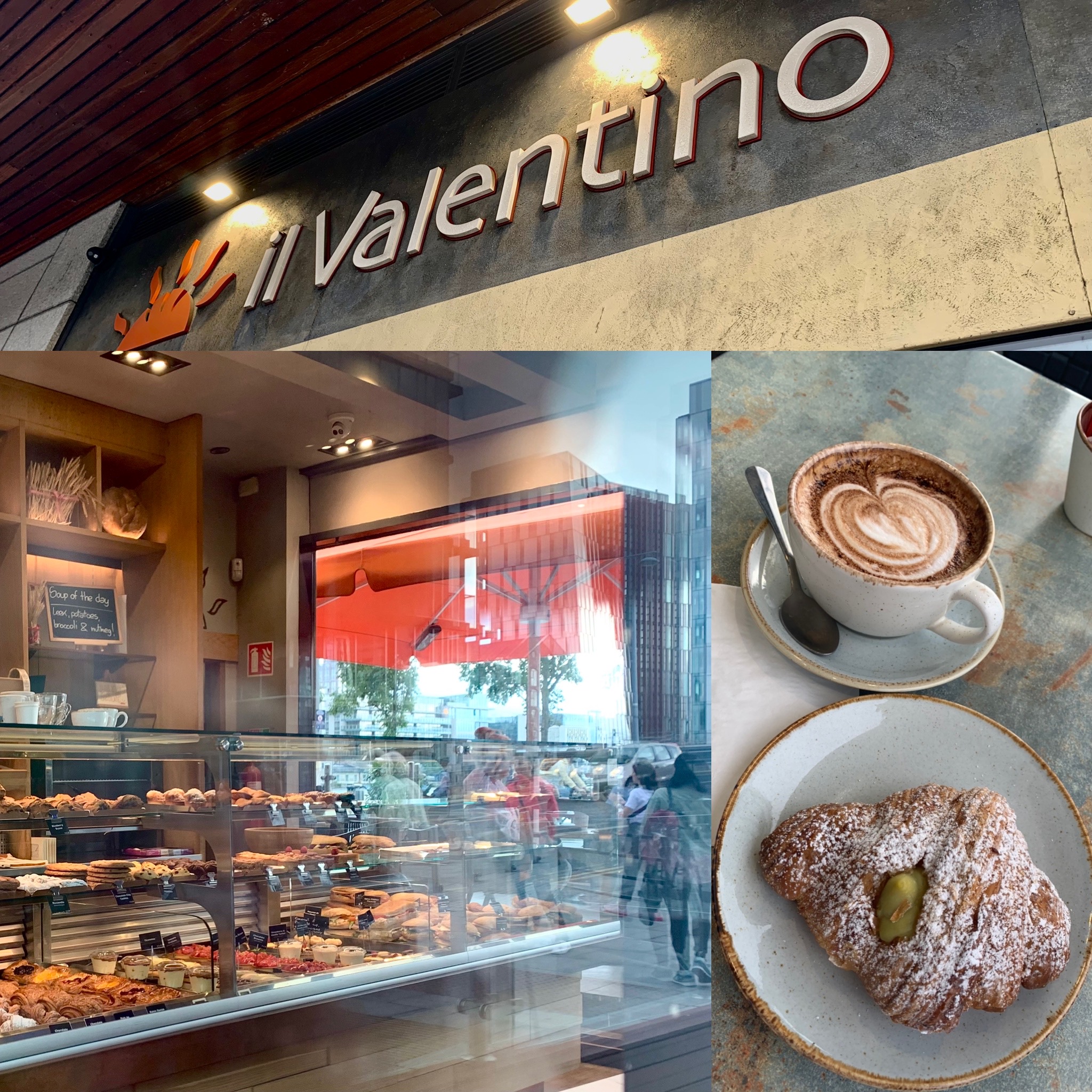
Il Valentino - This Italian-style bakery and cafe reminded me of places I knew as a child on “The Hill”, the Italian neighbourhood in St. Louis. Conveniently located just on the other side of the bridge from our house boat and 200 metres from my Dublin office, Il Valentino serves up artisan breads and pastries every morning, with lashings of southern sun. Croissants filled with pistachio cream. Succulent fruit danish. The best cannoli I’ve had anywhere between New York and Sicily. Thank god this isn’t on the way to our London office; I’d be in real trouble.

herbstreet - The Sunday queues and the collection of positive reviews from glossy magazines on their website are a good indication of this place’s popularity with the locals. Our first Sunday brunch experience was so good we immediately booked for the next week. Spicy and sweet bloody marys  and fruity cocktails offer glamorous “hair of the dog” to kill those hangovers. If you like your brunch sweet, there are thick and sticky waffles and stacks of fat, fluffy American pancakes swimming in maple syrup. Or go savoury with rich, comforting eggs Benedict with local ham or spectacular, spicy jumbo shrimp po-boys. Yes, the American spirit runs strong here, but the hospitality, servers and locals are all resolutely Irish.

Charlotte Quay - With a pan-European bistro menu and elegant modern decor, you could be anywhere in the world, and wherever you were you’d be glad to have landed there. Charlotte Quay has a particularly fortunate location. The main docks are “L” shaped; the restaurant sits on the inside corner with frontages looking over the vast majority of the waterway. There’s a generous pavement between building and water hosting a bustling happy hour on weeknights and special events, including weddings, on weekends. I ate here twice, as well … unsurprising as it was stumbling distance from our houseboat. The starters are especially sumptuous and one night we made a meal of just a collection of those, tapas style: deep-fried soft shell crab, tuna tartare, pork croquettes, stone bass ceviche, burrata and heirloom tomatoes. Interesting and wide-ranging wine list. 

The rooftop bar at The Marker Hotel - If money were no object, you’d be staying in this outpost of the luxury Antara chain, and would discover its rooftop options as part of your stay. Most tourists wouldn’t even realise this luxurious resting place with its magnificent views existed. The roof is supposed to be exclusive to hotel guests unless you make reservations, but if you’re a loquacious type who remembers
servers’ names and likes to chat you might be able to talk your way in. And once you’ve been up once, you’re more likely to get in again. I’d recommend it to anyone visiting Dublin. It’s a low-rise town with few vantage points for elevated, sweeping views. The one everyone knows about is the Guinness storehouse. The Marker will cost a bit more but you’ll have better food and be less jammed. Whether it’s the secret nature of the place or the tough admissions policy, the rooftop proved pleasantly uncrowded in an otherwise tourist-packed city. Most tables were full but there was plenty of room between them. Cool jazz plays on the speakers and conversation stays at a low buzz. The whole vibe is marvellously relaxing.

And the views are remarkable. You don’t see much of the city centre from here, but rather the docks below and the intriguing mix of modern architecture, much of it incorporating interesting lighting schemes. Beyond is Dublin Bay, the coast going south and the green hills where suburbia gives way to the Irish countryside. There’s a fun cocktail list (I will be trying to recreate the amaretto cherry sour at home), grazing boards to pair with them and some surprisingly substantial main courses for an outdoor menu; the spare ribs were memorable enough to come back for.


Thursday, 18 August 2022

To Kill a Mockingbird for the modern age is powerful but disturbing

 Spoilers from the start...

Aaron Sorkin's much-lauded reworking of To Kill a Mockingbird is a good deal darker and more visceral than I remember the beloved story to be. But memory, it turns out, is a funny thing.

Atticus Finch defined my ideas of respect for others and gave me a profound reverence for the law and learning. The iconic character made me, and classmates like me, proud our dads were lawyers. Most of my friends who went to law school did so with Finch's spirit beneath their wings. Scout, as the wise-cracking tomboy who was smarter than her years and naively idealistic, was a character with whom almost everyone at our all-girls' school could associate. The nuns, I suspect, found the book a far easier tool than the Bible for hammering the traits of kindness, understanding, patience and empathy into our characters.

I'd like to think that the messages hit home. And yet, last night, I realised with horror that I'd forgotten that Atticus lost the case. That Tom Robinson died in a miscarriage of justice. Atticus, the children, the bad guy's end and the redemption of Boo Radley lived in my mind. I remembered ... mis-remembered ... that Tom Robinson walked free, and Bob Ewell was driven mad by the defeat. I forgot that Atticus' ideals actually failed to save the victim at the heart of the story. And I'm ashamed to admit it.

I suspect no black reader of the story forgets that part.

Nor will anyone who sees this adaptation.  Tom, and the injustice done to him, takes centre stage. The racism is far more overt than the text of the book, expressed in language that is stomach-churning to hear spoken aloud. Clearly influenced by both modern America and Harper Lee's "sequel" (now thought to be a rejected first version), Go Set a Watchman, Atticus is more flawed and the moral lessons greyer. The classic version gave hope for a better future. This one ejects you from the theatre in sadness and frustration.

Maybe that's exactly what we need. This text has been in the core American curriculum for generations, and is taught in other countries around the world, but it hasn't changed us enough. So Sorkin is, as Scout might put it, smackin' us upside the head.

It is familiar territory for the writer behind The West Wing and A Few Good Men, who loves a courtroom drama and often features lawyers as the good guys. His usual combination of rapid banter and quick wit is here, as are the noble speeches appealing to our better selves that drop in like the big love songs in a musical. It's a shame about the accents, which in some cases are deployed with such an extreme drawl by the mostly British cast that they become hard to decipher. Gwyneth Keyworth gave us a magnificently acted Scout ... no small challenge for an adult to play an 8-year-old convincingly ... but her adopted accent obscured 20% of her words. That's a criminal loss with Sorkin, where every word matters. Far better to hear Jim Norton's native Irish accent regularly peeping through Judge Taylor's facade, but with complete clarity.

Rafe Spall is magnificent, and entirely audible, as an Atticus Finch for the new age. Still a role model but with flaws, foibles and fears aplenty. But best of all were Jude Owosu's dignified, noble Tom Robinson and Pamela Nomvete's firey, assertive housekeeper Calpurnia. Sorkin has significantly expanded the roles of the black characters, and it's to the story's overall benefit. 

If To Kill a Mockingbird is a sacred text of your childhood, you may be uncomfortable with the way this version shakes up how you see the story. But learning isn't supposed to be comfortable, and this story remains a requirement for the course curriculum of life.

To Kill a Mockingbird is at the Geilgud Theatre in London until 19 November.

Friday, 5 August 2022

Bows, arrows and battles keep my godmother credentials fresh

I’m blessed with a fantastic godson, but cursed by distance. We rarely rack up more than 10 days together over the course of a whole year, some of it usually during his expat family's annual "return to Blighty" each August. So when I get my turn, I want to roll out activities that perpetuate my best-godmother-ever reputation. 

The last summer before lockdowns, I scored big with his first baseball game as the Yankees and Red Sox came to London. Last summer, I was a hero thanks to the National Motor Museum and its Aston Martin Day. This year, he'd be staying for a whole week. How to maintain my track record? Archery, battle re-enactments and a few more battles on celluloid. With lashings of American pancakes, barbeques and home made pizza.

His favourite, I'm delighted to say, was the archery.

I probably could have found something closer than the hour and twenty minute drive, but online research showed New Forest Activities to have the best mix of instruction, timing and group size for the money. It turned out even better than planned when we were the only people in our time slot, meaning £27 each got us 90 minutes of exclusive use of their range with instructor Tom. 

It was blazing hot, humid, and we were shooting at things in a corn field. I was flashing back to my Missouri youth. Those days, of course, were why I'd chosen this. I like to have some credibility with kids when trying to impress them, and this was my high school sport. I was physically unfit and chronically uncoordinated, but I was also keenly competitive. I quickly realised that archery was the only "sport" at which I could stand still, not perspire, and be good enough to win Field Day prizes. The bookworm in me, meanwhile, loved all the literary connections. That still works for kids today, though they're more likely to associate with Hawkeye, the Green Arrow or Katniss Everdeen than Robin Hood.

Tom's instruction was fantastic and Sacha was soon getting most of his arrows somewhere on the target. I was doing better at a further distance but this was the kid's day, so after a third of our time further back we returned to the starting line. Meaning I didn't beat the kid by quite the margin I wanted to. (That's my story, anyway) He had a great time and used up almost every minute of our allocation, even though instructor Tom and I were both clearly ready to quit early if he'd wanted to wrap up.

New Forest Activities is only 10 minutes down the road from Beaulieu with its motor museum and adorable village, so you could easily do a kid-friendly weekend down there. New Forest Activities also do kayaking, canoeing, ropes courses and paint ball.

Earlier in the week we were off to the Marlborough 300 Pageant at Blenheim Palace, marking the tercentenary of the first duke's death. History is always dicey territory with teenagers, who may have had a bad experience in school and whose short attention spans can make traditional events boring. Luckily this one had a military encampment full of child-friendly historical re-enactors who were letting the kids beat on their drums, play with their weapons (under close supervision) and try on bits of their costumes. There was a full-scale battle re-enactment with foot soldiers, cannon, cavalry and a commentator on loudspeaker to explain it all. 

But the most captivating bit for teenager and adults alike was the "Meet the Churchills" session, where John and his wife Sarah welcomed you to their pavilion to tell you about their lives and answer their questions. Historical re-enactors are passionate about their periods and part of the game is staying in character, but I've never encountered any as good as these two. It was as if the real people had time travelled for our entertainment. Both were magnificent actors, fully inhabiting the persona of 17th century nobles, but they also both had a staggering knowledge of their subject matter. 

This is even harder than you might imagine because they had to place themselves at a very specific time: 1685. Because that was the date of the day's battle; a re-creation of part of the Monmouth Rebellion. (Re-enacting Marlborough's most famous victory at Blenheim would have required a troupe of re-enactors from Louis XIV's army who were willing to lose. Unlikely in the heart of England.) So the couple could only anticipate the victories ahead, the future residence and Blenheim and the falling out with Queen Anne. Between their performance and some very informed questions from the audience, it was the highlight of the day.

I am not above easy teenage-friendly options, however. Take the kid to a blockbuster summer film, buy him whatever he wants at the snack counter and enjoy the air conditioning. Fortunately, the film was Thor: Love and Thunder. My superhero grasp can be sketchy but is better when characters have links back to mythology or classical literature. With his deep immersion in Nordic myth, Sir Kenneth Branagh as an early director and co-stars like Natalie Portman and Anthony Hopkins, Thor has always been my favourite. And then there's the delectable Chris Hemsworth.

Not that you really need much prior knowledge for this glorious romp of a film. I didn't think anything could beat Maverick in the summer blockbuster sweepstakes but Love and Thunder is equally joyous. It's a comedy. A love story. An action flick. And while I might not have needed my context setting, a thorough grasp of mythologies of the pre-Christian world makes one plot-pivoting scene even better. I liked it so much I may be going back for a re-run with the husband.

The teenager is gone, the house is quiet, mountains of laundry await and I am perversely excited to have 13 days stretching ahead with nothing in the social or cultural diary. Perhaps I should use some of them to start researching next summer's godson activities. This trajectory of delight is going to be hard to keep up, even if Hollywood gives me a few more epic blockbusters.