Thursday, 19 March 2020

Art banishes gloom as I rush to London's museums before Covid-19 forces closure

I can date my first memory precisely: 20 July, 1969. My parents sat me before our television and proclaimed with solemn gravity: "Remember this, Ellen. You're watching history. You may live your whole life without something this important happening again." I didn't really grasp why Neil Armstrong stepping onto the surface of the moon that afternoon was so significant, but I knew it was a big deal.

Twenty years later, I was more conscious of the reasons for the history-book moment as I watched the Berlin Wall tumble. The next history maker was far less pleasant. A regular workday collapsed into horror on September 11, 2001 as our world changed forever. After that, frankly, I could have done without any more epoch-shaping events in my life. And yet here we are again.

We're all used to watching horrible diseases ravage developing countries. We give money. We say prayers. We don't imagine it will have much effect on us. Who in Europe or the US, just two short months ago, could have predicted how quickly normal life can tip into an apocalyptic drama? Who can say how far-reaching the impact of Covid-19 will be?

I suspect that, much as it was in the weeks following 9-11, the secret to fighting the dread is going to be making extraordinary efforts to keep life as normal as possible. For me, with the closure of London's museums on the horizon, that meant making my way into an eerily quiet capital to drink in the two exhibitions I'd planned to see this spring. Staying six feet away from other humans, trying not to touch anything and regularly sanitising my hands, naturally. I got there just in time. Cultural institutions locked their doors 48 hours later.

If you need cheering up, it's hard to go wrong with the exuberance of the British Baroque or the merry excess of George IV's collecting mania, now sitting in splendid isolation inside Tate Britain and the Queen's Gallery.

The Baroque was a truly international movement, starting in Italy as the Catholic church's response to the reformation. If protestants were going austere, the Pope would fight back with magnificence. The trend for enormous classical buildings, opulent decor, fanciful frescoed ceilings, luxurious clothing and complex, multi-layered music spread quickly. Even protestant countries adopted the style, though they streamlined it a bit and stripped most of the bombastic religious images out of it.

In Britain the Baroque aligns with the late Stuarts. It was the look of choice for Charles II after his restoration. He was heavily influenced by (and probably jealous of) his style-setting first cousin Louis XIV of France (Le Roi Soleil). Charles' successors James II, William and Mary, and Anne all followed suit. The Tate's show, called British Baroque: Power and Illusion, focuses on how those rulers and their courts used the style to dazzle the country with their authority.

While there are interesting lessons in political history here, at its core this is simply a beautiful collection of things to look at. There are lots of sumptuous portraits of women in billowing silk and men in flamboyant wigs. (This may be the best era in fashion history for women. For men, condemned to shoulder-length curls, tights and ballooning short pantaloons, not so much.) There's an exquisitely-wrought silver chandelier, a font cover carved by Grinling Gibbons alive with putti, fruit and veg, an enamel and diamond portrait pendant of William II that would set any jewellery collector drooling, and some beautiful examples of pottery and furniture that show off the growing interest in the exotic Far East. The silver and gold loving cup in the shape of an oak tree, topped with a royal crown, is a masterpiece of the smith's art.

An intriguing section digs into the Baroque's obsession with fooling the eye, with photo-realistic flower paintings, the famous tromp l'oiel door from Chatsworth's music room with its painted violin hanging on a nail, and an amusing box that throws scenes painted on three sides into perfect perspective when you look through the designated eye holes.  There's a whole room devoted to the architecture of Sir Christopher Wren and his followers, with models, paintings and architectural drawings. In the next the curators try to bring to life the age's passion for exuberant walls and ceilings, often adorned with life-sized gods, goddesses and royals occupying heaven. One wall has an enormous reproduction of the view into the great hall at the Naval College at Greenwich, while the others have photos and sketches of  examples elsewhere in the country.
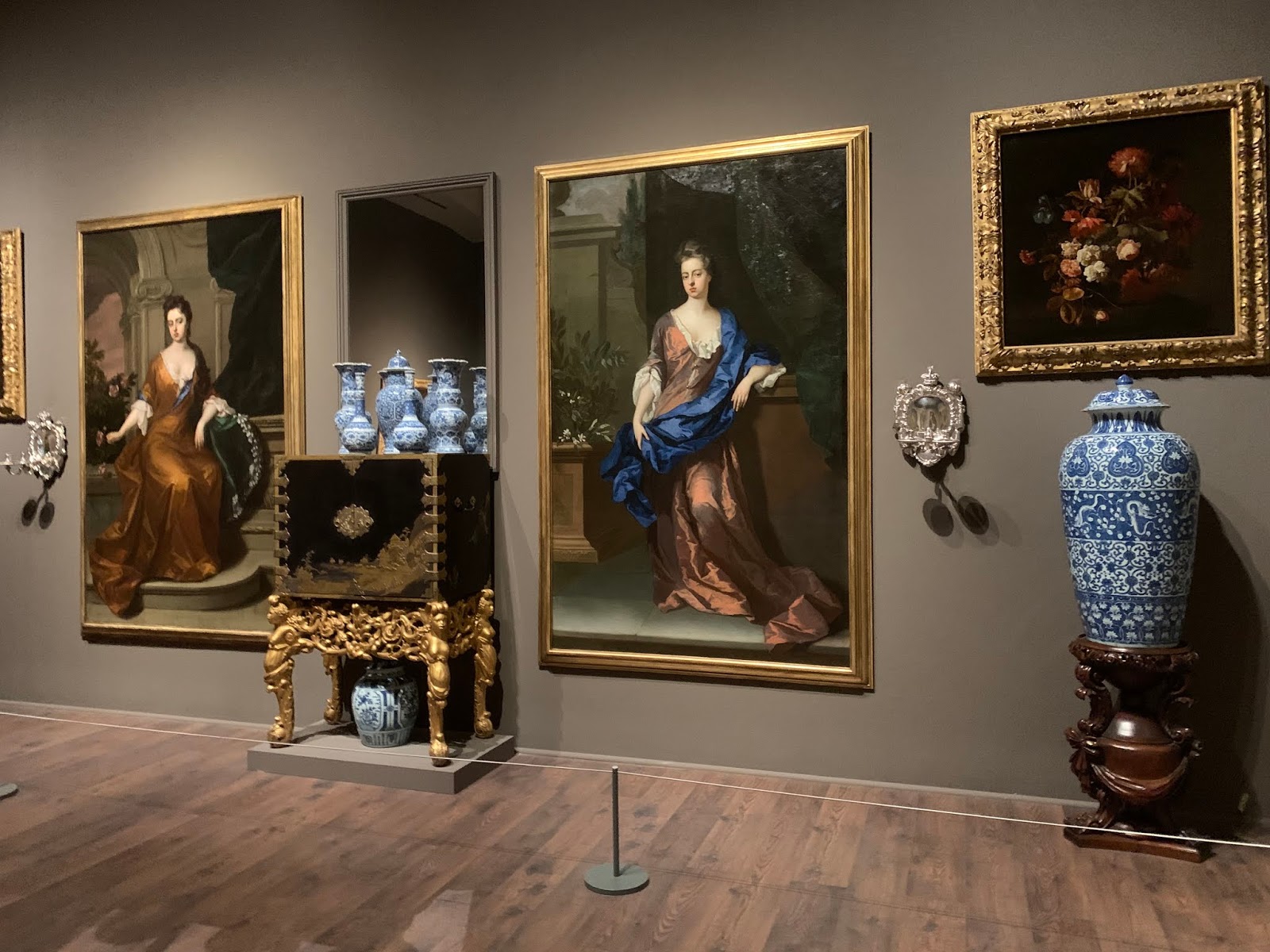
This exhibition wasn't quite as much fun as the Victoria and Albert's take on the Baroque in 2009, which included music, costume and much more of the decorative arts. But it was still a joyous outing, made more memorable by the sparsely populated galleries.

People were even thinner on the ground at the Queen's Gallery, a little-known secret that's rarely crowded even when London's operating at capacity.
The Queen's Gallery sits next to Buckingham Palace and exists to share treasures from the Royal Collection with the general public. While the source is always the same, exhibitions vary to show off items under different themes. For a bargain £13.50, you get into exhibitions for a year (that can be as many as three if you time it right), audio guide included.

While under normal circumstances I wouldn't have jammed two big shows into one day, George IV: Art and Spectacle is a fitting companion to the Baroque. George loved excess, was one of the monarchy's greatest collectors and was a big fan of his predecessor Charles II. George was particularly intrigued by the Catholic branch of the Stuart family that still existed in exile, ousted by his own protestant Hanoverians. There's an intriguing collection of Stuart memorabilia here.

That's probably the most humble of the many collections on view. George's irresponsible spending made him an unpopular king but left perhaps the biggest artistic legacy of any monarch since the Civil War. A savvy consumer of great painting, his purchases included priceless Rembrandts and some of Lawrence's greatest portraits,  on show here. His love of adornment gives the exhibition the glittering, diamond-studded circlet of national flowers familiar from the queen's image on stamps, and a whole range of over-the-top costumes and accessories from his lavish coronation. The Royal Plate had been liberated from its usual display at the Tower; a range of golden tableware that was supposed to be arrayed behind the monarch at state banquets, in an echo of Medieval tradition.
If, as I have, you've been a visitor to all of the Royal palaces, you will have seen most of this stuff before. The charm of the Queen's Gallery is that it brings items together to tell a story. And what we get here is a view into a man of impeccable taste, with greater depth and sensitivity than his historic reputation.

He collected a range of searing political cartoons lampooning him, suggesting a decent sense of humour. He commissioned multiple, beautiful portraits of his favourite sisters and his daughter, suggesting a soft spot for at least some of his fractious family. The books, prints, maps and memorabilia from Wellington's campaigns against Napoleon, including a captured French marshal's baton of command, demonstrate his intense interest in the greatest political events of his time. His love of Jane Austen, who ... when vigorously encouraged ... dedicated Emma to him, obviously shows his excellent literary taste. The presentation copy is here, in its original three-volume form. Most poignant are white marble and gold gilt copies of famous imperial arches in Rome. George desperately wanted to go on the Grand Tour, as his aristocratic peers would have done, but as heir to the throne he wasn't allowed to do so. These items show a desperate yearning for an Italy he would never see.

My two favourite items in the show, however, were the things I'd never seen before because they're not usually on display in the palaces' public spaces. The first was a pair of Humphry Repton's famous red books. An early example of visionary marketing, Repton would bid for potential work by presenting a watercolour of a landscape as it existed and then, with the movement of a flap, the landscape as it could be with his help. His before-and-after scenes were all the rage in the early 19th century, but few survive because they were essentially working design tools. The other is a suite of Oriental-style furniture created for the Royal Pavilion at Brighton. Lifelike, small Chinese sages hold up a console table, each dressed and presented with distinctive facial expressions. On either side loom porcelain pagodas, originally made in China but enhanced in Europe with tiny ormolu dogs and bells on every level. They are gob-stoppingly magnificent and possibly worth the price of entry on their own.
Sadly, now they sit in an empty gallery, seen by even fewer people than would normally pass by in the private East wing of Buckingham Palace, where they normally live.

With only a handful of people out and about, London's museums and tourist destinations last weekend were glorious. It was like an almost-private view. I wanted to stop time, so I could experience the same at the British Museum and the Victoria and Albert. But time marched on. Covid-19 marched on. The museums are closed, and there's no telling when they'll open again. Just like the businesses that are shutting down, our cultural institutions will take an enormous financial hit from this crisis. I can only hope that while they're inaccessible, people gain a greater appreciation for what they're missing and flock back through all those august portals when this significant moment in history has passed.

Thursday, 12 March 2020

Despite big budget firepower, ENO's Luisa Miller pales before a provincial Butterfly

Warning, readers: I'm climbing onto my opera soapbox again.

I've written regularly about my frustration when the modern preference for "innovative" opera staging tips over into something that's incomprehensible and just plain ugly. From its birth, opera was an art form of lavish visual spectacle. While I appreciate that artists get bored repeatedly staging the same interpretations, and smaller opera companies can't afford the spectacle that Mozart, Wagner or Puccini would recognise, I'm becoming exasperated by the major opera companies' love affair with sparse modernism and the reinvention of the original work's time and place.

In the UK, however, the less an opera company looks to London, the more liberated they seem to be to embrace traditional staging. The word provincial usually comes with negative associations: rustics from small towns aping urban sophistication and never quite getting it right. I suspect that's the way Londoners would dismiss the production of Madame Butterfly I saw at the Anvil in Basingstoke last month. But with its abundant kimonos and traditional setting, it was a classic interpretation that was easy on the eyes and far less challenging that the production of Luisa Miller I saw at the English National Opera a fortnight later.
If you'd listened to a radio broadcast of this Luisa, you'd make no mistake about which one was the big-budget, top-of-the-food-chain production.  The ENO's orchestra swells, powers, cajoles and stirs. This is one of Verdi's lesser known works but the music still moves the soul. Young American bass Soloman Howard was the best thing in the production; a spine-tingling voice and emotive acting that almost transformed the bad-guy Wurm into the hero of the story. He has the kind of headliner quality that pulls you to almost any opera just to see him. Elizabeth Llewellyn, playing the eponymous heroine, is a powerful soprano with an impressive range, and while David Junghoon Kim's Rodolfo sometimes lacked power he is a pure, sweet tenor in the classic style. Unfortunately, the love triangle that drives two of the three to a terrible death has no credibility. The acting is as wooden as the singing is lovely; I didn't buy Luisa as a sweet heroine or Rodolfo as an obsessed romantic hero.

But those issues pale in comparison to the stark, brutalist set. Luisa Miller was written as an exploration of class divisions in a 17th century Tyrolean village. (Luisa is the humble Miller's daughter, Rodolfo is the lord's heir who falls in love where he shouldn't.) But don't expect lederhosen, beer steins and sets with lavish mountain backdrops. The vast ENO stage was a brutal white rectangle with harsh light. A structure in the centre sometimes appears, just a ghost of a building made from white girders. The side walls sometimes come in and out. There's little to look at until characters start daubing graffiti on the white walls.

The lord of the manor seems to have morphed into a violent gangster ... at one point an enemy is executed in a hanging reminiscent of Catholic martyrdoms ... and the graffiti, daubed in thick black stuff that comes out of oil barrels, oozing with heavy menace. By the end it's dripping ominously from the top of the walls. Stark and horrific, the staging certainly made an impact. But it was exceptionally ugly. And I haven't even mentioned the bizarre costumes of the villagers, who seem to have been conjured out of one of Hieronymus Bosch's scenes from hell.

It was hard work.

Not so, our little provincial Butterfly. There wasn't an innovative thing about it. The set ... unchanged throughout ... would have been recognisable to anyone who saw the original in 1904. There was a charming Japanese house set in a blooming garden, regularly populated with a chorus of people in lavish silken robes. The singing was solid though not memorable, the acting occasionally over-the-top, but the total package was a delightful evening's entertainment. For about half the price of the middling tickets at ENO.
I'm not arguing that operas shouldn't evolve from their original staging. But if you're going to take chances, I'd like them to make sense. The ENO was pushing boundaries by casting a black woman as Luisa and a Korean man as Rodolfo. Why not run with that, and turn the class war Verdi wrote into an exploration of what happens when a poor girl from a rough bit of LA ends up in a relationship with a rich doctor's son? I also want operas that can attract the next generation. At Basingstoke's Butterfly I spotted a mother with her daughter, about 8 years old, dressed for a special occasion and alert with excitement. Butterfly's simple tale with its magnificent music and storybook visuals connected with a young audience in a way I can't imagine with Luisa's frightening modernism.

The ENO reportedly receives about £100 in public subsidies for every ticket it sells. That compares to £22 for the National Theatre and ... though I have no data on this ... probably a pittance for provincial companies. Surely with that amount of cash you can give me something better to look at? More importantly, if you're entrusted with public money, I think you should be aiming for entertainment that can reach a wider public rather than the shock value so beloved by opera's inner circle. 

Friday, 6 March 2020

Glorious Upstart Crow is one of the funniest things to ever bless the London Stage

If you appreciate Shakespeare, think the finest form of comedy is witty wordplay, believe that Blackadder is a masterpiece of British television, and can get to London before 25 April, you need to book tickets to The Upstart Crow. 

Now. 
You probably shouldn’t even finish reading this review. Because if you don’t catch this masterpiece’s short run you will miss one of the most gloriously funny, joyously silly yet fiercely intelligent productions to ever grace a London stage. 

The Blackadder reference is intentional, as this gem is written by that series’ scribe, Ben Elton, and he’s on top form here. And like the earlier historical romp, Upstart Crow started life as a TV series. This is not, however, one of those screen-to-stage copies that West End producers turn to when looking for quick profits (Mamma Mia, Pretty Woman) but an entirely new work. 

We’ve moved on from the TV show’s Elizabethan period to the new regime of James I, where Shakespeare needs to prove himself afresh. Naturally, his creative juices are running dry and much merriment ensues to get them flowing. 

We’re treated to the familiar leads from the original series. David Mitchell returns as the insecure, callous but ultimately kind-hearted Bard, pinching ideas from those around him before falling into genius when the spirit strikes. It’s hard to believe this is Mitchell’s first appearance on stage: his live timing is perfect and he’s remarkably moving when the action briefly turns serious and he has to do the mad scene from Lear. Gemma Whelan reminds us why she’s one of Britain’s best young actresses, banishing memories of her as a rampaging, hard-ass pirate queen in Game of Thrones and the prim sister in Gentleman Jack to give us the sweet, clever and determined Kate, clearly Shakespeare’s muse. 

History won’t allow Mark Heap to reprise his role as Shakespeare’s nemesis, theatre censor Robert Greene, as he was long dead by the Jacobean accession. So Heap comes back in a new role as a Puritan doctor channeling the spirit of Twelfth Night’s Malvolio. And Rob Rouse is back as servant, straight man and ego-pricker Bottom. 

In the best Eltonian ... and Shakespearean ... tradition, the comedy alternates between farce, slapstick and brainy wordplay. While the extreme role reversals, physical pratfalls and very modern send-ups of public transport and political correctness will get a laugh out of anyone, there’s no denying that the better you know your Shakespeare, the funnier this play is. The Upstart Crow treats Shakespeare’s work not as a sacred canon but as a living larder of human creativity, where the brilliant and the bad, the strikingly original and the shamelessly copied, all live side-by-side.

The plot gleefully mashes up Twelfth Night, Othello, Romeo and Juliet and King Lear. For those who laboured over the plays at school, your efforts will be amply rewarded as you spot the jokes and chuckle at how one story slides into another. References to many other plays pop up, including jibes about the bad ones, the cheap plotting tricks and the plagiarism. Will’s constantly noting down lines that come out of other characters’ mouths that the Shakespeareans amongst us know will go on to become classics. There’s even an explanation of The Bard’s most enigmatic stage direction, complete with a dancing bear who almost steals the whole show. 
This isn’t new, of course. Elton and Mitchell take a path well trodden, most notably by Tom Stoppard in Shakespeare in Love. One my favourite Doctor Who episodes in the David Tennant era springs to mind. But for pure, glorious, feel-good comedy, it’s never been done better than here. 

I’d expect that much of this will eventually come to the small screen as elements of a fourth series. But there’s a magic on the live stage I doubt a filmed version will be able to capture. The communal joy of hundreds of people joining in belly-aching laughter. The actors playing to the audience. The wonderfully authentic Shakespearean set design. And the dancing bear. The dancing bear needs to be seen live. 

What are you doing still reading this? Go book some tickets. Now!

Friday, 21 February 2020

Leonardo grabs the headlines, Apollon wins my heart

Leonardo da Vinci draws superlatives like pollen pulls bees, so it's no surprise that the Louvre went big on the marketing of its current show. It was supposed to be the biggest, most insightful, most comprehensive of all the many exhibitions put on to mark the 500th anniversary of the death of the ultimate Renaissance Man. Most tickets sold out well in advance. The hype is so big that this coming weekend ... the last of the show's run ... it will be open 24/7 from Friday morning to late Monday afternoon. And as a special treat, if you go between 9pm and 8:45 am you get in for free.

Fascinating idea. And, maybe, if you went at 4am you might actually have enough space to enjoy it. Because with normal attendance, even with the Louvre supposedly limiting numbers by time slots, the crowds were so intense it made the whole experience profoundly uncomfortable. As a consequence, even though there were some remarkable items on display, we enjoyed our time wandering around the Louvre's regular galleries more than our claustrophobic visit to this "landmark" exhibition.

The show is undeniably impressive. Leonardo may be one of the most famous artists in history, but his output was tiny: there are just 24 complete or nearly complete paintings attributed to him by general agreement. Some can't move (such as the Last Supper, since it's painted on a wall) and many are so valuable that either their owners won't take the risk of letting them travel, or the insurance is prohibitively expensive. By getting 11 of Leonardo's total on the exhibition's walls, with the Mona Lisa upstairs and available on the same entry ticket, the Louvre has worked some impressive magic. (Although if you caught the National Gallery's Leonardo show in 2011, you probably saw the better effort.)

You can't have a major exhibition with just 11 paintings, of course, so the curators have expanded the show with Leonardo's drawings ... which remain in numbers as prolific as his paintings are sparse ... works by his teacher and contemporaries he influenced, copies, works by his students, and true-to-size x-rays of both paintings in the exhibition and some that couldn't travel. You're advised of this from the very beginning, when the major work that greets you isn't a Leonardo but a monumental bronze of Jesus and doubting Thomas by Andrea Verrocchio, his teacher. (Legend says Leonardo modelled Thomas' foot.) The show is, essentially, exploring the whole "ecosystem" of Leonardo.

It's always a delight when exhibitions bring you items you may never see on your own, thus I particularly appreciated the Madonna and Child from the Hermitage. Leonardo did many variations on this theme, however, and my favourite item in the whole exhibition was the Lansdowne Madonna, which has emerged from a private collection and was once owned by the same family that gave their name to, and once lived in, my club in London. The painting is exquisite and I love the personal connection. It hangs next to another version called the Buccleuch Madonna, and it's great fun to compare the two. The X-rays are fascinating and, in the case of the Mona Lisa, arguably more interesting than the painting itself (top photo). My biggest smile came from an old friend: Verrochio's Tobias and the Angel, which usually hangs in London's National Gallery, and features a ghostly, half-completed, shaggy canine reputedly by the young Leonardo that's one of the great dogs in art. I've always loved the idea that dogs are angels' best friends as well as man's.

There are 160 marvellous works to see here, but the density of the crowd made appreciating them an
endurance test rather than a joy. It was particularly frustrating in the room that was primarily drawings, arranged in long rows of display cases with narrow aisles in between. The scrum was so intense we skipped the whole section. This is a shame, as many art critics will tell you that the most intriguing masterpieces lay there. But I've been lucky to see a lot of Leonardo drawings in my life (the majority on display here come from the Royal Collection in Windsor), and I just wasn't up for the physical fight needed to see these.

When you know you're going to be packing the crowds in, putting so many things that require close study in low cases with limited access was a poor curatorial decision. A higher hang of the major paintings would also have created a better line of sight over the shoulders in front of you. They could have learned a great deal from the designers of the King Tut exhibit I saw in London earlier this year.

The curators could also, one assumes, have put a tighter limit on numbers and raised the ticket cost. At €17, Leonardo was priced well below the £20 - £25 of most major British exhibitions, and came with the added benefit of admission into the rest of the Louvre. Which normally costs €17. Bafflingly good value for money. Perhaps too good?

Though Leonardo should have been my highlight of the day, that honour belonged to the Galerie d'Apollon in the Denon wing. This jaw-dropping, gold-gilt blockbuster of a room dates from the time of the "Sun King" Louis XIV and was an artistic trial run before he commissioned the similar, but even grander, Hall of Mirrors at Versailles. You won't be missing anything with this version, however, but the people. The room has been closed for 10 months for renovation and even when open it's off the natural route through the Denon wing, so many people miss it. (I've spent many hours wandering the Louvre and I never knew it was here.) While still full of appreciative visitors, it's nothing like the crowds in Leonardo or the even more horrific body-to-body crush at Versailles. You have time and space to take it all in; though the human brain has a hard time processing this much grandeur.
The hall is 200 feet long, its barrel vault almost 50 feet above you, and its walls and ceilings are covered with paintings of mythological allegory, great battles and portraits of the artistic worthies of France, surrounded by an astonishing array of life-sized, nearly three-dimensional stucco figures, all covered with gold gilt. Few spaces in the Louvre deliver as potent a reminder that this was once a royal palace.

If you can tear your eyes away from looking upwards, you'll find that the room holds some of the greatest treasures in the museum: Louis XIV's collection of objects made from semi-precious stone and what's left of the French crown jewels. Given France's penchant for revolution, it's amazing any of this stuff survived, much less ended up in the same room.
There's only one crown here from the monarchy before Louis XVI lost his head, as the rest of his stuff was broken up during the political upheaval that followed. The regimes after that seem to have over-compensated for their feared inadequacies, much to the modern viewer's benefit. Louis Philippe presented his Bourbon queen with a set of diamonds and Sri Lankan sapphires that is the stuff of fantasy. The Empress Eugénie’s crown is a masterpiece of emeralds, diamonds and golden eagles with raised wings. Her diamond brooch is comprised of stones so big it's hard to believe they're real, though the refracted rainbows sparking out of them thanks to small, cleverly placed spotlights leave no doubt.
The Sun King's stones may seem humble next to this bling, but they are extraordinary in their own right. Lapis lazuli, malachite, agate and rock crystal have been painstakingly carved into goblets, bowls, boxes and other lovely little objects, then accented with gold and precious jewels. Any one of these would be a priceless treasure in most museums. Here, they're fighting with the architecture to get noticed. It's sensory overload, and it's glorious.

The Denon wing is also the home of a magnificent Roman sculpture collection, the galleries featuring the enormous history paintings of Jacques Louis David and Leonardo's most famous work, the Mona Lisa.

She hangs in the middle of an enormous gallery dedicated to the Italian Renaissance. The Louvre has recently renovated the gallery and instituted a new queuing system to see her. There's now an enormous one-way route so you can only enter the gallery through one door, and leave through the other. She hangs higher than before, so people who don't want to wait can see her from a distance. There's an amusement park style chicane of barriers organising the shuffling file of hundreds, who all wind their way forward to get their requisite selfie with the most famous painting in the world. Few of them bother looking at the rest of the gallery to see Veronese's monumental Wedding at Cana (for me, the best painting in the room) or the wall of luscious Titians. This isn't art appreciation, it's tourists ticking boxes.
I'm glad I had a chance to see the Leonardo exhibition. Seeing the Mona Lisa "live" is better than consuming her through thousands of tacky reproductions. But what my day at the Louvre really reinforced is that in this era of social media-driven tourism and uncomfortable over-crowding, the less appreciated experiences, off the beaten track, can be more meaningful than the "must sees".


Sunday, 16 February 2020

Odd but enjoyable, the Moulin Rouge keeps drawing the crowds

There are few nightlife spots as legendary as the Moulin Rouge. Whether through the paintings of
Toulouse-Lautrec, Baz Lurhmann's rollicking musical, shadowy stories of intrigue during WWII or reputation as the birthplace of the can-can, most people are aware of this Paris landmark. I suspect fewer realise that the place is still going strong nearly 130 years after its founding.

When it opened its doors in 1889, the Moulin Rouge gave Paris' rich a place to "slum it"; opulent luxury and racy entertainment in one of the city's poorest neighbourhoods. While today's Pigalle is no slum, it remains a somewhat dodgy red light district and the club's prices are still for high rollers. The show with dinner is €195; the evening's second, late performance without food is €97.  Prices are marginally cheaper on weeknights. Most nights sell out. A full house is 850 seats. Though the show's costumes and sets are lavish, this production has been running since 1999, so one assumes those costs were recouped long ago. It's a family-run business, and they own the building. Contemplating the profits is an eye watering exercise.

Having sat through the show, I'm a bit surprised they're still packing in the crowds. The production is curiously old-fashioned. You'll see better quality dancing and hear stronger voices in a London West End musical. (I suspect this isn't actually down to the talent of the performers, but the fact that they've been doing the same show twice a day since they started and there's an element of "going through the motions"). But there's quirky charm that makes the experience utterly unique, as do the magnificent surroundings. And there's no cabaret in the world with this provenance. You're at the source, and the ghosts of history are thick around you.

The experience is part old-style Vegas show, part Cirque du Soleil and part theme park production. With breasts. Lots and lots of naked breasts. At times is was almost comic, as lovely costumes had panels awkwardly cut out to tick the boob requirement. When I was a child, I believe this kind of thing was big in Vegas and called a "topless review". Those shows are long gone from The Strip but thriving at the Moulin Rouge. It seemed a bizarre contradiction in these days of #metoo and gender equality, but it was hard to get offended when most of the dancing was about as sexy as a Disney Princesses parade.
I did, however, find myself a bit irritated at the lack of parity in costuming. While the troupe of 60 women was parading around showing off most of their assets, the 20 or so male dancers left almost everything to the imagination. Why didn't I get to appreciate more six packs and taught thighs instead of cheesy sequinned suits? Hey ho.
The evening starts in an enormous queue. With tables packed at high density and 850 meals to be served in just over an hour, management has seating down to an art form; it's a bit like boarding a plane. The audience enters into an enormous, characterless lobby space next to the original club. You're released in small groups to go single file through a narrow door into the original lobby, and then down a plush red concourse to be seated. There are various price levels and group bookings obviously go through various resellers; I suspect prices, proximity to the stage, menus and alcohol shift accordingly.

We booked through Viator on Trip Advisor, which was able to offer dinner show tickets when the main Moulin Rouge web site was sold out. It was only a few euro more expensive than the direct price and featured transport back to any hotel in the Paris city centre. (Tip: If your plans are flexible we saw that Viator drops the price of unsold tickets on the evening of the show in their Place de la Concorde office, from which the excursion departs. Swing by here between 5:30 and 6 and you may get a last minute deal.) Without discounts, the evening is roughly the equivalent of good seats in the stalls of a London show, plus a top-quality pre-theatre dinner, and pre-show and interval drinks at the theatre. Is it worth it?

Yes, for a one-time experience, though I wouldn't return.

You do, to be fair, get two shows for the price of one. As everyone is getting seated and having dinner there's a band on stage with two excellent singers. Ironically, rather than delivering expected classics like La Vie en Rose and La Mer, the tuxedo-clad crew is sliding out Vegas standards from the Rat Pack and Nat King Cole. It just didn't seem right to be perusing a lovely French menu as the chanteuse rolled into "well it goes from St. Louis, down through Missouri, Oklahoma City looks oh so pretty..." 

I was pleasantly surprised to find a menu with options rather than the uninspiring banquet food you might expect with these numbers. We could choose between tuna tataki, beetroot chutney and beetroot salad or a rabbit terrine for our first course, hake on black rice or chicken with roast vegetables for the main and a pear charlotte or chocolate and caramel cake for dessert. The price included half a bottle of wine per person, with a choice between champagne, red or white and the ability to move between them if you have enough people at your table to be opening and sharing full bottles. The food was uniformly excellent, far better than any of the bistros we dined at over the weekend. Service is fast and efficient, and surprisingly personal despite the huge numbers.

The Las Vegas Lounge singers wrap up and a solid barrier comes down on the stage with carefully timed precision as the desserts start to hit the tables. This gives you a few minutes to properly appreciate your rather extraordinary environment. It's not quite a Baz Lurhman set, but he was clearly working from reality. The decor is fin de siecle France meets tart's boudoir: burgundy with lavish accents of gold, striped fabric draping the ceiling, little lamps with shades on all the tables keeping the overall lighting low. Wall paintings around the edge of the auditorium recall the glories of the past in styles much inspired by Toulouse-Lautrec.

Though there are some tables for two tucked away around the back edges of the auditorium, most of the seating is at long, narrow tables of eight or more radiating out from the crescent of the stage like rays from a child's drawing of the sun. Each consecutive circle of tables sits on a curved terrace above the ones below; it looked like everyone would have an excellent view. Tables went right up to the stage on the side but there was an intriguing rectangle left clear in the middle. Clearly, the show would be projecting into the audience.

The main show consists of four "scenes" interspersed with guest acts. The scenes are long musical numbers that tell a story, almost like mini-musicals with custom written scores and different "stars" called out of the line-up. Costumes are a very big deal; there's a lot of promenading to the music as you appreciate the feathers, sequins and breasts. The first, "The Moulin Rouge Yesterday and Today", and the last, "The Moulin Rouge from 1900 to ..." are remarkably similar, other than the fact that the last is the one that has the obligatory can-can number. The second, "The Pirates", is pure Disney, with princesses pining for love, dancing corsairs waving their blades and even a love duet with a turbaned prince and princess flying over the audience on wires. Very Aladdin.
Within it there was also this bizarre scene with a bunch of priestesses at a snake temple ... one of a handful of places the choreography does get quite sexy ... who are preparing a victim, with heaving naked breasts, naturally, for sacrifice. Up from the centre of the auditorium comes a water-filled glass tank roughly the size of a small suburban pool, filled with large boa constrictors happily swimming. In goes the "sacrifice" to swim for a few minutes with the snakes as the music reaches its crescendo. I hate snakes, so was torn between keeping my eyes closed until it was over and watching the double drama of the girl in the pool and the stage hands keeping her companions from escaping as they slithered over the tank's rim.

The third scene, "Au Cirque" was probably the best for pure entertainment value, combining some truly magnificent circus sets with wonderful costumes, comic clown acts and the 60-girl chorus line in some of the most magnificent of the night's costumes. The other noticeably "not for children" act was here, when a borderline-dominatrix "lion trainer" was working to bring a pack of very sexy lionesses under her control in a fairly steamy dance number.
And yet moments later we were back to Disney as a troupe of dancers dressed as jockeys promenaded around with adorable miniature horses.

Despite the fame of the Moulin Rouge's dancing girls, it's the guest acts between scenes that are most impressive. There's a contortionist who winds her body into knots with ease, seeming to defy both the laws of gravity and the existence of a skeletal infrastructure. Two brawny acrobat-cum-gymnasts do a series of moves with lifts and balances that take the combination of grace and strength to an extreme. Most memorable, however, is a male-female roller skating act. The couple perform on an elevated, circular stage perhaps 10 feet across. In this tiny space they manage to work up remarkable speeds, then do seemingly death-defying spins and lifts, moving at high speed and always seemingly just a few inches from plummeting off the edge of their circular stage. Both the contortionist and the female roller skater did their acts fully clothed.

The main show runs from 9pm without a break and wraps at 10:30. Everyone's encouraged to leave promptly as the staff turns the table settings with a blinding speed to match the skaters'. The next performance starts at 11 and the punters are already lined up in that lobby next door. The show goes on. And, I suspect, will keep going on for many years to come, despite ... or perhaps because of ... its odd feeling of being frozen in time.

No photography is allowed inside the Moulin Rouge, so I've borrowed these publicity shots from their web site. To get the full effect, you'll need to imagine a layer stripped off the girls' costumes. The web site, amusingly, gives no hint at the show's distinctive USP.


Monday, 3 February 2020

Rugby, Montmartre and 25 Hours brighten up a grungy Paris

Songwriters may love Paris in the springtime, but on a grey, rainy weekend in February there's a lot less poetry about the place, particularly given current levels of rubbish, graffiti and homeless people.

It's been almost six years since the last time we were in Paris, and the city has changed noticeably. I'd always considered it to be cleaner than London, but no more. Discarded papers and packaging blew down streets in most neighbourhoods. Go out when shops are closed and you'll see that most security blinds have been defaced by street "artists". The graffitti isn't just in marginal neighbourhoods. I spotted several defaced walls on the Left Bank overlooking the Île de la Cité, in buildings likely to house multi-million dollar apartments.

Most surprising were the homeless. Around the Gare du Nord and Montmartre we saw them established on full-sized, filthy and rain-sodden mattresses, looking like they were long settled. We saw obviously homeless people sleeping on the ground in metro stations or riding trains to stay warm. Tragic bundles of humanity huddled in doorways in Saint-Germain-des-Prés, amongst some of the world's most expensive galleries and antique shops. While London has a significant homeless problem, they don't seem to be as obviously established in the middle of traffic patterns as those we saw in Paris.

Though the city looked grubbier everywhere we went, I confess that three days of rain and staying just across from the Gare du Nord probably gave us a disproportionately grim view. Neighbourhoods around train stations are inevitably a bit dodgy, no matter how hard they push their urban renewal projects. Someone's clearly been putting effort in around here since my last visit, since the station's grand facade is now spotlessly clean, artfully lit and fronted with new civic sculpture. Ignore what you see on street level and it's quite magnificent.

The 10th arrondissement may lack the charm of my usual preferred bolthole in the Marais, but if you're coming from London by train ... and if your primary objective for the weekend is a rugby match at the Stade de France ... you can't beat the location. And if you want to stay around here, I'd recommend the 25 Hours. It's an enormous hotel within the Accor chain in a classic 19th century building, immediately across the street from the station's main entrance, but it feels neither corporate nor traditional. In fact, they've somehow managed to pull off the feel of a boutique hotel despite having hundreds of rooms.

The decor is North African fusion with hints of Asia and industrial chic. A minimalist front desk also has the feel of an African or Caribbean market, with craft items inspired by the hotel's design for sale and a coffee and pastry stand to one side. Upstairs, hallways are an eye-popping fuschia, rooms are decorated in bright primary colours and vivid batik prints. The rooms are well-lit (often a problem in old building renovations) thanks to fun exposed bulbs and signage, mattresses are deep and pleasantly firm, there are surprisingly large shower rooms and even more surprisingly large TVs with sharp definition. The whole place is flooded with high-speed WiFi. The first (American 2nd) floor has a cocktail bar with a cool vibe, an extensive drinks menu and a live DJ on weekend evenings. There's a lounge area with a big communal table for people who want to hang out outside of their rooms and ... the big boutique-y touch ... a table with typewriters and printing stamps where you can write and post a love letter to whoever you're missing.

This floor also features a family-run restaurant called Neni that served up the best meal we had the whole weekend. It markets itself as Persian-Arabic-French-Russian fusion, but I'd simplify that by putting it in an eastern Mediterranean category. Think hummus, babaganoush, spiced lamb. I had their Jerusalem chicken platter; think fajitas, but the grilled chicken and peppers were served on a pillow of silky-smooth hummus and served with the best pitta bread I've ever had. We didn't get to Neni until our last night, when we'd exhausted all the most likely-looking bistros in the street. Had we started there, we would have been back.
I hadn't done any restaurant research before the trip, because the primary objective of the weekend was a simple one: rugby. Typhoon Hagibis had cancelled the France v. England match to which we'd had tickets during last year's World Cup, so getting to the same match up in the 2020 Six Nations tournament seemed like an excellent Christmas present for my husband. (It also gave me the chance to go to Paris' much-publicised Da Vinci exhibition. Of that, more later.)

If you get in on the day the tickets go on sale at the Stade de France you can get tickets direct from the venue. I missed this window so bought tickets through rugbyticketservice.com They're highly professional, with frequent communications and an emergency number if anything goes wrong. It's still stress-inducing, however, to be using a reseller when the official tickets warn so prominently against it. And, of course, you're paying double the price. Best to be more organised in the future.

If you were an England fan, the result was disappointing but the experience of seeing a game in the Stade de France fantastic. This is entirely different from the carnival-like atmosphere of seeing an away game in Rome, where visitors outnumber Italians. The French take their rugby seriously and the huge stadium (2nd largest in rugby) was sold out. The stadium managers are a canny lot, laying a French tricolour across each four seats and seemingly not selling seats to visiting fans in blocks. I'd guess there were at least 15,000 English fans there but they melted into the sea of beret-wearing, flag waving French. La Marseillaise is one of the world's great national anthems, and hearing it sung with passion by tens of thousands is a cultural highlight on par with ascending the Eiffel Tower or eating a classic French meal.
English fans were far more obvious around the Gare du Nord before and after the game, where bar and bistro owners ran up both nation's flags and invited fans to celebrate or eat and drink away their sorrows. Nobody seemed to care that it was Brexit weekend and the UK had just left the union ... save for one bar owner who mentioned it as excuse to drink with him, whatever your feelings. Business, rugby and tourism seem to flow despite government disputes. Over the weekend we tried the Terminus Nord, Au Baroudeur and Le Bouquet de Nord. All offered standard French bistro fare, tasty but unexceptional. Terminus Nord probably has a slight edge with its art deco interior and fresh seafood, but it's the most expensive of the three.

Staying in this neighbourhood also puts you within walking distance of Montmartre, the obvious sightseeing choice if you want something close and easy. This 130-metre hill is the highest natural point in Paris, made even more prominent because it's topped with the high, triple domes of the Basilica of the Sacre-Coeur. The fit can hike it but we took the funicular up and a taxi back to the hotel. The view from the top is spectacular; arguably better than the one from the Eiffel Tower because the tower is in it.  (Top photo.)

The church itself is worth a wander ... particularly for its mosaics ... though is much more modern than most people think. It was only dedicated in 1919, though planning started in the 1870s. Amusingly, it was conceived as an enormous public penance for 100 years of decadence that, the founders believed, led God to allow defeat in the Franco-Prussian War. Part of the decadence was also the revolt of the Communards (French proto-communists, not the '80s pop band), so city government felt perfectly justified evicting hundreds of undesirables ... lefties, artists and the like ... from the land to build the church. And so you end up with an enormous monument to the establishment and conservative values in the heart of Paris' most alternative neighbourhood. No wonder construction took so long.

The streets winding down the hill from Sacre-Coeur are a jumble of picturesque architecture housing restaurants, boutiques and galleries. This is picture-postcard Paris. The main square here is packed with caricaturists and artists selling the same sweet scenes your grandparents might have brought home in the 1950s. This may be the neighbourhood of Picasso, Matisse and Modigliani, but don't expect edgy stuff in the streets; that's on the gallery walls.

An older generation of artists was also associated with this neighbourhood: Monet, Renoir, Degas and Toulouse-Lautrec. The last is more closely associated with a little place at the bottom of the hill called the Moulin Rouge. And that establishment really needs its own story...

Friday, 31 January 2020

Fishmongers' Hall is a magnificent palace of London history

It was February of 1986 when I started to suspect that I didn't actually want to be a journalist. This was NOT a good thing.

Making England my hobby
I had decided on my life plan at 14. I doggedly followed my path for six years. The Damascene
realisation came in the spring of my senior year at university. I should have been locking down my first job, not wavering. Instead, I announced to my mother that I wanted to stay in school to get my PhD in English history.

With an ancestry split between Sicilians and the Irish, my mother was prone to emotion. But this sent her to new levels of alarm. Wasn't journalism bad enough? Children in my family were supposed to become doctors and lawyers. I was already disappointing. All a history degree would get me was an undervalued teaching job and a life of unfulfilled desire. (Exactly what my mother, an art historian, had ended up with.) I'd never get to any of those places I wanted to see, because though I'd have the summer off, I wouldn't have enough money to travel anywhere.

I needed to make England my HOBBY, and devote my LIFE to something that would give me a comfortable income.

Neither of us realised it at the time, but that was the most significant advice she was ever to give me. I followed orders. I topped up my journalism degree with a masters and then, in search of decent salaries, moved quickly through newspapers and university PR before I landed my first corporate job. The rest is history. If mentoring a young professional, I can tell a different tale of thoughtful career progression, but the reality is that all I really cared about was England and English history. My work was the necessary evil to fuel my passion.

In my 20s, my motivation was earning enough cash for as many holidays to the country as possible. My first work assignments in England had nothing to do with my growth plan, though that was the official line. It was getting me to the place where weekends and evenings would have meaning. I accepted my first full-time job here with no cost-of-living comparisons, pensions considerations or career path contemplation; all I could think of was a life of using my National Trust card every weekend!

As I got more senior in my UK jobs, the opportunities rolled in. Corporate dinners in the Banqueting House in Whitehall. Private group access to the Ceremony of the Keys. Cocktails in the Dorchester's one-of-a-kind, Oliver Messel-designed penthouse. And, most remarkably, a seat at the last State Opening of Parliament before the elimination of the hereditary peers. Every professor of English history would want to do such things. Very few do. For London's business elite, however, this stuff is part of the job. Great historical settings, unique access and picturesque traditions energise a business community that loves to slip on formal wear and enjoy a good party.

I couldn't help thinking of that last night as I lifted my long skirts to process up the grand marble staircase at Fishmongers' Hall, to then be formally announced by a "beadle" in traditional dress banging his ceremonial staff on the floor and formally announcing me. This had all the hallmarks of one of those memorable, history-soaked events. The occasion was the investiture of one of my friends and former colleagues as the master of the Worshipful Company of Marketors. And though this "Livery Company", as it's formally known, only dates back to the 1970s, the event drew from traditions that stretch all the way back to London's Medieval guilds. In fact, it's the origin of those guilds, set up to ensure proper training and management of different professions, that still lies at the heart of these gatherings today.

The Master and her "court" wear robes that Americans would associate with university graduations. The higher the position, the more adorned with chains of office, medals, gold or fur trim. Most Livery Companies also have a ceremonial affiliation with a branch of the military, which seems to mostly be about making sure that people with splendid uniforms add to the visual appeal of the occasion. Of course, when men are in white tie and tails ... or tuxedos if dressing down ... and women in long gowns, everyone's looking quite grand anyway.

Dining tables are set up as you've seen in the great Oxbridge colleges or, more likely, in Harry Potter films: the most important people at a head table stretching across the top of the room, with long tables descending from that at a right angle for all the guests. The ceremonial silver of the guild hall hosting the event is scattered along the tables; given how old and well-endowed many of these establishments are, that can be a formidable spread. The important people process in with great pomp, in the case of the Master of the Marketors proceeded by a sword of state and a bagpiper. (The latter isn't usual; the new Master was injecting a bit of her native Scottish flare.) There's a long, venerable program of formal toasts running in between courses of excellent food and wine, each one requiring a rise to your feet. So much popping up and down, in fact, I wondered if someone whipped up this concept during the Reformation as a comforting substitute for the Catholic Mass. Toasts end with a robust belting out of "God Save the Queen".

Most delightful, however, is the loving cup ceremony that takes place towards the end of the meal. It's popular throughout all of London's Livery Companies, and supposedly dates back to the assassination of King Edward the Martyr in 987, though it smacks of the re-invention of ancient traditions so typical of the Victorians. It is, essentially, an elaborate way of sharing a drink while pledging your friendship and protection to your colleagues. The cup is an oversized, lidded chalice with two graceful handles. Each sip requires three people: the drinker holds the cup, his partner
facing him removes the lid (with his dagger hand, another pledge of safety), while the person who's just been the drinker now turns his back to the current drinker to protect him. The drinker sips, wipes his spot with a ceremonial napkin, lets the lid be replaced and then hands the cup to the one who just held the lid for him. And then it starts over.

It's the lavish settings, of course, that lend credibility to tradition-laden events like this. You could dress everyone up and perform all the ceremonies in a modern hotel ballroom, but in those surroundings it would all feel like children play-acting. (American debutante balls come vividly to mind.) The backdrop dignifies everything and breathes history through proceedings.

Though London has 110 Livery Companies, only about 40 of them have their own halls and those tend to be the ones that date back to the Middle Ages. There may not be much call for armourers, glovemakers and mercers these days, but their halls do a roaring trade hiring out to all the companies that don't have their own. Or to anyone who has the cash to book them. You've probably seen many of them without knowing it, as their grand interiors often show up in historical productions as palaces or stately homes. Despite the Medieval roots, most of the halls are grand Georgian affairs, with a sprinkling of Victorian and Edwardian architecture, and many are re-creations of originals destroyed in WW2 firebombing. True to their roots, they all use art and architecture to proclaim that their members are just as worthy as aristocrats or royals. These are palaces of business.

Fishmongers' Hall is a Palladian mansion that wouldn't look out of place dropped in the middle of a vast Capability Brown park. It just happens to stand next to the Thames, at the northwest corner of London Bridge. This is at least the fourth version of the fishing industry's HQ to occupy this site since the 14th century. A grand entry hall leads through to a monumental staircase that rises to a landing in front of the life-sized statue of some Tudor-era worthy before splitting and climbing around the sides of the space, eventually joining a gallery above. Grand reception rooms radiate off this, the ones looking over the Thames offering spectacular views. The massive barrel-vaulted hall directly behind the staircase is a room so grand it wouldn't be out of place at Windsor Castle.

Though what you see today is 1950s restoration, it's true to the lavish Regency/Georgian design that stood here before the war. There are mosaic floors and grand coffered ceilings, engaged marble columns and lofty mahogany door surrounds, cornices dripping with ornate plasterwork and crystal chandeliers still illuminated by scores of candles. The identity of the Fishmongers is stamped everywhere, though without concession to the idea this might ever be a hard, dirty or smelly profession. The badges of past masters in carved and painted wood grace the walls. Life-sized merpeople brandishing weapons support the company's crest. The art collection is noticeably piscene, whether it's oversized 17th century still-lives of fishmonger's stalls or
a modern mobile that looks like a school of golden minnows. Most magnificent are the silver wall sconces, where fish the size of massive salmon twine around each other and Poseidon's trident; candle-holders project from the fish mouths. There's also an impressive collection of royal portraiture, including a beautiful depiction of Queen Victoria as a very young monarch and Annigoni's famous portrait of Queen Elizabeth II ... one of the best of her as a young woman.

It is, quite simply, an honour to be a part of anything in this setting, and even better when the ceremonies you're a part of connect you to generations past. I've come a long way since my main reason for working in the UK was to get myself into events like this. But the wonder hasn't worn off. And I'll pledge you a loving cup that for me, it never will.

Note: Londoners may remember that Fishmongers' Hall was the scene of the terrorist attack late last year in which a young man on early release had from his prison term for terrorist offences had been attending a workshop there, went on the attack when leaving, stabbed five and killed two before being shot dead. Whoever booked a venue this grand for an offender rehabilitation meeting should be facing some serious questions. Bringing people who have issues with authority into an opulent palace that celebrates the lofty establishment could only ever foster anger and resentment. It makes no sense. The famous narwhal tusk, grabbed by a staff member and used to keep the terrorist at a distance, is no longer on display. One assumes it's in an evidence store somewhere...