Showing posts with label Shakespeare. Show all posts

Friday, 28 February 2025

Star-studded, dance-mix production of “Much Ado” is a marvel

Casting Hollywood stars on the stage and putting on radical interpretations of classics re-styled to appeal to youth are two time-honoured tactics for producers in London’s West End. These strategies fail as often as they work. But not Jamie Lloyd’s Much Ado About Nothing. He has combined both tactics, casting Tom Hiddleston and Haley Atwell while setting the play in a contemporary dance club complete with pulsating soundtrack. It is a very long way from the beloved film version where Denzel Washington, Kenneth Branagh, Emma Thompson and a gaggle of other luvvies donned renaissance clothing and capered about a dreamy Tuscan villa. And yet this production is just as joyous.

Indeed, it may actually work better thanks to Lloyd’s decision to cut out the entire secondary plot of Constable Dogberry and to severely trim down the cast of characters. Dogberry is, in theory, the comic relief. But his crew of bumbling cops has always been a lot less amusing than the sparkling battle of wits between Beatrice and Benedick. By cutting out the superfluous, Lloyd’s production gets us to the ultimate nugget of truth: Much Ado About Nothing gave birth to the modern RomCom.

As any Hiddleston fan already knows, he’s a perfect RomCom lead. Sexy but interesting-looking rather than vapidly handsome, able to slide effortlessly between drama and mirth, flawless comic timing. Atwell is equally captivating, though much of her performance was so similar to Emma Thompson’s in tone and cadence it didn’t feel like she really made the role her own. Hiddleston’s Benedick was fresh. Both actors are obviously comfortable with Shakespeare. Indeed, it was Hiddleston’s early bread and butter in London. Sorry to say I didn’t even notice him, much less mention him in my review, when I saw the legendary Donmar Othello with Ewan McGregor and Chiwetel Ejiofor … in which Hiddleston played a supporting role. Bottom line: both actors’ Marvel identities may be bringing the punters in, but it’s their complete ease with Shakespeare and their classical theatre experience that anchors this production.

The modern dance party idea is inspired. Few of us can relate to lounging about an aristocratic Tuscan villa singing “Hey Nonny Nonny”, though you might have fantasised about it. But I suspect just about everyone in the audience can remember the throbbing energy of a dance club or fraternity party where alcohol and noise combined to heighten their senses while confusing reality. It’s this atmosphere that most of the action takes place within. Confusion is the key to multiple plot twists in this story, the atmosphere here making it more credible than I’ve ever seen it. It also makes the whole thing a great deal of fun. Pre-show and at intermission glitter balls sparkle, coloured lights strobe over the audience and most people are tapping toes, if not having a little boogie in the aisles. The curtain call turns into a raucous dance party as Atwell and Hiddleston show off their best moves while Mason Alexander Park … wonderful as the serving woman Margret and a memorable voice giving us tunes throughout … serenades us all with a rousing “When Love Takes Over”.

The cynical will claim this is just a ploy to provoke a standing ovation, which has become more norm than exception in London theatre these days. I wasn’t bothered. This small but dynamic cast deserved the accolades. The show is only running until 5 April and is mostly sold out already, so if you want to see it get booking immediately.

And a quick post-script: I’m not sure how I’ve managed all these years in London without entering the Theatre Royal Drury lane but this was my first time and … wow. The public spaces are lavishly impressive. There’s a multi-story rotunda, two dramatic staircases that are stage sets in themselves, statues of theatrical greats, frescoes taken from famous plays, and a gorgeous double-height ballroom at the front that feels like something out of a Georgian palace. All the space means more bars than the average theatre, so less queuing, and there was a space in that ballroom clearly set up for evening dining. (I was at the matinee.) It is as grand, and memorable, as the Royal Opera House and in future I’ll be more likely to book something just knowing it’s playing here.

Thursday, 6 June 2024

Two London productions re-interpret literary classics: I only love one of them

If I were a real arts critic, paid to be an arbiter of good taste, I would no doubt tell you that the best theatre experience I’ve had in London in recent weeks was Player Kings, the mash-up of Henry IV parts one and two currently providing a star vehicle for Ian McKellen at the Noël Coward Theatre. But I’m not, and I won’t. Because though there was much that was worthy and thought-provoking in the Shakespearean offering, my heart belongs to an extension of Jane Austen’s universe brought to life on a tiny West End stage that even most of London’s theatre cognoscenti don’t know exists.

Being Mr. Wickham is a one-man, one-act show that drops us in to the study of Jane Austen’s most notorious villain on the evening of his 60th birthday. He’s had a spat with his wife Lydia, but he’s fired with the energy of the day and he wants to talk. Given the milestone of age, he’s in the mood to reminisce. What follows is a wildly entertaining conversation that updates us on how all of our favourite characters from Pride and Prejudice have evolved, makes us question the plot we thought we knew, and suggests some interesting parallels with our modern times.
I use the word “conversation” intentionally. No, you’re not talking back to the actor. But the 70-seat Jermyn Street Theatre is so intimate, and Adrian Lukis so adept at engaging the audience, that everyone else seems to disappear and you really do feel like you’re having an intimate tête-à-tête with one of literature’s most charismatic rogues. The fact that Lukis brings Wickham to such glorious, credible life is no surprise. He played the role in the BBC’s landmark 1995 adaptation, and though he’s been a busy actor in the three decades since, there’s a whole generation who will always imagine him as a Regency-era rake.  

He also wrote the play, thus brings an author’s intimate understanding to the words. And good words they are, too. Many writers have tried to extend Austen’s world, with varying levels of success. They usually get the language wrong, forgetting that Austen was remarkably sparse in her description, simple in her vocabulary, and deftly subtle in her characterisations. Lukis gets all of this spot on, as well as giving us plot evolutions that are entirely credible. His combined amazement and horror both at making it to 60 and evolving into a somewhat respectable member of society is so Wickham.

Austen never wrote scenes without women, because she insisted on writing only what she knew. So another delight of this show is getting a perspective that feels authentically Austen, but is also undeniably masculine. It goes places Jane could not, reminding us of a sexual licentiousness and an urban dynamism within the Regency that are alien to the novels, but would have been familiar to … if unspoken by … her male characters. Wickham’s anecdote about almost winning a night with one of the greatest courtesans of the age, only to by cut out by Byron, is thrilling.

Lukis originally wrote the one-act play for the 2019 Jane Austen festival in Bath, and I originally saw it during a broadcast production when the pandemic locked us all in. I liked it so much then that I jumped at the chance to see it live, and I’m so glad I did. The size of the theatre and Lukis’ electric presence made this a truly memorable theatrical experience.
Player Kings was equally memorable, even if I didn't enjoy it as much. There’s a reason that Ian McKellen is considered one of the greatest actors of his generation. He commands the stage with a presence few other human beings can muster. As expected, he delivers the best Falstaff I’ve ever seen. Remarkably complex. Villainous yet vulnerable. Unattractive yet compelling. Funny yet heartbreaking. Robert Icke’s editing of two plays into one has, naturally, left a lot on the cutting room floor. What remains might have just as well been called Falstaff.

The challenge of this approach for me is that Falstaff’s always been the character who irritates me most in these plays. Queen Elizabeth might have loved him so much she asked Shakespeare to give him his own play (giving us the Merry Wives of Windsor), but I would have asked The Bard to cut that role way back. I get the poignancy, and real-world relevance, of balancing the father Prince Hal has with the father figure he chooses to have fun with. But I want the plays to focus on Hal’s unexpected development from disappointing rebel to great king, and his changing relationship with his father. Falstaff is a necessary catalyst to those changes, but I prefer him in the background.

I wanted the Prince Hal focus even more from this production, since Prince Hal is being brought to life by Toheeb Jimoh, who gave us the delectable Sam Obisanya in Ted Lasso. Jimoh is fantastic. He probably did a better job than any other actor I’ve seen in the role at bringing out the teenage irresponsibility and madness of the young Hal. I think the prince’s character transformation is one of the hardest in literature to pull off … yes, I know Shakespeare is sacred but his plot makes the evolution pretty hard to believe … but Jimoh manages well. 

He’s hindered by Icke’s interpretation however, which makes some odd choices. I’ll avoid spoilers but say the way this production delivers the duel between Hal and Hotspur bothered me so much I pulled out the play as soon as I got home to check the author’s stage instructions. While Icke isn’t specifically countering anything written by Shakespeare, he’s introducing stuff that brings Hal’s whole character development … and thus the traditional meaning of the whole play … into question. No matter how good the acting, “the play’s the thing”, and I’m not a fan of what this production did to this one.
Of course, I’m not the target market. Player Kings, like the current production of Romeo and Juliet with Tom Holland playing just down the street, has been designed to bring in a younger audience that isn’t naturally drawn to Shakespeare. Thus the present day East End gangland setting, the mixed race casting, the modern music. Being Mr. Wickham, on the other hand, was clearly developed for a generation of people … mostly female … for whom that 1995 television production was transformative. It’s no surprise that we meet Wickham on turning 60; I suspect his frustrations at reaching an age he doesn’t feel parallel a great many in the audience. Including me in a few months. So while I’m glad I made the effort to see McKellen and Jimoh live on stage, it’s Lukis who gave me the greatest joy.

Both shows have very short London runs closing on 22 June, so if you’re interested in either get booking now.

Sunday, 15 August 2021

Booms, The Bard and Bach herald the return of live audiences in England

Domestic restrictions regarding COVID-19 ended in England on 19 July, pretty much in line with the traditional start of the summer school holidays. Most of the events of “the season” … the Chelsea Flower Show, Henley, Glastonbury, etc. … were either cancelled or curtailed, but the ability to welcome crowds again ushered in a high summer that felt almost normal.

For us, the first two weeks of August brought a welcome return to the Highclere Battle Proms, Shakespeare at our local pub and our first foray into a London theatre for 16 months.

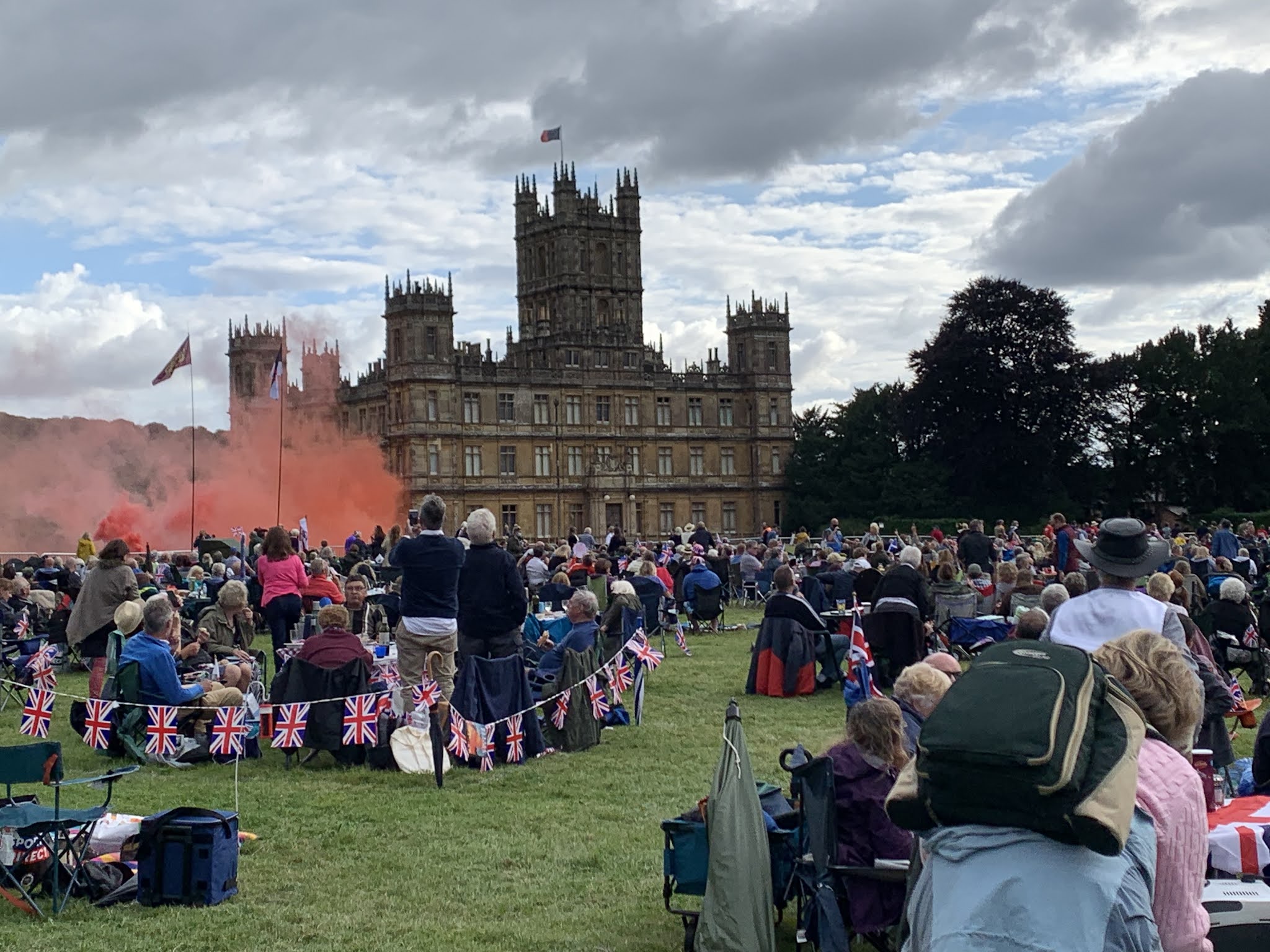
I’ve written of the Battle Proms here multiple times over the years. Its unchanging features have never been more comforting than after our long, forced separation from normality. The Regency cavalry display. The opening act of WW2 classic songs. The Red Devils parachute display drop. The Spitfire flyover. The classical music concert with the rousing programme of patriotic tunes and fireworks that never varies.  

There were two new elements for us this year. We chose to hire a marquee rather than bringing our own. It was supposed to simplify the organisation of a large family group, though five of our planned eight were stuck on the continent due to continuing quarantine rules for foreign travel. At £122 is was a humorously palatial splurge for the three remaining ticket holders, but we realised it came with distinct advantages. A guaranteed spot meant we didn’t have to arrive early and join the mad scramble to claim a space. We could turn up at leisure and set up in the first row of marquees with a straight view to the stage. None of the hassle of pitching our tent or, even better, trying to strike it and find all the tent pegs and ropes in the dark.

Second, since our last Battle Proms we’ve met the Earl and Countess of Carnarvon. I wrote about the surprisingly intimate cocktail party on their lawns here, which gave us the familiarity to say hello. They didn’t remember us, of course, but the earl returned our greetings and the countess stopped for a lengthy chat. As ever when exposed to the modern aristocrats running the enterprises built around England’s stately homes, I’m amazed by their easy familiarity and ease with “the people”. Highclere’s owners floated amongst the crowds like any other attendee, looking and interacting like the people next door. You can’t run a hospitality business without that talent, of course, but it always amuses me to imagine what the founders of these dynasties would think of the way “aristocracy” has evolved. 

The event could have been concocted by the English tourism board to give life to the fantasy most foreigners have of this country. A benevolent lord and lady welcoming the locals into their grounds. Genial, well-behaved crowds spreading lavish picnics on the sloping lawns of a stately home, flags fluttering in a gentle breeze, a view of picturesque countryside stretching for miles and the slowly setting sun turning a world of green and blue into gold and dark purple. 

English tourism would also do well to celebrate Fuller’s “Shakespeare in the Garden” series. Growing up in America, my early exposure to The Bard was all high culture to be slaved over at school and given worthy respect in serious theatres. That happens here too, of course, but in the land of Shakespeare’s birth there’s enough familiarity to bring a more casual treatment, plus more actors trained in his works. Thus we get David Mitchell and Ben Elton’s Upstart Crow on screen and stage, and a hefty schedule of outdoor performances throughout the summer by small companies in the grounds of stately homes. Fuller’s pubs make things even merrier with their “Open Bar” company.

These talented young actors know their Shakespeare, but they’re also skilled at improv, physical comedy and audience interaction. We saw them put on The Merry Wives of Windsor at The Calleva Arms in Silchester in 2019 and were curious to see what they’d do with the much more challenging Love’s Labour Lost. They updated bits of the text with contemporary humour, added music and slipped in and out of character and gender. We watched just four of them take on a story about of trio of men wooing another trio of women, who interact with at least five significant secondary roles. With basic costume changes, a couple of dummies assembled from balloons and a tremendous amount of skill, the company managed to tell a complex story and keep us entertained.

That’s no mean feat for what I consider to be one of Shakespeare’s most difficult comedies. It’s an early one, much in need of editing … no surprise it holds both Shakespeare’s longest scene and longest soliloquy … and the characters are neither particularly memorable nor loveable. It’s a romantic comedy without a resolution or a happy ending. But its biggest challenge is being laden with rapid-fire wit and pedantic word play at a pace that would be familiar to fans of Hamilton.  As with that modern musical, I suspect contemporary audiences would have needed to see Labours three or four times to digest all the dialogue. With more than four hundred years of linguistic evolution since then, it’s hard for even well-read Shakespeare fans to follow. The fact that four young actors could transform it into a jolly, comprehensible romp in a pub garden was truly amazing. 

Our theatrical outing a week later was much more serious. Bach and Sons explores the difficult relationship between the magnificently talented Johann Sebastian and his two eldest sons. Firstborn Wilhelm was reportedly a prodigy, but frittered his life away in drink and undemanding jobs. Carl Friedrich lacked his father’s spark, but hard work sharpened his proficiency enough to become a court musician to Frederick the Great and a composer whose work is still played. (I was a bit disappointed that the much younger sibling, Johann Christian, who went on to be known as “the English Bach”, didn’t feature.) 

Written by award-winning Nina Raine, directed by London theatre giant Nicholas Hytner and starring the wonderful Simon Russell Beale, you’d think there would be enough talent here to create something as memorable as Amadeus. No such luck.

Bach and Sons can’t decide what it wants to be. On one side, it’s an exploration of J.S.’s  music and genius. On the other, it’s the story of parental favouritism and the trauma that fault inflicts on a family. Amadeus offered a similar mix of genius profile and everyman story (in that case, professional jealousy), but did it much better. With Bach and Sons, I think people without a solid background in the music and the history might struggle to keep up. And while the family dynamics delivered enough melodrama to bring tears to sensitive eyes at the end, the whole thing was entertaining rather than profound. Good, but not great. I suspect the flaws are most evident in the fact that the relatively small role of Frederick the Great (played with a masterful mix of vulnerability, megalomania and charm by Pravesh Rana) stole the show comprehensively. I left the theatre thinking a play about him, starring Rana, would have been far more exciting than the time I’d just spent with the Bachs. 

All that said, if you’re a fan of Bach and his music I’d still recommend this as an excellent night out. If you don’t have that foundation as a starting point, I’d pass. Bach and Sons is on at The Bridge Theatre through 11 September.

Despite my joy of being in public at these three events, the spectre of COVID-19 still haunts us, of course. Even though it was an outdoor activity, Highclere reduced ticket sales by 40% to ensure plenty of room between family groups, and it was fascinating to watch how strangers … even in the most gregarious circumstances … now instinctively give each other a wider berth. Staff at all the concession booths wore masks and guests were respectively asked to do so while moving around the festival grounds.  The same mask protocol was in place at our pub. The Bridge, more sensitive because they’re indoors, kept buffer seats between booked groups, asked everyone to remain masked throughout, kept their coat check closed, didn’t serve food and requested that people pre-book interval drinks online to reduce the potential contact that comes with queuing. These are tolerable irritations for guests but must be cutting into producers’ profit margins severely. So while life is starting to appear normal, we have a long way to go.

Friday, 6 March 2020

Glorious Upstart Crow is one of the funniest things to ever bless the London Stage

If you appreciate Shakespeare, think the finest form of comedy is witty wordplay, believe that Blackadder is a masterpiece of British television, and can get to London before 25 April, you need to book tickets to The Upstart Crow. 

Now. 
You probably shouldn’t even finish reading this review. Because if you don’t catch this masterpiece’s short run you will miss one of the most gloriously funny, joyously silly yet fiercely intelligent productions to ever grace a London stage. 

The Blackadder reference is intentional, as this gem is written by that series’ scribe, Ben Elton, and he’s on top form here. And like the earlier historical romp, Upstart Crow started life as a TV series. This is not, however, one of those screen-to-stage copies that West End producers turn to when looking for quick profits (Mamma Mia, Pretty Woman) but an entirely new work. 

We’ve moved on from the TV show’s Elizabethan period to the new regime of James I, where Shakespeare needs to prove himself afresh. Naturally, his creative juices are running dry and much merriment ensues to get them flowing. 

We’re treated to the familiar leads from the original series. David Mitchell returns as the insecure, callous but ultimately kind-hearted Bard, pinching ideas from those around him before falling into genius when the spirit strikes. It’s hard to believe this is Mitchell’s first appearance on stage: his live timing is perfect and he’s remarkably moving when the action briefly turns serious and he has to do the mad scene from Lear. Gemma Whelan reminds us why she’s one of Britain’s best young actresses, banishing memories of her as a rampaging, hard-ass pirate queen in Game of Thrones and the prim sister in Gentleman Jack to give us the sweet, clever and determined Kate, clearly Shakespeare’s muse. 

History won’t allow Mark Heap to reprise his role as Shakespeare’s nemesis, theatre censor Robert Greene, as he was long dead by the Jacobean accession. So Heap comes back in a new role as a Puritan doctor channeling the spirit of Twelfth Night’s Malvolio. And Rob Rouse is back as servant, straight man and ego-pricker Bottom. 

In the best Eltonian ... and Shakespearean ... tradition, the comedy alternates between farce, slapstick and brainy wordplay. While the extreme role reversals, physical pratfalls and very modern send-ups of public transport and political correctness will get a laugh out of anyone, there’s no denying that the better you know your Shakespeare, the funnier this play is. The Upstart Crow treats Shakespeare’s work not as a sacred canon but as a living larder of human creativity, where the brilliant and the bad, the strikingly original and the shamelessly copied, all live side-by-side.

The plot gleefully mashes up Twelfth Night, Othello, Romeo and Juliet and King Lear. For those who laboured over the plays at school, your efforts will be amply rewarded as you spot the jokes and chuckle at how one story slides into another. References to many other plays pop up, including jibes about the bad ones, the cheap plotting tricks and the plagiarism. Will’s constantly noting down lines that come out of other characters’ mouths that the Shakespeareans amongst us know will go on to become classics. There’s even an explanation of The Bard’s most enigmatic stage direction, complete with a dancing bear who almost steals the whole show. 
This isn’t new, of course. Elton and Mitchell take a path well trodden, most notably by Tom Stoppard in Shakespeare in Love. One my favourite Doctor Who episodes in the David Tennant era springs to mind. But for pure, glorious, feel-good comedy, it’s never been done better than here. 

I’d expect that much of this will eventually come to the small screen as elements of a fourth series. But there’s a magic on the live stage I doubt a filmed version will be able to capture. The communal joy of hundreds of people joining in belly-aching laughter. The actors playing to the audience. The wonderfully authentic Shakespearean set design. And the dancing bear. The dancing bear needs to be seen live. 

What are you doing still reading this? Go book some tickets. Now!

Sunday, 16 June 2019

The Bridge's "Midsummer" is riotous fun. Book now!

I went to a dance club with a couple of famous TV actors on Friday. I also sampled a Glastonbury-
like music festival. Then there were some Cirque de Soleil style acrobats doing ridiculously impossible things while hanging from silken sheets. And there was Shakespeare.

Rather remarkably, it was all Shakespeare.

The Bridge Theatre's new production of A Midsummer Night's Dream may be the most fun I have ever had in a theatre. (Well, it's pipped to the comedy post by Book of Mormon, but it's close.) This is Shakespeare's most accessible play. With the highly-physical comedy of love potions gone wrong, and its famous play-within-a-play open to lots of interpretation, it's not so important that you grasp every nuance of the 400-year-old language. It was my introduction to Shakespeare on a grade school trip and it's the play I've seen most, through numerous Shakespeare festivals, summer park productions and interpretations on the lawns of English country houses. There are at least three major film versions, the classic being the 1999 outing with Michelle Pfeiffer, Kevin Kline, Rupert Everett and Stanley Tucci. (Highly recommended.) But I've never enjoyed it more than I did in this rollicking, modern production.

At the start, I wasn't sure that would be the case. We entered to see the star attraction, Gwendoline Christie (better known to millions of fans as Game of Thrones' Brienne of Tarth) incarcerated in a glass box as the audience filed in around her. As with last year's exceptional Julius Caesar, this production was in the round with the "groundlings" playing an active role throughout. As the action started, the costuming was decidedly channelling The Handmaid's Tale, with everyone in sober colours and the women all wearing headscarves and sensible shoes. The interpretation highlights a plot point that's often overlooked in productions: the impending nuptials are forced ones. The hero Theseus won the Amazon Queen Hippolyta by defeating her in battle. This is not a love match but an act of political subjugation. Thus the casting of Christie was inspired; enraged, brooding warrior maiden is old hat for her.

Fortunately, things get brighter very quickly and we spend most of the play in the fairy world in the forests beyond Athens where Christie and Oliver Chris (a stalwart of British stage and TV, best known for the play King Charles III on both) play Titania and Oberon, queen and king of the fairies, as well as Hippolyta and Theseus. As is traditional. What is most definitely not traditional is that this production swaps parts, giving Titania the lines meant for Oberon and vice versa. Meaning that it's the man who falls into a ridiculous enchanted passion with a donkey-headed rustic, while the woman manipulates the action.


Not only does this bring some much needed balance to a play where the women are traditionally the subservient characters, but it's just plain funnier. And Chris is a genius of physical comedy. The scenes of passionate courtship between his Oberon and the Barry White wanna-be Bottom, played by Hammed Animashaun, will have you laughing so hard you'll be fighting to breathe. While the whole cast is strong it's these two, rather than the crowd-pulling Christie, who deliver the most memorable performances.

Christie is excellent as well, unsurprisingly, and brings a dignity to the role we don't usually see from Titania. She is a loving wife teaching her spoiled and complacent husband a much needed lesson before their warm reunion.

The groundlings are as much a character as the actors. They dance, they cheer, they join hands and circle the stage as bewitched lovers commit their madness. At one point, we shift scenes with an enormous white cloth being passed over their heads as pop music booms. The peasant players borrow a phone from the audience to check calendar dates, only returning it after a cast selfie. At the end, we all join in to the wedding festivities as cast and groundlings dance together, bouncing enormous inflatable moons around the theatre as Beyonce's Love on Top swells out of the sound system.

The staging makes the most of The Bridge's ability to bring blocks of the performance area up and down, constantly shifting the contours and location of the performance space along with the plot. They also put the gantry above the stage to good use, with the fairy folk doing impressive acrobatics in silk slings and beds levitate.

Reviews of this production have been decidedly mixed, with some Shakespeare purists saying the Oberon/Titania switch didn't work, that the interpretation overdoes the comedy and eclipses some of Shakespeare's poetry, and that an excessive (and unscripted) distribution of love potion forces a gender-bending hilarity in line with Pride Month but distracting from the plot.

I'd ignore them all. This Midsummer is fun. Too many people think Shakespeare is about stuffy classics to be endured rather than enjoyed. Something only the highly educated can appreciate. What BS. Shakespeare was a man of the people who played to the masses. A Midsummer Night's Dream is one of the best examples of that. I think the The Bard would have loved this production, and would have been the centre of the party as the post-production dancing kicked off.


Saturday, 17 March 2018

Shockingly relevant Caesar christens London's newest theatre

It's a generally-acknowledged fact that Shakespeare's plays transcend their original time period, but I've never seen the time shift done better than the production of Julius Caesar now running at London's Bridge Theatre.


It was clearly meant from its inception to be a blockbuster to lure audiences to London's newest venue. The cast is particularly starry. Ben Whishaw is a wistful, scholarly Brutus pushed against his will into doing the right thing. David Calder gives us an aging dictator in leather bomber jacket and red baseball cap emblazoned with "Caesar" in bold white letters; a none-to-subtle channelling of Donald Trump mobilising the mob. David Morrissey, fresh from playing the creepy, manipulative Roman commander in Britannia, gives a compellingly manipulative Marc Antony. And Michelle Fairley (most recognisable as Catelyn Stark in Game of Thrones) is brilliantly cast as Cassius. The gender bending ... Casca and Decius Brutus also appear as women ... gives a whole new and topical angle to the frustration of the conspirators as outsiders; you can interpret their frustration as that of intelligent women trying to crack through the glass ceiling of Caesar's inner circle.

The powerful performances from all of these familiar faces would have been enough to make this memorable. The creative staging made it remarkable.

The Roman mob is oft referred to in Shakespeare's text. Here, it's a very tangible additional character. This production is staged as theatre in the round, with 150 or 200 audience members standing on the floor. They're encouraged to play their part by theatre staffers mixed amongst them. We enter the theatre to a political rally in full swing. A band is playing hard-driving rally standards: Eye of the Tiger, We're Not Gonna Take It. Red flags with Ceasar's logo fly, vendors sell Caesar hats, the audience dances. Above, three circles of seats look down on the crowd; merely by our seats and our separation, we've become part of Brutus and Cassius' liberal elite, looking down on a populist uprising with vague discomfort.


It's brilliant theatre. And by plugging into current fears it has a visceral relevance. Later on, those same audience members are given Caesar posters to hold up at his funeral. We watch the tide turn on their faces as Brutus' carefully reasoned, fact-based, confident but uninspired address at first has them on side. Then their mood flips completely as Mark Antony's emotional appeal whips them into a fury. The Roman elite stand by in bewilderment, unable to understand how the people have been lured to support something so obviously against their own best interests. It's Brexit all over again.

The stage itself plays as much of a role as the crowd. It's comprised of big rectangles that can lift from slightly elevated to towering over the crowds' heads. The ground beneath us is shifting constantly, a metaphor for the politics on stage. It's particularly effective in Caesar's assassination scene, when levels ascend to him on a king-like throne, and in the final battle when the two sides are separated by a physical chasm between them.

Nicholas Hytner, the director of this production and one of the people behind The Bridge's creation, argued passionately that London didn't have a truly modern theatre space. This staging certainly validates his point. I was less enthused about the Bridge's public spaces. Considering that it's purpose-built and that pre-visit emails entice you to come early for an exiting variety of food and drink, I was shocked at some of the basic issues. There's just not enough room.

There's one main public space that functions as dining area, lounge, bar, box office and coat check area. It certainly looks cool and trendy: one long bar, a constellation of interesting light fixtures, a collection of small tables and breakfast-bar style perches. Arriving two full hours before the play, all available seats were already gone. By half an hour before curtain the pile-up at the bar was challenging. Exiting was a shoulder-to-shoulder scrum, as all members of the ground-floor mob were waiting in two sluggish queues that stretched all the way to the doors (they'd been forced to check everything before getting in). And this wasn't even a sell-out performance.


It's possible that these are just early teething pains, and the situation will certainly improve in the summer. There's a wide lawn in front of the theatre with a sweeping view of The Tower and Tower bridge; it's clear they plan for crowds to spill out here in good weather. But in the winter, it certainly seems like the facilities are inadequate for the performance space.

I'd definitely recommend seeing performances here, but go elsewhere for your pre-theatre libations. There's a new branch of The Ivy directly next door, which definitely requires advance booking but would certainly be the logical choice for dining. And, whatever you do, avoid checking anything.

Julius Caesar runs until 15 October. Can't get to London? There's a live broadcast to cinemas on 22 March. You won't see a better transposition of Shakespeare to the modern world. Book it!

Saturday, 8 April 2017

Wanamaker's feminist Othello is interesting, but only partially successful

I don't mind modernist re-interpretations of Shakespeare when they make a valid point. But they can be tricky to make work, and particularly so when your setting is the candlelit, Jacobean-revival Wanamaker Theatre. It's a space created specifically to show off 17th century drama as it would have been performed when written. So swapping male characters for female, using pop music lyrics and having a one-armed actress doing trapeze moves is a bigger risk here than it would be in a modern setting.

Director Ellen McDougall does all of this, most notably casting Casio ... Othello's faithful lieutenant, whose promotion enrages Iago and thus sets the whole tragedy in motion ... as a woman. For 80% of the play, this seems either pointless or downright confusing. But as we near the crisis, it works. First, as Iago gets Casio drunk in order to frame her, we see a woman in a man's word, drinking with the boys in an attempt to be considered part of their fellowship. (I doubt there's a woman in the corporate world for whom this bit doesn't resonate.) Later, when Casio joins Desdemona and her maid to bemoan fate and plan a way back into Othello's good graces, we have a shattering scene of powerless women, acted upon by less-wise, less-mature men in complete control of the women's fate. At this point, McDougall's feminist take goes straight to the heart.

The interpretation might have worked better with a stronger Iago. Sam Spruell was good, but not great, lacking the truly evil duplicity that's made my spine tingle with other performances. What we really needed here was that mix of contempt and fear that radiates uncontrollably towards all women when a misogynist has to deal with them, counterbalanced by excessive bloke-ishness when he's with the lads. Though Spruell's Iago treated his wife (who is also, critically, Desdemona's maid) abominably, he's doing it here because he's a bad man, not because he hates women.

My biggest issue with this reading of the play, however, is that we lose Othello's story. This version could have been rebranded Desdemona, with the Moor relegated to a manipulated chump. We lost the complexities of his outsider status and the tremendous power of his love for his wife. This Desdemona, meanwhile, is far too confident and self-assured. (Though she's admirably played by Natalie Klamar, whose scenes with Thalissa Teixeira's Emilia were ... unsurprisingly, given the re-working ... amongst the strongest in the play.)

Shakespeare wrote a young girl in the devoted flush of first love, her story all the more poignant because she doesn't understand what's happening to her. McDougall's knowing Desdemona is more angry than bewildered. One of the reasons this tragedy works so well is that you care deeply about both characters, mourning that they've both been betrayed into a senseless end. Here, McDougall goes so far as to change Desdemona's last words, swapping out the pitiful "but while I say one prayer" for a bitter scream of "Get OFF" as she puts up one hell of a fight. The scene's transformed into a tawdry peepshow into modern domestic violence. Disturbing and powerful, but it's a very different ... and less original ... story than the one you probably paid to see.

I am, no doubt, overly critical because I was fortunate enough to be in the audience for one of the greatest Othellos of all time here in London in 2008. I reviewed it here. Chiwetel Ejiofor (since Oscar-nominated for 12 Years a Slave) gave us a Moor raging against the machine and collapsing in upon himself. Ewan McGregor gave us an Iago so slimy as to make your skin crawl. While an unknown newcomer named Tom Hiddleston offered a heart-wrenchingly naive Casio. When this Othello realised the magnitude of his stupidity and gathered his murdered wife into his arms, there wasn't a dry eye in the house.

Back at the Wanamaker, the feminist version is sold out. As are most performances in this tiny jewel box of a theatre. If you're a fan of the play, but didn't get a ticket, don't mourn too much. It was interesting, but definitely not an Othello for the ages.