Showing posts with label Jane Austen. Show all posts

Thursday, 6 June 2024

Two London productions re-interpret literary classics: I only love one of them

If I were a real arts critic, paid to be an arbiter of good taste, I would no doubt tell you that the best theatre experience I’ve had in London in recent weeks was Player Kings, the mash-up of Henry IV parts one and two currently providing a star vehicle for Ian McKellen at the Noël Coward Theatre. But I’m not, and I won’t. Because though there was much that was worthy and thought-provoking in the Shakespearean offering, my heart belongs to an extension of Jane Austen’s universe brought to life on a tiny West End stage that even most of London’s theatre cognoscenti don’t know exists.

Being Mr. Wickham is a one-man, one-act show that drops us in to the study of Jane Austen’s most notorious villain on the evening of his 60th birthday. He’s had a spat with his wife Lydia, but he’s fired with the energy of the day and he wants to talk. Given the milestone of age, he’s in the mood to reminisce. What follows is a wildly entertaining conversation that updates us on how all of our favourite characters from Pride and Prejudice have evolved, makes us question the plot we thought we knew, and suggests some interesting parallels with our modern times.
I use the word “conversation” intentionally. No, you’re not talking back to the actor. But the 70-seat Jermyn Street Theatre is so intimate, and Adrian Lukis so adept at engaging the audience, that everyone else seems to disappear and you really do feel like you’re having an intimate tête-à-tête with one of literature’s most charismatic rogues. The fact that Lukis brings Wickham to such glorious, credible life is no surprise. He played the role in the BBC’s landmark 1995 adaptation, and though he’s been a busy actor in the three decades since, there’s a whole generation who will always imagine him as a Regency-era rake.  

He also wrote the play, thus brings an author’s intimate understanding to the words. And good words they are, too. Many writers have tried to extend Austen’s world, with varying levels of success. They usually get the language wrong, forgetting that Austen was remarkably sparse in her description, simple in her vocabulary, and deftly subtle in her characterisations. Lukis gets all of this spot on, as well as giving us plot evolutions that are entirely credible. His combined amazement and horror both at making it to 60 and evolving into a somewhat respectable member of society is so Wickham.

Austen never wrote scenes without women, because she insisted on writing only what she knew. So another delight of this show is getting a perspective that feels authentically Austen, but is also undeniably masculine. It goes places Jane could not, reminding us of a sexual licentiousness and an urban dynamism within the Regency that are alien to the novels, but would have been familiar to … if unspoken by … her male characters. Wickham’s anecdote about almost winning a night with one of the greatest courtesans of the age, only to by cut out by Byron, is thrilling.

Lukis originally wrote the one-act play for the 2019 Jane Austen festival in Bath, and I originally saw it during a broadcast production when the pandemic locked us all in. I liked it so much then that I jumped at the chance to see it live, and I’m so glad I did. The size of the theatre and Lukis’ electric presence made this a truly memorable theatrical experience.
Player Kings was equally memorable, even if I didn't enjoy it as much. There’s a reason that Ian McKellen is considered one of the greatest actors of his generation. He commands the stage with a presence few other human beings can muster. As expected, he delivers the best Falstaff I’ve ever seen. Remarkably complex. Villainous yet vulnerable. Unattractive yet compelling. Funny yet heartbreaking. Robert Icke’s editing of two plays into one has, naturally, left a lot on the cutting room floor. What remains might have just as well been called Falstaff.

The challenge of this approach for me is that Falstaff’s always been the character who irritates me most in these plays. Queen Elizabeth might have loved him so much she asked Shakespeare to give him his own play (giving us the Merry Wives of Windsor), but I would have asked The Bard to cut that role way back. I get the poignancy, and real-world relevance, of balancing the father Prince Hal has with the father figure he chooses to have fun with. But I want the plays to focus on Hal’s unexpected development from disappointing rebel to great king, and his changing relationship with his father. Falstaff is a necessary catalyst to those changes, but I prefer him in the background.

I wanted the Prince Hal focus even more from this production, since Prince Hal is being brought to life by Toheeb Jimoh, who gave us the delectable Sam Obisanya in Ted Lasso. Jimoh is fantastic. He probably did a better job than any other actor I’ve seen in the role at bringing out the teenage irresponsibility and madness of the young Hal. I think the prince’s character transformation is one of the hardest in literature to pull off … yes, I know Shakespeare is sacred but his plot makes the evolution pretty hard to believe … but Jimoh manages well. 

He’s hindered by Icke’s interpretation however, which makes some odd choices. I’ll avoid spoilers but say the way this production delivers the duel between Hal and Hotspur bothered me so much I pulled out the play as soon as I got home to check the author’s stage instructions. While Icke isn’t specifically countering anything written by Shakespeare, he’s introducing stuff that brings Hal’s whole character development … and thus the traditional meaning of the whole play … into question. No matter how good the acting, “the play’s the thing”, and I’m not a fan of what this production did to this one.
Of course, I’m not the target market. Player Kings, like the current production of Romeo and Juliet with Tom Holland playing just down the street, has been designed to bring in a younger audience that isn’t naturally drawn to Shakespeare. Thus the present day East End gangland setting, the mixed race casting, the modern music. Being Mr. Wickham, on the other hand, was clearly developed for a generation of people … mostly female … for whom that 1995 television production was transformative. It’s no surprise that we meet Wickham on turning 60; I suspect his frustrations at reaching an age he doesn’t feel parallel a great many in the audience. Including me in a few months. So while I’m glad I made the effort to see McKellen and Jimoh live on stage, it’s Lukis who gave me the greatest joy.

Both shows have very short London runs closing on 22 June, so if you’re interested in either get booking now.

Thursday, 26 January 2023

Chawton celebrates literary women far beyond its Austen connections

I am always delighted by bits of English heritage that are thriving thanks to the money and passions of Americans. Many of these rescue stories are well known: Blenheim Palace, Hidecote Manor Gardens and Hever Castle are just the tip of an enormous iceberg. Little did I realise that Chawton House, in my own neighbourhood, is another member of the American club.

If you’re judging on the usual stately home standards of architectural grandeur or museum-quality contents, Chawton is little known and insignificant . Amongst one group, however, it’s vastly important. Serious Jane Austen fans, aka “Janeites” will know of it as the home of Jane’s brother, Edward, whose generousity gave her the time and space to write her novels. While the Austen link is important, it’s the house’s role as an advocate for and repository of the works of literary women from the Tudor through Georgian periods that makes it truly unique these days. Chawton’s survival as a heritage attraction open to visitors, and its broader literary endeavours, are due to California-born Sandy Lerner.

Lerner was a co-founder of Cisco Systems and, in classic Silicon Valley style, graduated from IT exec to investor and benefactor. With degrees in international relations and economics before she embraced computing, Lerner was more of a Renaissance being than your typical IT boffin, displayed in her subsequent involvement in animal welfare, historic home renovation and the founding of Urban Decay cosmetics. Most salient to the Chawton story, however, is Lerner’s fascination with early female writers, many of whom produced popular works in their lifetimes but were forgotten in male-curated history. When Chawton's owners in the early 1990s decided they could no longer maintain the house, Lerner’s literary passions and love of Jane Austen made her the perfect buyer. She didn’t just spearhead the restoration of a building in tenuous shape, she established a Centre for the Study of Early Women’s Writing (1600-1830) and donated a significant, and probably unique, collection of books by those oft-neglected writers. Though Lerner is no longer actively involved in running the place, her spirit lives on.

As someone who’s spent her whole working life in the IT industry, I can assure you that female executives are rare beasts, and senior leaders interested in history and the arts rank with dragons and hippogriffs. The Chawton story filled me with joy. More practically, so did the experience of visiting the house. 

It’s not a large place, but full of charm. Not an aristocratic residence, but the kind of small estate over which you’d find Austen characters like Mr. Knightly or Colonel Brandon presiding. Unsurprising; Jane spent a great deal of time here and it would have been a natural model. It’s a venerable, grey stone pile with two pronounced gables and a generally Jacobean appearance, though its roots are Elizabethan and the Victorians added bits. It sits three quarters of the way up a hill, woods to its back and a verdant valley at its feet, with thatch-heavy, hugely picturesque Chawton village just a 10-minute walk.

Inside, there’s a procession of pretty, panelled rooms, some hugely atmospheric hallways and all the split levels and strange corners you’d expect of a place that’s been added to bit by bit over more than 400 years without ever seeing a comprehensive makeover in any one style. Most magical, no doubt because I was already in a literary frame of mind and the house is, functionally, a giant library, were the many nooks that seemed perfect for reading or writing. The most obvious spot was labelled as the alcove that had once been Jane’s favourite, but there were armchairs in front of fires or on small landings, benches in sunlight-filled hallways and a cozy little room with a writing desk in it that invited paper-based recreation. 

Other items of interest on permanent display in the house include family portraits … a fascinating clan full of interesting women ... a striking 17th century staircase, a detailed map of early Georgian London on an enormous folding screen, armourial glass in windows and period costumes. Entering the library, tucked behind the gift shop, is by request and worth doing to see shelves packed with historic tomes you've probably never heard of. Here was the only disappointment of touring Chawton. Quite understandably, you have to be supervised by a staff member when you're looking at this precious collection, and unless you're a registered academic who's made a request in advance you can't take anything down to read. If you love books, it's like walking into a lavish bakery when you're on Weight Watchers.

The shop can assuage that unfulfilled hunger; it's a small but beautifully curated selection of books, literary-themed gifts and country house-influenced homeware. 

Upstairs, two rooms serve as galleries for temporary exhibitions, mostly drawn from the books in the library. There's none of the fancy set design, lighting and projection I recently wrote about in my article on the Museum of Danish Resistance, but there’s still a strong effort here at storytelling … even if what you’re looking at is mostly books and documents. The current exhibition is Trailblazers: Women travel writers and the exchange of knowledge. Obviously, a topic near and dear to my heart.

None of these early women set out to earn money off the descriptions of their journeys. Most travelled for other reasons, from their husbands' jobs to escapism to enjoying the same grand tours as their brothers. Many had outrageous adventures beyond the imaginations of modern professionals: imprisonment, shipwreck, death of the travelling companion who was their reason for travel, revolution. Unsurprisingly, their adventures made for some fabulous literature, much of it sadly no longer in print. 

We meet Lady Mary Wortley Montagu, who accompanied her ambassador husband to the Ottoman court, and amongst other wonders wrote about successful vaccinations 75 years before Jenner “invented” the smallpox vaccine in England. Hester Stanhope, niece and hostess to Prime Minister William Pitt the Younger, went travelling across the Eastern Mediterranean, became an early archeologist, went native and never came home. Maria Graham accompanied her naval officer husband around the world, started writing about her travels and eventually earned her living from writing after her husband died. 

These are just a few of the fascinating heroines you get to meet. On display are their notes and published books, plus ephemera like 19th century grand tourists’ calling cards, historic passports and letters of transit (ones from the Ottoman Empire are spectacularly beautiful), sketches and watercolours. Curators add a bit of fun with a “passport” you can pick up at the start and “stamp” with different locations as you learn about each of the women in the spotlight. The exhibition continues until 26 February.

Chawton has a surprising number of special events given its humble size, including upcoming lectures on the exhibition, snowdrop walks and a Valentine's Day dinner in its old kitchen, all listed on its website. General admission is free for Historic Houses Association members. An adult day ticket is £12.

Related stories:

- Chawton Cottage is amongst the sites I mention in my roundup of North Hampshire highlights

-A "Hawk Walk" in Chawton House grounds is the perfect gift for someone who needs nothing

-Jane Austen sites make for a grown up hen do

-A walk around Steventon and its lush environs

Saturday, 10 April 2021

West of Basingstoke: Literary roots, architectural surprises and dreamy riverbanks

Many great men have made their mark on Basingstoke, but it's a woman who'd achieved only a modest reputation by the time she died who stars on the signs marking the entrance to our borough.

Jane Austen's fame has grown exponentially since her death in 1817. If you're a foreign tourist making an effort to get to North Hampshire, there's a good chance she's the reason why. I've visited, and written before about, her house and museum at Chawton Cottage and her burial place at Winchester Cathedral. But I'd never made the effort to check out her birthplace at Steventon, just seven miles to the west of Basingstoke. 

It was an ideal objective for staycation exploration and lies just off a road that offers one of my favourite drives in the area. Turns out there are some pretty walks along it, too.

Calling Steventon a village is a stretch. It's a broadly-scattered collection of houses and farms just off the road that runs west from Basingstoke to Whitchurch (the B3400). The land here slopes gently down from the B3400 before starting to climb to a tree-lined ridge. From its top, you get a soothing view of the rolling hills and valleys, patch-worked with farm fields and woodland, that characterise this bit of England. 

The house where Jane grew up no longer exists, but Steventon's high point ... both geologically and for tourism ... is the church where her father was vicar.

I can imagine her eyes tracing the patterns on the painted arch, watching dust motes dance in the pools of sunlight and letting her mind drift to making up stories about other villagers in other places.

There are memorials to her father, mother and brother, who followed in his father's parish footsteps, near the altar. But as with the memorials in Winchester Cathedral, it took fans from later generations to commemorate Jane's presence here.

Returning to the main road, you continue west to the pretty and much larger village of Overton. In Jane's day it was probably best known for being near the source of the River Test, and would have been the easiest place for her family to do a bit of shopping. Later in the 19th century its claim to fame was a mill that created the paper used for official government banknotes, now transformed into the Bombay Sapphire Distillery.

My usual destination on the B3400 lies a mile further west: Hardy's Cottage Garden Plants. But with my favourite nursery for herbaceous perennials still closed to the public, I decided to stop just short of it to take a look at something along the road that had always caught my eye.

Locals claim that the picturesque line of estate cottages at Freefolk comprise the longest continuous stretch of thatching in the country. Whether true or not, they're certainly make one of the most photogenic scenes in the local area.


And locals know it. They've even multiplied their charm by insisting on matching thatched bus stops out front.

Follow the brown sign to the Church of St. Nicholas, up a little lane across the road, for another treat. The old vicarage here is now a multi-million pound manor house beside the Test; the stuff lottery dreams are made of. 

Tucked into the south flank of the property is the tiny, ancient church. Its foundations date from the 13th century but the exterior you see today is thanks to some remodelling at the time of William and Mary (early 1700s).


The interior has a peaceful simplicity


but also reminds you of the layers of history that build up in a place like this. Recent work has uncovered some early wall paintings of St. Christopher, probably whitewashed during the reformation.

The most spectacular thing here, however, and delightful surprise in such a simple place, is the ornate tomb of Richard Paulet, son of the 2nd Marquess of Winchester. 

After seeing the relatively simple family tombs in the church at the family seat in Old Basing, it was a surprise to find one of them lying in such isolated splendour. 


A signboard outside reveals that there's a county-maintained trail linking 5 different mills along the Test, running from the Bombay Distillery at the Laverstoke Mill to the Silk Mill at Whitchurch. 


Following it a short way from St. Nicholas' (where there's free parking just across the lane) takes you down to the main road, past the thatched estate cottages and into a riverside woodland so magical it reminded me of the famous moss-garden we visited in Japan. (Sadly the light at the time didn't allow me to get any decent pictures of it.)

Beyond that, a bridge crosses the test offering magnificent views, and just a few steps further on a cement weir that offers you a place to sit beside the river.

The same geography that makes North Hampshire's rivers clean, swift-flowing and exquisitely beautiful also makes them rare, ecologically fragile and home to prized brown trout. This means that most of the riverbanks are fenced off on inaccessible private land, jealously guarded for their fishing rights and zealously protected from polluters. This is one of the few places I've found where you could sit quietly beside the water, and I plan to be back. Next time, it will be with a picnic hamper, a chair and a watercolour set. 

I suspect not much has changed here since Jane Austen's day ... and I'd guess that's just the way the locals like it. I certainly do.

Friday, 2 April 2021

Beneath the modern blight, Basingstoke is rich in history and architecture

Modern Brits are so attached to foreign holidays that "staycation" typically means not leaving the country.
Not leaving home? Now that's a stretch. 

It's no surprise that my wanderlust fit well amongst the English; other than Christmas, I don't think I've ever taken off work and not gone somewhere. But I'm doing it now. With three intense months at my back I simply don't have the energy to wait until lockdowns lift and hotels open. Thus I'm embarking on two weeks Chez Bencard, without even local museums, stately homes and restaurants open to make things memorable. What's a holiday sightseer to do?

I've decided to treat my home territory as if I were a foreign tourist, going out on an excursion every day to learn about, photograph and walk around spots I may take for granted in my daily life. Pandemic lockdowns take interiors off-limits, so my explorations will be about exteriors, views and outdoor rambles. First up: Basingstoke.

If you want to see how the English class system is still alive and well, tell upper-middle class professionals you've moved to Basingstoke. Their inherent politeness will prevent them from saying what they really think, but for just a moment as they master their surprise their faces will register a mix of surprise and horror. Then will come the understanding consolation. "I suppose the commuting is good from there, eh?"

Why the disdain? In modern minds Basingstoke is perhaps best known for its role in post-war slum clearances from London. Government money poured into the place in the 1960s to fund great swathes of social housing into which some of the capital's poorest were re-located. The architecture was dismal and oppressive. However, as an informative exhibit in the town centre's museum points out, the new housing was considered luxurious by people who'd had little access to indoor plumbing, space or fresh air. 

The town grew steadily but poor architectural choices continued. Brutalist office blocks and grimy overpasses line the motorway-like main drag through town. Strip malls, office parks and industrial estates ring the town centre. Doubtless trying to improve things, civic worthies in the early 1970s bulldozed much of the town centre and replaced it with a shopping mall and car-parks. It is, on first glance, a charmless, down-at-heel amalgamation of cement, steel and eye-punishing signage that is only made palatable by its transport links. (And perhaps by Berry Bros. & Rudd's HQ in one of those industrial estates.)

Yet Basingstoke is not a "New Town" like Basildon, Bracknell or Milton Keynes. The links that make it beloved of today's commuters and warehouse managers run along pathways that have been here since pre-historic times. The original name, Embasinga stocæ, goes back to an Anglo-Saxon tribe known as the Basingas, led by one Basa. All of the "Basings" are homes of Basa's people. Basingstoke saw the defeat of King Aethelred by the Danes in 871, was a thriving market town by the time it turned up in Domesday and was sophisticated enough to host Katherine of Aragon overnight as she journeyed to the English court for the first time from her native Spain.

There's more existing from Tudor and Medieval times than you'd think, but you have to look hard. The most picturesque are the ruins of the mortuary chapels just northwest of the train station.


The chapels once held the remains of, and services for, the great and the good of the area. Destroyed in the Civil War, they're just picturesque ruins now, but heavily-worn monuments like that of Sir William de Brayboeuf (below) give a sense of the magnificence of the place.

The chapels would have once looked down upon St. Michael's church, sitting in a green valley beside a tributary of the River Loddon. The church is still there, though the view is blocked by the train station and the bulk of The Anvil Theatre. I suspect most shoppers in Festival Place never realise that a historic monument lies just out M&S' back door.

Though most of the current building dates from the 16th century, its foundations are far older. If shoppers can be bothered to leave the mall, they'll see this:

A walk around to the front and west side reveals a showy chequerboard pattern of stone and flint. The architectural flourish is a reminder that local worshippers in Tudor and Stuart times might have included Henry VIII's Lord Chamberlain or the Marquesses of Winchester. 


It's the steadfastly royalist Marquess you can credit for the artillery damage it's still possible to pick out on the south side of the building. Basingstoke was the scene of fierce fighting and the Marquess was such a thorn in Parliament's side that Cromwell came to the town to oversee the royalist's destruction himself.
Facing the church's west door across an unfortunate car park is Church Cottage, probably Basingstoke's best-preserved and least-altered Medieval building. Appearing in records from 1277, the building has been a home, a school and brewery offices. It's now the administrative centre for the church.

The rest of the town's Medieval roots seem to have disappeared, but if you look at the backs of buildings you can see that many Georgian facades are covering much older buildings.


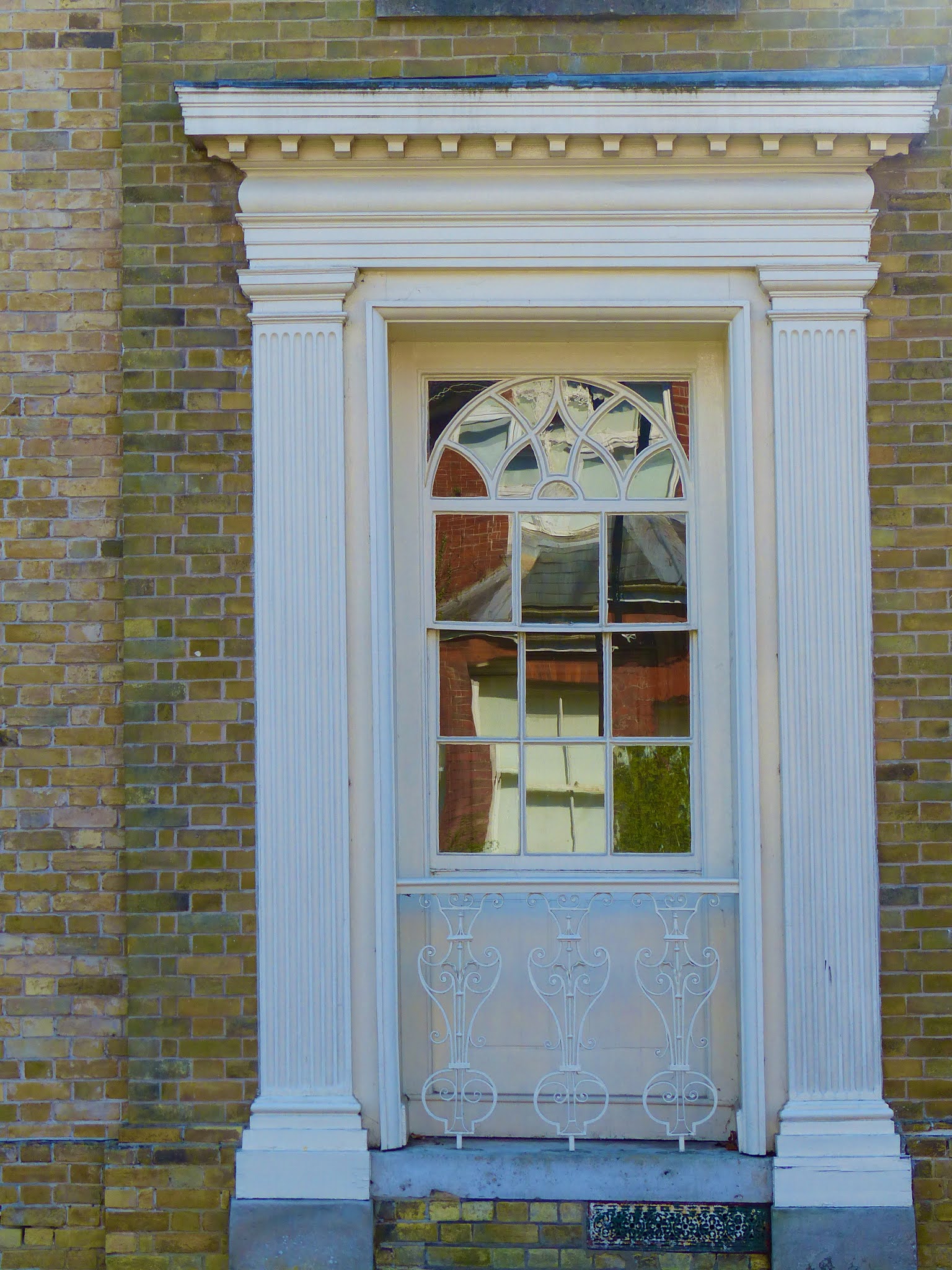
There's one significant building from the early 17th century: a lovely row of alms houses that demonstrates how social housing in times past managed to be both useful and architecturally gratifying.

In fact, I suspect a historian might find rich source material for a book on the history of social housing, since the town seems to be full of examples from the 17th century right up to this delightful Lutyens-style row from the 1930s...

And these by the church. It's not until the developments of the 1960s that things got ugly.
If you escape the shopping mall and wander through what's known as the "Top of Town", you'll find a mix of Georgian, Victorian and Edwardian facades with just a few modern intrusions. Sadly its charm is obscured by a mix of grime, poor repair, garish signage and empty shopfronts. This classic building with its bow-fronted Regency windows is a case in point. (I'm sure the team at Wawa deliver excellent massages, I'm just commenting on how glorious the building could be with some TLC and a better use of those windows.)

Observant explorers will notice a profusion of broad arches built into the architecture:


These are the telltale remains of the coaching inns that once competed vigorously throughout town. Roughly half way between London and Southampton, Basingstoke was the perfect place to stop on the journey. Coaches would clatter through these arches into busy yards where horses could be refreshed while people went inside for food, drink and rest. Only the Red Lion has stayed true to its original purpose.

Here are some other Georgian highlights from the town centre:


One of the most famous people associated with Basingstoke's history in this period is Jane Austen, who grew up in a village eight miles away and would have come here regularly for shopping and socialising. The Assembly Rooms where she would have danced no longer exist, but the town recently put up a statue of her in front of the Wallis Museum at the centre of the "Top of Town" district.


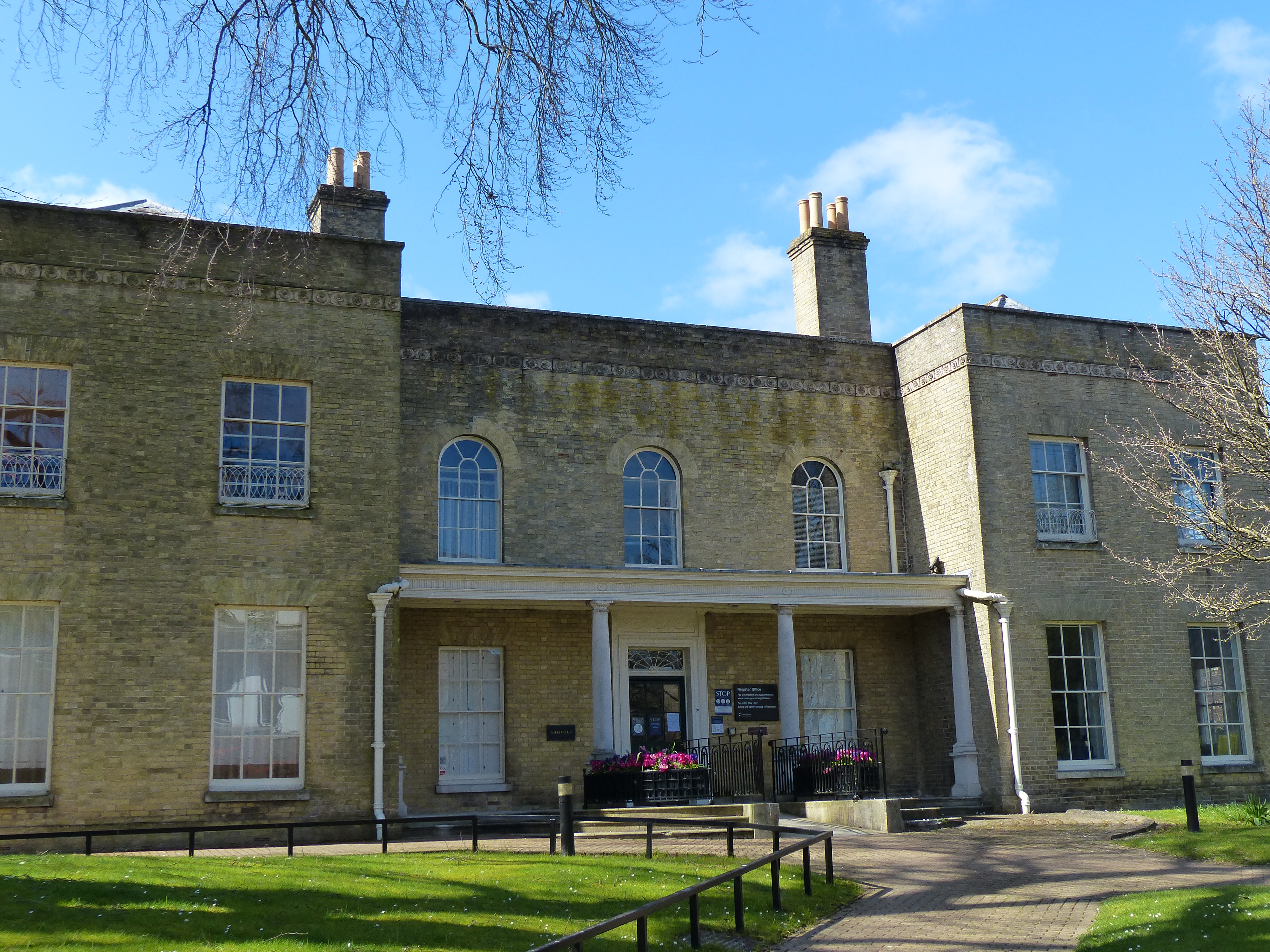
After Jane, the town's most famous association is with Thomas Burberry, a local draper whose early observations of how shepherd's smocks seemed to become resistant to weather after their wearers handled lots of sheep led him to develop waterproof gabardine. His outerwear would no doubt have been popular in any circumstance, but a lucrative army supply deal during WW1 and direct endorsement from the king ensured his fortunes. His headquarters and factory, once in the Top of Town, are long gone. But his greatest legacy is undoubtably the Regency-era house and grounds he purchased and later donated to the town.
These days the Council occupies newer buildings around it, leaving Burberry's legacy to be used for special events and weddings. It also forms the gateway to War Memorial Park, created from the house's original grounds and marked by the town's monument to the conflict from which Burberry made his fortune.
The park is a pleasant, if unexceptional, lawn ringed by trees. Its best feature is probably its bandstand, used for summer concerts, and an aviary full of brightly-coloured songbirds.


Other shopfronts, the town's majestic Fairfields School and the opulent cemetery caretaker's cottage (where cricket commentator John Arlott was born) attest that Basingstoke was a prosperous and gracious place in Burberry's time.


It's no surprise that a rapid population explosion altered the place almost beyond recognition. At the start of WW2 the town had barely 13,000 residents. It's now the largest town in Hampshire with more than 157,000 (according to the Council's web site). It is, sadly, all too typical in England in its disfigurement by well-meaning officials with a taste for drab modern architecture and a contempt for history. And the challenge continues.  The Council predicts another 20,000 residents in the next 20 years.

Some of the new housing supporting this boom is attractive stuff tapping in to the region's history and architectural vernacular. Some is cookie-cutter horrible. Most intriguing is a new committee investigating the revival of the Top of Town area. As my walk revealed, what's left of the historic centre is full of good potential. With renovation and ... most critically ... a use plan that brings in people with money to spend, central Basingstoke could still be a place to make Thomas Burberry, Jane Austen or the Marquesses of Winchester proud.