Saturday, 7 May 2016

Crowds make Badminton a challenge, but the shopping's worth the crush

As with the rest of the British Season, Badminton has become so crowded that it takes some work to enjoy it. Unless, of course, you're in one of the hospitality tents, which have expanded in proportion with the overall rise in gate entries.

If you're after a pleasant walk through rolling countryside, punctuated by passing riders tackling impressive jumps, you might actually enjoy one of the much smaller events on the circuit. But if you're after a piece of glorious tradition, Badminton is hard to beat, so prepare to queue and jostle along together.

For the uninitiated: The Badminton Horse Trials is a three-day equestrian competition comprising dressage, show jumping and eventing. The last, always held on the Saturday, sees competitors gallop over a four-mile course, dotted with challenging jumps, that winds through the Duke of Beaufort's sumptuously landscaped estate. It's one of six Trials classified as four star, attracting the best competitors in the world and contributing to their international ranking. The fact that we're just months away from the Rio Olympics no doubt contributed to the crowds. Performance today mattered even more than usual.

Any eventing day is a joy for fans of horse, hound and countryside. The tradition is casual and laid-back. It's customary to bring your dog, and a picnic if you wish, and drift gently between course and trade stands. On a beautiful day, as this was, there are few things more glorious than settling on the grass beside a jump with a jug of Pimm's, soaking up the sun and watching a horse and rider emerge into your line of sight every few minutes to vault over the obstacle before you.

Two problems. First, our young and troublesome spaniel Bruno barks with gusto at the sound of galloping hooves. This is not the done thing, thus one of us always had to stay well back from the course while the other one went up to check out the action. Second, the crowds were so intense there was no chance of seated observation. It was more like viewing a Chelsea Flower Show display garden: a 10-deep crowd stands at the barrier, shuffling forward patiently as people at the front depart, until you finally get to the front and get your turn to see what's going on. As it's not polite to hog the spot for too long, and it's not the most comfortable of situations to stand in the press of bodies for the minutes between horses, you probably only end up watching one or two riders. For me, an appreciator of the sport but not expert enough to differentiate much between the top riders and the youngsters, I actually prefer watching the action at our local Wellington Horse Trials.

But it's not just about horses. Especially at Badminton. It's about shopping. Badminton is renown for its shopping village, where a massive, open-air mall dedicated to crafts, artisan foods, country clothing and every item imaginable for horse or hound pops up from the fields. We emerged with goodies as diverse as well-cut tweed jackets, specialised brushes to clean garden pots, laser-cut three-dimensional greeting cards and custom-created shoe insoles. You could easily enjoy Badminton without ever seeing a horse.

As with all of these things, I'm sure that frequent attendance yields secrets to enjoying yourself and beating the crowds. There's a 12-foot-wide stretch of open grass between the two main hospitality areas, for example, on which the general public can stake a claim. We discovered it far too late to take advantage of that patch. To avoid frustrating hours in traffic, it's critical to get there early. We arrived by nine even though the first horse didn't take off until almost noon.

Given the crowds, I'm not sure we'll make the effort to get to another four star event any time soon. Then again, with Blenheim happening a few weeks after the Olympics close, maybe interest will have eased off a bit. Maybe. In between, we'll inevitably head up the road two miles to the Wellington Trials on 27 August. Without the irritating spaniel.

Friday, 6 May 2016

Medieval boundary beating is a stroll through London's past

Most Americans are suckers for British Ceremony. There's something about the way that Brits weave ancient, often ridiculous-looking traditions into their contemporary lives that appeals to children of young countries. If you're an American expat, it's probably one of the charms that enticed you to move here.

Grown men wearing ridiculous blazers at Henley. Swan upping. Black Rod hammering the door at the State Opening of Parliament. Incinerating the Guy. The Ceremony of the Keys. I love them all, and will rearrange my schedule dramatically to get to anything of the sort. This week, fortunately, I didn't have to juggle any appointments; ancient ceremony fell right into my professional lap.

A colleague invited me along to to a meeting of the Worshipful Company of Marketors, of which she is a member. Professional networking is usually the same the world over. Listen to a presentation, have a few cocktails, work the room. Things get a lot more fun when you hook them in to London's glorious traditions of medieval guilds and parish churches.

The occasion: Beating the bounds for the parish of St. Bride's Church. Known as the journalists' church, this is a place of legend in London's communications industry. The first printing presses were set up in the alleys nearby and journalism grew to maturity along Fleet Street, which runs down the middle of the parish. It's a stone's throw from Ye Olde Cheshire Cheese, storied watering hole of writers and a favourite bolthole of mine. (Story here.)

We started with a church service of exquisite traditional beauty. Officers of the organisation processed down the aisle in colourful robes of medieval origin, holding aloft signs of office like an intricately-wrought, crown-topped gold mace and a sword of state. A professional choir contributed haunting melodies, including the spine-tingling Allegri's Miserere. Even beneath a mask of scaffolding necessary for current renovations, Christopher Wren's dignified architecture lent an aura of gravity, while memorial plaques to great journalists, publishers and printers of the past reminded us of that even the most seemingly mundane of our corporate communications jobs springs from greatness.

So far, so expected. Things got more surprising as we left the church to beat the bounds. This ancient ceremony began in a time when people's identity was tightly bound up with their parish. Few people could read, and maps were rare, so public demonstrations of where the boundaries were mattered. Not just for identity. The church was once the main provider of social services, and history is filled with anecdotes of one parish dumping the indigent over the border so the other parish would have to fund their welfare. (There's nothing new in these immigration debates.) Thus, boundary marking was important, and moving markers would have been a grievous offence.

Once each year, the vicars and other church worthies would lead the congregation around the boundaries to formally mark them. The tradition continues. Bamboo canes distributed to each of us, we set out for a circular hike taking in Ludgate Circus, Farringdon Street, Fetter Lane, The Temple, a swathe of Thames riverfront up to Blackfriars Bridge, and back to Ludgate Circus. At each point where a boundary marker once stood, the vicar led us in a prayer that called to memory something of the immediate surroundings, and then we commenced beating. Three lusty, repeated bellows of "Cursed be he that removeth his his neighbour's landmark!" while pounding our sticks on the pavement below. At first we were a bit hesitant, getting to know the words and awkward beneath the stares of puzzled London commuters. By Fetter Lane we'd gotten over that, and after a few glasses of champagne served up in the garden of the Master of The Temple (I can't imagine a more august venue for a London happy hour) we were performing our duties with gusto. I like to think the folks in Southwark heard our riverside warning.


If Addison, Steele and the other scribblers of Georgian words had stumbled upon us, they would have recognised the ceremony ... but not large swathes of the parish we were circling. The famous tiers of St. Bride's steeple (reputed to be the model for the tiered wedding cake) which would have once been visible from anywhere in the parish are now almost completely hidden by other buildings. The stretch between Farringdon and Fetter Lane is now entirely comprised of gleaming, glass-sheathed office buildings. Even journalists from the mid-20th century would be puzzled, as all of those famous newspaper offices have now been put to other uses since the trade moved away.

But every footstep covers rich history. There are the now-vanished sites of the western gate into the city of London, the infamous Fleet Prison and the homes of giants like Dr. Johnson, John Dryden and Tom Paine. The most venerable remaining architecture is in The Temple, through which the parish boundary cuts. As in so many cities, journalists and lawyers set up side-by-side. While the writers have gone, the lawyers still occupy their gracious complex of Georgian offices around the round medieval church that once belonged to the Knights Templar.

Finished with the annual beating we retired ... probably much as our medieval forebears would have ... to recover in a pub. London may constantly evolve, but there are some things that never change.

Monday, 2 May 2016

British Museum's new Sicily show is a compelling celebration of mixing cultures

The less you know about Sicily, the more extraordinary you will find the British Museum's new exhibition.

The British, on the whole, know the Mediterranean's largest island as a holiday destination. Dependable sun, good food, child-friendly hosts and reasonable rental apartments an easy flight away. They'll have seen a handful of mafia films, and they may have noticed that some of the most dependable value-for-money wines on supermarket shelves come from here. After that, their awareness may get fuzzy. The idea of Sicily as a melting pot of diverse peoples that has twice dominated the whole Mediterranean with the dazzling genius of its culture may ... unless you opted for some serious sightseeing on that beach holiday ... come as a surprise.

The British Museum's new show Sicily: Culture and Conquest aims to change that. It focuses on two periods in which Sicily was, arguably, the most dynamic, exciting and intellectually advanced place in the Western world. First, you'll explore the late Greek period, when a culture far older and more sophisticated than Rome's became the jewel in that empire's crown. Then jump forward a thousand years to the dazzling Norman court, always in my top three for time travel destinations if I ever get the chance.

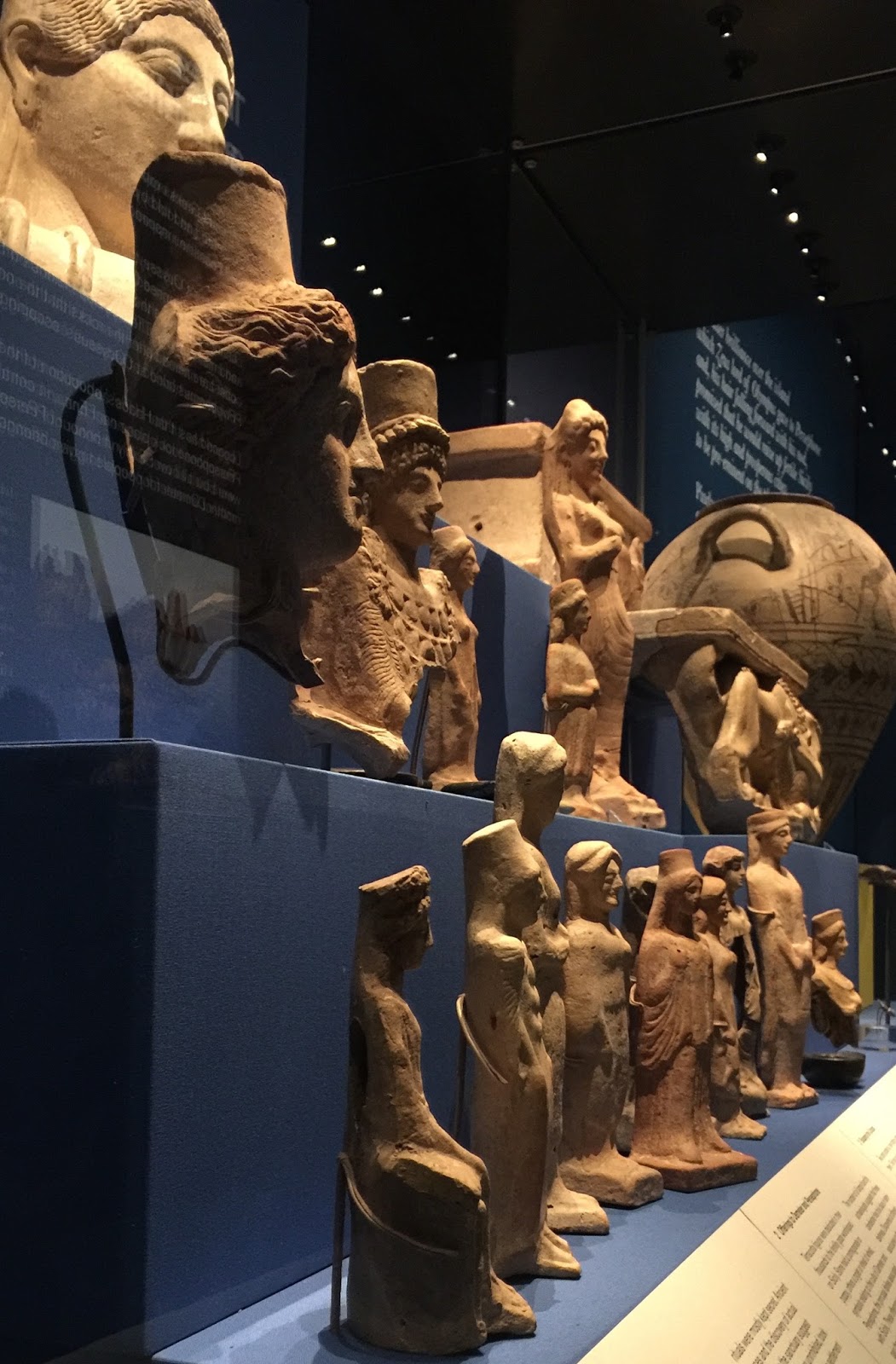
You're greeted not by artefacts, however, but by an enormous photo of a lush, green valley beneath warm blue skies and Etna's looming bulk. It's the kind of picture that draws you in, enticing you with beauty and reminding you of exactly why everyone was always conquering this place. First it was the Phoenicians, who also founded Carthage, then the Greeks. Their cultures merged here, evident in statues, altars and masks that aren't quite of one place or another. The altar held up by three alluring yet slightly alien maidens could be something dredged up from a mythical Atlantis. A stone slab with a dramatic, modern, spiralling design rewards study with shock when you realise it's obviously a man's organ penetrating a uterus topped by breasts.

Perhaps significantly, the female form is on top. This was the island where the goddess Persephone disappeared and her mother Demeter haunted the landscape searching for her. There's an evocative case of their devotional figures. Medusa contributes a slightly more threatening slice of femininity in a face that once served, gargoyle like, to decorate a temple's roofline. But she's more comic than threatening, picking up on a sense of fun that flows throughout the ages here. Further on, you'll see the first preserved use of paper in a European court, holding instructions written by the king's mother. Anyone familiar with Sicilian families will know that, however powerful the men seem to be, Mama calls the shots.

The show doesn't spend much time on the Arab era, using it as a transition between the ages rather than exploring it in any depth. Which is a shame, as I would have liked more. Instead, you can ponder an exquisite ivory casket, made by Arab craftsmen in Islamic style yet depicting Christian saints. Nearby is another enormous photo, this time of a sunny Palermo with the medieval Christian palace at the top and the towers of an ancient mosque (now a church) in the foreground. Both drive home the point that the melange of cultures here was a fruitful one for both the people, and the art.

The Normans took Sicily from the Arabs late in the 11th century. While they captured government, they let Islamic culture continue to flourish and bound it into their own ... leading to not only a model of productive tolerance, but one of the artistic triumphs of the Middle Ages. There's an exact replica of Roger II's magnificent coronation robe here (the original is too delicate to travel), on which Norman lions ... who look suspiciously like they've just come out of The Arabian Nights ... conquer placid camels while flowing Arabic script celebrates the regime.

The single most beautiful thing
in this section is a ceiling panel from Roger's palace, containing a whole forest of animals fleeing the hunt, framed by sinuous foliage inside precise Islamic geometry. Each animal is no more than a few inches high, and would have been completely invisible to people on the ground, yet the carving is a masterpiece. It shows the passion for beauty that permeated the island.

The most evocative piece, however, was a simple tombstone in four languages. Nothing else so powerfully evoked the multiculturalism the British Museum was celebrating here. I wonder, when they started putting the show together years ago, if they realised just how timely their message would be. In a world of growing xenophobia and factionalism, the brilliance of Sicily's melting pot is an uplifting message.

The Norman section has a challenge, however: the greatest glories of that age were architectural. The curators make noble attempts. There's a lovely mosaic of a madonna and child. They've made clever use of a light box to suspend a full-colour photo of the ceiling of the Palatine Chapel above you. But the photo lacks depth, thus you have no sense of the stalactites of ornamentation dripping towards you from heaven. And one small mosaic, no matter how fine, can convey the jaw-dropping awe that the golden jewel-boxes of the Palatine Chapel or the Cathedral at Monreale convey. (For more on the delights of seeing these things in person, read my take on Palermo here.)

This is probably the reason for my biggest disappointment with the show: it simply wasn't big enough. And that's inevitably because to really tell this story, you need to walk around inside it. See how the Christian church in Syracuse is built within the walls of the Greek temple. Marvel at the size of the complex at Agrigento. Wander around the crazy, compelling cultural mash-up that is the streets of Palermo. Maybe this show will inspire you to do that on your next holiday. Meanwhile, get to the British Museum for a taste.

PS. If you want to finish your day appropriately, then head off for dinner at Luce e Limoni, London's only properly Sicilian restaurant. Review here.


Sunday, 24 April 2016

Let's make St. George's Day a national holiday ... with this as the national feast

If there's one thing I could change about my adopted homeland, it would be patriotism. The Welsh, Irish and Scots revel in distinct identities, national symbols, local traditions and flag waving. Doing the same in England, outside of the sporting arena or proms concerts, is highly suspect. I understand imperial guilt, and the fear of association with the far right, but I think it's time to embrace the positive.


I'd start by making St. George's Day a proper national holiday. Give people the day off work. Bring back old traditions (yes, including Morris dancing) and invent new ones. Create a focus ... as the French have with Bastille Day and the Americans with July 4th ... for a celebration of being English.

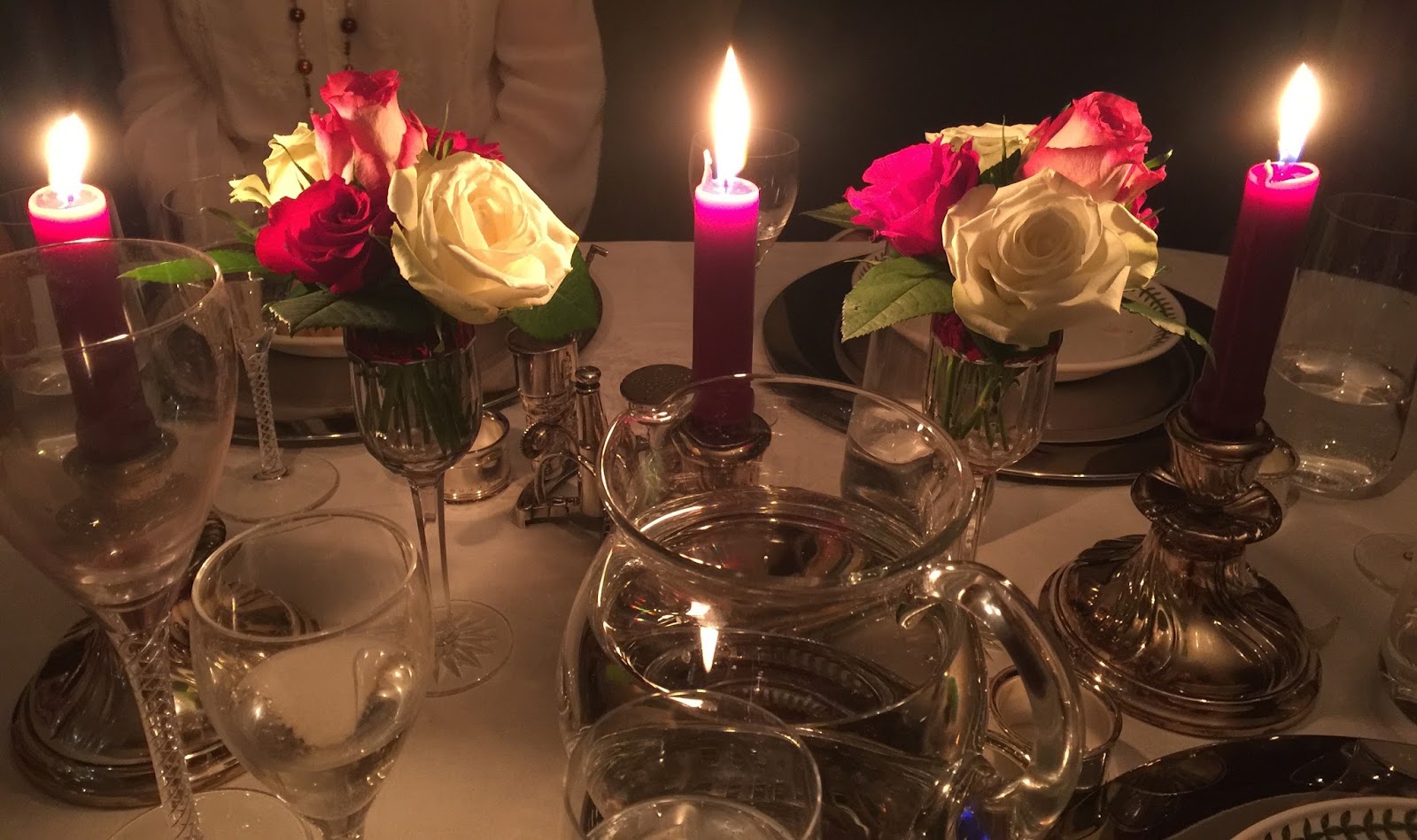
We did our part here in North Hampshire with a pull-out-all-the-stops dinner party. Our celebration of English cuisine was traditional, seasonal and sourced locally. Almost everything was English. We made two exceptions ... Gascon foie gras and Bordeaux wine ... something we decided to allow because Eleanor of Aquitaine made both territories English for a while. And because, no matter how good English wine has become, we've yet to find a red with the body and deep fruit necessary for a hearty, beefy main.

Here's the menu.

The amuse bouche:
Minted pea soup (served in shot glasses) and home-made pork scratchings
served with Hambledon (Hampshire) Classic Cuvee

The soup is very easy to whip up (recipe here) and can be done well in advance. In fact, it's best made the day before to let the flavours marry. And it's good cold, too, so an excellent choice for summer parties and picnics. We use Tom Kerridge's recipe for the pork scratchings ... one of those things where, once you have had it made at home, you'll never want a commercial variety again. Just be prepared for the mess it makes of your oven. The Hambledon is one of our favourites of all the English sparkling wine we've tried, and made less than an hour from our house.

The starter:
Cornish crab and Mayfield (Sussex) cheese soufflé, shaved salad of new season asparagus
served with Kenton Vineyard (Devon) Estate White 2014


This recipe worked beautifully, with the souffles puffing up more than double their size. The trickiest bit is getting them out of a hot bain marie, onto a plate and to the table before they collapse too far. Crab is in season right now, and you can get picked white meat in Cornish Fishmonger. The salad looks elegant and "cheffy" but it's actually ridiculously easy: use a vegetable peeler to create ribbons of asparagus stem. Quickly poach and chill the asparagus tops. Dress the raw veg with olive oil, lemon juice and pepper. Add in the tops, and serve.
bulk, delivered to your door, from the

The Kenton is an excellent choice if you want to go English with a white table wine that's fruity, light and flexible with most starters. At just a bit over £10 a bottle, it's also better value for money than many of the equivalent English labels. We sourced ours from Caviste at Newlyns Farm Shop.

The main:
Beef Wellington, bubble & squeak, broad beans on pureed wild garlic
served with Frank Phelan, Saint-Estephe, 2004

Wellington is my husband's "go to" special occasion recipe. (It was the centrepiece of the first meal Newlyns, who will cut to order to exactly the size and shape we want), and brushing it with a coat of spicy mustard adds a bit of piquancy that balances the richness of the other ingredients. Mr. Bencard's latest innovation is mixing the mushroom duxelle (which we make with fresh chestnut mushrooms and dried porcini, to deepen the woody flavour) with the foie gras to make a combined paste. It's much easier to coat the beef with than using two separate elements.
he ever cooked for me.) There are many variations of the recipe online; my biggest advice is not to skimp on the ingredients. I've had some Wellingtons ruined by mealy liver pate. We always try to get our hands on proper foie gras and, if we can't, use the best and smoothest duck liver pate we can buy. Obviously, really good fillet steak is a given (we love the butchers at

We got a case of the Bordeaux as a wedding gift in 2011. Wine expert Oz Clark wrote in his 2016 guide that it was at peak and ready to drink. He was right.

The pudding:
St. George's tart, clotted cream ice cream
served with Chapel Down (Kent) Nectar, Late Harvest, 2013

I confess I used shop-bought ice cream. And I'm still perfecting my frangipane tart. It's something I learned at Gascon Cooking School last year and it's essentially very easy but, as with any recipe, you need to remember those little nuances. Like how you must cream the butter and sugar first, and only then add the egg a little at a time (which I did remember) and how you should blind bake the pastry cases as well as refrigerating them for half an hour (which I didn't). The great thing about frangipane tart is that you can do variations with most fruit. I find it particularly good with rhubarb. To create the cross of St. George, I put rhubarb jam on the bottom of the tart, then the frangipane. Then I used batons of rhubarb, which I'd roasted in the oven with lots of sugar until they were soft, but not falling apart, to create the cross.

The Nectar is a fantastic dessert wine, sweet but not too cloying. You can read about our visit to the winery here.

As a celebratory feast, I don't think it gets much better. And it would be hard to get any more English.

Once established as an official holiday, I'd suggest moving the big meal forward to mid-afternoon, like Christmas or American Thanksgiving. Then everyone could adjourn to the sitting room for a post-prandial national viewing of Shakespeare. Who, quite fittingly, was born and died on St. George's Day. This being the 400th anniversary of his death, the BBC did exactly the kind of celebratory broadcast I imagined last night. But we were cooking and feasting. Shakespeare is a treat I'll save for later in the week.

Wednesday, 20 April 2016

Chiltern Firehouse deserves its fame. But check your credit limits before you go.

Google "Chiltern Firehouse", and you're likely to find as much about it being an "in" spot for the celebrity set as you are to see people talking about its food. Since it opened in 2014, this remodelled Victorian Firehouse in Marylebone has been the spot to see and be seen. Tables have been rarer than foie gras in California ... so I was delighted when a friend pulled in a favour to grab us one last week.

I was looking forward to the experience, but wasn't expecting that much from the food. Wafer-thin actresses whose idea of dinner is a small plate of greens are hardly my go-to arbiters of fine dining. I'm delighted to say: how wrong I was!

The Chiltern Firehouse delivered an extraordinary meal, notable for its confident and creative balance of textures. There were beautifully complementary wines, genial service and a buzzy atmosphere. The drawback? It's priced for those celebrity diners. Even for those accustomed to London fine dining prices, this is a save-up-for-a-special-occasion restaurant. I have done the chef's menu, with wine flight, at several Michelin star places for the same amount I spent on three a la carte courses, my share of two bottles of wine (between four) and coffee here.

My starter of roast garlic custard with peas, broad beans and bacon crumb gave me my first insight into the textural experience that was to define the evening for me. Custard unctuously smooth and comforting, balanced by the bite of fresh garden peas lightly cooked to a sweet al dente, kicked into the taste stratosphere by crunchy, salty, umami bacon crumbs. One of the most memorable starters I've had in ages.

The whole table wanted the day's special sea bass. We'd ordered, and chosen and started on the wine (a Gavi, at £37 one of the cheaper wines on the list) when the waiter came back with apologies that they were all out. Given that we sat down at the unusually early time of 6:30, that's a black mark against their kitchen management. The advantage, however, was that it pushed two of us into ordering the pork, and the other two into a shared, roasted lamb served Middle-Eastern style with flatbread and an array of tiny sides.

I sampled the latter. Even though lamb is my least-favourite meat, I would have happily tucked in with gusto. But my choice was far better. Iberico pork, perfectly pink and beautifully seasoned, with cuttlefish, served with a wild garlic puree topped with broad beans and broken rice porridge. The last bit brought in that crunch again. As did toasted spices strewn atop the exquisite truffled buckwheat polenta I had on the side. This is a serious candidate for a last-meal-on-Earth discussion.

And the food was made even better by the appearance of schioppetino on the menu. Not only did its light, yet fruit-rich and peppery profile go well with both meat choices ... it worked its usual treat of shortcutting to a great relationship with the sommelier. (For another story of how that happened, read this.) When I shared my delight about the appearance of this unusual variety on their list, he immediately grew enthusiastic and we swapped stories about our schioppetino experiences. Ten minutes later, he quietly appeared at my elbow and slipped me a glass of something, on the house, he thought I might appreciate trying. An impressive '92 Saint-Julien Bordeaux. Which, at least in part, eased the pain over moving up to a much more expensive wine to match our alternative main courses.

Dessert presented a challenge. Key lime pie? As every Floridian knows (and, having spent all my formative holidays there, I claim honorary affiliation), a key lime is a specific variety that only comes from the Florida Keys. They're smaller and have a thinner skin than other limes, and are known for their distinct sweet and bitter balance. Where, I wanted to know, did they source their limes from? Because I didn't want an imposter. This threw the waiters into a bit of confusion, but I finally got my answer from the kitchen. Not Floridian, but a Brazilian variety they thought was close. They promised they did something very unique with their recipe. Two Floridians had tried it thus far: one loved it, one wasn't impressed. They'd like my opinion. (Although not enough to comp me the course!)

So I gave it a go. Stunning appearance, the right flavour profile on the lime ... though calling it key lime pie was quite a stretch. It was more like a lime fondant, with a baked outer layer collapsing to reveal a gooey citrus cream when punctured. The real star of the dish, however, was the topping. Sails of meringue wafer (crunch, again) studded with lime zest formed a roof over a quenelle of mascarpone. Eaten together, you'd swear the chef had subtly integrated white chocolate ... a classic friend of key lime ... but it was only an illusion. In the overall taste stakes, I would have been just as happy with a slice of the classic served up at Lauderdale-by-the-Sea's Aruba Beach Cafe. But as a fine-dining level dessert, it was memorable and delicious.

We didn't see anyone famous that night and, frankly, we didn't need to. The stars were on our plates, and in our glasses. And that was good enough for us.


Saturday, 16 April 2016

Painting the Modern Garden: Sweet, soothing, but not enough

Confession time: I'm lukewarm on the Impressionists.

I understand their transformative influence on modern art. I appreciate the brushwork, the connection to nature, the capturing of a moment, the fascination with light. And yet I stand in a room of Monets and think: "All very pleasant. Would be fabulous as wallpaper, fabric or a mural in a garden room. But is it Great Art?"

I know, of course, that I am in a tiny minority. And I knew, the moment I saw it publicised, that the Royal Academy was on to a winner with Painting the Modern Garden: Monet to Matisse. Everyone's favourite artistic movement, combined with one of the Brits' greatest passions? A sell-out proposition. Indeed, getting tickets to this exhibit required serious advanced planning, despite the RA extending its hours. We slipped in just five days before the exhibition's close.

Yes, I enjoyed it. How could I not? I love gardens, and here were 10 galleries packed with gorgeous examples. While few canvases provoked rapt fascination, every painting was a thing of beauty and ... as spring brings my own garden to life ... a celebration of the new season.

Monet was the obvious star, dominating several galleries from start to finish. Already familiar with him as an artist, I was most intrigued by the chance to see how he developed as a gardener, from his "starter garden" at Argenteuil to the Giverny we all know. My favourites from his works were large, blue-tinted canvases painted at the end of his career when his eyesight was going. The undeniable climax for most viewers, however, would have been the display of three massive, watery canvases known as the Agapanthus Tryptich. Much was made of the RA bringing these together for the first time ever in Britain, though they've pulled it off several times in my home town of St. Louis. That's where the middle canvas lives ... the others coming from Kansas City and Cleveland.

All very soul-soothing and gorgeous. But I found other artists more captivating. My revelation was three Spaniards I'd never heard of: Santiago Rusinol, Joaquin Sorolla and Joaquin Mir y Trinxet.

All three moved far beyond pretty floral visions, drawing us in to magical gardens with mysterious lighting. I wanted to leap through the frames to explore. The best picture in the exhibition for me was Rusinol's Jardines de Monforte. You're standing in a classical garden room enclosed by walls of clipped evergreens. It's obviously approaching dusk on a summer's day; beyond the hedges the sun is still blazing, but here you can feel the cool relief of the growing shadows. You can practically hear the evening crickets begin to chirp. Nearby, Sorolla's depiction of his gardens in Madrid sent me searching for more when I got home. (Yes, still there. Open to public. Now on bucket list.) And Mir y Trinxet's Catalan gardens, flaming red in the setting sun, were beguiling visions of a fantasy world rather than our own.

Given the topic, the curators took a noble stab at making this show as much about gardening as about art. They explained that revolution was sweeping horticulture and painting, and that major movements like Arts and Crafts influenced both disciplines. Some of the paintings are displayed side-by-side with seed catalogues and gardening implements, and there's an entertaining room 2/3rds of the way through where you could sit down on teak garden furniture to watch films of Monet wandering around at Giverny and look at photos of the featured artists planting, pruning and watering.

But as someone really interested in gardening, they didn't go far enough. Broadway was mentioned briefly, as a favourite venue for John Singer Sargent. (His bold poppies, at left, were another favourite of mine. I could have done with more of him and less Monet.) Yet despite the Cotswolds reference, no paintings featured nearby Hidcote ... one of the most influential gardens of the 20th century. Nor Sissinghurst, or any of the other world-shaping gardens in this country. Almost everything depicted in the show was continental, with the majority in France.  Understandable if you're focusing on the most famous garden painters, but if you're linking art to horticulture ... for a show in London ... the absence of the great English gardens of the early 20th century is inexcusable. I also wanted to know how the artists might have influenced plant choice or colour schemes. We got a bit of a sense that the artists helped make dahlias and irises all the rage, but I wanted more. (There might have been more detail in the audio guide or the catalogue, but I explored without their help.)

Overall, it was an enjoyable show and I'm delighted I went. But for me, they tried to accomplish too much. I would have enjoyed a smaller exhibition, with less emphasis on Monet, that dug much deeper into connections with garden design. But that wouldn't have brought in the same crowds. On the basis of ticket sales alone, I suspect this is one of the most successful exhibitions the Royal Academy has put on in years.


Sunday, 10 April 2016

The Sealed Knot brings history to life at Basing House

At least once each year we'll be subjected to another news story bemoaning how terrible the English are at history, accompanied by the inevitable vox pop interviews of natives who think Queen Victoria might have rebelled against the Romans while Winston Churchill fought the French. How this is possible in a country where history is so all-pervasive, accessible and real is a great mystery to me.

I suspect the members of the Sealed Knot share my frustration. In fact, they spend a good deal of their free time trying to inspire the kind of interest that will turn this trend around. The largest re-enactment society in Europe, the Sealed Knot has thousands of members who re-create the civil wars of the 1640s, complete with noisy artillery and impressive costumes. I'm just back from their re-enactment of the siege of Basing House. And while, sadly, the re-enactors outnumbered the spectators, I have no doubt that the children who attended will be inspired to learn more.

It's hard to believe from the sleepy village lanes and sheep-grazed mounds that remain today, but Basing House was once one of the grandest homes in England, similar to Hampton Court in both architecture and scale. Seat of the marquesses of Winchester, it had hosted every monarch from Henry VIII through James II. Inevitably, such tight connections to the royal family made the house a royalist stronghold in the Civil Wars. It was besieged for three years before the final battle in 1645, when just 300 remaining defenders finally couldn't hold the house against more than 7,000 parliamentarians.

It's the final day of this battle the Sealed Knot turns up to re-enact every year. Spectators settle on the old defensive earthworks in comfort as the battle unfolds below. Costumes and weapons are rigorously authentic, though a modern sound system is deployed to help the audience follow the action. The commentators are seasoned professionals, describing who's doing what and including dramatic readings to emphasise the pathos of it all. They even throw the action down to a roving reporter on the field, who does live interviews with commanders of various units.

There's no ammunition and everyone practices long and hard to avoid injury. But there's plenty of noise, smoke and clanging swords. The clash of the pikemen looks remarkably like a rugby scrum, in costume with poles. It's a glorious day out.

As is typical with these things, there was an encampment where you could wander and talk to the re-enactors about life in the 17th century. While it's not how I'd want to spend the majority of my weekends, I appreciate the craftspeople who turn up at these things to demonstrate wicker work, carpentry, needlework and pottery.

The day also gave me an excuse to have my first poke around the site of Basing House, which I drive by regularly but had never explored. As was his usual practice when Royalist homes refused to surrender, Cromwell made an example of the place by raising it to the ground. The villagers were then encouraged to take bricks for their own use, which explains why the centre of Old Basing is so charming. Thus there's not a great deal to see of the old house, though the Borough of Basingstoke and Deane has done a fine job of putting informative, family-friendly boards throughout to interpret the site. The most impressive thing left standing is the tithe barn which, it turns out, is the largest Tudor barn in the south of England. Yet another thing to recommend my neighbourhood.

Once through the pretty gate, there's a little building housing a model of Basing House at the height of its glory ... in Lego. Not only fun, but absolutely essential to get a sense of what occupied the grassy mounds you're then off to explore. There was a massive round keep with a variety of buildings inside (now you see a decent range of Tudor brick walls and foundations) and a neighbouring rectangular site where the family built an enormous extension when the first house wasn't big enough. Considering that royal visits could come with an entourage of more than 1000, this wasn't surprising.

Elsewhere in the grounds, there's an impressive knot garden in the shape of the coat of arms of the marquesses of Winchester, and a tiny museum where a collection of bits and pieces unearthed from the site gives you a sense of how rich the interiors must have been. Without the re-enactors, it would be a quiet place, good for a ramble on a sunny day. You're welcome to bring in dogs and picnics, and there's plenty of lawns to relax upon.

The views from the top of the old keep are lovely; rolling countryside interrupted only by Basingstoke's modern skyline. Standing amidst the ruins and the musket fire of the 17th century, looking toward the glass towers of the 21st ... just another Sunday in England.